Malaria Elimination by 2030: India's Strategy, Progress, and Challenges
As India nears its 2027 indigenous transmission cutoff, defeating entrenched focal reservoirs in remote tribal belts tests the limits of public health equity.
Nov, 2026
•11 min read
Overview
India aims to end local malaria transmission by 2027 and secure World Health Organization malaria-free certification by 2030 under the National Framework for Malaria Elimination. Achieving this national milestone requires transforming malaria control from a generalised public health campaign into high-precision, focal surveillance that targets entrenched transmission pockets.
Nationwide interventions reduced caseloads by four-fifths over the past decade. Even so, clearing the final mile depends on resolving biological threats like drug resistance and diagnostic evasion in remote forested regions.
Why Malaria Elimination Is Back in the Spotlight
India is entering the decisive phase of its National Framework for Malaria Elimination (2016–2030) as key deadlines near. The central policy thesis is direct: broad epidemiological gains must give way to hyper-targeted focal surveillance across remote tribal belts.
Under the framework established by the Directorate of National Vector Borne Disease Control Programme, India set two firm benchmarks:
- 2027 interim target: Interrupting all indigenous transmission nationwide.
- 2030 certification target: Securing formal World Health Organization (WHO) malaria-free certification.
Reaching official eradication demands an uncompromising standard of public health performance. Under WHO certification standards, a country must prove beyond reasonable doubt that indigenous transmission has halted nationwide for at least three consecutive years. Meeting that international threshold requires active surveillance. Health teams must locate every isolated infection before onward transmission resumes.
The political urgency has intensified because residual transmission is tightly clustered. As of 2025, just 33 high-burden districts accounted for 64 percent of all malaria cases and 54 percent of malaria deaths, according to the Ministry of Health and Family Welfare. Eliminating transmission in these remaining pockets is an equity test for India's public health delivery systems.
Understanding India's 2030 Malaria Elimination Blueprint
The National Centre for Vector Borne Diseases Control guides India's strategy through phased, district-level operational milestones. Through the National Strategic Plan for Malaria Elimination (2023–2027), the Ministry of Health and Family Welfare operationalises a Test, Treat, Track strategy designed to push high-transmission districts into elimination phases. This operational model treats each detected infection as a focal epidemiological emergency requiring mandatory contact tracing.
A cornerstone of this architecture is district stratification based on Annual Parasite Incidence (API). The API measures the number of laboratory-confirmed malaria cases per 1,000 population per year. This metric allows health authorities to deploy targeted intervention packages rather than uniform national measures.
| Operational Category | Epidemiological Threshold | Primary Programmatic Focus |
|---|---|---|
| Category 0 (Prevention of reintroduction) | 0 indigenous cases for at least 3 consecutive years | Sustained vigilance, inbound case screening, outbreak prevention |
| Category 1 (Elimination phase) | API < 1 case per 1,000 population at risk | Case-based surveillance, rapid focal containment, radical cure |
| Category 2 (Pre-elimination phase) | API between 1 and < 2 cases per 1,000 population | Intensified case detection, mass vector control, active screening |
| Category 3 (Intensified control phase) | API ≥ 2 cases per 1,000 population | Universal LLIN coverage, indoor residual spraying, therapeutic access |
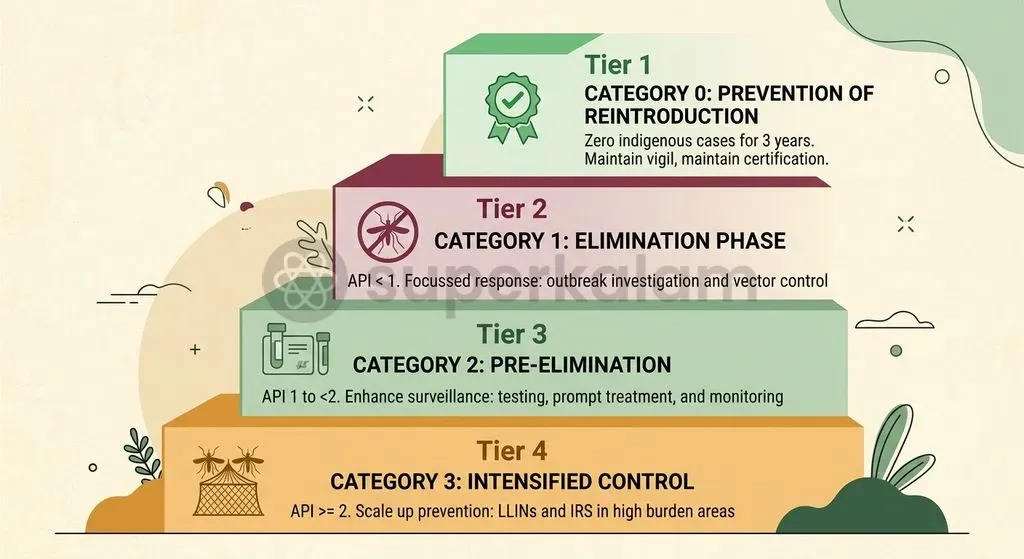
Stratifying districts prevents misallocated resources. Areas with zero transmission avoid blanket chemical spraying, while Category 3 blocks receive concentrated logistical assets. Under guidelines from the National Framework for Malaria Elimination, districts transition systematically through these operational bands until the entire country reaches Category 0.
Discuss with Superkalam
What epidemiological threshold and timeframe must a country satisfy to secure official malaria-free certification from the WHO?
Ask NowHow Far Has India Come in Curbing Malaria Cases?
The Indian Council of Medical Research documented an 80 percent decline in both malaria cases and deaths between 2015 and 2025. Data released by the Ministry of Health and Family Welfare shows that annual confirmed malaria cases plunged from 1,169,261 with 384 deaths in 2015 to 227,564 cases with 83 deaths in 2023.
This sustained retreat reflects three coordinated interventions across endemic zones:
- Expanding field deployment of rapid diagnostic kits.
- Distributing targeted insecticidal bed nets across vulnerable hamlets.
- Guaranteeing timely frontline access to Artemisinin-based Combination Therapy.
Progress is equally evident in geographical consolidation. The number of high-burden districts with an API of two or higher fell from 155 in 2015 to 33 by 2025. Between 2022 and 2025, a total of 160 districts across India reported zero indigenous malaria cases, proving that local transmission chains can be dismantled.
This performance altered India's standing in international health metrics. The World Health Organization confirmed that India exited the global HBHI group in 2024 following sustained reductions in morbidity. According to the World Malaria Report 2024, India accounts for roughly 0.7 percent of global malaria cases and 0.6 percent of global deaths.
Challenges persist at the regional level despite these major milestones. India still contributes approximately 73 percent of all malaria cases in the WHO South-East Asia Region and carries 46 percent of global vivax burden. The high prevalence of Plasmodium vivax complicates eradication due to dormant liver stages that cause recurrent relapses months after an initial bite.
Discuss with Superkalam
How does stratifying districts into Categories 0 through 3 by Annual Parasite Incidence prevent the misallocation of public health resources?
Ask NowWhere the Burden Persists: The Geography of High-Transmission Districts
The National Centre for Vector Borne Diseases Control identifies forested, hilly, and tribal belts as the primary remaining reservoirs of malaria. India's remaining transmission is concentrated across nine States and Union Territories, led by forested corridors in Odisha, Chhattisgarh, Jharkhand, Madhya Pradesh, and several northeastern states.
Three environmental and demographic conditions keep parasite circulation active in these focal pockets:
- Canopy and humidity: Dense forest canopies and perennial slow-moving streams sustain high densities of vector mosquitoes.
- Disproportionate tribal burden: According to the National Strategic Plan: Malaria Elimination 2023-27, Scheduled Tribe communities account for nearly half of all malaria cases in India, despite comprising only 8.6 percent of the national population.
- Monsoonal isolation: Remote settlements face seasonal physical cutoff from secondary health facilities when transmission reaches its annual peak.
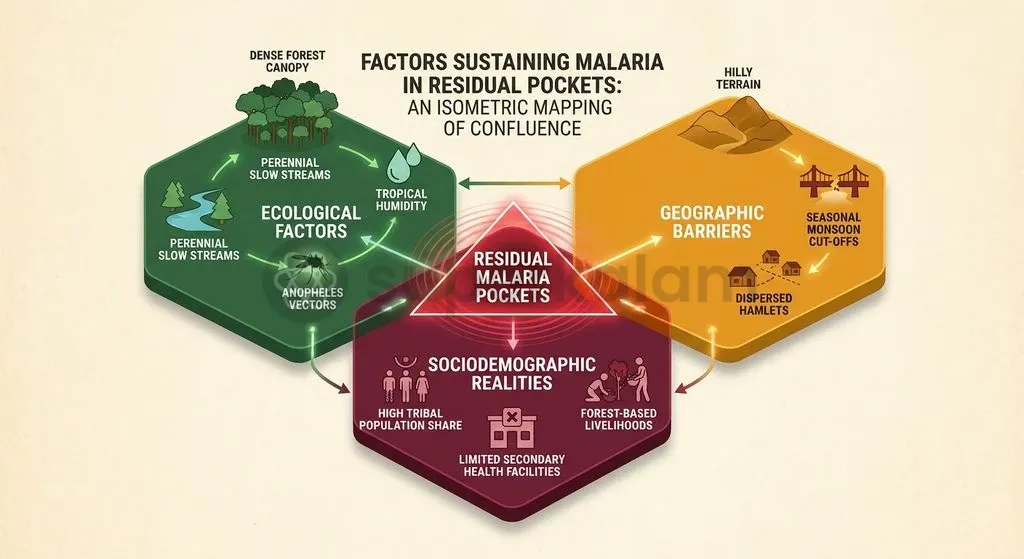
Cross-border transmission vectors add another operational barrier. The National Strategic Plan identifies porous international boundaries, including the 4,096-kilometre border with Bangladesh and the 1,643-kilometre border with Myanmar, as persistent conduits for imported cases.
Cross-border population movements across forested frontiers frequently introduce fresh parasites into Category 0 and Category 1 northeastern districts. These inbound transmissions threaten to unravel hard-won local elimination gains.
Discuss with Superkalam
Suppose an elimination-phase district reports an outbreak linked to pfhrp2-deleted parasites. How should the local surveillance and diagnostic protocol be adapted?
Ask Now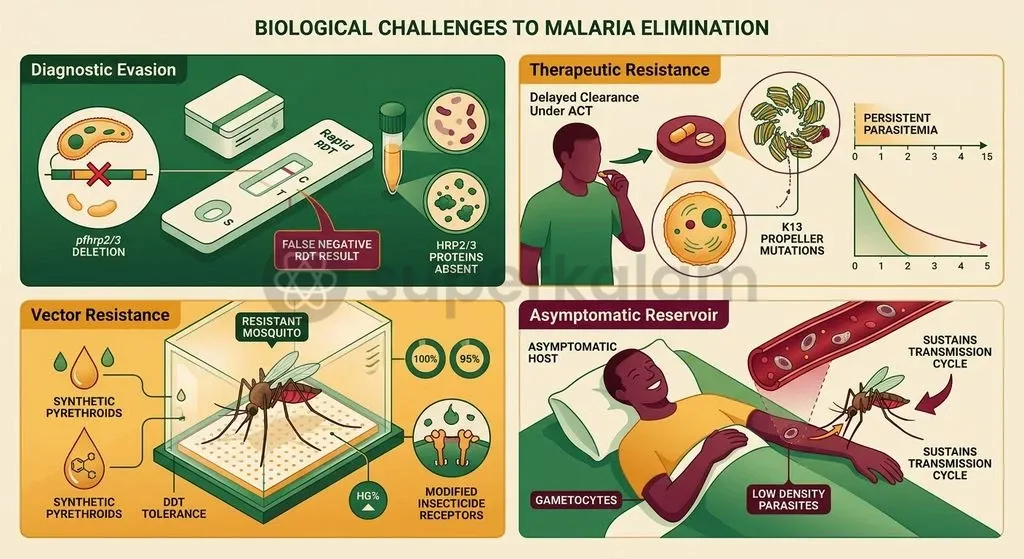
Discuss with Superkalam
Why do Scheduled Tribe communities carry a disproportionately large share of India's malaria burden relative to their population size?
Ask NowEvaluating the Health System: Diagnosis, Vector Control, and Tribal Outreach
The Ministry of Health and Family Welfare distributes vector-control assets to shield vulnerable populations in remote regions. Through the Intensified Malaria Elimination Project, the central government distributed more than 70 million LLINs free of charge across high-endemic tribal districts in Odisha, Chhattisgarh, Jharkhand, and Madhya Pradesh. These pre-treated nets provide a physical barrier while killing mosquitoes on contact, lowering community-wide vector longevity.
State-level operational innovations demonstrate how to overcome difficult terrain. Odisha launched the Durgama Anchalare Malaria Nirakaran (DAMaN) initiative in 2017 to deliver healthcare directly to inaccessible tribal hamlets. Research documented in Scientific Reports showed that DAMaN achieved a greater than 80 percent reduction in malaria burden within targeted areas by pairing vector management with repeated, village-level mass screening and treatment camps.
Local demonstration projects confirm that coordinated intervention packages can dismantle stubborn transmission chains. In Madhya Pradesh, the Mandla Malaria Elimination Demonstration Project showed that an integrated operational model combining active case detection, vector management, and complete radical cure reduced indigenous malaria cases by 91 percent within three years, as reported in the Malaria Journal.
| Strategic Component | Conventional Operational Model | Elimination-Phase Operational Model |
|---|---|---|
| Surveillance Posture | Passive case detection at fixed public clinics | Active door-to-door screening and mass screening camps |
| Diagnostic Standard | Basic peripheral blood smear microscopy | Bivalent RDTs and molecular screening for gene deletions |
| Therapeutic Target | Symptom clearance using monotherapy | Complete radical cure targeting blood and liver hypnozoites |
| Digital Integration | Monthly paper-based aggregate registry returns | Real-time fever case logging via the digital IHIP platform |
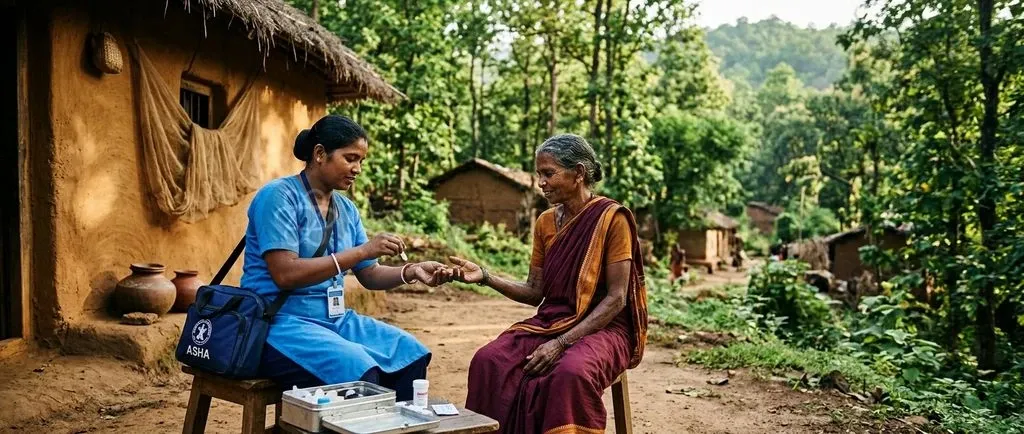
Decentralised primary care infrastructure is the operational anchor for these field protocols. Health authorities are embedding rapid bivalent testing and complete radical cure into Ayushman Arogya Mandirs, supported by frontline Accredited Social Health Activists (ASHAs). Field workers now log fever cases and entomological indices directly into the Integrated Disease Surveillance Programme's Integrated Health Information Platform, shortening response times from detection to focal indoor spraying.
Discuss with Superkalam
Considering vector resistance to pyrethroids and emerging partial artemisinin resistance, propose two strategic shifts India must adopt to maintain its 2027 elimination timeline.
Ask NowWhat India Must Do Next to Achieve Zero Transmission by 2030
Securing zero local transmission requires four focused technical shifts:
- Deploy dual-antigen rapid diagnostics: The National Centre for Vector Borne Diseases Control must systematically replace single-target test kits in Category 2 and Category 3 districts with combination tests detecting both parasite lactate dehydrogenase (pLDH) and histidine-rich protein 2. This prevents parasites with pfhrp2 and pfhrp3 deletions from evading detection.
- Rotate insecticidal chemical classes: District health societies should alternate synthetic pyrethroids with organophosphates and deploy novel dual-active ingredient mosquito nets to slow the development of vector resistance.
- Coordinate border surveillance units: State health departments sharing forested borders must synchronise mass screening drives and vector control schedules. Joint surveillance units along borders with Myanmar and Bangladesh will safeguard malaria-free zones from imported resurgence.
- Protect frontline elimination financing: As case numbers decline, public health systems face the risk of surveillance fatigue. State governments must protect domestic financing for primary healthcare, maintain real-time case reporting, and support frontline ASHAs in remote tribal settlements.
Key Takeaways
- India's National Framework for Malaria Elimination targets nationwide interruption of all indigenous transmission by 2027 and complete WHO malaria-free certification by 2030.
- Confirmed malaria cases fell from over 1.16 million in 2015 to roughly 227,000 in 2023, enabling India to exit the WHO High Burden to High Impact group in 2024.
- Residual malaria transmission is concentrated in 33 high-burden districts across nine States and Union Territories, with Scheduled Tribe communities accounting for nearly half of all cases.
- Biological hurdles threatening the 2030 deadline include pfhrp2/3 gene deletions that evade standard diagnostic kits, k13 propeller mutations linked to partial artemisinin resistance, and vector resistance to synthetic pyrethroids.
- Proven state interventions, including Odisha's DAMaN programme and the Mandla demonstration project, show that combining mass screening, radical therapy, and universal bed net coverage can slash local transmission by over 80 to 90 percent.
Mains Question
"According to the National Strategic Plan for Malaria Elimination (2023–2027), Scheduled Tribe communities account for nearly half of all malaria cases despite comprising only 8.6 percent of India's population." In this context, evaluate the key operational and geographical hurdles in achieving malaria elimination in high-transmission tribal belts. (10 Marks)
Evaluate NowMains Question
"While nationwide interventions reduced malaria caseloads and deaths by 80 percent between 2015 and 2025, clearing the 'final mile' by 2030 is severely threatened by biological mutations and surveillance blind spots." Critically analyse. (15 Marks)
Evaluate NowPractice MCQs
QUESTION 1
With reference to the National Framework for Malaria Elimination (2016–2030) in India, consider the following statements:
- The interim target under the framework is to halt all indigenous malaria transmission nationwide by 2027.
- Securing formal World Health Organization (WHO) malaria-free certification requires proving zero indigenous transmission nationwide for at least three consecutive years.
- In 2024, India was designated as a 'High Burden to High Impact' (HBHI) focus country by the WHO due to rising regional vivax burden. Which of the statements given above is/are correct?
QUESTION 2
Under the National Strategic Plan for Malaria Elimination, districts are stratified into operational categories using the Annual Parasite Incidence (API). Consider the following pairs:
- Category 0 : Zero indigenous cases for at least 3 consecutive years
- Category 1 : API between 1 and less than 2 cases per 1,000 population at risk
- Category 3 : API of 2 or more cases per 1,000 population Which of the pairs given above is/are correctly matched?
QUESTION 3
Consider the following statements regarding the biological and entomological challenges confronting malaria elimination in India:
- Deletions in the pfhrp2 and pfhrp3 genes of Plasmodium falciparum allow parasites to evade detection by standard rapid diagnostic tests.
- Point mutations in the Kelch13 propeller domain of Plasmodium falciparum have been linked to delayed parasite clearance under Artemisinin-based Combination Therapy.
- Primary vectors like Anopheles culicifacies and Anopheles stephensi continue to show universal susceptibility to organochlorines such as DDT. Which of the statements given above are correct?
QUESTION 4
According to the World Malaria Report 2024 cited in the context of India's malaria epidemiology, consider the following statements:
- India accounts for less than 1 percent of global malaria cases and deaths.
- India contributes nearly three-fourths of all malaria cases in the WHO South-East Asia Region.
- India carries close to half of the global Plasmodium vivax burden. Which of the statements given above are correct?
QUESTION 5
In the context of public health surveillance under the National Strategic Plan for Malaria Elimination, what does 'Annual Parasite Incidence' (API) measure?