India TB Elimination 2025: Why Undernutrition Stalled the Target
While clinical treatments achieved a 94% cure rate, persistent undernutrition kept primary transmission alive, derailing the 2025 national eradication goal.
Nov, 2026
•9 min read
Overview
India's ambitious target to eliminate tuberculosis by 2025 under the National Strategic Plan has stalled. High-tech diagnostic expansion and potent drug regimens cannot overcome a transmission cycle rooted in pervasive undernutrition. The National Tuberculosis Elimination Programme modernised molecular diagnostics and achieved high clinical treatment success, yet systemic macronutrient deficits continue to fuel disease reactivation across a vast latent reservoir.
As of November 2026, epidemiological evidence confirms that clinical therapy cures the individual patient while leaving poverty-driven immune vulnerabilities unaddressed. Closing this gap requires shifting the national public health architecture from a purely biomedical paradigm to an inter-sectoral strategy. That approach must integrate social determinants, direct food support, and targeted social protection.
Why in the News? India's 2025 TB Elimination Deadline and Reality
India committed under the National Strategic Plan for Tuberculosis Elimination (2017–2025) to end the tuberculosis epidemic by 2025, setting an aggressive timeline five years ahead of Sustainable Development Goal 3.3. This target required an 80% reduction in incidence to 44 cases per lakh and a 90% reduction in mortality compared to 2015 baselines, as documented by the Central TB Division.
Data released by the World Health Organization and the Union Ministry of Health and Family Welfare highlights the gap between targets and reality:
- India registered a 38% decline in TB mortality between 2015 and 2026, exceeding the global reduction of 35% reported by the World Health Organization.
- Concurrently, incidence fell by 21% from 237 per lakh in 2015 to 187 per lakh population in 2024.
- India still accounts for approximately 25% of all global TB cases and 32% of global multidrug-resistant or rifampicin-resistant TB cases, according to the WHO Global Tuberculosis Report.
Clinical interventions successfully reduced deaths. Yet the national elimination deadline remained unfulfilled because biomedical tools cannot halt primary transmission driven by structural undernutrition.
Discuss with Superkalam
Recall the two key numerical targets (percentage reduction in incidence and mortality) set under the National Strategic Plan (2017–2025).
Ask NowThe Biomedical Push: What India Got Right in Modern Diagnostics and Care
India's clinical apparatus under the National Tuberculosis Elimination Programme underwent extensive technical modernisation over the past decade. The Union Health Ministry transitioned diagnostic protocols toward universal drug susceptibility testing, conducting over 68.3 lakh NAAT tests in 2023 through rapid CBNAAT and TrueNat platforms.
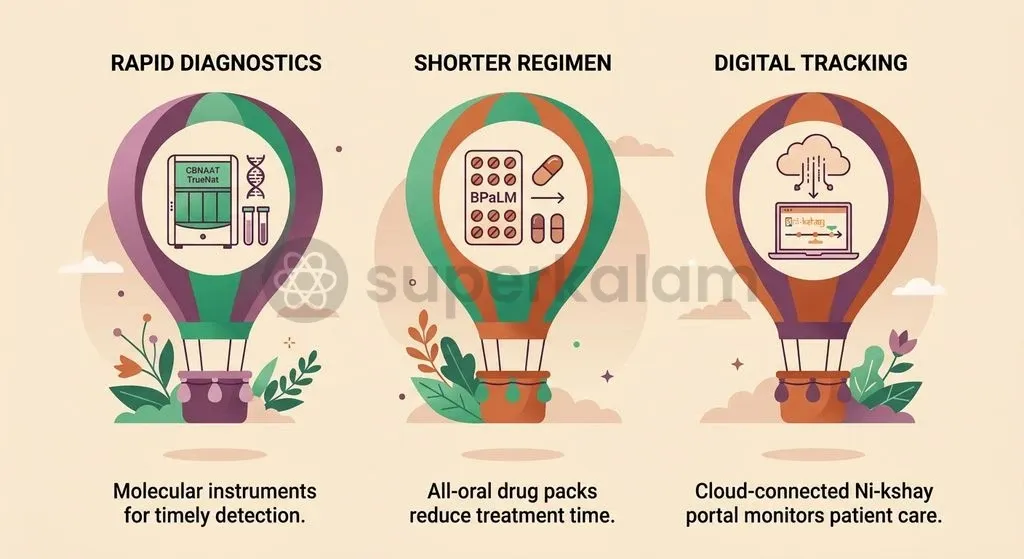
On September 6, 2024, the Union Health Ministry approved the nationwide rollout of the six-month BPaLM regimen—combining Bedaquiline, Pretomanid, Linezolid, and Moxifloxacin—for drug-resistant cases. This protocol replaced toxic eighteen-month injectable regimens, improving compliance and patient outcomes.
Surveillance and case notification experienced an overhaul through digital infrastructure. The Central TB Division deployed the Ni-kshay digital portal as an end-to-end information architecture, managing real-time notifications, adherence tracking, and financial reconciliation across public and private sectors. Proactive screening expanded through the deployment of handheld ultra-portable digital X-ray devices powered by artificial intelligence, screening over 25 crore individuals and finding over 14.9 lakh asymptomatic cases.
These systemic investments yielded solid operational outcomes across public health institutions:
- The national programme recorded an overall TB treatment coverage rate of 92% in 2024.
- Clinical teams maintained a 94% treatment success rate among patients with drug-susceptible tuberculosis as of November 2026.
- The national elimination budget attained fiscal self-sufficiency, with 96% of programme funding sourced from domestic budgets rather than external donors by 2026.
The Biological Link: How Undernutrition Fuels Tuberculosis
Clinical interventions treat active disease, but nutritional status determines whether an exposed individual develops active tuberculosis in the first place. Public health research published in The National Medical Journal of India and The Lancet Global Health identifies undernutrition as the leading population-attributable risk factor for tuberculosis in India, responsible for 35% to 55% of incident active cases.
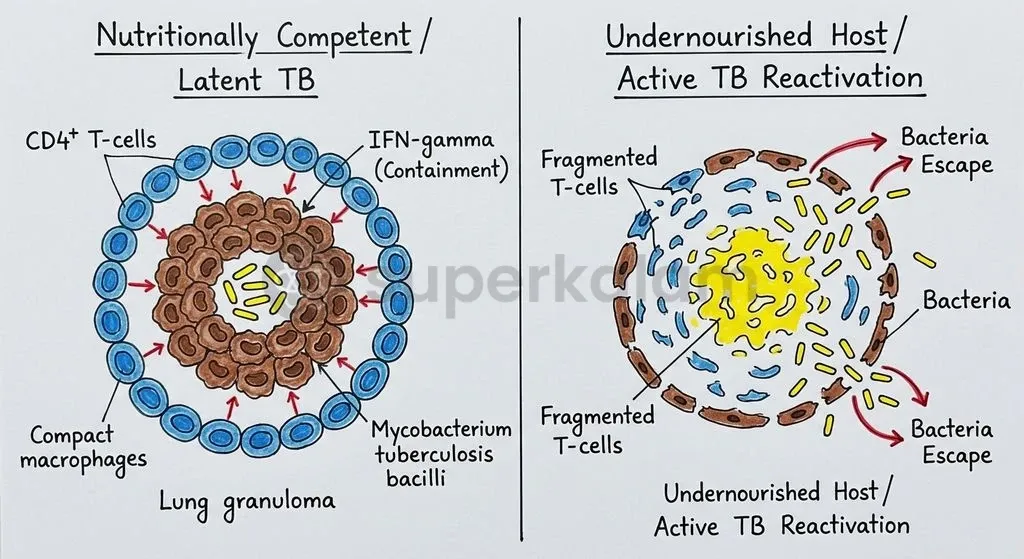
Approximately 35% to 40% of the Indian population carries latent tuberculosis infection, forming a massive reservoir where bacteria remain clinically dormant. A healthy immune system contains these latent bacilli within stable pulmonary granulomas. When nutritional intake falls below baseline metabolic needs, this immunological containment breaks down.
Undernutrition produces a profound suppression of host cell-mediated defences known as nutritionally acquired immune deficiency, or N-AIDS, as characterised in studies in the British Medical Journal. Protein and energy deprivations impair the proliferation of CD4+ and CD8+ T-lymphocytes and slash the production of interferon-gamma—a key cytokine necessary for macrophage activation. Deprived of interferon-gamma signals, alveolar macrophages fail to restrain intracellular Mycobacterium tuberculosis, triggering unchecked bacterial multiplication and clinical disease reactivation.
Empirical evidence from the landmark RATIONS trial conducted by the Indian Council of Medical Research in Jharkhand demonstrated the protective power of direct nutritional support:
- Monthly macronutrient food baskets provided to household contacts reduced two-year TB incidence by 39% to 48%, confirming that food acts as a social vaccine.
- Providing adult pulmonary TB patients with 1,200 daily kilocalories and 52 grams of daily protein reduced TB mortality by 35% to 50%.
- Baseline assessments showed severe physical wasting, with over 80% of adult patients underweight and 16% severely emaciated with a Body Mass Index below 14 kg/m².
Discuss with Superkalam
Explain the biological mechanism through which severe protein and caloric deprivation leads to the breakdown of latent tuberculosis containment.
Ask NowWhere Cash Transfers Fall Short: Assessing the Ni-kshay Poshan Yojana
The Union Government instituted the Ni-kshay Poshan Yojana on April 1, 2018, to alleviate nutritional distress by providing monthly direct benefit transfers to notified patients. Between 2018 and late 2025, the central administration disbursed over ₹4,322 crore via direct transfers to more than 1.35 crore patients. On October 7, 2024, the Ministry of Health and Family Welfare increased this financial support from ₹500 to ₹1,000 per month per patient.
Alongside this fiscal adjustment, the government introduced Energy Dense Nutritional Supplementation, covering approximately 12 lakh underweight TB patients having a Body Mass Index below 18.5 kg/m² during their initial two months of therapy. Community contributions under the Pradhan Mantri TB Mukt Bharat Abhiyaan complemented this effort, mobilising volunteer Ni-kshay Mitras to distribute over 45.66 lakh food baskets to 20.3 lakh individuals. In October 2024, the ministry expanded this volunteer initiative to include household contacts.
Operational assessments nevertheless show that unconditional cash transfers encounter acute systemic friction:
- Disbursal Latency: Public health studies indexed in PubMed Central identified severe operational delays, with median payment disbursals lagging between 43 days and 5.2 months after diagnosis.
- Intra-Household Dilution: Clinical economists at the Yenepoya Centre for Nutrition Studies observed that unconditional monetary assistance of ₹500 to ₹1,000 per month is regularly absorbed into general household survival expenditure rather than funding the patient's individual dietary recovery.
- Structural Identity Barriers: Implementation reviews in the Indian Journal of Tuberculosis report that mandatory Aadhaar-seeded bank accounts generate administrative exclusion for unbanked women, remote tribal settlements, and seasonal migrant labourers.
Discuss with Superkalam
If you were the District Collector of a high-burden tribal district, how would you address the administrative and banking hurdles that delay Ni-kshay Poshan Yojana transfers?
Ask Now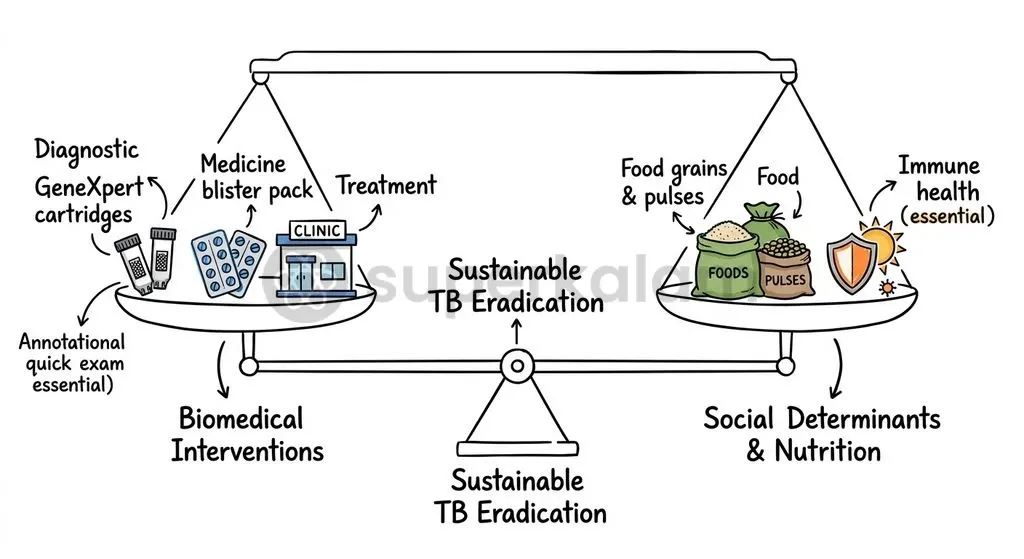
Governance and Ethical Challenges: The Burden on India's Poorest Households
Tuberculosis is an infectious illness sustained by social inequality. While testing and standard drugs are free in state health facilities, poor families face devastating auxiliary costs. The India TB Report 2024 highlighted that a large share of households suffer catastrophic health expenses exceeding 20% of annual household earnings due to frequent transport, lost daily wages, and costly protein supplements.
This dynamic creates a cascading economic and biological trap:
- Income Shock: When an impoverished manual worker falls sick, lost physical stamina leads to an immediate loss of daily wages.
- Nutritional Depletion: Plummeting earnings worsen food insecurity for dependents, deepening micronutrient and protein deficits across the home.
- Secondary Activation: Worsening nutrition impairs the cell-mediated immunity of household contacts, causing dormant infections to flare into secondary active cases.
- Cash Absorption: In destitute households, monetary transfers get diverted to rent, debt repayment, or shared calories, leaving the patient without the dense protein needed for healing.
Relying solely on personal bank transfers without guaranteed food distribution places the burden of disease recovery directly onto destitute families.
Discuss with Superkalam
Compare the epidemiological impact of molecular diagnostics (like CBNAAT) with targeted nutritional interventions in curtailing transmission from India's latent TB pool.
Ask NowThe Way Forward: Anchoring TB Eradication in Nutritional Security
Ending tuberculosis requires moving past a hospital-centred approach to an inter-sectoral strategy that treats nutritional security as vital medical care. Public health bodies, including the Indian Council of Medical Research, highlight practical steps to bridge this gap:
- Institutional Convergence with Food Security Infrastructure: Public health specialists recommend linking the National Tuberculosis Elimination Programme directly with the National Food Security Act's Public Distribution System. State civil supplies departments should supply monthly protein-fortified rations—containing pulses, oil, and millets—directly to registered TB patients and their immediate contacts.
- Universalising Differentiated Care Pathways: Health systems must implement the Central TB Division's Differentiated TB Care guidelines. These protocols require systematic triage for severe undernutrition (BMI under 16 kg/m²) to ensure inpatient medical stabilisation.
- Transitioning from Delayed Cash to In-Kind Food Baskets: Relying exclusively on delayed monetary transfers should shift to immediate in-kind food distribution upon case notification. Providing packaged ration hampers at primary health centres eliminates digital payment delays and ensures nutritious food reaches the household immediately.
- Targeting Household Contacts to Halt Transmission: Expanding Ni-kshay Mitra nutritional support to all household contacts must become a mandatory public service, rather than depending on optional corporate or civic donations.
- Decentralised Nutritional Delivery via Panchayati Raj: Local gram panchayats and urban primary health centres should oversee nutritional supplementation through community health workers, ensuring uninterrupted delivery to mobile and marginalised populations.
Key Takeaways
- India's 2025 TB elimination deadline remained unmet because clinical tools could not counter primary transmission driven by widespread undernutrition, despite a 38% drop in mortality since 2015.
- Undernutrition is the leading population-attributable risk factor for tuberculosis in India, contributing to 35% to 55% of active cases by weakening cell-mediated immunity.
- Findings from the ICMR-supported RATIONS trial demonstrated that providing monthly food baskets to household contacts cut TB incidence by 39% to 48%, while nutritional support for patients lowered mortality by up to 50%.
- The Union Health Ministry doubled monthly cash transfers under Ni-kshay Poshan Yojana to ₹1,000 per patient in late 2024, yet implementation faces hurdles from bank-linkage issues and disbursal delays.
- Sustainable elimination requires bridging vertical health programmes with social protection, specifically linking the National Tuberculosis Elimination Programme with the Public Distribution System and local panchayat networks.
Mains Question
"Clinical interventions cure the individual patient, but biomedical tools alone cannot overcome an epidemic rooted in structural undernutrition." In the context of the National Strategic Plan for Tuberculosis Elimination, critically analyse why modern diagnostics and regimens have proved insufficient to achieve the 2025 targets. (15 Marks)
Evaluate NowMains Question
Evaluate the efficacy of the Ni-kshay Poshan Yojana in addressing nutritional distress among tuberculosis patients in India. (10 Marks)
Evaluate NowPractice MCQs
QUESTION 1
Consider the following statements regarding India's National Strategic Plan for Tuberculosis Elimination (2017–2025):
- It set a target to end the tuberculosis epidemic by 2025, which was five years ahead of Sustainable Development Goal 3.3.
- The plan targeted an 80% reduction in incidence to 44 cases per lakh compared to 2015 baselines.
- By 2024, India achieved a decline in TB incidence to below 100 cases per lakh population. Which of the statements given above is/are correct?
QUESTION 2
With reference to the biological linkages between undernutrition and tuberculosis, consider the following statements:
- Undernutrition is considered the leading population-attributable risk factor for tuberculosis in India.
- Protein and energy deprivation induce nutritionally acquired immune deficiency by impairing the proliferation of CD4+ and CD8+ T-lymphocytes.
- Reduced production of interferon-gamma impairs alveolar macrophages from containing intracellular Mycobacterium tuberculosis. Which of the statements given above are correct?
QUESTION 3
Regarding the findings of the RATIONS trial conducted by the Indian Council of Medical Research (ICMR) in Jharkhand, consider the following statements:
- Providing monthly macronutrient food baskets to household contacts reduced two-year TB incidence by 39% to 48%.
- Nutritional supplementation provided to adult pulmonary TB patients led to a 35% to 50% reduction in mortality. Which of the statements given above is/are correct?
QUESTION 4
In the context of India's TB treatment protocols, the 'BPaLM regimen' approved by the Union Health Ministry in September 2024 consists of which combination of drugs?
QUESTION 5
Consider the following statements regarding the Ni-kshay Poshan Yojana:
- It was launched in 2018 to disburse direct benefit transfers to notified TB patients.
- In October 2024, the monthly monetary benefit was raised from ₹500 to ₹1,000 per patient.
- The scheme includes Energy Dense Nutritional Supplementation for underweight patients having a Body Mass Index below 18.5 kg/m² during the first two months of therapy. Which of the statements given above are correct?
Discuss with Superkalam
Given the trade-off between direct food basket distribution and unconditional cash transfers, assess which approach offers greater public health returns for undernourished TB households.
Ask Now