Transgender Healthcare in India: Ayushman Bharat vs State Delivery Models
Evaluating demand-side insurance vouchers against direct public delivery exposes the clinical and statutory hurdles facing gender-affirming healthcare in India.
Nov, 2026
•9 min read
Overview
India’s evolving transgender healthcare architecture confronts a fundamental structural tension between voucher-based demand-side insurance packages under Ayushman Bharat TG Plus and direct, supply-side clinical delivery pioneered through Delhi’s universal public health system. While the central scheme offers portable financial protection of ₹5 lakh across empanelled hospitals, persistent administrative bottlenecks in statutory identity certification, non-viable surgical tariff ceilings, and widespread institutional prejudice leave many individuals excluded from basic gender-affirming treatments. Meaningful coverage requires coupling financial risk pooling with direct public tertiary investments, non-binary clinical facilities, and nationwide medical curriculum reforms.
Why in the News: Expanding Transgender Health Coverage in India
As of November 2026, the Delhi Cabinet approved an enhanced annual health cover of up to ₹10 lakh for eligible transgender community members. According to the Delhi Cabinet Decision Notification, this policy supplements the central Ayushman Bharat PM-JAY allocation of ₹5 lakh with an additional ₹5 lakh from the Government of National Capital Territory of Delhi (GNCTD). The official cabinet statement notes that the initiative targets an estimated 5,656 transgender persons across the capital, backed by an annual state budgetary outlay of approximately ₹1.19 crore.
Access to this enhanced entitlement remains tied to strict administrative documentation. Under the eligibility framework announced by the Delhi government, beneficiaries must feature on the Delhi Revenue Department verification list and possess a valid identity certificate issued by the concerned District Magistrate. This expansion brings into sharp focus the comparative effectiveness of demand-side insurance mechanisms versus direct public healthcare provision.
Discuss with Superkalam
Which landmark 2014 Supreme Court judgment first established that self-determination of gender identity is an integral part of Articles 14, 19(1)(a), and 21?
Ask NowThe Constitutional Mandate: NALSA (2014) and Section 15 of the 2019 Act
The Supreme Court of India anchored the fundamental right to healthcare and self-identified gender in Articles 14, 19(1)(a), and 21 of the Constitution. In National Legal Services Authority (NALSA) v. Union of India (2014), the Court affirmed that self-determination of gender identity constitutes an inalienable component of personal autonomy and human dignity]. The bench directed central and state governments to establish dedicated medical facilities in public hospitals, including sex reassignment surgery (SRS) and specialised HIV surveillance mechanisms.
Parliament subsequently codified these constitutional guarantees within the Transgender Persons (Protection of Rights) Act, 2019:
- Section 15(b) and (c): Mandates the appropriate government to provide dedicated hospital facilities, access to sex reassignment surgery, hormonal therapy, and comprehensive pre- and post-surgical psychological counselling.
- Section 15(d) and (e): Directs authorities to draft a Health Manual for transition procedures in alignment with World Professional Association for Transgender Health (WPATH) standards, alongside revising the national medical curriculum.
- Section 15(g): Obligates the government to facilitate medical insurance coverage covering hormone therapy, reconstructive interventions, and laser therapies.
Two Competing Approaches: Demand-Side Insurance vs Supply-Side Public Care
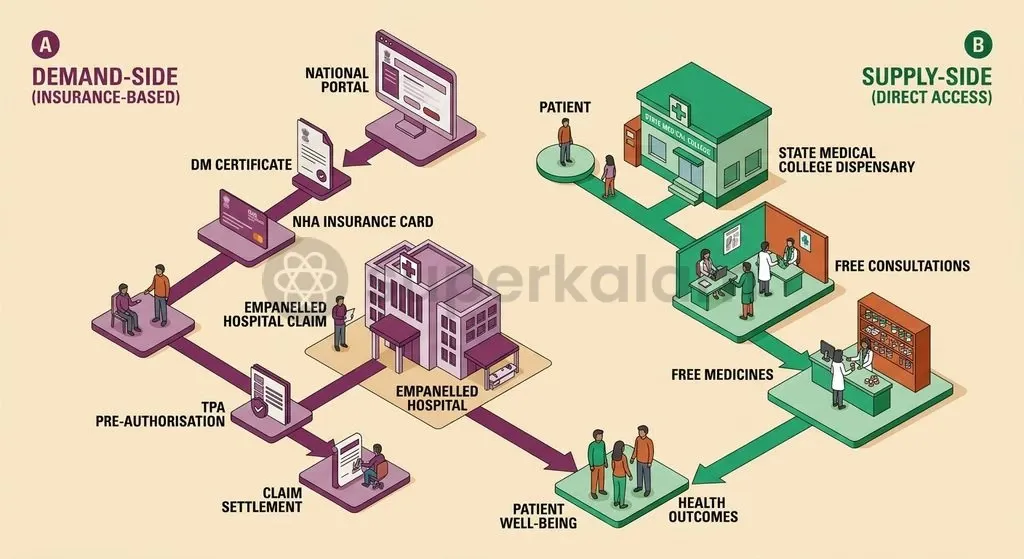
The National Health Authority (NHA) operationalised the central statutory mandate by executing a Memorandum of Understanding with the Ministry of Social Justice and Empowerment (MoSJE) on 24 August 2022. Operating under the SMILE scheme (Support for Marginalized Individuals for Livelihood and Enterprise), the resulting Ayushman Bharat TG Plus provides an annual cashless cover of ₹5 lakh, fully funded by MoSJE for transition-related procedures across empanelled hospitals.
In contrast, the traditional Delhi public healthcare system relies on a direct supply-side delivery model. Under this framework, state-run secondary dispensaries and tertiary hospitals provide clinical consultations, diagnostics, and essential medications free of charge at the point of care. This approach bypasses commercial third-party administrators (TPAs), pre-authorisation delays, and claims adjudication systems.
| Comparative Dimension | Ayushman Bharat TG Plus (Central Model) | Delhi Public Healthcare (State Model) |
|---|---|---|
| Financing Mechanism | Demand-side targeted health insurance (₹5 lakh central cover under SMILE). | Direct supply-side funding via the state budgetary allocation. |
| Point of Delivery | Empanelled public and private secondary and tertiary hospitals. | State-run dispensaries, polyclinics, and government tertiary hospitals. |
| Intermediary Role | Relies on National Health Authority claims processing and TPA approvals. | No third-party administrator; care is provided directly at facilities. |
| Transition Coverage Scope | Specific pre-packaged tariff bundles for hormone therapy and surgeries. | General clinical care is fully subsidised; specialized reconstructive surgeries remain limited to select tertiary institutions. |
| Prerequisite Documentation | Mandatory identity certificate from the National Portal for Transgender Persons. | General hospital access is universal; enhanced ₹10 lakh top-up requires DM certification and Revenue Department verification. |
Discuss with Superkalam
How does a direct supply-side public healthcare model differ from a demand-side insurance mechanism in providing transition-related medical care?
Ask NowAdministrative Hurdles: Certification Gatekeeping and Digital Exclusion
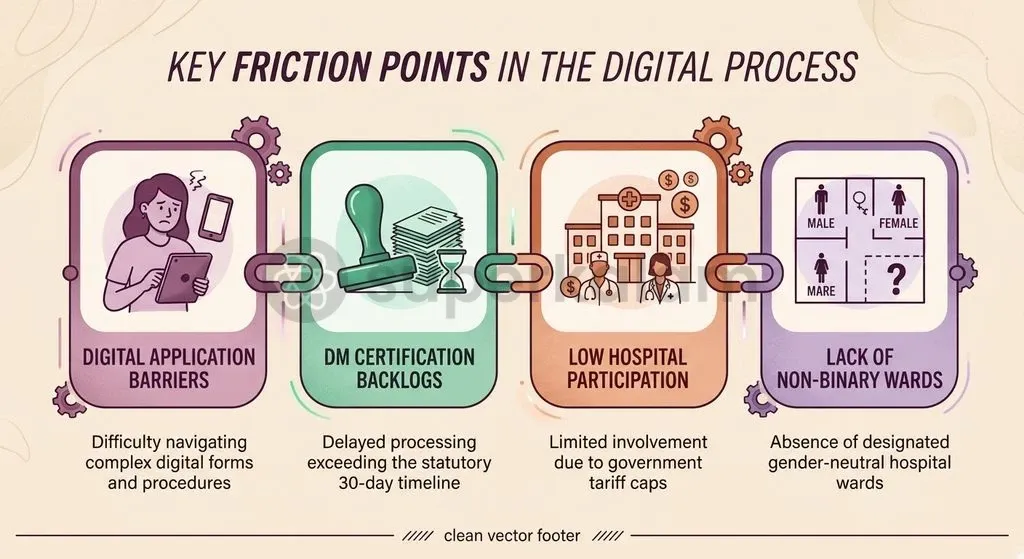
The primary operational bottleneck across insurance-based mechanisms is the mandatory registration gateway. Under the Transgender Persons (Protection of Rights) Rules, 2020, District Magistrates are required to issue an official Certificate of Identity within 30 days of receiving an application on the National Portal for Transgender Persons.
Field assessments by the Centre for Law and Policy Research (CLPR) reveal that applications routinely face delays and rejections extending months beyond the statutory deadline. Because Ayushman Bharat TG Plus strictly requires this national identity certificate, bureaucratic delays directly stall access to life-saving medical care.
Digital exclusion compounds this gatekeeping. The 2011 Census recorded 4,87,803 transgender persons in India—a figure widely recognized by sociologists as a severe undercount due to social stigma. Many socio-economically marginalized transgender individuals lack smartphone access, stable digital literacy, or matching foundational paperwork, effectively locking them out of the national registry.
Clinical Gaps: Why Health Cards Fail Without Trained Doctors and Protocols
A valid health card does not ensure treatment when medical infrastructure remains unequipped for gender-affirming interventions. The World Professional Association for Transgender Health (WPATH) Standards of Care, Version 8 (SOC-8), states that gender-affirming medical and surgical care is medically necessary care that must be embedded within national clinical protocols.
In India, private hospital participation under Ayushman Bharat TG Plus remains severely constrained. Clinical survey data and investigations published in the International Journal of Transgender Health indicate that private empanelled providers frequently opt out of offering gender-affirming procedures due to inadequate package tariffs. Commercial tertiary hospitals charge between ₹5 lakh and ₹7 lakh for multi-stage gender-affirming procedures, rendering public insurance tariff caps financially unattractive to private providers.
Public tertiary capacity also remains thin. While Dr. Ram Manohar Lohia (RML) Hospital in Delhi established India's first dedicated transgender Outpatient Department (OPD) clinic on 17 September 2023, institutional facilities of this kind remain rare exceptions across India's public health system.
Discuss with Superkalam
If you were a District Magistrate, how would you address administrative backlogs on the National Portal for Transgender Persons to meet the statutory 30-day certificate issuance deadline?
Ask NowEthical Dimension: Stigma, Bodily Autonomy, and Institutional Bias
Institutional prejudice within hospital administration directly violates professional medical ethics and the guarantee of equal protection under the law. Field investigations published in The Hindu document that transgender patients routinely face violations of privacy and human dignity due to the complete absence of non-binary inpatient wards, which often forces trans women into male wards.
The National Medical Commission (NMC) acted to eliminate harmful practices in September 2022 by issuing a circular declaring conversion therapy to be professional misconduct punishable by State Medical Councils. The regulatory body followed this directive in October 2022 by mandating the removal of unscientific, pathologising descriptions of non-heteronormative sexualities and transgender identities from undergraduate medical textbooks.
These regulatory interventions address foundational ethical duties:
- Autonomy and Dignity: Respecting self-identified gender without subjecting patients to intrusive psychiatric vetting or invasive physical scrutiny.
- Non-Maleficence: Protecting transgender persons from predatory, unscientific practices that exacerbate psychological distress and suicidal ideation.
- Distributive Justice: Allocating public health resources to ensure that lower-income transgender persons are not driven into catastrophic medical debt or unsafe, back-alley surgeries.
Discuss with Superkalam
Why has the availability of health insurance cards failed to guarantee access to gender-affirming surgeries in private empanelled hospitals?
Ask NowState Best Practices: What Other States Can Learn from Tamil Nadu
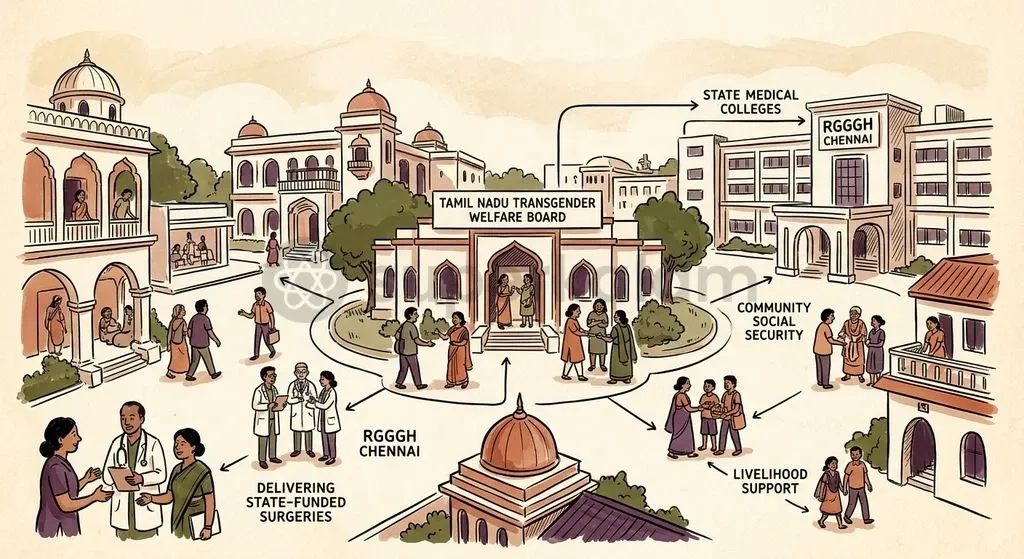
State governments seeking sustainable models can examine the institutional framework developed in Tamil Nadu. In April 2008, the Tamil Nadu government established the country's first dedicated Transgender Welfare Board under Social Welfare Department G.O. (Ms) No. 74.
The Tamil Nadu model delivers free gender-affirming surgeries across premier public tertiary facilities, including Rajiv Gandhi Government General Hospital (RGGGH) and Stanley Medical College in Chennai. By pairing social security pensions and community identification with dedicated surgical capacity in state-run teaching hospitals, Tamil Nadu reduces reliance on commercial insurance networks.
Way Forward: Building Stigma-Free, Universal Transgender Healthcare
Reforming transgender healthcare in India requires a balanced public policy framework combining robust social insurance with direct public hospital capacity:
- Harmonise Financing with Direct Supply-Side Investments: Insurance vouchers cannot substitute for functional public infrastructure. State governments must fund specialized plastic surgery, endocrinology, and psychological support units in government medical colleges, following the Tamil Nadu and RML Hospital models.
- Revise Insurance Tariff Schedules: The National Health Authority must recalibrate reimbursement tariffs for gender-affirming care under the SMILE scheme, ensuring public and private providers can cover multi-stage reconstructive procedures.
- Decouple Care from Strict Administrative Gateways: Urgent, primary, and diagnostic healthcare must be accessible without requiring a District Magistrate's identity certificate, preventing bureaucratic backlogs from blocking clinical consultations.
- Enforce Medical Education and Clinical Protocols: The National Medical Commission and the Ministry of Health and Family Welfare must implement standardised WPATH-compliant clinical manuals and enforce the removal of outdated, discriminatory material from medical curricula nationwide.
- Establish Trans-Inclusive Inpatient Facilities: State health departments must create dedicated, non-binary short-stay and post-operative recovery wards across tertiary hospitals to safeguard dignity and personal safety.
Key Takeaways
- The Supreme Court in NALSA v. Union of India (2014) established that self-determination of gender identity is protected under Articles 14, 19(1)(a), and 21 of the Indian Constitution.
- Section 15 of the Transgender Persons (Protection of Rights) Act, 2019, mandates that the state provide gender-affirming surgical care, hormone therapy, and comprehensive insurance.
- Ayushman Bharat TG Plus provides ₹5 lakh in cashless annual cover under the SMILE scheme, while the Delhi government approved a top-up bringing total annual protection to ₹10 lakh for verified beneficiaries.
- Mandatory certification requirements through District Magistrate offices and the National Portal for Transgender Persons create bureaucratic delays that disrupt timely medical access.
- Inadequate package reimbursement tariffs and a nationwide shortage of trained plastic surgeons prevent broad private hospital empanelment, underscoring the need for dedicated public hospital infrastructure.
Mains Question
"Demand-side health insurance models such as Ayushman Bharat TG Plus often fail to translate into effective care without robust public tertiary supply and administrative streamlining." In this context, critically analyse the operational, clinical, and ethical bottlenecks in delivering universal transgender healthcare in India. (15 Marks)
Evaluate NowMains Question
The Transgender Persons (Protection of Rights) Act, 2019 codifies the constitutional guarantees of bodily autonomy and healthcare laid down in the landmark NALSA judgment. Elucidate the statutory mandate under Section 15 of the Act and evaluate the progress achieved in its institutional implementation. (10 Marks)
Evaluate NowPractice MCQs
QUESTION 1
Consider the following statements regarding the constitutional and statutory framework governing transgender healthcare in India:
- In the NALSA v. Union of India (2014) judgment, the Supreme Court anchored the right to gender self-determination in Articles 14, 19(1)(a), and 21 of the Constitution.
- Section 15 of the Transgender Persons (Protection of Rights) Act, 2019 obligates the government to facilitate medical insurance coverage covering hormone therapy and reconstructive interventions.
- The Transgender Persons (Protection of Rights) Act, 2019 mandates the formulation of a Health Manual aligned with World Professional Association for Transgender Health (WPATH) standards. Which of the statements given above are correct?
QUESTION 2
With reference to the Ayushman Bharat TG Plus scheme, consider the following statements:
- It is fully funded by the Ministry of Social Justice and Empowerment under the SMILE scheme.
- It provides an annual cashless health cover of ₹10 lakh across all empanelled tertiary hospitals in India.
- Enrolment under the scheme requires a mandatory Certificate of Identity issued via the National Portal for Transgender Persons. Which of the statements given above is/are correct?
QUESTION 3
Consider the following statements regarding administrative and institutional actions in transgender healthcare:
- Under the Transgender Persons (Protection of Rights) Rules, 2020, District Magistrates are required to issue an official Certificate of Identity within 30 days of receiving an application.
- Dr. Ram Manohar Lohia (RML) Hospital in Delhi established India's first dedicated transgender Outpatient Department (OPD) clinic in September 2023.
- The National Medical Commission (NMC) declared conversion therapy to be professional misconduct punishable by State Medical Councils in September 2022. Which of the statements given above is/are correct?
QUESTION 4
With reference to state-level public healthcare delivery models for transgender persons, consider the following statements:
- Tamil Nadu established the country's first dedicated Transgender Welfare Board in April 2008.
- The Tamil Nadu model relies primarily on private commercial insurance networks rather than state-run medical colleges for gender-affirming surgeries. Which of the statements given above is/are correct?
QUESTION 5
Which among the following actions was ordered by the National Medical Commission (NMC) in October 2022 regarding medical education and ethics in India?
Discuss with Superkalam
Between Tamil Nadu's direct public tertiary hospital framework and the Ayushman Bharat TG Plus voucher model, which offers a more sustainable path to universal transgender healthcare, and why?
Ask Now