State Cash Transfers vs Capex: Reshaping India's Fiscal Federalism
Rising welfare handouts crowd out high-multiplier infrastructure and test Article 293 borrowing caps, setting off a crucial constitutional dilemma for states.
Nov, 2026
•9 min read
Overview
State-level unconditional cash transfers are transforming Indian fiscal federalism. They widen revenue deficits, squeeze out capital spending, and spark constitutional friction with the Union over borrowing ceilings under Article 293.
According to PRS Legislative Research, aggregate state revenue deficits widened from 0.23% of Gross Domestic Product in 2022-23 to 0.71% in 2025-26 as spending on recurring welfare guarantees expanded rapidly. This shift directly impairs long-term growth. Empirical assessments from the Reserve Bank of India show capital outlays generate an economic output multiplier of up to 3.84, whereas direct revenue transfers yield multipliers below unity.
Tensions continue to escalate. The Union Ministry of Finance now routinely invokes Article 293(3) to curb off-budget borrowings and enforce fiscal discipline on sub-national balance sheets.
Why in the News? The Surge in Direct Cash Transfers Across Indian States
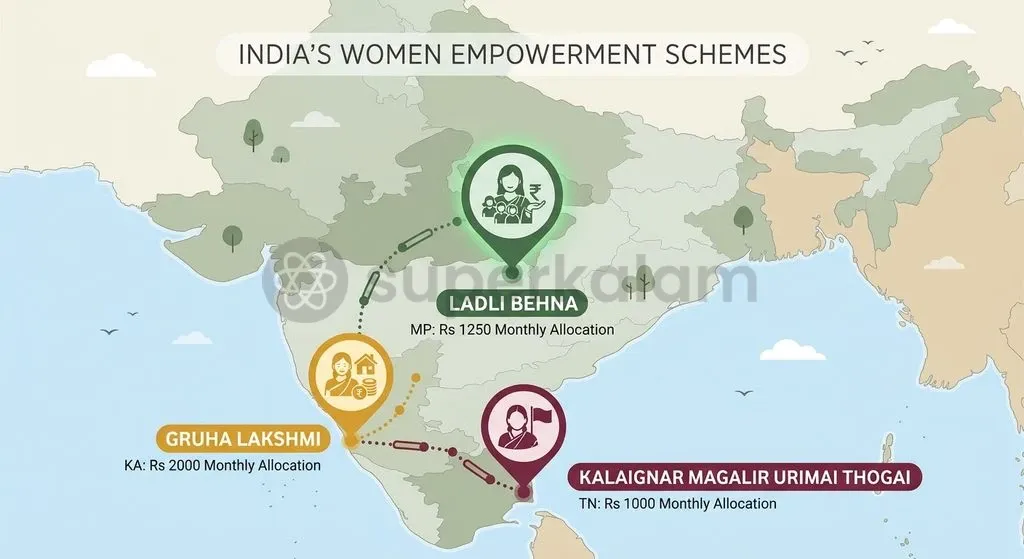
State governments across India have expanded unconditional cash transfers to support vulnerable populations, focusing specifically on adult women. Major sub-national initiatives include:
- Madhya Pradesh: Ladli Behna Yojana providing Rs 1,250 per month, according to PRS Legislative Research.
- Karnataka: Gruha Lakshmi disbursing Rs 2,000 per month, according to PRS Legislative Research.
- Tamil Nadu: Kalaignar Magalir Urimai Thogai transferring Rs 1,000 monthly, according to PRS Legislative Research.
Electoral pressures accelerated this expansion across states regardless of ruling parties. As reported by PRS Legislative Research, state spending on cash transfer schemes grew at an annual rate of 24% over the five years up to 2023-24. Their collective allocations are estimated to reach approximately Rs 4 lakh crore (~1% of GDP) by 2026-27.
This growth creates an acute macroeconomic trade-off. Widening deficits now force state governments to choose between recurring handouts and statutory debt sustainability.
Revenue Deficit vs Capital Outlay: Understanding the Core Fiscal Trade-off
Public finance draws a clear line between revenue spending and capital investment under standard accounting rules. Revenue expenditure creates no physical or financial assets, absorbing funds for operational costs, salaries, pensions, subsidies, and cash handouts.
In contrast, capital outlay funds the acquisition of assets of a material and permanent character. These projects encompass transport corridors, irrigation schemes, and the retirement of recurring financial liabilities.
A revenue deficit arises when operational spending exceeds current revenue receipts. When this happens, governments divert borrowed capital to clear everyday running costs instead of financing productive assets.
The Golden Rule of Public Finance dictates that borrowing must fund only productive capital projects. Current receipts must fully fund current consumption. Channelling borrowed debt into immediate consumption breaches this principle, starving long-term public asset formation.
| Dimension | Revenue Expenditure | Capital Outlay |
|---|---|---|
| Asset Creation | Creates no physical or financial assets | Creates tangible, permanent infrastructure assets |
| Nature of Outgo | Recurring operational costs and cash transfers | Non-recurring, long-term project allocations |
| Economic Impact | Short-term consumption smoothing | Long-term enhancement of productive capacity |
| Fiscal Rule Target | Must be eliminated under the 'Golden Rule' | Financed prudently through sustainable borrowing |
| Asset Examples | Salaries, pensions, subsidies, cash handouts | Roads, railways, schools, hospitals, power grids |
Discuss with Superkalam
What was the estimated output multiplier for capital expenditure over three years according to the Reserve Bank of India's sub-national assessment?
Ask NowThe Multiplier Dilemma: Why Economists Distinguish Capex from Revenue Outgo
Capital investments expand an economy far more effectively than recurring cash payouts over time. An empirical study by the National Institute of Public Finance and Policy (NIPFP) found the capital expenditure multiplier in India to be 2.45, compared to 0.98 for transfer payments and 0.99 for other revenue expenditure. Every rupee spent on physical assets yields nearly two and a half rupees of broad economic activity. By contrast, direct transfers leak quickly without compounding.
Sub-national assessments by the central bank confirm this structural gap:
- Capital expenditure yields an output multiplier well above unity with a peak impact of approximately 3.84 over three years.
- Sub-national revenue expenditure multipliers average 1.43 and decline below one over the medium term.
Infrastructure builds durable forward and backward linkages. Constructing logistics networks, water storage, and rural roads lowers supply-chain friction, attracts private investment, and expands tax receipts. Cash payouts inject immediate purchasing power into local markets, lifting consumer demand for non-durable goods. Yet they neither enlarge productive capacity nor build long-term economic resilience.

State Balance Sheets Under Stress: Guarantees, Subsidies, and Fiscal Prudence
State balance sheets face severe stress because committed outlays and non-merit subsidies crowd out developmental budgets. According to PRS Legislative Research, committed expenditure—encompassing salaries, pensions, and debt servicing—along with subsidies absorbed approximately 62% of total revenue receipts across Indian states in FY24. This pre-emption leaves minimal room for capital works.
Committed liabilities vary substantially across states, exposing deep balance sheet vulnerabilities:
- In Punjab, committed expenditure reached 107% of revenue receipts in FY24, completely consuming its operational income base.
- In Himachal Pradesh, committed outlays absorbed 85% of revenue receipts in FY24.
- In Tamil Nadu, committed liabilities accounted for 77% of revenue receipts in FY24.
- In Kerala, committed commitments required 75% of revenue receipts in FY24.
Non-funded pension commitments deepen these fiscal strains. The Reserve Bank of India estimated that if all State governments were to revert from the National Pension System (NPS) to the Old Pension Scheme (OPS), the cumulative fiscal burden would be 4.5 times that of NPS, adding an extra 0.9% of GDP annually by 2060.
States' total outstanding debt-to-GDP ratio stood at 28.5% as of March 2024, down from its pandemic peak of 31% in March 2021, yet remaining well above the 20% ceiling recommended by the FRBM Review Committee.
Discuss with Superkalam
Why does a widening revenue deficit force a government to violate the 'Golden Rule of Public Finance'?
Ask NowArticle 293 and Borrowing Ceilings: How the Centre Enforces Fiscal Discipline
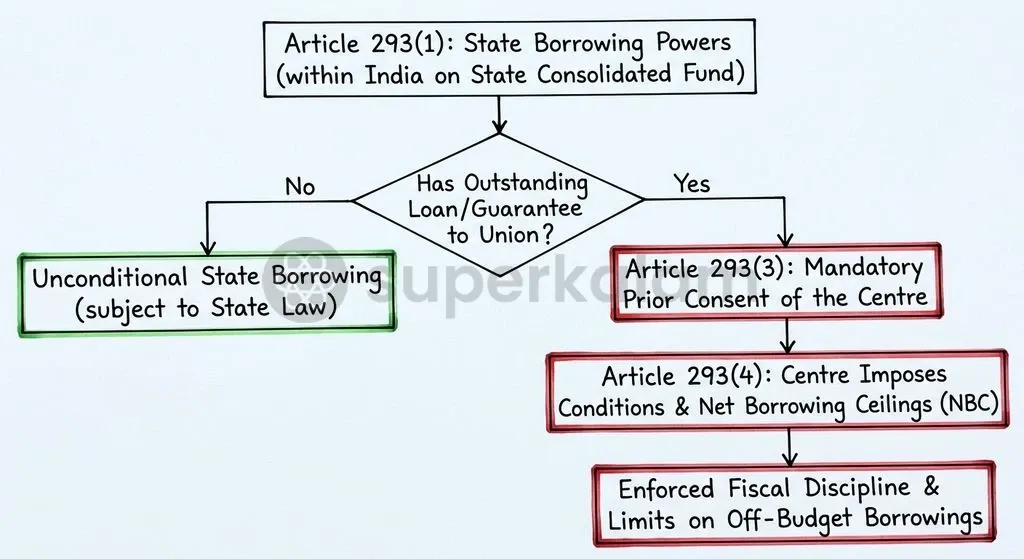
Article 293 defines state borrowing powers while establishing central regulatory control. Under Article 293(1), the executive power of a State extends to borrowing within India on the security of its Consolidated Fund, subject to limits set by the State Assembly.
Article 293(3) imposes a strict constitutional check. A State may not raise any loan without Union consent if any part of a central loan or guarantee remains outstanding. Article 293(4) further empowers the Union to grant consent subject to such conditions as it deems fit. Because every state carries debt to the Union, the Ministry of Finance determines the Net Borrowing Ceiling (NBC) each year.
The Union enforces sub-national debt rules through several statutory and financial instruments:
- Standard Ceilings: The Fifteenth Finance Commission anchored the normal Net Borrowing Ceiling at 3.0% of Gross State Domestic Product (GSDP) for 2021-22 to 2025-26, adding an extra 0.5% for completing power sector reforms.
- Off-Budget Accounting: In March 2022, the Ministry of Finance directed that borrowings by State Public Sector Enterprises or Special Purpose Vehicles serviced via state budgets must count against the State's Net Borrowing Ceiling.
- Judicial Review: In State of Kerala v. Union of India (2024 INSC 253), the Supreme Court denied interim relief to Kerala against the NBC cap and referred Article 293 to a 5-judge Constitution Bench.
- Targeted Capital Lending: The Union launched the Scheme for Special Assistance to States for Capital Investment (SASCI), granting 50-year interest-free loans over normal ceilings. Concessional lending under SASCI funded approximately 19% of states' aggregate capital outlay in FY25.
Welfare Protection or Fiscal Drag? Weighing the Arguments on State Transfers
The expansion of unconditional transfers divides economists into two distinct camps. Welfare advocates emphasise direct poverty relief, whereas fiscal analysts warn that recurring consumption outlays crowd out long-term public works.
The Case for Targeted Income Support
- Direct income transfers provide an essential buffer against real-income volatility for low-income households.
- Unconditional cash transfers routed to female heads of household expand nutritional security, healthcare access, and female financial agency.
- Direct digital benefit transfers bypass bureaucratic intermediaries, minimising distribution leakages compared to physical commodity procurement.
The Case Against Uncontrolled Revenue Transfers
- Aggregate sub-national revenue deficits expanded from 0.23% of GDP in 2022-23 to 0.71% in 2025-26, driven substantially by cash transfer commitments.
- Borrowing to finance non-merit consumption transfers compromises intergenerational equity by shifting debt repayment burdens onto future generations without creating productive economic assets.
- Fixed welfare overheads constrain state-level discretionary fiscal space, leaving little capacity to absorb unexpected climatic, economic, or public health shocks.
Discuss with Superkalam
If a state government borrows funds to launch a new monthly unconditional income scheme for adults, how would this affect the state's future debt-servicing capacity compared to allocating those funds to rural transport corridors?
Ask NowDiscuss with Superkalam
Analyze the fiscal consequences of committed liabilities absorbing 62% of aggregate state revenue receipts in FY24 on states' developmental autonomy.
Ask NowKey Takeaways
- Revenue expenditure creates no physical or financial assets, while capital outlay builds durable infrastructure that expands long-term productive capacity.
- Empirical studies by NIPFP and the Reserve Bank of India establish that India's capital expenditure multiplier ranges between 2.45 and 3.84, while revenue transfer multipliers remain below unity.
- Aggregate state revenue deficits widened from 0.23% of GDP in 2022-23 to 0.71% in 2025-26, driven substantially by outlays on direct cash transfer programmes.
- Article 293(3) and 293(4) empower the Union government to regulate state borrowing when central loans remain outstanding, leading to disputes over off-budget borrowings now before a 5-judge Constitution Bench in State of Kerala v. Union of India (2024 INSC 253).
- Committed expenditures and subsidies consumed approximately 62% of states' total revenue receipts in FY24, exceeding 100% in Punjab and crowding out sub-national capital investments.
- State cash transfer outlays grew at an annual rate of 24% up to 2023-24 and are estimated to reach Rs 4 lakh crore (~1% of GDP) by 2026-27, representing a projected allocation that remains subject to final budgetary verification.
Mains Question
"Channelling borrowed funds into immediate consumption breaches the Golden Rule of Public Finance, starving long-term public asset formation." In light of widening sub-national revenue deficits and escalating cash transfers, critically examine this statement. (15 Marks)
Evaluate NowMains Question
Examine how the Union Government has operationalized Article 293 of the Constitution to enforce sub-national fiscal discipline, and explain why this has emerged as a point of friction in Indian fiscal federalism. (10 Marks)
Evaluate NowPractice MCQs
QUESTION 1
With reference to the constitutional provisions governing State borrowing in India, consider the following statements:
- Under Article 293(1), the executive power of a State extends to borrowing outside the territory of India upon the security of the Consolidated Fund of the State.
- Under Article 293(3), a State may not raise any loan without the consent of the Government of India if any part of a central loan or guarantee remains outstanding.
- Under Article 293(4), the Union Government may grant consent for borrowing subject to such conditions as it deems fit. Which of the statements given above are correct?
QUESTION 2
With reference to fiscal multipliers and public expenditure in India, consider the following statements:
- According to the National Institute of Public Finance and Policy (NIPFP), the capital expenditure multiplier in India is higher than the multiplier for direct transfer payments.
- Sub-national assessments by the Reserve Bank of India indicate that capital outlays can generate an output multiplier peak of approximately 3.84 over three years.
- The NIPFP study estimated the multiplier for transfer payments to be well above unity at 2.45. Which of the statements given above is/are correct?
QUESTION 3
Consider the following statements regarding the borrowing framework and state finances in India:
- The Fifteenth Finance Commission anchored the normal Net Borrowing Ceiling for states at 3.0% of Gross State Domestic Product (GSDP) for 2021-22 to 2025-26.
- Borrowings raised by State Public Sector Enterprises that are serviced through state budgets are entirely exempt from the State's Net Borrowing Ceiling.
- The Scheme for Special Assistance to States for Capital Investment (SASCI) provides 50-year interest-free loans over normal ceilings. Which of the statements given above is/are correct?
QUESTION 4
In the landmark case 'State of Kerala v. Union of India' (2024 INSC 253), which specific constitutional issue was referred by the Supreme Court to a 5-judge Constitution Bench?
QUESTION 5
Consider the following statements regarding State finances as highlighted by official and research assessments:
- Committed expenditure and subsidies together absorbed approximately 62% of total revenue receipts across Indian states in FY24.
- In Punjab, committed expenditure alone accounted for 107% of its revenue receipts in FY24.
- States' aggregate outstanding debt-to-GDP ratio stood below the 20% ceiling recommended by the FRBM Review Committee as of March 2024. Which of the statements given above is/are correct?
Discuss with Superkalam
Weigh the constitutional arguments: Does the Union's enforcement of the Net Borrowing Ceiling under Article 293 protect macroeconomic stability, or does it erode federal autonomy by curbing state welfare mandates?
Ask Now