Kashi Tamil Sangamam 5.0: Dates, Theme, Organisers and UPSC Relevance
Kashi Tamil Sangamam 5.0 runs 28 November to 12 December 2026, opening at Namo Ghat, Varanasi, with the theme Thirukkural Payilvom. Dates, organisers and UPSC relevance explained.
Nov, 2026
•9 min read
Overview
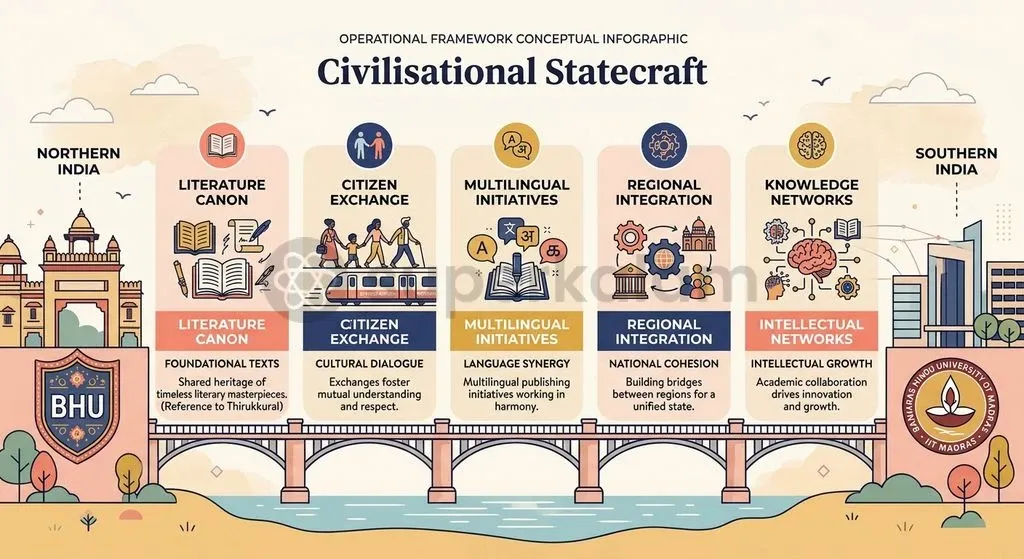
The Kashi Tamil Sangamam deploys civilisational statecraft to link northern and southern India through shared spiritual geography and classical literature. Organised under the Ek Bharat Shreshtha Bharat initiative, the programme pairs Banaras Hindu University with IIT Madras to coordinate academic cohorts. Its fifth edition centres on the ethical philosophy of the Thirukkural.
While the initiative revives linkages spanning six centuries, structural debates persist. Observers question whether periodic cultural exchanges can resolve linguistic disparities without lasting curriculum reforms and formal inter-state administrative cooperation.
Why in the News: The Push for North-South Cultural Integration
The Union Ministry of Education announced the fifth edition of the Kashi Tamil Sangamam to strengthen ties between Uttar Pradesh and Tamil Nadu. As of November 2026, according to a press release by the Press Information Bureau, the Department of Higher Education scheduled Kashi Tamil Sangamam 5.0 to run from 28 November to 12 December 2026 opening at Namo Ghat, Varanasi.
The central theme for this edition is 'Thirukkural Payilvom – Thirukkural Abhyas Karen', which translates to 'Let Us Learn the Thirukkural'. The curriculum focuses on the universal ethical and philosophical maxims of the classical Tamil text, authored by the ancient philosopher-poet Thiruvalluvar.
Targeted institutional interventions drive the pedagogical outreach:
- The Ministry of Education invited 1,000 higher education institutions across India to nominate one student each to study the text multilingually through the Central Institute of Classical Tamil portal.
Deep Roots: How Kashi and the Tamil World Connected for Centuries
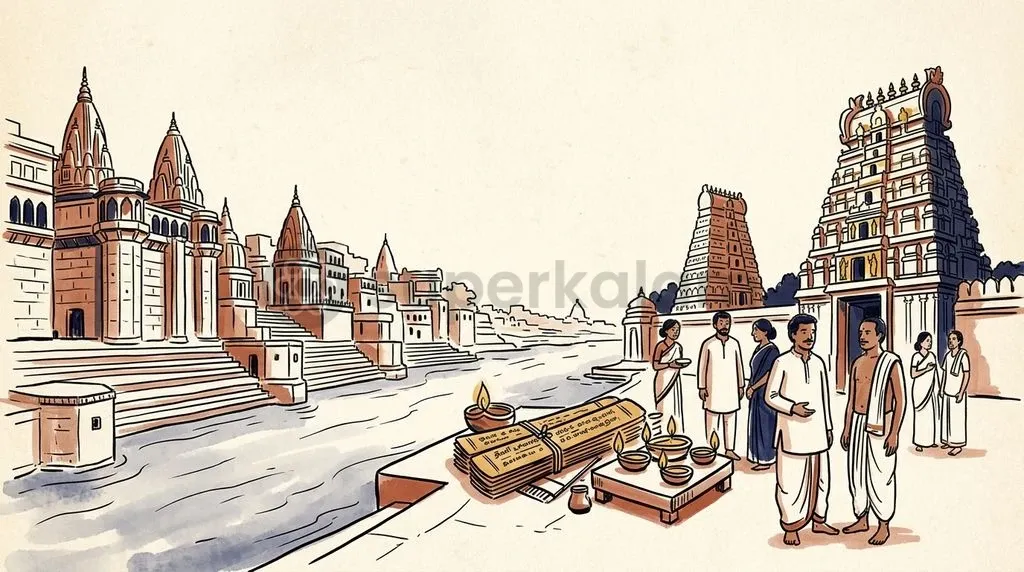
Spiritual migration, royal patronage, and literary exchange have linked Varanasi and Tamil Nadu for over six centuries. Modern organisers invoke these pre-modern networks because they flourished long before centralised state interventions existed.
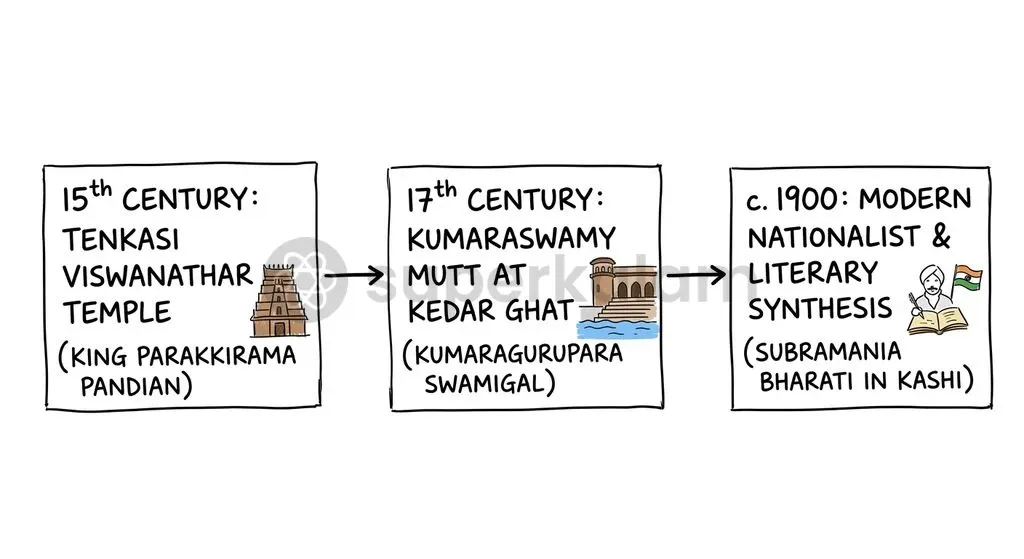
In the 15th century, King Harikesari Parakkirama Pandian ruled the southern regions of Tamil Nadu. According to historical temple surveys, the monarch founded the town of Tenkasi ('Kasi of the South') and constructed the Sri Kasi Viswanathar Temple between 1445 and 1460 CE. The temple was erected specifically so that pilgrims unable to undertake the arduous journey to northern Kashi could offer worship locally.
| Historical Figure | Era / Century | Key Contribution to Kashi-Tamil Linkage |
|---|---|---|
| King Parakkirama Pandian | 15th Century | Founded Tenkasi and built the Kasi Viswanathar Temple |
| Kumaragurupara Swamigal | 17th Century | Established Kumaraswamy Mutt at Kedar Ghat in Varanasi |
| Mahakavi Subramania Bharati | Late 19th / Early 20th Century | Spent formative years in Varanasi |
During the 17th century, the Saivite poet-saint Kumaragurupara Swamigal travelled from the Tamiraparani basin to Varanasi. Official devasthanam records note that he composed the devotional hymn 'Sakalakalavalli Maalai' to seek linguistic proficiency in Hindustani. He subsequently established the Kumaraswamy Mutt (Kasi Mutt) at Kedar Ghat, creating a permanent institutional presence for Tamil ascetics and pilgrims on the banks of the Ganga.
Modern literary history connects the two regions through the nationalist poet Mahakavi Subramania Bharati. Bharati spent formative years in Varanasi, a link that Tamil cultural memory still carries.
Discuss with Superkalam
Recall the 15th-century Pandyan king who founded Tenkasi and explain the practical purpose behind constructing the Sri Kasi Viswanathar Temple.
Ask NowThe Modern Setup: How the Sangamam Works on the Ground
The Ministry of Education administers the Kashi Tamil Sangamam through a direct academic partnership between IIT Madras and Banaras Hindu University. These two institutions serve as the northern and southern anchors, handling academic curation, cohort management, and symposium logistics.
The programme operates under the Union Government's Ek Bharat Shreshtha Bharat framework, which was launched on 31 October 2015 to build mutual engagement among diverse states. The Prime Minister inaugurated the inaugural Kashi Tamil Sangamam on 19 November 2022 to commemorate the Azadi Ka Amrit Mahotsav celebrations.
| Operational Dimension | Institutional Mechanism |
|---|---|
| Nodal Ministry | Union Ministry of Education (Department of Higher Education) |
| Academic Anchors | Banaras Hindu University (BHU) and IIT Madras |
| Content Development | Central Institute of Classical Tamil (CICT), Chennai |
Academic content generation is coordinated by the Central Institute of Classical Tamil, an autonomous body headquartered in Chennai. The institute develops multilingual modules for the Thirukkural, enabling students across participating states to engage with classical verse through regional vernacular translations.
Discuss with Superkalam
Explain how the concept of 'civilisational statecraft' differs from traditional administrative or fiscal instruments in fostering national unity.
Ask NowThe Strategic Goal: Unpacking India's Turn to Civilisational Statecraft
Civilisational statecraft operationalises shared spiritual geography and historic tirthas to build horizontal cultural cohesion across diverse linguistic regions. Rather than relying solely on administrative unity, public policy increasingly leverages cultural memory to reinforce national integration.
According to research published by the Indian Council of World Affairs, initiatives like the Sangamam bypass standard political disagreements by appealing to organic civilisational consciousness. The state positions Varanasi and the Tamil heartland not as competing linguistic zones, but as complementary poles of a unified heritage.
- Sacred Geography: Reviving traditional pilgrimage circuits and historic tirtha networks.
- Civil Society Mobilisation: Assembling cross-regional cohorts of artisans, scholars, farmers, and students.
- Linguistic Reciprocity: Distributing multilingual translations and financing dedicated university chairs.
- National Integration: Strengthening social unity beyond administrative or fiscal mechanisms.
The approach also incorporates institutional publishing. During KTS 2.0 in December 2023, the government released multilingual and Braille translations of classical Sangam epics, including the Manimekalai and Thirukkural, rendering them into Hindi and other scheduled languages. This linguistic mediation seeks to convert regional literature into shared national assets.
The Friction Points: Federal Worries, Language Politics, and Tokenism
Dravidian political parties and regional commentators argue that central cultural festivals risk turning into performative spectacles that bypass state administrative machinery. While central agencies frame the Sangamam as an exercise in national fraternity, regional critics view it through the lens of political centralisation.
Key points of contention centre on structural asymmetry:
- Administrative Circumvention: The Union Ministry of Education executes the festival primarily through autonomous central institutions like IIT Madras and central universities, leaving state government cultural departments on the periphery.
- Episodic Engagement: Critics contend that short sponsored rail journeys generate brief media visibility without establishing long-term cultural or linguistic integration.
| Dimension | Union Government Stance | Regional & Sceptical Stance |
|---|---|---|
| Federal Structure | Fosters organic national unity | Bypasses elected state machinery |
| Linguistic Integration | Promotes classical Tamil nationwide via modern digital tools | Asymmetrical; northern schools omit Dravidian languages |
| Institutional Depth | Structured cohorts generate direct civil-society linkages | Brief cultural tourism without permanent educational reforms |
The friction highlights the delicate balance between promoting a composite national identity and protecting regional linguistic autonomy. Without systemic inclusion of southern languages in northern secondary schools, regional leaders argue that cultural outreach risks remaining symbolic rather than transformative.
Discuss with Superkalam
Analyse the structural criticisms raised against the Sangamam regarding linguistic asymmetry between northern and southern states.
Ask NowConstitutional Perspective: Cultural Pluralism and Article 51A(f)
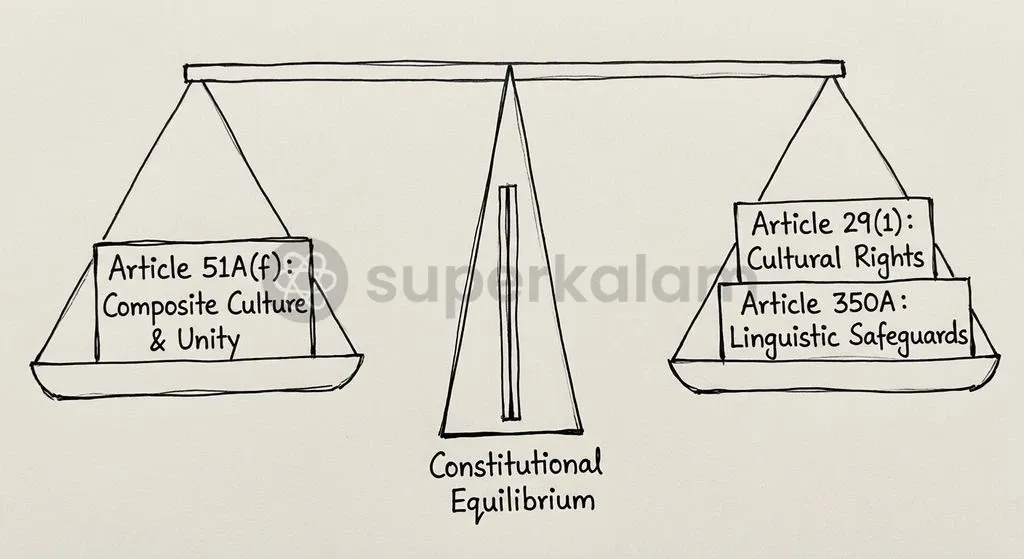
The Constitution of India harmonises national composite identity under Article 51A(f) with distinct linguistic protections under Article 29 and Article 350A. These provisions provide the legal framework within which state-sponsored cultural integration operates.
Article 51A(f), located in Part IVA, imposes a Fundamental Duty on every citizen to value and preserve the rich heritage of our composite culture. Because Fundamental Duties are non-justiciable directives, they serve as moral guideposts for public policy rather than legally enforceable mandates. Initiatives like the Sangamam directly draw operational legitimacy from this duty to celebrate inter-regional linkages.
| Constitutional Provision | Legal Nature | Mandate & Scope |
|---|---|---|
| Part IVA: Article 51A(f) | Fundamental Duty (Non-Justiciable) | Directs citizens to preserve the rich heritage of India's composite culture |
| Part III: Article 29(1) | Fundamental Right (Justiciable) | Empowers distinct linguistic or cultural sections of citizens to conserve their heritage |
| Part XVII: Article 350A | Constitutional Directive | Directs states to provide primary instruction in the mother tongue for linguistic minorities |
In contrast, Article 29(1) in Part III guarantees a justiciable Fundamental Right to any section of citizens residing in India to conserve their distinct language, script, or culture. State-led cultural programmes must operate without undermining the autonomous development of regional languages.
Furthermore, Article 350A directs every state and local authority to provide adequate facilities for instruction in the mother-tongue at the primary stage of education to linguistic minority children. True constitutional reciprocity requires that the promotion of national unity does not obscure statutory and constitutional safeguards established for linguistic diversity.
Discuss with Superkalam
Design an institutional roadmap that state governments and the Centre could adopt to transform periodic cultural festivals into permanent curricular integration.
Ask NowThe Way Forward: Turning Annual Spectacles into Lasting Institutions
The Ministry of Education can convert episodic cultural exchanges into permanent institutional networks through structural policy reforms. Moving beyond annual pilgrimage tours requires sustainable investments in education, translation, and administrative federalism.
To ensure long-term reciprocity, cultural bodies have suggested establishing reciprocal chairs for Northern literature and modern Indian languages across universities in Tamil Nadu, balancing the academic mandate of the Subramania Bharati Chair at BHU [per NITI Aayog Policy Brief (as reported, May 2025)]. Such bilateral academic appointments create continuous scholarly exchange rather than seasonal gatherings.
Key policy interventions for long-term integration include:
- Reciprocal Chairs in State Universities: Establishing bilateral academic endowments in both northern and southern state universities.
- Automated Translation Engines: Scaling National Translation Mission tools to translate Sangam classics and technical texts.
- Institutionalised Inter-State Collaboration: Embedding cultural programming into statutory bodies like the Inter-State Council.
Linguistic translation requires systematic modernisation. The National Translation Mission under the Central Institute of Indian Languages has proposed developing automated translation pipelines to render Sangam literature and the Tolkappiyam into northern and northeastern vernaculars. High-quality, widely distributed regional translations allow classical literature to reach public school libraries across the country.
Finally, inter-governmental cooperation must replace unilateral administrative execution. Consulting state cultural directorates through the Inter-State Council framework would ease regional political apprehensions, transforming state-led festivals into cooperative federal partnerships.
Key Takeaways
The Kashi Tamil Sangamam highlights the evolving dynamics of cultural federalism and civilisational statecraft in modern India.
- Administrative Coordination: Kashi Tamil Sangamam 5.0 is organised by the Union Ministry of Education from 28 November to 12 December 2026, pairing IIT Madras with Banaras Hindu University.
- Thematic Focus: The fifth edition centres on the theme 'Thirukkural Payilvom – Thirukkural Abhyas Karen', with one student nominated by each of 1,000 institutions, supported by the Central Institute of Classical Tamil.
- Historical Precedents: The event builds upon tangible historical links, including King Parakkirama Pandian's 15th-century Tenkasi temple, Kumaragurupara Swamigal's 17th-century mutt at Kedar Ghat, and Subramania Bharati's residence in Varanasi.
- Constitutional Architecture: The programme operationalises the non-justiciable Fundamental Duty in Article 51A(f) to preserve composite culture, which must remain balanced against the justiciable Fundamental Right in Article 29(1) safeguarding linguistic identity.
- Federal Challenges: Sustaining genuine integration requires addressing regional concerns regarding administrative circumvention and achieving real linguistic reciprocity within school curricula across Northern states.
Mains Question
'Civilisational statecraft seeks to operationalise organic civilisational consciousness and shared spiritual geography to achieve horizontal integration, yet it risks friction with constitutional federalism.' In the context of the Kashi Tamil Sangamam under the Ek Bharat Shreshtha Bharat initiative, critically examine this statement. (15 Marks)
Evaluate NowMains Question
Highlighting the historical linkages forged by figures like Kumaragurupara Swamigal and King Parakkirama Pandian, elucidate how the Kashi Tamil Sangamam attempts to bridge pre-modern civilisational ties with modern pedagogical outreach. (10 Marks)
Evaluate NowPractice MCQs
QUESTION 1
With reference to the historical connections between Varanasi and Tamil Nadu, consider the following statements:
- King Harikesari Parakkirama Pandian established the town of Tenkasi and built the Sri Kasi Viswanathar Temple in the 15th century.
- Kumaragurupara Swamigal composed the devotional work 'Sakalakalavalli Maalai' and founded the Kumaraswamy Mutt at Kedar Ghat in Varanasi.
- Mahakavi Subramania Bharati resided at Varanasi's Hanuman Ghat, where a dedicated chair in Tamil Studies was later instituted at Banaras Hindu University in his honour.
Which of the statements given above are correct?
QUESTION 2
With reference to the institutional framework of Kashi Tamil Sangamam 5.0, consider the following statements:
- It is administered under the aegis of the Union Ministry of Culture as part of the Azadi Ka Amrit Mahotsav initiative.
- Banaras Hindu University and IIT Madras function as the academic partner institutions anchoring the programme.
- The Central Institute of Classical Tamil is responsible for coordinating the academic content and multilingual translations of classical literature.
Which of the statements given above is/are correct?
QUESTION 3
Which of the following classical Tamil works were translated into Hindi and Braille script and released during the Kashi Tamil Sangamam 2.0 to enhance linguistic reciprocity?
QUESTION 4
Consider the following pairs regarding historical figures and their institutional or literary contributions to Varanasi:
- King Harikesari Parakkirama Pandian : Construction of the Kumaraswamy Mutt
- Kumaragurupara Swamigal : Composition of 'Sakalakalavalli Maalai'
- Mahakavi Subramania Bharati : Establishment of the Tenkasi Viswanathar Temple
How many of the above pairs are correctly matched?
Related Blogs
Keeladi Gottiprolu Dairying Study: Pottery Residue Evidence of South Indian Diet
Nov, 2026
•4 min read
PLI Scheme Impact Assessment by NITI Aayog: Achievements and Challenges
Nov, 2026
•5 min read
Pannun Case: Hague Service Convention Article 19 and Section 29 CPC on Service of Foreign Summons
Nov, 2026
•4 min read


