RERA Recovery Orders: Why Execution Delays Stall Homebuyer Relief
While regulatory orders promise swift refunds, antiquated revenue recovery and insolvency conflicts leave homebuyers trapped in an enforcement deadlock.
Nov, 2026
•9 min read

Overview
The Real Estate (Regulation and Development) Act, 2016 empowers homebuyers to secure refund orders against defaulting developers. Enforcement often stalls. Regulatory authorities hold no direct execution powers, relying instead on overburdened district collectorates.
Under Section 40(1) of the Act, unpaid dues are treated as arrears of land revenue. This statutory mechanism shifts recovery to district revenue officers. These officials routinely prioritise sovereign taxation and law enforcement over civil restitution.
Moratoriums under the Insolvency and Bankruptcy Code, 2016 compound this divide, reducing binding decrees to paper victories. Ending this deadlock requires granting tribunals powers of civil attachment and creating dedicated recovery units.
Why in the News: The Growing Backlog of Unexecuted Recovery Orders
District collectors across major real estate hubs face a mounting pile of unexecuted Recovery Certificates issued by Real Estate Regulatory Authorities. Thousands of homebuyers hold valid refund orders that yield zero financial relief.
Enforcement data across key states illustrates the scale of this execution gap:
- Karnataka (as of August 2026): The Karnataka Real Estate Regulatory Authority had issued 2,556 revenue recovery certificates against defaulting promoters valued at ₹1,214.3 crore, but revenue officials had realised only ₹123.8 crore across 329 certificates, leaving ₹1,090.5 crore uncollected according to enforcement data.
- Uttar Pradesh (by July 2025): The Uttar Pradesh Real Estate Regulatory Authority had recovered ₹1,410 crore across 5,700 recovery certificates through revenue enforcement and conciliation, with ₹861 crore recovered between August 2023 and July 2025 alone.
- Administrative lag in disbursements (September 2026): The authority disbursed ₹73.84 lakh in accrued bank interest across 430 homebuyer accounts where recovered sums had languished in transit accounts during administrative verification.
The root flaw is structural. While real estate regulation provides rapid dispute adjudication, its execution machinery remains tethered to an antiquated revenue recovery framework.
Discuss with Superkalam
What percentage of collected funds must a promoter deposit in a dedicated bank account under Section 4(2)(l)(D) of RERA?
Ask NowHow RERA Redressal Works: From Section 18 Claim to Adjudication
Section 18(1) of the Real Estate (Regulation and Development) Act, 2016 establishes the promoter's liability to return all receipts with prescribed interest and compensation upon project delivery failure. If a builder fails to complete an apartment or plot according to the agreement for sale, the allottee possesses an unconditional right to demand an immediate exit from the stalled project.
Section 19(4) of the Real Estate (Regulation and Development) Act, 2016 mirrors this protection. It grants allottees an explicit entitlement to claim full refunds with interest and compensation.
To safeguard customer capital before defaults occur, Section 4(2)(l)(D) of the Act obligates developers to deposit 70% of realised funds into a dedicated scheduled bank account. Developers can withdraw these construction funds only in proportion to verified physical progress certified by an architect, an engineer, and a chartered accountant.
| Statutory Dimension | RERA Authority (RERA) | Adjudicating Officer (AO) |
|---|---|---|
| Jurisdictional Mandate | Refund claims and interest under Sections 18 and 19 | Pure compensation claims under Sections 12, 14, 18, and 19 |
| Primary Statutory Power | Directing project completion or full capital reimbursement | Assessing unliquidated damages and financial distress |
| Enforcement Modality | Issuing Recovery Certificates under Section 40(1) | Transmitting compensation decrees under Section 40(1) |
| Governing Apex Ruling | Newtech Promoters (2021) confirmed exclusive jurisdiction | Newtech Promoters (2021) restricted mandate to compensation |
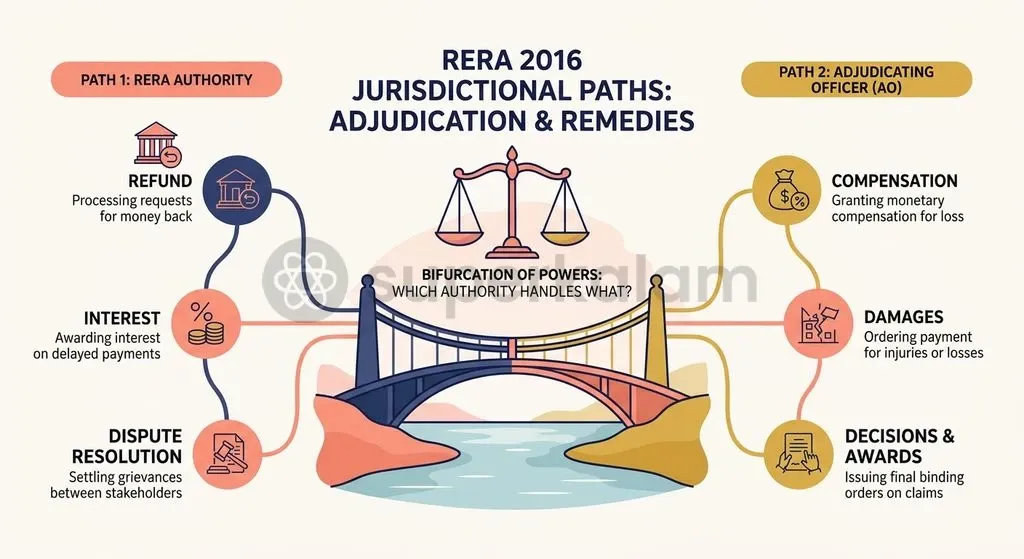
The adjudication architecture maintains a strict institutional division. In M/s Newtech Promoters and Developers Pvt. Ltd. v. State of UP & Ors. (2021), the Supreme Court settled this jurisdictional boundary. It ruled that the Regulatory Authority holds exclusive jurisdiction over refunds and interest, whereas the Adjudicating Officer's mandate is confined strictly to quantifying damages and compensation. Once either forum issues an award, the decree enters the enforcement phase under Section 40.
The Enforcement Bottleneck: Why Recovery Certificates Stall at Collectorates
Section 40(1) of the Real Estate (Regulation and Development) Act, 2016 mandates that unpaid interest, penalties, or compensation must be recovered as arrears of land revenue. In Newtech Promoters (2021), the Supreme Court interpreted Section 40(1) purposively, ruling that the principal refund itself is executable through land revenue recovery. Section 40(2) further provides that non-monetary directions shall be enforced as prescribed under state rules.
Execution stalls at the district level due to three structural factors:
- Competing administrative mandates: District revenue officials routinely prioritise sovereign tax collections, statutory law and order maintenance, and general land administration over civil recovery certificates issued under state revenue codes.
- Cross-jurisdictional friction: Under Section 3 of the Revenue Recovery Act, 1890, when a promoter maintains registered offices or bank accounts outside the project district, the local collector must route requests to external collectorates, bogging down progress in multi-tier bureaucratic correspondence.
- Absence of independent execution cadres: Regulatory authorities possess no field bailiffs or independent recovery staff. Decrees therefore languish whenever collectorates face administrative constraints.
To overcome these hurdles, the Karnataka state government approved the establishment of dedicated Revenue Recovery Units headed by special recovery officers in July 2025 to execute pending regulatory certificates and civil decrees.
Discuss with Superkalam
Why does the classification of RERA dues as 'arrears of land revenue' create a practical bottleneck at the district collectorate level?
Ask NowRERA vs. IBC: How Insolvency Proceedings Override Homebuyer Decrees
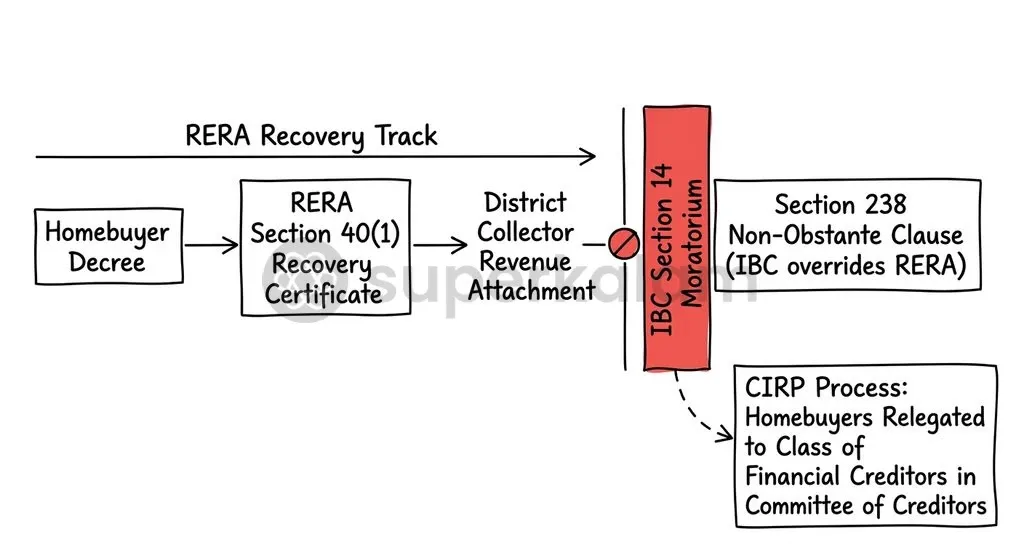
Section 14 of the Insolvency and Bankruptcy Code, 2016 imposes an immediate statutory moratorium the moment an insolvency petition is admitted against a developer. This statutory freeze legally halts all ongoing execution proceedings, prohibiting District Collectors from attaching promoter assets or disbursing recovered amounts. A homebuyer holding a valid Recovery Certificate finds their individual execution decree subordinated to a collective corporate restructuring process.
Section 238 of the Insolvency and Bankruptcy Code, 2016 contains a non-obstante clause dictating that code provisions override any conflicting provisions in other enactments. When RERA execution proceedings under Section 40 clash with an IBC resolution process, the Supreme Court has affirmed that the insolvency moratorium takes precedence.
| Dimension | RERA Redressal Route | IBC Resolution Framework |
|---|---|---|
| Governing Statute | Real Estate (Regulation and Development) Act, 2016 | Insolvency and Bankruptcy Code, 2016 |
| Primary Objective | Consumer restitution, project delivery, and compensation | Corporate revival and collective asset resolution |
| Status of Homebuyer | Aggrieved consumer holding an executable decree | Financial creditor within Committee of Creditors |
| Statutory Supremacy | Subject to prevailing insolvency codes under Section 238 | Overrides conflicting statutes via Section 238 |
| Filing Threshold | Single aggrieved allottee can file individually | Minimum 100 allottees or 10% of total project allottees |
Collective action thresholds introduce further hurdles for individual allottees seeking bankruptcy remedies. The second proviso to Section 7(1) of the IBC, enacted through the Insolvency and Bankruptcy Code (Amendment) Act, 2020, requires a joint application by at least 100 allottees or 10% of total allottees in the same real estate project. An individual allottee armed with an unexecuted Section 40 recovery certificate cannot trigger an IBC process alone, leaving them dependent on wider consensus.
Discuss with Superkalam
If a developer's corporate office is located outside the project district, how does Section 3 of the Revenue Recovery Act, 1890 operate to enforce a decree?
Ask NowLandmark Judgments: Defining Homebuyer Rights Across RERA and Bankruptcy
The Supreme Court of India has systematically resolved statutory intersections between property regulation, consumer law, and commercial insolvency through three key precedents:
- Pioneer Urban (2019) on financial creditor status: A three-judge bench upheld the 2018 amendment treating real estate allottees as financial creditors under Section 5(8)(f) of the IBC. The bench clarified that remedies across RERA, the Consumer Protection Act, and the IBC operate concurrently rather than mutually exclusively.
- Pioneer Urban v. Govindan Raghavan (2019) on unconscionable clauses: The Court held that one-sided builder-buyer agreements constitute unfair trade practices. Contractual clauses penalising allottees exorbitant interest while offering nominal delay compensation were declared unenforceable.
- Newtech Promoters (2021) on retroactive application: The Supreme Court ruled that the Real Estate (Regulation and Development) Act, 2016 applies retroactively to ongoing projects lacking completion certificates at statutory commencement. This ensured past delivery defaults remained within the regulatory remit.
Discuss with Superkalam
Compare the individual consumer relief philosophy of RERA with the collective resolution mandate of the Insolvency and Bankruptcy Code.
Ask NowEthical and Governance Dimensions: Accountability and Asymmetric Market Power
Asymmetric market power in the real estate sector undermines consumer autonomy and procedural fairness. For decades, developers leveraged structural economic dominance to draft adhesion contracts that transferred commercial risks entirely onto individual allottees.
This structural imbalance generates two governance failures:
- Execution void: Even after regulatory intervention establishes statutory liability, promoters exploit revenue recovery delays, creating an ethical vacuum in execution where civil remedies fail to deliver timely justice.
- Dilution of protective governance: When district revenue offices treat recovery certificates as tertiary priorities behind routine tax collection, the state abdicates its protective duty. Buyers service commercial home loans for years while waiting for collectorates to attach corporate property.
Regulatory efficacy cannot be measured by formal order disposal alone. It must be judged by real restitution.

Way Forward: Structural Reforms to Transform Paper Orders into Real Restitution
Closing the gap between adjudication and recovery requires three structural interventions:
- Direct civil execution powers: Amend RERA to grant regulatory authorities direct civil attachment powers and contempt authority under the Code of Civil Procedure, 1908. This mirrors Section 71 of the Consumer Protection Act, 2019, which permits Consumer Commissions to execute monetary awards directly without routing decrees through collectorates.
- Dedicated revenue recovery cells: State governments should institutionalise specialised revenue recovery units staffed by deputed revenue officers operating under the oversight of regulatory authorities, following Karnataka's administrative reform. These cells resolve inter-district friction under the Revenue Recovery Act, 1890 and speed up bank attachments.
- Real-time digital escrow tracking: Implement the Central Advisory Council's recommendation under Section 41 of RERA by deploying synchronised digital escrow architectures that connect state portals directly with core banking infrastructure. Tracking Section 4(2)(l)(D) accounts in real time prevents fund diversion before projects stall.
Discuss with Superkalam
Design an institutional reform model to empower RERA with direct enforcement capabilities without overburdening existing civil courts.
Ask NowKey Takeaways
- Under Section 18(1) and Section 19(4) of the Real Estate (Regulation and Development) Act, 2016, allottees hold an absolute statutory entitlement to claim full refunds with interest and compensation upon project delivery default.
- Section 40(1) routes monetary recovery through District Collectors as arrears of land revenue, creating acute administrative backlogs where over 90% of recovery value remains unrealised in jurisdictions like Karnataka as of August 2026.
- Section 14 and Section 238 of the Insolvency and Bankruptcy Code, 2016 override pending execution decrees the moment corporate insolvency proceedings are admitted against a defaulting builder.
- The Supreme Court in Newtech Promoters (2021) affirmed the retroactive applicability of RERA to ongoing projects and vested exclusive refund jurisdiction in the Regulatory Authority, while Pioneer Urban (2019) upheld concurrent remedies across RERA, consumer courts, and the IBC.
- Structural resolution demands vesting regulatory authorities with direct civil attachment powers under the Code of Civil Procedure, alongside implementing synchronised digital escrow monitoring to curb upstream capital diversion.
Mains Question
"The efficacy of consumer protection under the Real Estate (Regulation and Development) Act, 2016 is severely undermined by an antiquated enforcement mechanism relying on arrears of land revenue." Critically examine. (15 Marks)
Evaluate NowMains Question
Examine how the statutory interplay between the Real Estate (Regulation and Development) Act, 2016 and the Insolvency and Bankruptcy Code, 2016 affects the legal restitution available to aggrieved individual homebuyers. (10 Marks)
Evaluate NowPractice MCQs
QUESTION 1
With reference to the Real Estate (Regulation and Development) Act, 2016 (RERA), consider the following statements:
- Under Section 4(2)(l)(D), promoters are required to deposit seventy percent of the realised amounts in a dedicated bank account to cover construction costs.
- Under Section 40(1), unpaid dues such as interest, penalties, or compensation are recovered as arrears of land revenue.
- The Adjudicating Officer holds exclusive statutory jurisdiction to order refunds and interest upon project delivery failure. Which of the statements given above are correct?
QUESTION 2
Consider the following statements regarding the legal interplay between RERA, 2016 and the Insolvency and Bankruptcy Code, 2016 (IBC):
- The admission of an insolvency application against a promoter triggers a moratorium under Section 14 of the IBC, halting ongoing recovery certificate executions.
- In the event of a conflict between RERA and IBC provisions, the IBC overrides RERA by virtue of the non-obstante clause under Section 238.
- A single allottee holding an unexecuted RERA recovery certificate can independently initiate corporate insolvency resolution proceedings under Section 7 of the IBC. Which of the statements given above is/are correct?
QUESTION 3
With reference to the Supreme Court's ruling in M/s Newtech Promoters and Developers Pvt. Ltd. v. State of UP & Ors. (2021), consider the following statements:
- The jurisdiction to award refunds of principal amounts and interest lies exclusively with the Real Estate Regulatory Authority.
- The mandate of the Adjudicating Officer under RERA is confined strictly to quantifying damages and compensation.
- The recovery of principal refund amounts through the land revenue recovery mechanism under Section 40(1) was held to be legally impermissible. Which of the statements given above is/are correct?
QUESTION 4
Regarding the institutional mechanisms for the execution of RERA orders, which of the following provides the primary statutory route for recovering unpaid monetary awards under Section 40(1) of the Real Estate (Regulation and Development) Act, 2016?
QUESTION 5
In the landmark judgment Pioneer Urban Land and Infrastructure Ltd. v. Union of India (2019), the Supreme Court of India held that: