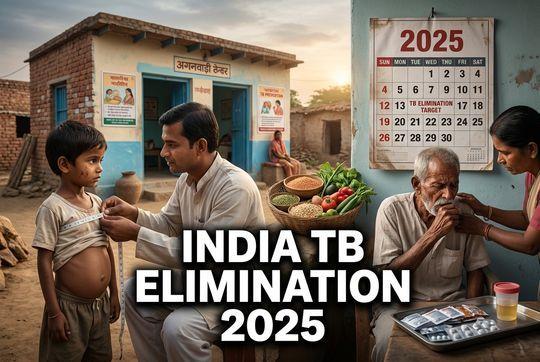
AI vs Ground Surveys in India: Why Field Data Still Matters
While algorithms promise rapid macroeconomic tracking, capturing India's vast informal economy still demands irreplaceable door-to-door ground enumeration.
Nov, 2026
•9 min read
Overview
Modern computational proxies, big-data feeds, and artificial intelligence models offer rapid macroeconomic tracking. However, they cannot replace India's direct ground surveys. Algorithmic systems fundamentally fail to observe the nation's dominant unorganised workforce and complex rural economy.
The Ministry of Statistics and Programme Implementation (MoSPI) approved the Rs 4,371.10 crore VISTAR modernisation scheme to embed machine learning in official data processing. Yet predictive tools still depend on formal digital trails that bypass unrecorded rural transactions. Direct field enumeration by the National Sample Survey Office provides the essential empirical ground truth. These data calibrate synthetic indicators, audit federal fiscal transfers, and measure real poverty.
Without verified primary door-to-door enumeration, computational governance risks severe algorithmic drift. It invites administrative exclusion and triggers contested inter-state resource distribution across Indian states.
Why in the News? The Push to Modernise Official Data
As of November 2026, the Union Cabinet approved the VISTAR scheme to overhaul India's statistical infrastructure using modern machine learning tools. The Viksit Bharat Initiative for Statistical Transformation, Analytics & Research carries a financial outlay of Rs 4,371.10 crore spanning FY 2026-27 to FY 2030-31.
This modernisation push arrives as economic planners demand high-frequency indicators to track a fast-evolving economy. Under the scheme, MoSPI plans to conduct 59 national surveys during the 16th Finance Commission cycle, expanding from 43 major surveys conducted previously. The initiative structures ministerial operations across three core pillars:
- Comprehensive Statistical Operations and Strengthening of Ecosystem
- Support for Statistical Strengthening (SSS 2.0)
- The 8th Economic Census
Concurrently, MoSPI has initiated base-year revisions for India's core macroeconomic aggregates. These include Gross Domestic Product (GDP), the Index of Industrial Production (IIP), and the Consumer Price Index (CPI), shifting bases to 2022-23 and 2024. In official accounting, this base-year revision represents a statistical recalibration of structural weights rather than real-economy acceleration.
How India Collects Official Data: From NSSO to Modern Sample Surveys
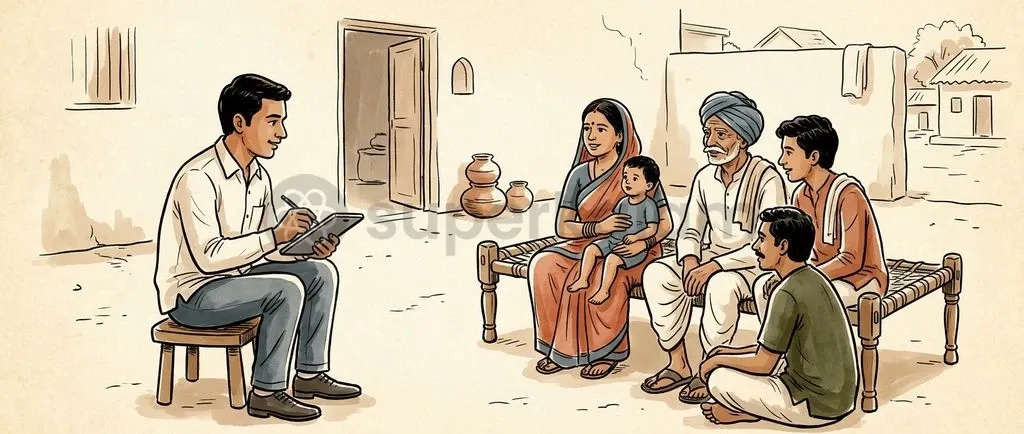
India's household data architecture relies on scientifically structured field surveys. The National Sample Survey Office historically anchored this system through large-scale, stratified socio-economic field inquiries across rural villages and urban blocks.
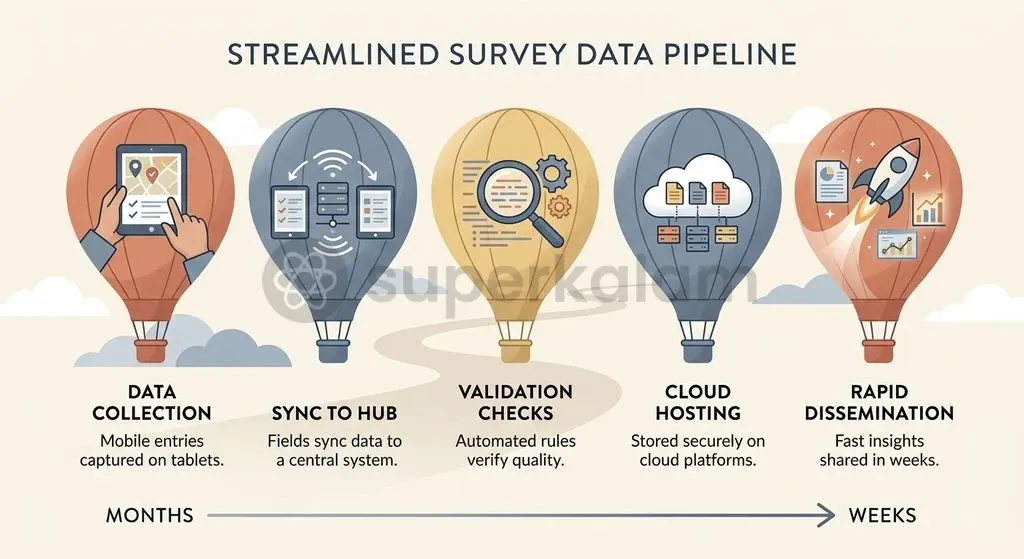
To resolve historical delays in data processing, MoSPI transitioned sample surveys from paper schedules to Computer-Assisted Personal Interviewing on digital tablets. Operating through the proprietary e-SIGMA digital platform, this shift has reduced survey data release cycles from 8–9 months down to 45–90 days.
Recent reforms have altered how these operations run on the ground:
- District-level stratification: The National Sample Survey designated the administrative district as the basic stratum across major surveys.
- Localised policy targeting: This methodological change enables States and Union Territories to produce granular welfare estimates directly aligned with local governance.
- Digital fieldwork capture: Enumerators record household observations on pre-validated handheld schedules to prevent post-survey transcription errors.
Discuss with Superkalam
What are the three core pillars of the Rs 4,371.10 crore VISTAR modernisation scheme?
Ask NowWhere Artificial Intelligence Enhances National Data Collection
The Ministry of Statistics and Programme Implementation is integrating artificial intelligence to accelerate high-frequency macroeconomic tracking and administrative data processing. Traditional sample surveys provide unmatched structural depth but require significant time and public expenditure.
To bridge the gap between periodic surveys, MoSPI partnered with NITI Aayog and the World Bank across four alternate data pillars:
- Mobile Positioning Data for human mobility and domestic tourism analytics
- Point-of-sale scanner data collected from commercial retail chains
- Geospatial remote sensing for real-time agricultural monitoring
- Advanced machine learning for official data compilation and anomaly detection
Under the VISTAR modernisation framework, MoSPI is developing two new high-frequency production indicators: the Headline Index of Services Production and the Index of Unincorporated Sector Enterprises. These computational indices synthesise administrative streams to assess economic momentum between comprehensive survey rounds.
Data interoperability supports this analytical expansion. MoSPI created a standardised registry of national unique identifiers spanning Aadhaar, GSTIN, PAN, CIN, Udyam, and Local Government Directory codes. Furthermore, public transparency has expanded through the e-Sankhyiki portal, which offers API-driven access to more than 175 survey datasets and 135 million microdata time-series records.
Discuss with Superkalam
Why does designating the administrative district as the basic stratum in sample surveys improve policy targeting compared to regional aggregates?
Ask NowWhere Ground Enumeration Remains Essential for Public Policy
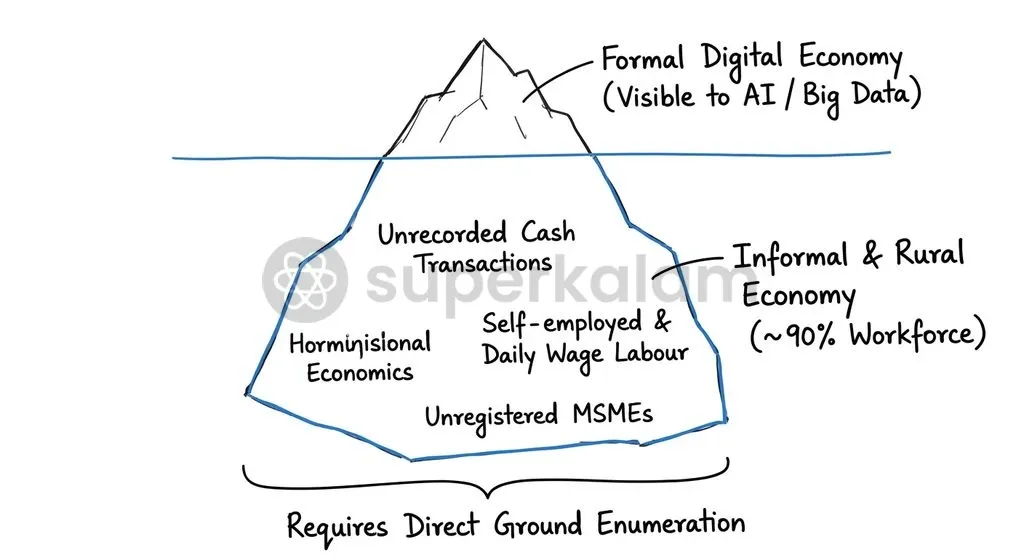
India's vast informal economy prevents purely computational models from accurately measuring national income, living conditions, and real employment. Algorithms depend on recorded digital transactions, but unorganised economic activities leave minimal digital trails.
Three structural realities explain why algorithmic systems miss the bulk of India's economic life:
- Informal output dominance: According to the Parliamentary Standing Committee on Finance, over 60 percent of the Indian economy operates within unorganised sectors. The informal sector contributed approximately 45 percent to total Gross Domestic Product in FY 2022-23.
- Unrecorded labour contracts: The Periodic Labour Force Survey (PLFS) 2023-24 revealed that approximately 73 percent of non-agricultural workers hold no written contracts, paid leave, or social security. Furthermore, 58.4 percent of the total workforce is self-employed, consisting primarily of own-account workers and unpaid family labour.
- Cash-based retail transactions: Organised retail and e-commerce accounted for approximately 20 percent of total retail sales in 2025, leaving around 80 percent of retail transactions in unorganised manual markets. Local bazaar prices depend on personal bargaining that scanner models cannot track.
The Household Consumption Expenditure Survey remains the indispensable benchmark for living standards. Computational models cannot record non-market food production, intra-household nutritional disparities, or the exact consumption impact of free public distribution grain transfers. Only physical interviews capture these qualitative and non-monetised realities.
Discuss with Superkalam
If a state government uses real-time mobile positioning and POS scanner data to allocate food subsidies, what administrative exclusions might arise?
Ask NowMachine Learning Models vs Door-to-Door Field Surveys
Comparative evaluation of computational models and field surveys reveals stark structural trade-offs between measurement velocity and demographic representation.
| Analytical Dimension | Artificial Intelligence & Proxy Models | Traditional Ground Field Surveys |
|---|---|---|
| Data Collection Mechanism | Digital scraping, satellite feeds, administrative logs | Direct face-to-face interviews using CAPI tablets |
| Update Frequency & Speed | Real-time nowcasting and daily or weekly tracking | Periodic cycles released within 45 to 90 days via e-SIGMA |
| Coverage of Informal Sector | Poor; blind to unrecorded and cash transactions | Comprehensive; captures informal enterprises and unpaid labour |
| Methodological Nature | Black-box predictive models and synthetic simulations | Transparent, stratified probability sampling |
| Resolution of Non-Market Goods | Cannot measure domestic food production or intra-household sharing | Directly enumerates non-monetised consumption and transfers |
| Institutional Suitability | Supplementary early warning and high-frequency proxy tracking | Mandatory legal baseline for fiscal devolution and policy targeting |
Key Pitfalls of Over-Relying on Algorithms in Public Administration
Algorithmic proxies create severe risks of model drift and fiscal discord when applied to public resource allocation across Indian States. Machine learning models trained on past relationships degrade rapidly when external shocks alter structural consumer behaviour.
Operational limits emerge across multiple analytical domains:
- Satellite signal saturation: Research by the Reserve Bank of India found that while nighttime lights luminosity correlates with economic activity, elasticity varies substantially between rural and industrial districts. Luminosity saturates in dense cities and fails to distinguish productive investments from household lighting.
- Compounding predictive error: Without systematic survey benchmarks, artificial intelligence tools generate cumulative estimation errors and algorithmic hallucinations. Models calibrated exclusively on corporate tax logs or digital payments project an artificial buoyancy that overlooks agrarian distress.
- Federal fiscal disputes: Horizontal revenue sharing under the 16th Finance Commission demands complete auditability across all Union and State finance ministries. Replacing audited survey microdata with opaque algorithms risks intense inter-state litigation over contested devolution quotas.
Discuss with Superkalam
Contrast the analytical reliability of nighttime lights luminosity with door-to-door consumption expenditure surveys in assessing rural poverty.
Ask NowEthical and Governance Dimensions: Representation and Algorithmic Bias
The United Nations Statistical Commission mandates strict methodological transparency to prevent unrepresentative algorithms from distorting public resource distribution. Official data agencies must adhere to fundamental ethical benchmarks that automated black-box architectures frequently breach.
Governance challenges centre on three key structural flaws:
- Methodological opacity: Under the UN Fundamental Principles of Official Statistics, public agencies must select methodologies based purely on statistical considerations and maintain complete transparency. Proprietary machine learning algorithms operate through complex weights that prevent public scrutiny.
- Demographic survivorship bias: Digital footprints belong disproportionately to urban, male, and affluent demographics, leading models to treat connected groups as the national norm. Vulnerable social groups lacking smartphones or formal bank linkages disappear from automated poverty matrices.
- Erasure of qualitative realities: Professional survey enumerators record distress migration, unpaid care work performed by women, and regional social exclusion. These detailed socio-demographic indicators cannot be derived from synthetic datasets or credit card transaction streams.
Direct human enumeration preserves the visibility of marginal communities. Physical surveys ensure that unbanked and non-digital populations remain fully represented in national planning.
Way Forward: Building a Hybrid Statistical Architecture for India
The National Statistical Commission requires statutory backing to safeguard empirical integrity while orchestrating a balanced hybrid data framework. Instituted via an executive Government Resolution in 2005, the NSC still lacks legislative authority despite repeated recommendations by parliamentary committees. Conferring statutory independence is critical to shielding official statistics from external administrative pressures.
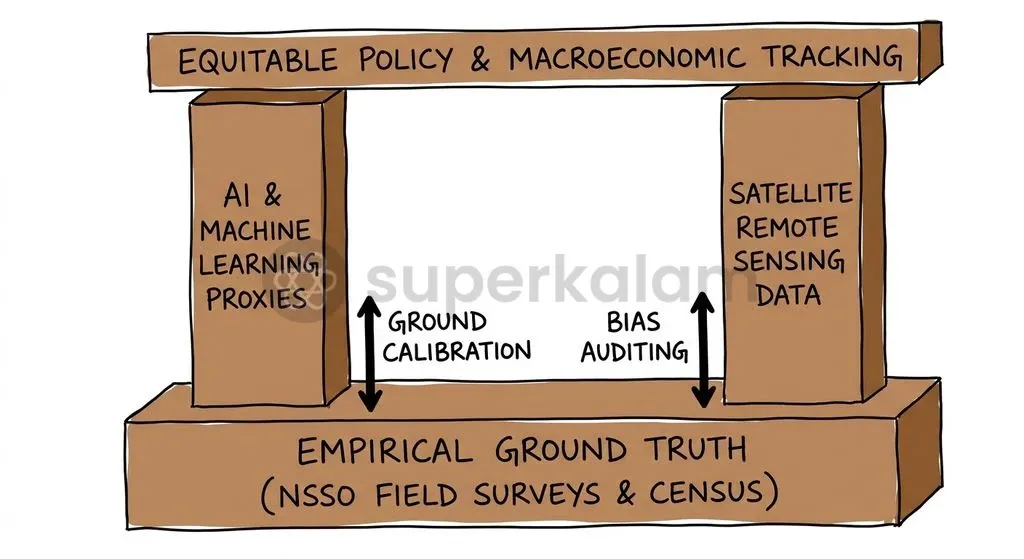
India must avoid an artificial binary between technology and field enumeration by institutionalising a calibrated hybrid model:
- Ground surveys must serve as the non-negotiable anchor to calibrate predictive machine learning models and correct algorithmic drift.
- High-frequency AI nowcasting should identify emerging regional shocks between major multi-year survey rounds.
- Tablet-based CAPI platforms should expand across all subnational statistical directorates to eliminate data collection lags.
- Administrative data integration must respect rigorous data privacy standards to prevent unlawful profiling.
Primary field inquiries remain the irreplaceable foundation of public policy. Automated technologies can refine, process, and accelerate statistical workflows, but direct human enumeration guarantees democratic equity and constitutional fairness in Indian governance.
Discuss with Superkalam
Design a hybrid statistical architecture that balances the velocity of high-frequency AI indicators with the empirical integrity of ground surveys.
Ask NowKey Takeaways
- The Union Cabinet approved the Rs 4,371.10 crore VISTAR scheme to modernise India's statistical systems and execute 59 national surveys during the 16th Finance Commission cycle.
- India's vast informal sector, which contributes 45 percent of GDP and employs 73 percent of non-agricultural workers, remains largely invisible to digital algorithms.
- Automated proxies like nighttime lights luminosity cannot substitute for household surveys due to wide elasticity variations and urban saturation.
- Base-year revisions for GDP, IIP, and CPI represent statistical recalibrations of structural weights rather than real-economy growth accelerations.
- The National Statistical Commission remains an executive body established in 2005, requiring statutory backing to guarantee methodological independence.
Mains Question
"Algorithmic proxies and computational big-data models cannot substitute direct field surveys in an economy dominated by informal transactions and unrecorded labour." In light of the VISTAR modernization scheme, critically examine the role and limitations of AI in official statistics. (15 Marks)
Evaluate NowMains Question
Highlighting the structural reforms introduced by the Ministry of Statistics and Programme Implementation (MoSPI), elucidate how ground-level survey modernization strengthens evidence-based policy targeting. (10 Marks)
Evaluate NowPractice MCQs
QUESTION 1
Regarding the modernization of India's statistical architecture, consider the following statements:
- The VISTAR scheme has been approved with a financial outlay of Rs 4,371.10 crore spanning from FY 2026-27 to FY 2030-31.
- Under recent sample survey reforms, the administrative district has been designated as the basic stratum across major surveys.
- The transition to Computer-Assisted Personal Interviewing (CAPI) on the e-SIGMA platform has reduced survey data release cycles to 45–90 days. Which of the statements given above are correct?
QUESTION 2
Consider the following statements regarding the structural realities of the Indian economy and official data collection:
- Over 60 percent of the Indian economy operates within unorganised sectors, contributing approximately 45 percent to total GDP in FY 2022-23.
- According to the Periodic Labour Force Survey (PLFS) 2023-24, more than 70 percent of non-agricultural workers hold written contracts and formal social security.
- Organised retail and e-commerce accounted for the vast majority of retail sales in 2025, leaving less than 25 percent in unorganised manual markets. Which of the statements given above is/are correct?
QUESTION 3
Consider the following statements regarding high-frequency data indicators and alternative data sources introduced by MoSPI:
- MoSPI partnered with NITI Aayog and the World Bank to explore alternate data pillars including Mobile Positioning Data and point-of-sale scanner data.
- Under the VISTAR framework, MoSPI is developing the Headline Index of Services Production and the Index of Unincorporated Sector Enterprises.
- The e-Sankhyiki portal restricts data access exclusively to government departments to prevent unauthorized use of microdata. Which of the statements given above is/are correct?
QUESTION 4
With reference to the limitations of computational and proxy data models in India, consider the following statements:
- Nighttime lights luminosity data saturates in dense urban areas and exhibits varying elasticity between rural and industrial districts.
- Household Consumption Expenditure Surveys can be entirely substituted by scanner data because point-of-sale systems capture intra-household nutritional disparities. Which of the statements given above is/are correct?
QUESTION 5
Under the VISTAR scheme approved by the Union Cabinet, which of the following is NOT one of the three core pillars structuring ministerial operations?