India Solar Energy Targets: Balancing Tariffs and 2030 Goals
Balancing domestic trade barriers with rapid deployment defines India's challenge in adding over 120 GW of solar power to achieve its statutory 2030 targets.
Nov, 2026
•10 min read
Overview
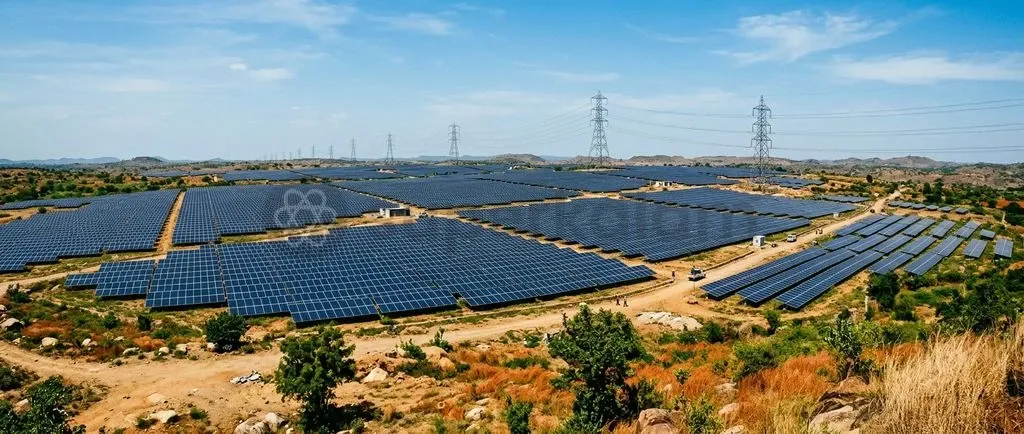
India faces a structural trade-off as the Ministry of New and Renewable Energy attempts to reconcile domestic manufacturing protectionism with rapid solar additions. The country aims to achieve 500 gigawatts of non-fossil electric power by 2030.
Tariff walls and procurement curbs shield domestic cell and module makers from external price shocks. Yet, these trade barriers increase capital expenditures for solar developers, testing the pace of utility-scale procurement and rooftop adoption. Resolving this friction requires coordinating fiscal incentives, upstream technology integration, and grid modernisation across jurisdictions.
Why in the News? The Push for Rooftop Solar and Manufacturing Shields
On April 1, 2024, the Ministry of New and Renewable Energy reimposed the Approved List of Models and Manufacturers mandate to restrict module imports for public and open-access solar installations. This procurement shield operates alongside the PM Surya Ghar: Muft Bijli Yojana, which the Union Cabinet approved on February 29, 2024, with an outlay of Rs 75,021 crore.
As of August 2026, India's installed solar capacity reached 168.04 GW. This tally highlights the urgent need to accelerate both utility and distributed generation.
Policymakers must balance two competing priorities:
- Industrial self-reliance: Expanding domestic manufacturing under Make in India by establishing local supply chains.
- Deployment velocity: Meeting international decarbonisation commitments without project delays caused by domestic wafer and polysilicon shortfalls.
The 2030 Milestone: Breaking Down India's Clean Energy Math
The Central Electricity Authority projects that India requires approximately 292 GW of installed solar photovoltaic capacity by 2029-30 to anchor its broader non-fossil target. At COP-26 in Glasgow, India committed to installing 500 GW of non-fossil electricity capacity by 2030, a pledge confirmed in its updated Nationally Determined Contributions. To realise this trajectory, solar energy must supply 58.4% of all non-fossil capacity additions planned for the decade.
Data from the Ministry of New and Renewable Energy shows cumulative solar installations stood at 168.04 GW as of August 31, 2026. This leaves a deficit of roughly 124 GW against the statutory 2030 generation trajectory.
Closing this gap demands 30 to 35 GW annually in newly commissioned solar capacity between 2026 and 2030. That pace sits well above historical commissioning averages.
| Metric | Target / Projected Value (2030) | Status as of August 2026 | Required Trajectory |
|---|---|---|---|
| Total Non-Fossil Generation Capacity | 500 GW | 168.04 GW (Solar PV component) | Multi-technology scaling across solar, wind, and hydro |
| Solar PV Target Capacity | 292 GW | 168.04 GW | Commissioning 30 to 35 GW annually |
| Residential Rooftop Solar Households | 100 Lakh (1 Crore) households | Over 50 Lakh households | Expanding decentralized adoption across states |
| Distributed Solar Generation | Part of 292 GW aggregate plan | 14.8 GW via PM Surya Ghar | Upgrading low-voltage local distribution grids |

The Manufacturing Bet: How PLI and Import Duties Seek Self-Reliance
On April 1, 2022, the Ministry of Finance introduced a tariff barrier levying a Basic Customs Duty of 40% on solar modules and 25% on solar cells. This fiscal intervention sought to shield infant domestic assembly units from lower-cost overseas equipment. The Union Budget 2025 subsequently adjusted this trade framework, lowering the Basic Customs Duty to 20% while introducing an Agriculture Infrastructure and Development Cess of 20% on modules and 7.5% on cells.
To match tariff protection with capital backing, the Union Cabinet approved the Production Linked Incentive Scheme under the National Programme on High Efficiency Solar PV Modules. The programme carries an aggregate financial outlay of Rs 24,000 crore executed across two sequential phases:
- PLI Tranche-I: Awarded Rs 4,500 crore in incentives, securing 8,737 MW of fully integrated manufacturing capacity spanning polysilicon to finished modules.
- PLI Tranche-II: Disbursed Rs 19,500 crore across 11 selected industrial bidders to create 39,600 MW of manufacturing capacity across three separate integration baskets.
The Ministry of New and Renewable Energy reinforced these incentives through administrative procurement mandates. The Ministry's reimposition of the Approved List of Models and Manufacturers List-I on April 1, 2024, obligates all government-funded projects, subsidised schemes, and open-access corporate buyers to procure modules solely from empanelled domestic entities.
The Ministry broadened this non-tariff measure by issuing ALMM List-II on December 9, 2024. This order makes domestic solar cell sourcing compulsory for listed module fabricators starting June 1, 2026.
The Core Tension: Does Protecting Domestic Industry Slow Down Deployment?
Utility-scale solar developers encounter higher project costs when tariff barriers and administrative import lists restrict access to overseas supply chains. Analysts at JMK Research & Analytics noted in an assessment reported in August 2022 that the 40% Basic Customs Duty alongside entry barriers under the Approved List of Models and Manufacturers elevated capital expenditure noticeably. This shift brought an end to the multi-year downtrend in solar auction tariffs.
Restricting developers to domestic supply chains still building technological parity caused bidding rates to climb from earlier historic lows. This cost dynamic creates a dual challenge for the sector:
- Upstream supply tightness: Domestic cell and module lines struggle to supply adequate high-efficiency hardware on tight schedules.
- Commissioning hurdles: Higher equipment costs and procurement delays directly affect developers attempting to install 30 to 35 GW annually to hit 2030 targets.
Discuss with Superkalam
Recall the two main fiscal and regulatory instruments India currently uses to restrict foreign solar module imports.
Ask NowThe Rooftop Reality Check: Why DISCOMs Stall PM Surya Ghar Rollouts
State electricity distribution companies often delay residential rooftop interconnections to protect their operating finances from declining commercial revenues. The Union Cabinet approved the PM Surya Ghar: Muft Bijli Yojana on February 29, 2024, deploying Rs 75,021 crore to facilitate rooftop solar additions across 1 crore households.
The scheme provides Central Financial Assistance calibrated by system size:
- 1 kW systems: Rs 30,000 subsidy.
- 2 kW systems: Rs 60,000 subsidy.
- 3 kW systems or higher: Capped at Rs 78,000.
Official deployment data indicates that residential installations under PM Surya Ghar crossed 50 lakh households by August 2026, delivering 14.8 GW of decentralised solar generation.
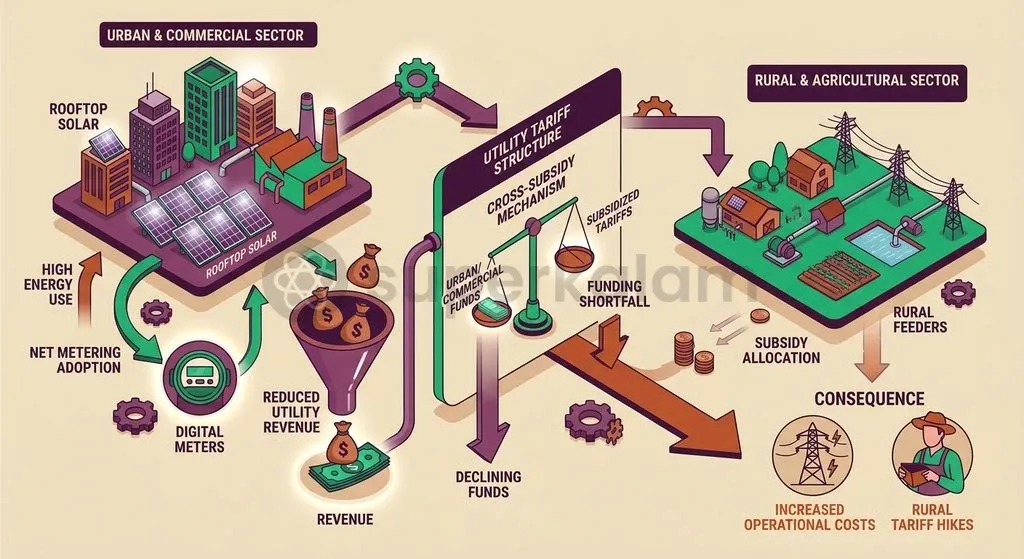
Despite this expansion, structural friction persists within state electricity distribution companies. Research published by the Forum of Regulators and TERI highlights that rooftop solar adoption remains clustered among affluent domestic consumers. These high-slab users provide the commercial revenues that power distribution companies rely on to subsidise agricultural and rural consumer categories.
To halt this revenue erosion, multiple State Electricity Regulatory Commissions have replaced 1:1 net metering with gross metering or net billing frameworks carrying low feed-in tariffs. Distribution utilities also delay meter testing and connection approvals, generating persistent procedural hurdles for residential adopters.
Discuss with Superkalam
Explain why cross-subsidisation mechanisms make state electricity distribution companies reluctant to support rooftop net metering.
Ask NowGrid and Land Roadblocks: Transmission Bottlenecks and Environmental Clashes
The Central Electricity Authority reported in March 2026 that large utility-scale solar parks face midday grid curtailment and price risks during peak generation hours. These operational disruptions arise from a local sub-transmission capacity deficit and inadequate grid-scale Battery Energy Storage System infrastructure. Evacuating renewable energy across long distances requires coordinated inter-state and intra-state transmission lines to keep pace with rapid capacity additions.
The Ministry of Power addressed regional transmission constraints through the Green Energy Corridor infrastructure initiative. Under Green Energy Corridor Phase-I, intra-state infrastructure evacuated approximately 24 GW of renewable electricity across eight resource-rich states.
The Cabinet Committee on Economic Affairs sanctioned Green Energy Corridor Phase-II for intra-state networks at a cost of Rs 12,031.33 crore. This tranche includes 33% Central Financial Assistance amounting to Rs 3,970.34 crore to evacuate 20 GW across seven states. For high-altitude frontiers, the Union Cabinet approved the Green Energy Corridor Phase-II Inter-State Transmission System for Ladakh with an outlay of Rs 20,773.70 crore and a 40% central grant of Rs 8,309.48 crore.
| Transmission Programme | Financial Outlay / Support | Evacuation Capacity & Scope |
|---|---|---|
| GEC Phase-I (Intra-State) | Central Financial Assistance | Evacuated ~24 GW across 8 resource-rich states |
| GEC Phase-II (Intra-State) | Rs 12,031.33 cr (Rs 3,970.34 cr CFA) | Evacuating 20 GW across 7 states |
| GEC Phase-II (ISTS Ladakh) | Rs 20,773.70 cr (Rs 8,309.48 cr grant) | Evacuating 13 GW RE + 12 GWh BESS to Kaithal, Haryana by FY 2029-30 |
Judicial rulings have also altered the deployment timetable of transmission corridors across western solar hubs. In M.K. Ranjitsinh & Ors. v. Union of India & Ors. (2024 INSC 280), the Supreme Court of India established that citizens hold a fundamental right under Articles 14 and 21 to be free from the adverse effects of climate change.
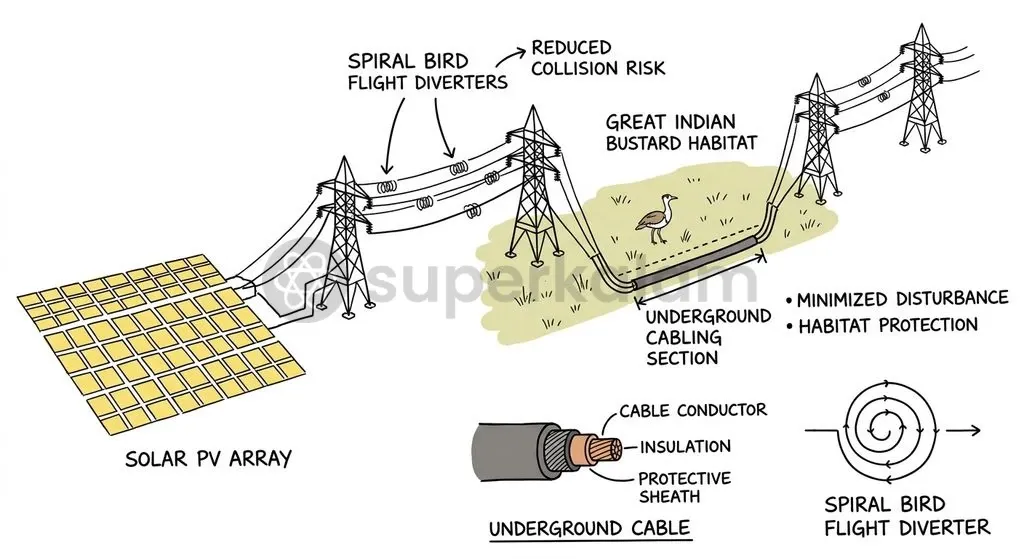
Balancing ecological protection with infrastructure velocity, the bench modified its April 2021 blanket undergrounding order for lines across 80,000 sq km of Great Indian Bustard habitat. The court confined technical undergrounding reviews to a 13,163 sq km Priority Area. The Supreme Court refined this balance in M.K. Ranjitsinh v. Union of India (2025 INSC 1472), directing a corridor-based planning mechanism across Revised Priority Areas that blends bird flight diverters with designated ecological passages.
Discuss with Superkalam
If an open-access industrial consumer plans to build a solar plant after June 2026, how will the ALMM List-II mandate influence their component sourcing?
Ask NowGlobal Supply Chains: China's Polysilicon Dominance and India's Upstream Blind Spot
India depends on international suppliers for more than 90% of its critical solar raw materials, including polysilicon, silicon ingots, and wafers. Joint market assessments by NITI Aayog and Mercom India confirm that foreign suppliers, predominantly based in China, supply the raw materials feeding domestic cell manufacturing lines. While fiscal policies encourage local assembly of modules and cells, ingot crystallisation and polysilicon refining remain concentrated overseas.
Developing an upstream domestic base faces distinct industrial obstacles:
- Capital intensity: Polysilicon refining requires vast upfront capital expenditure and advanced chemical engineering infrastructure.
- Power reliability: Ingot crystallisation demands continuous, low-cost electricity supplies.
- Supply exposure: Because early policy prioritised late-stage assembly, domestic solar production remains vulnerable to overseas upstream crunches.
Discuss with Superkalam
Analyze the trade-off between imposing high customs duties to build self-reliance and achieving the target of 30 to 35 GW annual solar commissioning.
Ask NowPolicy Roadmap: How to Balance Industrial Strategy with Climate Speed
The Ministry of New and Renewable Energy can harmonise industrial self-reliance with climate velocity through targeted regulatory interventions:
- Calibrate upstream tariffs: Phase out high tariffs on foundational wafers while PLI Tranche-II facilities complete construction to reduce module fabrication costs and maintain project speeds.
- Reform DISCOM incentives: Introduce time-of-day feed-in tariffs and revenue decoupling mechanisms through State Electricity Regulatory Commissions to insulate power distribution utilities from rooftop commercial revenue losses.
- Expand storage and evacuation: Upgrade sub-transmission grids, deploy the approved 12 GWh battery storage systems under the Ladakh transmission project, and install bird flight diverters per Supreme Court guidelines.
Discuss with Superkalam
Weigh whether gross metering or net billing is a fair compromise between protecting distribution company finances and encouraging residential adoption.
Ask NowKey Takeaways
- India committed to deploying 500 GW of non-fossil power by 2030, which the Central Electricity Authority translates into a 292 GW solar target.
- Cumulative installed solar capacity reached 168.04 GW as of August 2026, creating an annual installation requirement of 30 to 35 GW to satisfy 2030 goals.
- Industrial policies like the Rs 24,000 crore PLI Scheme and ALMM mandates build domestic manufacturing capacity, yet over 90% of upstream wafers and polysilicon remain import-reliant.
- PM Surya Ghar: Muft Bijli Yojana crossed 50 lakh homes and 14.8 GW capacity by August 2026, though state distribution companies resist net metering due to commercial revenue losses.
- Grid integration requires completing Green Energy Corridor infrastructure while abiding by Supreme Court judgments that balance transmission lines with bird flight diverters in Great Indian Bustard habitats.
Mains Question
"The structural trade-off between tariff-led industrial protectionism and deployment velocity threatens India's 2030 clean energy trajectory." In the light of the reimposition of the Approved List of Models and Manufacturers (ALMM) and customs duties, critically examine this statement. (15 Marks)
Evaluate NowMains Question
Despite a financial commitment of Rs 75,021 crore under the PM Surya Ghar: Muft Bijli Yojana, DISCOM disincentives remain a critical bottleneck for decentralized solar expansion. Elucidate. (10 Marks)
Evaluate NowPractice MCQs
QUESTION 1
With reference to India's solar energy targets and domestic manufacturing policy, consider the following statements:
- The Central Electricity Authority projects that India requires approximately 292 GW of solar PV capacity by 2029-30 to meet its non-fossil goals.
- The Approved List of Models and Manufacturers (ALMM) List-I restricts module imports for public and open-access solar installations.
- Under ALMM List-II, domestic solar cell sourcing becomes compulsory for listed module fabricators starting June 1, 2026.
Which of the statements given above are correct?
QUESTION 2
Consider the following statements regarding the financial support and tariff architecture for solar energy in India:
- The Production Linked Incentive (PLI) Scheme on High Efficiency Solar PV Modules holds an aggregate financial outlay of Rs 24,000 crore across two tranches.
- The Union Budget 2025 eliminated the Basic Customs Duty entirely, replacing it with an Agriculture Infrastructure and Development Cess.
- PLI Tranche-I awarded Rs 4,500 crore to secure fully integrated manufacturing capacity spanning polysilicon to finished modules.
Which of the statements given above is/are correct?
QUESTION 3
Regarding the PM Surya Ghar: Muft Bijli Yojana, consider the following statements:
- The scheme was approved with a financial outlay of Rs 75,021 crore targeting installations across 1 crore households.
- It provides a Central Financial Assistance of Rs 30,000 for 1 kW systems and Rs 60,000 for 2 kW systems.
- Central Financial Assistance is capped at Rs 78,000 for residential systems of 3 kW or higher.
Which of the statements given above is/are correct?
QUESTION 4
Under the Green Energy Corridor Phase-II initiative, what is the allocated role of the Intra-State Transmission System sanctioned by the Cabinet Committee on Economic Affairs?
QUESTION 5
Consider the following statements regarding the institutional challenges faced by rooftop solar adoption:
- Affluent domestic consumers adopting rooftop solar reduces the commercial revenue that DISCOMs use to cross-subsidise agricultural and rural consumers.
- To mitigate cross-subsidy losses, several State Electricity Regulatory Commissions have shifted from 1:1 net metering to gross metering or net billing frameworks.
Which of the statements given above is/are correct?