AI in Indian Courts: Human Primacy and Due Process
As India digitises its justice system to clear 4.4 crore pending cases, constitutional safeguards ensure artificial intelligence never replaces human judges.
Nov, 2026
•9 min read

Overview
Artificial intelligence can streamline administrative workflows and assist legal research across Indian courts. However, judicial discretion and the constitutional duty of adjudication must remain exclusively with human judges to protect due process under Article 21.
Automated models accelerate procedural throughput when indexing cases, providing live transcription, or translating vernacular documents. In contrast, assigning predictive risk scoring, evidence evaluation, or sentencing to opaque algorithms compromises fundamental justice. The emerging regulatory architecture balances practical technological efficiency with the constitutional guarantee of reasoned, human-delivered justice.
Why AI in the Judiciary Is in the Spotlight
The Supreme Court of India has drawn strict operational boundaries to ensure artificial intelligence assists court administration without usurping non-delegable judicial discretion. This regulatory urgency addresses staggering pendency across India's justice system:
- District and Taluka pendency: According to the National Judicial Data Grid, over 4.4 crore cases remained pending across District and Taluka courts as of November 2026.
- Modernisation funding: The Union Cabinet approved Phase III of the eCourts Project with a budgetary outlay of ₹7,210 crore to introduce modern cloud architecture, open application programming interfaces (APIs), and machine learning tools across subordinate courts.
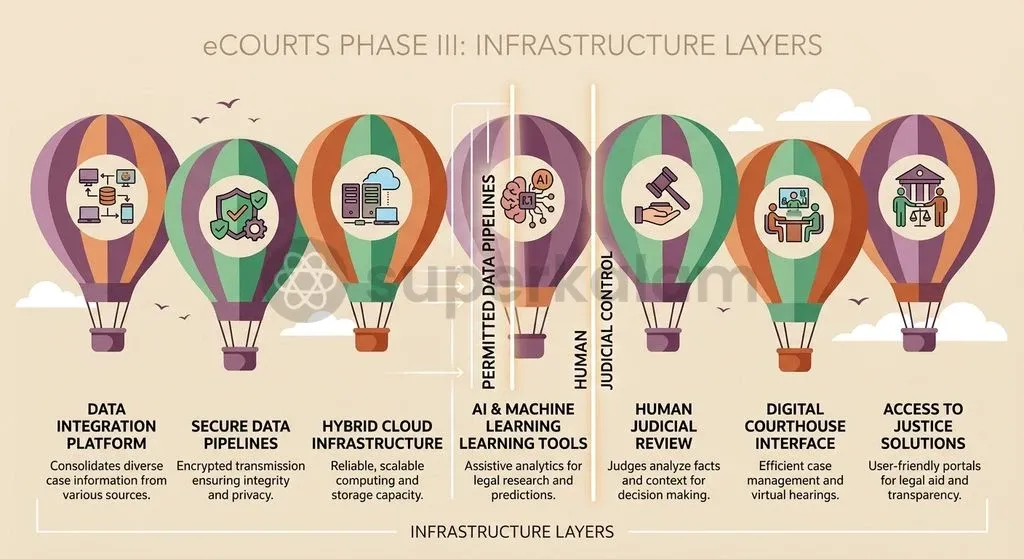
Technological integration cannot occur at the expense of procedural fairness. Under Regulation 4 of the Draft Regulations for Use of Artificial Intelligence in Courts, 2026, the Supreme Court formulated the doctrine of Human Primacy.
This doctrine mandates that automated tools remain strictly subservient to human authority. It vests the ultimate determination of law and justice exclusively in judicial officers. While technological tools can process voluminous records, they cannot replace the living judgment demanded by Indian constitutionalism.
Discuss with Superkalam
Which specific judicial tasks are permitted under Regulation 19 and prohibited under Regulation 20 of the Draft AI Regulations, 2026?
Ask NowWhere Machines Are Welcome: Permitted Uses in Court Administration and Research
The e-Committee of the Supreme Court has deployed targeted algorithmic solutions to eliminate administrative bottlenecks and expand linguistic access across the legal system. In November 2019, the Supreme Court introduced the Supreme Court Vidhik Anuvaad Software (SUVAS). Developed alongside the Ministry of Electronics and Information Technology, this open-source neural machine translation platform translates English judgments and orders into scheduled Indian languages, enabling vernacular access to higher judicial pronouncements.
Research automation expanded significantly when the Supreme Court launched the Supreme Court Portal for Assistance in Court Efficiency (SUPACE) in April 2021. SUPACE assists judges by mining extensive case archives, summarising procedural histories, and categorising complex factual briefs without making judicial determinations. Verbatim record creation saw similar innovation in February 2023, when the Supreme Court initiated live AI-powered transcription pilots during Constitution Bench hearings to produce verified transcripts for counsel and the public.
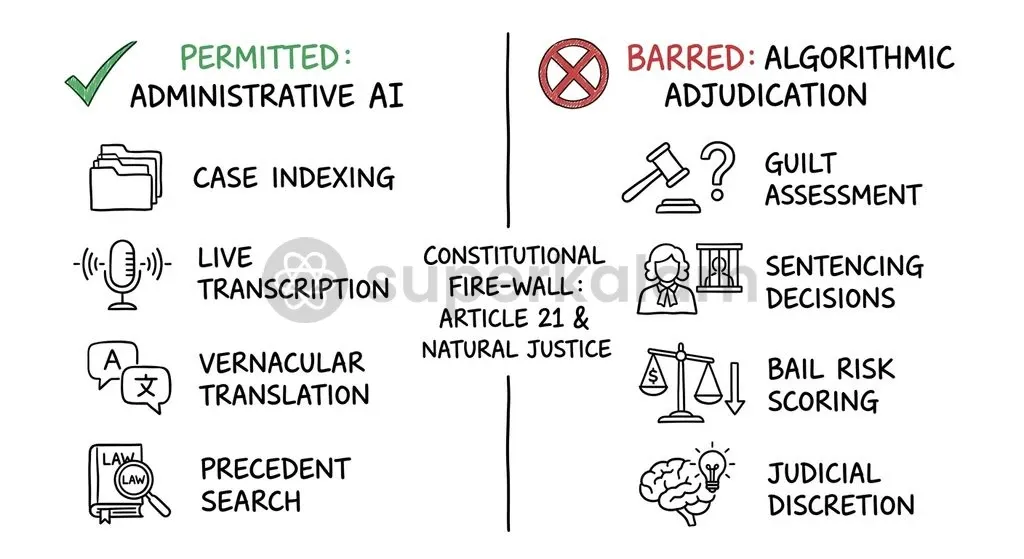
Regulation 19 of the Draft Regulations for Use of Artificial Intelligence in Courts, 2026 formalises these administrative integrations. Assistive AI tools require prior written approval from the designated Appropriate Authority and remain strictly confined to defined functions:
- Speech-to-Text Transcription: Real-time generation of court records during hearings.
- Multilingual Translation: Converting pleadings, orders, and statutory texts across regional languages.
- Case Docket Management: Smart indexing, scrutiny of filing defects, and automated cause-list generation.
- Legal Research Assistance: Parsing precedents and statutory citations for judicial review.
Discuss with Superkalam
How does the 'black-box' nature of deep-learning algorithms undermine the requirement of a 'reasoned speaking order' established under Article 21?
Ask NowWhere the Line Is Drawn: Why Algorithmic Adjudication Remains Barred
The Supreme Court of India prohibits automated systems from entering the adjudicative arena. Deciding disputes is an inherently sovereign, human function.
Under Regulation 20 of the Draft Regulations for Use of AI in Courts, 2026, the framework enacts absolute prohibitions on deploying algorithms for independent decision-making, sentencing, or credibility assessments. Algorithms cannot balance competing equitable rights, evaluate witness demeanour, or apply restorative discretion to complex individual circumstances.
| Judicial Function | Regulatory Status | Institutional Governing Provision |
|---|---|---|
| Multilingual Translation & Transcription | Permitted Assistive Use | Regulation 19, Draft AI Regulations, 2026 |
| Docket Indexing & Cause-List Generation | Permitted Assistive Use | Regulation 19, Draft AI Regulations, 2026 |
| Case Law Mining & Factual Summarisation | Permitted Assistive Use | Regulation 19, Draft AI Regulations, 2026 |
| Recidivism & Bail Risk Scoring | Strictly Prohibited | Regulation 20, Draft AI Regulations, 2026 |
| Witness Credibility Assessment | Strictly Prohibited | Regulation 20, Draft AI Regulations, 2026 |
| Independent Judgment & Sentencing | Strictly Prohibited | Regulation 20, Draft AI Regulations, 2026 |
Evidentiary submissions face stringent regulatory scrutiny to prevent manufactured evidence from entering the judicial record. Under Regulation 20(1)(h) of the Draft Regulations, litigants and advocates cannot submit any AI-generated output as an independent evidentiary source without full, transparent disclosure.
Hallucinated legal precedents pose severe procedural risks. In the United States federal proceeding of Mata v. Avianca, Inc. (2023), the District Court for the Southern District of New York sanctioned two litigators under Rule 11 of the Federal Rules of Civil Procedure for citing fictitious judicial opinions generated by ChatGPT. In Indian practice, directives reported in 2024 around trial proceedings (such as Gummadi Usha Rani v. Sure Mallikarjuna Rao) indicated that relying on generative AI fabrications constitutes professional misconduct rather than an innocent clerical mistake.
Natural Justice and Article 21: The Risks of Algorithmic Bias and Black-Box Reasoning
Article 21 of the Constitution establishes procedural protections that opaque machine-learning architectures directly undermine. Algorithmic adjudication clashes with core constitutional and natural justice benchmarks on three distinct fronts:
- Reasoned speaking orders (Article 21): In Maneka Gandhi v. Union of India (1978), the Supreme Court ruled that any procedure depriving life or liberty must be just, fair, and reasonable. Litigants are entitled to understand the legal rationale of an adverse ruling, which proprietary deep-learning algorithms cannot provide.
- Non-arbitrariness and equal protection (Article 14): In E.P. Royappa v. State of Tamil Nadu (1974), the Supreme Court affirmed that arbitrariness is antithetical to equality. Ingesting historical prosecution data reproduces systemic algorithmic bias against marginalised groups.
- Open and visible justice: In R v. Sussex Justices, Ex parte McCarthy (1924), the English King's Bench Division ruled that justice must manifestly be seen to be done. Hidden numerical weights deprive citizens of meaningful hearing, subverting the foundational doctrine of audi alteram partem.
Discuss with Superkalam
If an overworked trial judge relies uncritically on an automated bail recommendation tool, which fundamental rights of the accused are compromised and why?
Ask NowComparing Approaches: How Global Judiciaries Restrict Judicial AI
International jurisdictions have adopted divergent statutory and judicial standards to curb machine-learning hazards in courtroom administration:
| Jurisdiction | Regulatory Approach | Core Safeguard or Benchmark |
|---|---|---|
| United States | Judicial qualification of commercial risk tools | State v. Loomis (2016) permits COMPAS risk scores only with written warnings disclosing software opacity and racial disparities. |
| European Union | Comprehensive statutory classification | Regulation (EU) 2024/1689 (AI Act) classifies judicial fact-finding and statutory interpretation tools as High-Risk systems under Annex III, Section 8(a). |
While American practice relies on case-by-case caveats, the European Union enforces ex-ante technical documentation, continuous human oversight, and mandatory pre-deployment fundamental rights assessments.
Discuss with Superkalam
Compare the European Union's statutory high-risk classification of judicial AI with the judicial-warning approach adopted in the United States in State v. Loomis.
Ask NowGrassroots Reality: Can India's District Courts Safely Implement Judicial AI?
Subordinate courts across India face structural deficits that complicate the safe deployment of advanced machine learning solutions. These ground-level hurdles centre on two critical operational realities:
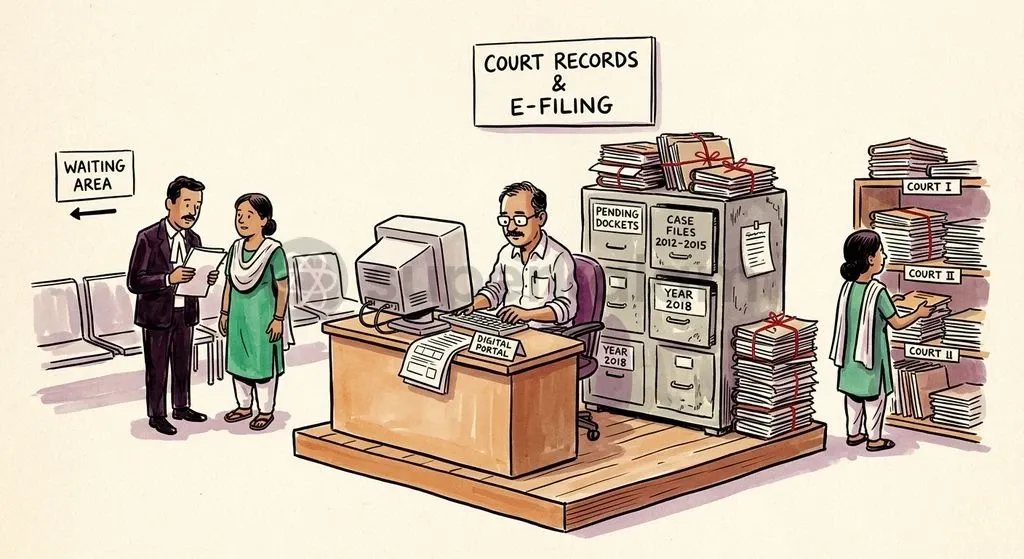
- Infrastructure and literacy deficits: Unlike higher constitutional benches, subordinate courts handle immense local dockets with erratic power supplies and limited high-speed connectivity. Deploying commercial algorithms without technical literacy creates serious risks of automated rubber-stamping by overworked magistrates.
- Data sovereignty and vendor capture: The Supreme Court's Centre for Research and Planning warned in its 2024 White Paper that proprietary software risks institutional vendor lock-in. Non-disclosure agreements prevent public auditing of software processing sovereign disputes. Handling court dockets also mandates strict compliance with the Digital Personal Data Protection Act, 2023, requiring sovereign cloud hosting and anonymisation protocols.
Ethical Dimensions: Transparency, Accountability, and the Human Core of Justice (GS4)
The ethical integrity of judicial office depends upon human moral agency, empathy, and personal responsibility. Algorithmic adjudication undermines this baseline across two core ethical dimensions:
- Erosion of restorative discretion: The Bangalore Principles of Judicial Conduct highlight that adjudicators must perceive the distinct human narrative underlying every dispute. Substituting human discretion with algorithmic models reduces unique circumstances to statistical aggregates, eliminating equitable mercy and individualised justice from the courtroom.
- The institutional accountability gap: As highlighted in the UNESCO Recommendation on the Ethics of Artificial Intelligence, algorithmic justice fragments responsibility among software developers, data vendors, system administrators, and presiding judges. When an unexplainable model produces a biased recommendation, no individual assumes clear constitutional culpability.
Judicial legitimacy rests on public trust. That trust erodes when automated systems treat citizens as numerical data points rather than rights-bearing individuals.
Way Forward: A Guardrail Framework for Tech-Enabled Justice
Parliament and the higher judiciary must establish a rigorous statutory framework to harness computational efficiency while preserving constitutional guarantees. The Draft Regulations for Use of Artificial Intelligence in Courts, 2026 incorporate structural mechanisms that point the way forward:
- Mandatory Human-in-the-Loop Architecture: System designers must build all court-facing tools on a strict human-in-the-loop (HITL) model, ensuring automated outputs remain non-binding exploratory drafts subject to de novo human appraisal.
- Systemic Error Tracking: In accordance with Regulation 39 of the Draft Regulations, court AI Secretariats must maintain an AI Incident Database to record, monitor, and rectify algorithmic bias, system malfunctions, and AI hallucinations.
- Institutional Redress Mechanisms: Institutional grievance oversight should reside in an independent Apex Body established at the Supreme Court level under Regulation 23(g) of the Draft Regulations, operating alongside standard appellate remedies.
- Sovereign Open-Source Development: The Ministry of Law and Justice should prioritise open-source, publicly auditable code over closed proprietary commercial platforms to avoid vendor capture and protect sovereign data integrity.
- Capacity Building for Legal Practitioners: Judicial academies and legal regulatory authorities (such as the Bar Council of India) should institute comprehensive training in prompt verification, algorithmic limitations, and digital evidence ethics.
Discuss with Superkalam
How can the Indian judiciary harness Phase III of the eCourts Project to tackle docket pendency without falling into vendor lock-in or compromising sovereign data protection?
Ask NowKey Takeaways
- The Supreme Court's Draft Regulations for Use of Artificial Intelligence in Courts, 2026 establish the doctrine of Human Primacy under Regulation 4, maintaining that algorithmic tools must remain strictly subordinate to human judicial authority.
- Permissible assistive applications under Regulation 19 are limited to non-adjudicative functions such as real-time transcription, language translation through SUVAS, case indexing, and legal research support via SUPACE.
- Regulation 20 strictly prohibits autonomous adjudicative operations, barring predictive risk scoring for bail, automated sentencing, witness credibility grading, and unreviewed AI-generated evidence.
- Algorithmic decision-making conflicts with Article 14 (freedom from arbitrariness under E.P. Royappa) and Article 21 (the requirement for reasoned, fair procedure established in Maneka Gandhi), alongside the common-law tenet that justice must manifestly be seen to be done.
- Phase III of the eCourts Project has allocated ₹7,210 crore to modernise digital judicial infrastructure, yet bridging the resource divide and preventing commercial vendor lock-in remain vital priorities.
Mains Question
"The doctrine of Human Primacy under the Draft Regulations for Use of Artificial Intelligence in Courts, 2026, reinforces the non-delegable nature of judicial discretion." Elucidate. (10 Marks)
Evaluate NowMains Question
Deploying algorithmic tools in the judicial process risks creating an 'institutional accountability gap' and eroding procedural due process. Critically examine this statement in light of constitutional protections and grassroots judicial realities. (15 Marks)
Evaluate NowPractice MCQs
QUESTION 1
With reference to the integration of Artificial Intelligence in the Indian judiciary, consider the following statements:
- Under the Draft Regulations for Use of Artificial Intelligence in Courts, 2026, the doctrine of Human Primacy mandates that automated tools remain strictly subservient to human authority.
- Assistive AI tools such as speech-to-text transcription and multilingual translation can be deployed without prior administrative sanction from designated authorities.
- Recidivism risk scoring and witness credibility assessment are strictly prohibited from being delegated to automated algorithms.
Which of the statements given above are correct?
QUESTION 2
Consider the following statements regarding digital initiatives deployed by the Supreme Court of India:
- The Supreme Court Vidhik Anuvaad Software (SUVAS) was developed in partnership with the Ministry of Electronics and Information Technology to translate judgments into scheduled Indian languages.
- The Supreme Court Portal for Assistance in Court Efficiency (SUPACE) is empowered to independently determine questions of fact and law in complex disputes.
- Live AI-powered transcription pilots were initiated during Constitution Bench hearings to produce verified transcripts for counsel and the public.
Which of the statements given above is/are correct?
QUESTION 3
Regarding the constitutional safeguards surrounding judicial decision-making in India, consider the following statements:
- The requirement of reasoned speaking orders as an aspect of procedural fairness under Article 21 was emphasized in Maneka Gandhi v. Union of India.
- In E.P. Royappa v. State of Tamil Nadu, the Supreme Court established that unguided arbitrariness is antithetical to the guarantee of equality under Article 14.
- Under Regulation 20(1)(h) of the Draft Regulations, 2026, litigants may submit AI-generated outputs as independent evidentiary sources provided they do not cite foreign precedents.
Which of the statements given above is/are correct?
QUESTION 4
Consider the following pairs regarding international regulatory approaches to judicial AI:
- United States: State v. Loomis — Permitted COMPAS risk scoring only with written warnings disclosing software opacity and racial disparities.
- European Union: Regulation (EU) 2024/1689 — Classifies judicial fact-finding and statutory interpretation tools as High-Risk systems.
- UNESCO: Recommendation on the Ethics of Artificial Intelligence — Warns against the fragmentation of institutional accountability in algorithmic systems.
How many of the pairs given above are correctly matched?
QUESTION 5
In the context of the Indian subordinate judiciary, which document warned that proprietary software adoption risks institutional vendor lock-in and compromises data sovereignty in courtroom processes?