Victoria Mode: Pacific Dynamics and Indian Monsoon Teleconnections
How extratropical Pacific thermal swings reshape Indian monsoon onset, expand semi-arid farming belts, and challenge conventional climate forecasting models.
Oct, 2026
•12 min read
Overview
The Victoria Mode is an extratropical oceanic-atmospheric climate pattern. Climatologists define it as the second empirical orthogonal function mode of sea surface temperature anomalies across the North Pacific Ocean poleward of 20°N latitude, marked by a distinctive northeast-to-southwest thermal dipole.
First documented by Nicholas Bond and colleagues in 2003, this pattern links mid-latitude atmospheric pressure swings to equatorial climate variability. Its alternating phases generate far-reaching teleconnections. These shifts modulate the El Niño-Southern Oscillation, alter tropical cyclogenesis, and influence the seasonal onset of the Indian summer monsoon.
Recent meteorological evaluations confirm that multi-decadal variations in this basin-wide mode actively reshape regional moisture transport. In doing so, they suppress monsoon circulation and accelerate the geographic expansion of semi-arid climate zones across northern India.
Why in the News? Recent Research on Pacific Climate Modes
Meteorologists at the India Meteorological Department and the Indian Institute of Tropical Meteorology have identified the North Pacific Victoria Mode as a major driver behind long-term climate shifts across India. As of October 2026, an exhaustive historical assessment published in the journal MAUSAM revealed that a persistent negative phase of this oceanic mode between 1981 and 2020 significantly suppressed seasonal moisture transport into the northern plains.
This teleconnected suppression altered regional climatic boundaries and intensified aridity across major farming tracts. Key aspects highlighted by the research include:
- Extratropical-to-tropical link: The Victoria Mode is an oceanic bridge regulating tropical atmospheric circulation and Indian agro-climatic stability.
- Agrarian vulnerability: Shifts in seasonal precipitation alter traditional sowing cycles across major agrarian belts.
- Exam relevance: Understanding its physical mechanics provides civil services aspirants with an integrated framework linking ocean-atmosphere dynamics to ground-level vulnerabilities.
Understanding the Victoria Mode: Definition and Core Mechanics
The Victoria Mode represents the second empirical orthogonal function (EOF2) mode of sea surface temperature anomalies across the North Pacific Ocean poleward of 20°N latitude. In climatology, empirical orthogonal function analysis decomposes complex spatial-temporal climate datasets into primary, independent modes of variability based on statistical variance. While the leading mode captures the largest share of thermal variance across the basin, the Victoria Mode captures the second-largest independent configuration.
The Victoria Mode Cycle
- Boreal Winter Trigger: The North Pacific Oscillation (NPO) establishes a meridional sea-level pressure dipole.
- Thermodynamic Amplification: Wind-evaporation-SST (WES) feedbacks activate across the subtropics.
- Spring Peak (Feb–Apr): The northeast-to-southwest sea surface temperature dipole (EOF2) reaches peak variance.
- Equatorial Teleconnections: Subtropical anomalies modulate ENSO development and delay Indian summer monsoon onset.
The spatial footprint of this mode manifests as a pronounced northeast-to-southwest thermal seesaw across the ocean basin. During its positive phase, warm sea surface temperature anomalies concentrate along the northeastern Pacific coastline, extending past the Gulf of Alaska, while cool anomalies dominate the central and western mid-latitude North Pacific.
Conversely, during its negative phase, this spatial configuration reverses entirely. It cools the northeastern coastal margins while warming the central and western mid-latitudes.
Discuss with Superkalam
Recall the statistical definition of the Victoria Mode and the primary atmospheric pressure system that triggers it during boreal winter.
Ask Now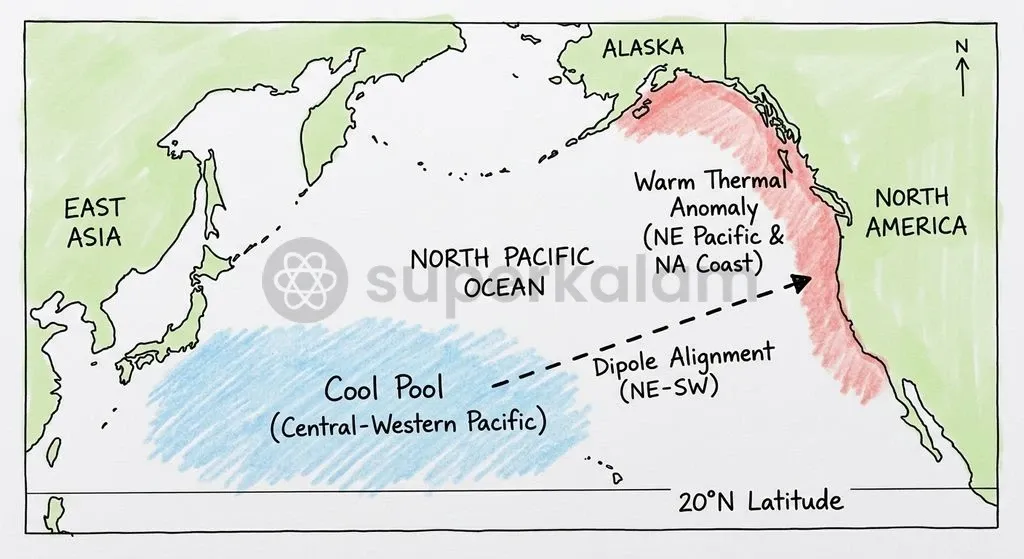
How the Victoria Mode Works: Atmospheric and Oceanic Drivers
Atmospheric forcing from the North Pacific Oscillation is the primary dynamic driver generating the Victoria Mode during boreal winter. The North Pacific Oscillation is a meridional atmospheric sea-level pressure dipole marked by simultaneous, opposite pressure anomalies between high and middle latitudes. When winter pressure gradients intensify, anomalous surface winds alter turbulent latent heat fluxes, imprinting anomalous temperature signatures directly onto the upper ocean mixed layer.
Air-sea coupling mechanisms subsequently preserve and amplify these oceanic signatures well past the decay of the initial winter storms:
- Thermodynamic feedback: The wind-evaporation-SST feedback sustains the mode and allows its subtropical thermal footprint to persist from winter into boreal spring.
- Wind-flux coupling: Anomalous surface winds modify latent heat evaporation, which reinforces existing sea surface temperature gradients.
- Atmospheric maintenance: These sustained gradients maintain the anomalous boundary layer winds driving the cycle.
Because ocean waters retain heat far longer than the overlying air, the Victoria Mode reaches its peak seasonal variance between February and April as a delayed response to wintertime forcing. This seasonal persistence through spring allows extratropical anomalies to survive into the sensitive transitional window when equatorial atmospheric systems respond strongly to subtropical oceanic triggers.
Victoria Mode vs Pacific Decadal Oscillation: Key Differences
Oceanographers distinguish the Victoria Mode from the Pacific Decadal Oscillation by analysing their underlying atmospheric drivers, empirical modes, and spatial orientations. The Pacific Decadal Oscillation represents the leading statistical mode of North Pacific sea surface temperature variability and is forced primarily by fluctuations in the Aleutian Low. In contrast, the Victoria Mode operates independently as the second statistical mode, governed by the North Pacific Oscillation.
The Victoria Mode also differs fundamentally from tropical climate patterns such as El Niño Modoki. El Niño Modoki is an internally driven tropical Pacific phenomenon characterised by sea surface warming confined strictly to the central equatorial Pacific, flanked by cooler waters on both sides. The Victoria Mode, by contrast, is an extratropical phenomenon generated north of 20°N that is an external catalyst for tropical changes.
| Diagnostic Dimension | Pacific Decadal Oscillation (PDO) | North Pacific Victoria Mode (VM) | El Niño Modoki |
|---|---|---|---|
| Statistical Mode | Leading mode (EOF1) of North Pacific SST | Second mode (EOF2) of North Pacific SST | Derived primarily from tropical Pacific SST EOF analysis |
| Primary Atmospheric Driver | Aleutian Low variations and strength | North Pacific Oscillation (NPO) pressure dipole | Tropical air-sea coupled Walker circulation anomalies |
| Spatial Core Location | Horseshoe pattern across the North Pacific basin | Northeast-to-southwest dipole north of 20°N | Central equatorial Pacific Ocean |
| Dominant Timescale | Multi-decadal persistence (20 to 30 years) | Interannual to decadal variability | Interannual variability (2 to 7 years) |
| Role in Tropical Coupling | Modulates background climate state | Acts as an extratropical-to-tropical trigger bridge | Direct tropical convective driver |
Discuss with Superkalam
Explain in your own words how the wind-evaporation-SST (WES) thermodynamic feedback enables extratropical anomalies to persist and influence equatorial waters.
Ask Now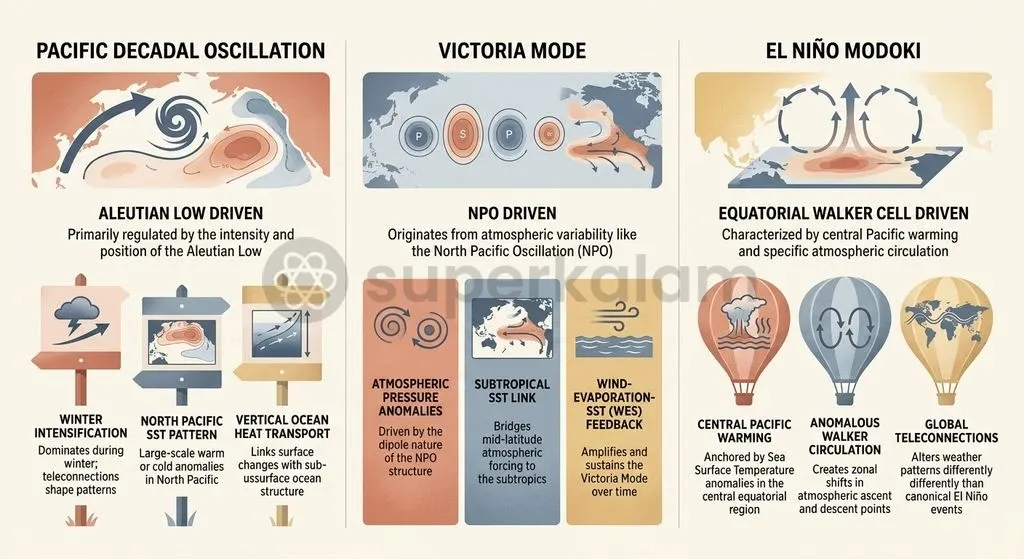
Global Teleconnections: Impact on El Niño, Typhoons, and the Indian Monsoon
The Victoria Mode is an extratropical-to-tropical oceanic bridge that can trigger the onset of the El Niño-Southern Oscillation in the following winter. It extends its subtropical sea surface temperature footprint toward the equator via the wind-evaporation-sea surface temperature feedback. This process weakens trade winds and induces anomalous downwelling oceanic Kelvin waves.
Observational records confirm that the Victoria Mode exerts a symmetric triggering influence on tropical Pacific waters. It can induce either El Niño or La Niña conditions depending on whether its initial phase is positive or negative.
Tropical storms and intraseasonal convective pulses are similarly steered by North Pacific surface conditions:
- Typhoon activity: Springtime Victoria Mode anomalies modulate tropical cyclogenesis frequency over the Western North Pacific by shifting the regional monsoon trough and altering vertical wind shear.
- Intraseasonal pulses: The mode alters low-level moisture convergence, actively modulating the propagation of the Madden-Julian Oscillation as it traverses eastward across the western-central Pacific.
| Teleconnection Route | Triggering Mechanism | Impact on Indian Monsoon |
|---|---|---|
| Tropical Pathway | Subtropical SST gradients drive low-level divergence over Indo-China, exciting an equatorial Rossby wave. | Produces anomalous easterlies over the northern Indian Ocean, opposing cross-equatorial monsoon flow. |
| Extratropical Pathway | Extratropical thermal anomalies trigger a stationary Rossby wave train from the Gulf of Alaska across Eurasia. | Induces cooling northwest of India, weakening the land-sea thermal contrast that drives the monsoon trough inland. |
The onset of the Indian Summer Monsoon Rainfall is directly modulated by these pathways. A positive phase of the Victoria Mode during May actively delays the summer monsoon onset over India through these twin atmospheric mechanisms:
- The Tropical Pathway: Subtropical sea surface temperature gradients induce anomalous atmospheric divergence at low levels over the Indo-China Peninsula. This divergence excites an equatorial Rossby wave that produces anomalous easterly winds over the northern Indian Ocean, counteracting the incoming cross-equatorial monsoon flow.
- The Extratropical Pathway: Extratropical thermal anomalies trigger a stationary Rossby wave train originating from the Gulf of Alaska. This mid-latitude wave train propagates across Eurasia and establishes anomalous atmospheric cooling northwest of the Indian subcontinent, directly weakening the land-sea thermal contrast indispensable for driving the monsoon trough inland.
This teleconnected influence has undergone significant interdecadal intensification since the early 1990s. This strengthening linkage highlights the growing vulnerability of South Asian weather patterns to climate perturbations originating in the extratropical Pacific.
Discuss with Superkalam
If meteorological models detect an intensifying negative phase of the Victoria Mode in spring, how should Indian agricultural planners adjust kharif season advisories?
Ask NowLong-Term Climatic Zone Shifts in India
Historical meteorological assessments confirm that persistent negative phases of the Victoria Mode have played a decisive role in shifting climatic boundaries across India. Long-term climate data analysed by the India Meteorological Department and IITM Pune revealed that persistent negative Victoria Mode conditions between 1981 and 2020 weakened the low-level Somali jet. This weakened flow suppressed moisture advection from the Arabian Sea, depriving northern meteorology subdivisions of critical summer precipitation.
The geographic consequences of this suppressed moisture transport have restructured agrarian microclimates across northern and north-western India:
- Expansion of Semi-Arid Steppe: The hot semi-arid steppe zone in Northwest India expanded from 25.7% of the region's area during 1951–1980 to 33.1% during 1991–2020.
- Eastward March of Aridity: The eastern boundary of the hot semi-arid climate zone shifted visibly eastward, migrating from western Uttar Pradesh into eastern Uttar Pradesh under sustained warming and drying trends.
- National Spatial Impact: Long-term climatic zone shifts associated with multi-decadal Victoria Mode variability have altered approximately 7% of India's total geographical area over the seven-decade record spanning 1951 to 2020.
- Contraction of Tropical Savannah: In Northeast India, the tropical savannah climate zone contracted from 18.4% of the regional area during 1951–1980 to 11.8% during 1991–2020, while the temperate zone expanded to cover 82.5% of the terrain.
Long-term rainfall deficits have compounded these boundary shifts along the Indo-Gangetic Plains. Observational rainfall records across Gangetic West Bengal and Bihar registered a persistent four-decade precipitation decline between 1981 and 2020, coinciding directly with the prolonged negative Victoria Mode regime. Such regional drying illustrates how distant extratropical oceanic modes exert direct pressure on water tables, crop cycles, and rainfed farming systems.
Discuss with Superkalam
Analyse the structural differences between the Pacific Decadal Oscillation, El Niño Modoki, and the Victoria Mode in terms of their spatial cores and atmospheric drivers.
Ask Now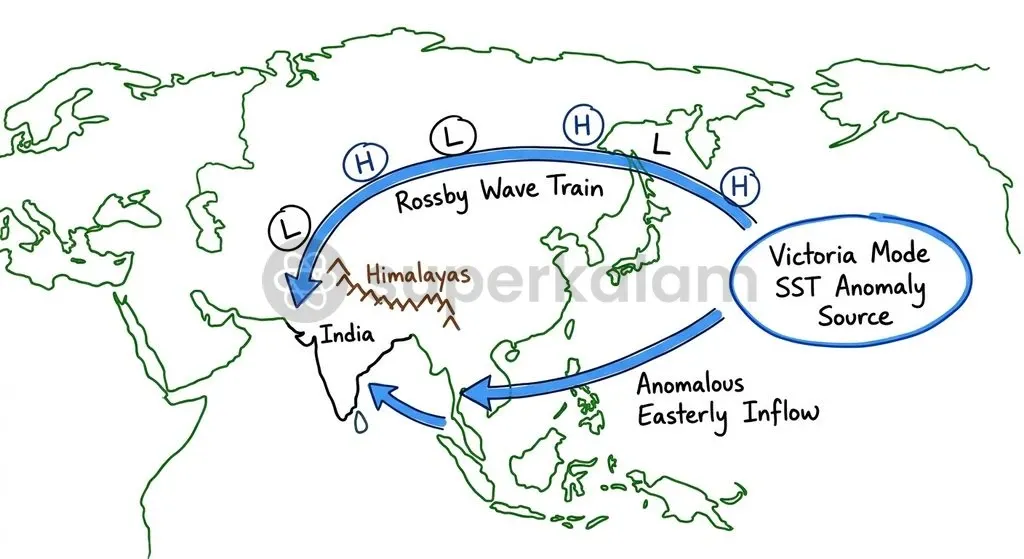
Implications for Weather Forecasting and Climate Resilience
Operational forecasting agencies experience notable skill degradation during boreal spring due to a persistent barrier in global models. Coupled ocean-atmosphere models encounter a recognised spring predictability barrier when projecting the future evolution of ENSO, largely because equatorial signals remain weak and unorganised during this season.
Because the Victoria Mode peaks between February and April, assimilating its sea surface temperature anomalies provides valuable predictive memory. This memory allows forecasters to bypass the seasonal barrier and accurately forecast ENSO events up to three seasons in advance.
Socio-economic planning in India depends heavily on accurate, long-range predictions of the summer monsoon onset and its spatial distribution. Operational gains from incorporating this mode include:
- Calibrated sowing windows: Unanticipated monsoon delays disrupt sowing windows for kharif staples like paddy, pulses, and oilseeds, depressing farm yields.
- Contingency management: Extratropical indices enable the India Meteorological Department to issue higher-confidence advisories for state disaster management authorities.
- Resource allocation: Early warnings help state authorities fine-tune drought contingency schemes, calibrate reservoir releases, and protect national food security.
Way Forward: Integrating Ocean Modes into Long-Range Prediction Models
Strengthening deep-ocean observation infrastructure across the Pacific and Indian oceans is essential for capturing rapid air-sea flux transitions. Sustained in-situ platforms, particularly deep-ocean mooring arrays like the Ocean Station Papa mooring in the North Pacific and the RAMA array across the tropical Indian Ocean, track the heat flux transfers that govern teleconnected climate modes. Expanding satellite altimetry and autonomous biogeochemical Argo floats will further refine boundary-layer parameterisations within operational models.
Climate Resilience and Prediction Roadmap
- Observational Base: Maintain deep-sea buoys, including Ocean Station Papa and the equatorial RAMA array.
- Model Assimilation: Incorporate North Pacific EOF2 anomalies into coupled ocean-atmosphere models.
- Forecast Application: Mitigate the spring predictability barrier to sharpen multi-season ENSO outlooks.
- Agrarian Resilience: Fine-tune IMD agro-meteorological advisories and district-level contingency plans.
Operational institutions are increasingly aligning their numerical architectures to leverage these teleconnection pathways. Scientists at the India Meteorological Department and research institutions report that operational agencies are working towards integrating extratropical ocean modes into the Monsoon Mission Coupled Forecast System to refine long-range subdivision rainfall forecasts.
At the local level, state agricultural departments must translate these refined long-range outlooks into targeted district-level contingency plans. Practical interventions include promoting drought-hardy crop varieties, expanding micro-irrigation infrastructure, and insulating rural livelihoods against shifting climatic zones.
Discuss with Superkalam
Evaluate the necessity of incorporating extratropical ocean modes like the Victoria Mode into long-range monsoon prediction systems compared to traditional equatorial indicators.
Ask NowKey Takeaways
- Conceptual Identity: The Victoria Mode represents the second empirical orthogonal function (EOF2) mode of sea surface temperature anomalies in the North Pacific Ocean poleward of 20°N, exhibiting a distinct northeast-to-southwest thermal dipole.
- Dynamic Engine: The mode is primarily forced during boreal winter by the North Pacific Oscillation, with its thermal footprint sustained through spring via the thermodynamic wind-evaporation-sea surface temperature feedback.
- Extratropical Bridge: Operating as an upstream catalyst, the Victoria Mode exerts a symmetric triggering influence on tropical Pacific waters, inducing both El Niño and La Niña events and overcoming the operational spring predictability barrier.
- Monsoon Modulation: A positive Victoria Mode phase in May delays the Indian Summer Monsoon onset through twin atmospheric pathways: an equatorial Rossby wave inducing easterlies over the Indian Ocean, and an extratropical Rossby wave train from the Gulf of Alaska cooling northwest India.
- Indian Agro-Climatic Impact: Multi-decadal negative phases between 1981 and 2020 suppressed moisture transport, expanding Northwest India's semi-arid steppe from 25.7% to 33.1% and shifting regional climate zones across 7% of India's total geographical area.
- Policy Priorities: Long-range forecasting accuracy requires sustaining deep-sea observation networks like the RAMA array and assimilating extratropical Pacific modes into India's Monsoon Mission coupled forecast architecture.
Mains Question
“The North Pacific Victoria Mode acts as an extratropical-to-tropical oceanic bridge with far-reaching consequences for tropical climate variability and the Indian summer monsoon.” Elucidate. (10 Marks)
Evaluate NowMains Question
Highlighting the findings of the historical assessment published in MAUSAM (1981–2020), examine how multi-decadal variations in the Victoria Mode affect the agro-climatic stability and semi-arid zones of northern India. (15 Marks)
Evaluate NowPractice MCQs
QUESTION 1
With reference to the Victoria Mode in the Pacific Ocean, consider the following statements:
- It represents the leading empirical orthogonal function (EOF1) mode of sea surface temperature anomalies across the North Pacific Ocean.
- It is primarily driven by the North Pacific Oscillation during the boreal winter.
- The mode attains its peak seasonal variance during the spring months of February to April. Which of the statements given above is/are correct?
QUESTION 2
Consider the following statements regarding the differences between the Pacific Decadal Oscillation (PDO) and the Victoria Mode (VM):
- While the PDO is forced primarily by fluctuations in the Aleutian Low, the Victoria Mode is governed by the North Pacific Oscillation.
- Unlike the Victoria Mode, which exhibits an interannual to decadal timescale, the PDO exhibits multi-decadal persistence.
- The Victoria Mode is confined strictly to the central equatorial Pacific Ocean, whereas the PDO forms a basin-wide horseshoe pattern. Which of the statements given above are correct?
QUESTION 3
Consider the following statements regarding the teleconnections of the Victoria Mode:
- It acts as an extratropical-to-tropical conduit capable of triggering both El Niño and La Niña events symmetrically.
- Its subtropical sea surface temperature anomalies extend towards the equator via wind-evaporation-sea surface temperature feedbacks.
- A persistent negative phase of the Victoria Mode has been associated with enhanced moisture transport into northern India and the retreat of semi-arid zones. Which of the statements given above is/are correct?
QUESTION 4
Which of the following mechanisms sustains the subtropical sea surface temperature footprint of the Victoria Mode through boreal spring after its wintertime atmospheric forcing decays?
QUESTION 5
With reference to the impact of the Victoria Mode on tropical atmospheric and oceanic systems, consider the following statements:
- It modulates tropical cyclogenesis frequency over the Western North Pacific by shifting the regional monsoon trough.
- It alters low-level moisture convergence and modulates the propagation of the Madden-Julian Oscillation. Which of the statements given above is/are correct?