Vibrant Villages Programme vs BADP: India's Border Strategy Shift
As Himalayan border tensions persist, India pivots from schematic BADP funding to saturate frontier villages as sovereign first posts against outmigration.
Aug, 2026
•9 min read
Overview
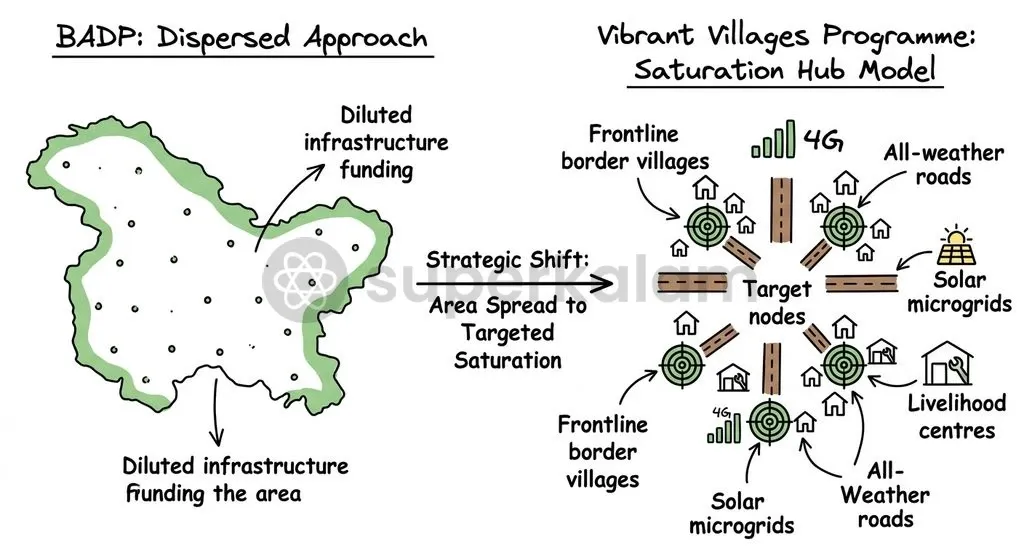
As of April 2026, the Ministry of Home Affairs has overhauled frontier governance. India moved away from the dispersed Border Area Development Programme to the Vibrant Villages Programme, turning remote settlements along the Line of Actual Control into fortified community hubs.
According to the Ministry of Home Affairs, this shift stems civilian outmigration from Himalayan valleys while countering China's dual-use border build-up. Dedicated central funds replace piecemeal schematic grants with tailored village plans. The policy treats border residents as the nation's foremost security sentinels.
Why Border Infrastructure and Governance Are in the Spotlight
Frontier governance is under sharp focus due to persistent friction along the Line of Actual Control. High Himalayan border management is no longer just territorial policing. Instead, it forms an integrated national security priority linking physical defence, civilian retention, and state reach.
| Parameter | BADP (1986–87 to Sunset) | Vibrant Villages Programme (2023 Onward) |
|---|---|---|
| Strategy | Broad schematic assistance | Saturation-based village development |
| Funding | Thin fund allocation across 0–10 km | 100% centrally sponsored outlay |
| Governance | State-level departmental planning | Gram Panchayat and district action plans |
| Frontier Role | Habitations viewed as "last miles" | Habitations designated as "first posts" |
Frontier settlements historically battled isolation, extreme weather, and scarce amenities. This triggered severe outmigration, leaving borderlines exposed.
Reversing this demographic drain is now urgent. Modern border strategy demands that frontier hamlets stay viable and tied into the national logistics grid.
Discuss with Superkalam
Which frontier village in Arunachal Pradesh served as the launch site for the Vibrant Villages Programme in April 2023?
Ask NowUnderstanding the Old Model: What Was the Border Area Development Programme (BADP)?
The Border Area Development Programme started during the Seventh Five Year Plan in 1986–87. It initially addressed developmental gaps along India's western frontier. According to the Ministry of Home Affairs BADP Guidelines, the scheme targeted the special needs of remote western border communities while assisting Border Security Force operations.
During the Eighth and Ninth Five Year Plans, the central government expanded the programme across all international land borders. As reported by the Ministry of Home Affairs, the footprint grew to 460 border blocks across 117 border districts in 16 states and 2 Union Territories. Funds flowed as Special Central Assistance using a formula based on border length, population, and block area.
BADP operated under four core parameters:
- Spatial target: Interventions focused primarily on the 0–10 kilometre zone from the international boundary.
- Funding mechanism: Special Central Assistance grants were distributed across states, requiring supplementary state matching shares in later iterations.
- Sectoral priorities: Projects covered primary healthcare, rural connectivity, basic education, and community infrastructure.
- Implementation modality: State-level screening committees cleared disjointed departmental proposals, leading to dispersed, sub-critical asset creation.
Dispersed funding could not match Himalayan operational realities. The Ministry of Home Affairs placed BADP into a sunset phase, limiting central support to committed liabilities as policy pivoted to the Vibrant Villages framework.
Discuss with Superkalam
How does transitioning from a 'last village' mindset to a 'first village' doctrine fundamentally shift border governance?
Ask NowUnderstanding the New Model: What Is the Vibrant Villages Programme (VVP)?
The Vibrant Villages Programme is a Centrally Sponsored Scheme approved by the Union Cabinet in February 2023 with an outlay of ₹4,800 crore. First announced in the Union Budget 2022–23, it upgrades northern border settlements marked by sparse populations, rugged terrain, and weak connectivity.
The scheme launched at Kibithoo in Arunachal Pradesh's Anjaw District on April 10, 2023. The operational doctrine discarded the notion of "last villages". Instead, it designated them as India's first villages and vital territorial sentinels.
| Component | Allocation & Coverage Details |
|---|---|
| Total Outlay | ₹4,800 crore (FY 2022–23 to 2025–26) |
| Road Infrastructure | ₹2,500 crore ring-fenced for all-weather roads |
| Livelihood & Saturation | ₹2,300 crore for power, social, and economic works |
| Phase-I Scope | 662 priority villages, 46 blocks, and 19 districts |
| Target Regions | Ladakh (UT), Himachal Pradesh, Uttarakhand, Sikkim, and Arunachal Pradesh |
Phase-I targets 662 border villages across 46 blocks in 19 districts spanning Ladakh, Himachal Pradesh, Uttarakhand, Sikkim, and Arunachal Pradesh, selected from 2,967 northern villages identified for phased coverage. Road connectivity gets pride of place: ₹2,500 crore of the ₹4,800 crore outlay is dedicated solely to all-weather roads.
To expand this model across all frontiers, the Union Government cleared Vibrant Villages Programme-II (VVP-II). As notified by the Ministry of Home Affairs, VVP-II covers 1,954 villages across 334 border blocks along non-northern boundaries in 15 states and 2 Union Territories through FY 2028–29.
Head-to-Head Comparison: BADP vs Vibrant Villages Programme
The shift from BADP to the Vibrant Villages Programme moves border policy from dispersed grants to targeted village saturation. Where BADP filled broad municipal gaps across districts, VVP focuses on halting frontier depopulation.
| Comparison Dimension | Border Area Development Programme (BADP) | Vibrant Villages Programme (VVP) |
|---|---|---|
| Origin & Policy Mandate | Seventh Five Year Plan (1986–87); initially created for western border BSF deployment needs. | Union Budget 2022–23; Cabinet approval in February 2023 to secure northern borders. |
| Geographic Scope | All international land borders: 460 blocks in 117 districts across 16 states and 2 UTs. | Phase-I: 662 priority villages (out of 2,967 identified) across northern border states and UTs. |
| Funding Architecture | Special Central Assistance; historical sharing pattern with states, spread across broad border belts. | 100% centrally funded model; ₹4,800 crore outlay with ₹2,500 crore ring-fenced for road works. |
| Planning & Governance Unit | Block/district level allocations vetted through State Level Screening Committees. | Village-specific Vibrant Village Action Plans prepared by district teams with Gram Panchayats. |
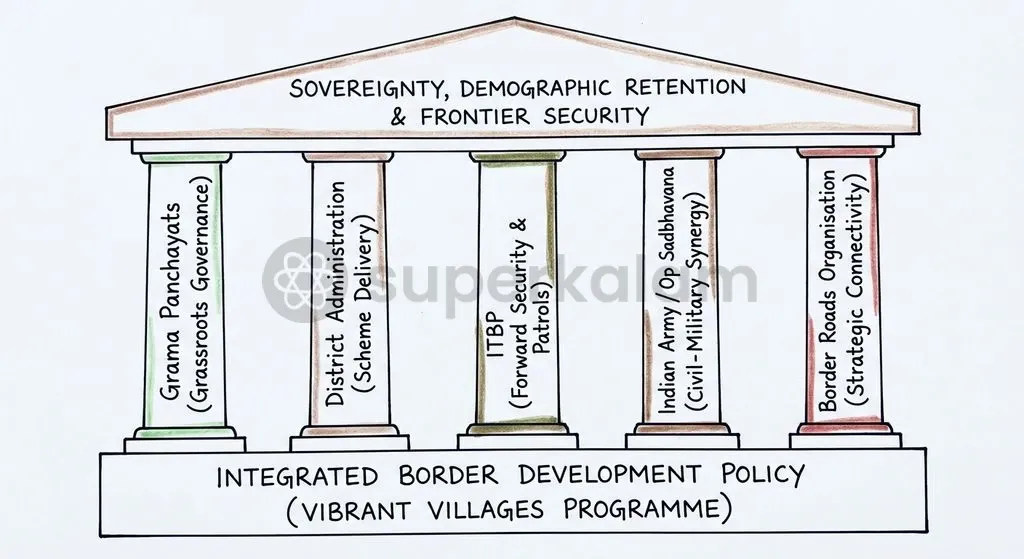
| Strategic Integration | Primarily civil-administrative gap filling with incidental security force support. | Direct civil-military synergy, integrating ITBP, Indian Army, and BRO as institutional development partners. |
| Economic Development Engine | Basic physical infrastructure construction such as community halls and link paths. | Value-chain saturation via One Village One Product, ecotourism circuits, homestays, and cooperative societies. |
| Current Operational Status | Transitioned to a sunset phase, restricted primarily to committed liabilities. | Active flagship execution under Phase-I, expanding to non-northern frontiers under VVP-II. |
Discuss with Superkalam
Why does civilian outmigration and the rise of 'ghost villages' directly undermine territorial surveillance along the Line of Actual Control?
Ask NowWhy India Shifted Strategy: The Geopolitical and Security Drivers Along the LAC
Tensions along the Line of Actual Control and rapid demographic thinning forced New Delhi's hand. When civilians leave frontier valleys, they leave behind empty ghost villages. That deprives armed forces of local territorial surveillance.
This civilian retreat occurred alongside aggressive Chinese construction. China built over 628 dual-use Xiaokang border defence villages in the Tibet Autonomous Region. On January 1, 2022, Beijing operationalised its Land Border Law, mandating civilian settlements to support border defence operations.
| Civil Administration Track | Security Apparatus Integration |
|---|---|
| Gram Panchayat Action Plans | ITBP expansion: 7 new battalions and 9,400 personnel |
| Decentralised green energy | Indian Army civic action: Operation Sadbhavana projects |
| SHG and cooperative promotion | BRO connectivity: Frontier and Trans-Arunachal Highways |
India responded by pairing civilian saturation with forward troop deployments. The Cabinet Committee on Security approved 7 new Indo-Tibetan Border Police (ITBP) battalions and a sector headquarters, adding 9,400 personnel along northern frontiers.
Under VVP, security forces play direct developmental roles. Through initiatives like Operation Sadbhavana, the Army provides medical care, transport support, and vocational skills. Meanwhile, the Border Roads Organisation (BRO) builds strategic links—such as the Frontier Highway and Trans-Arunachal Highway—to connect VVP clusters directly to forward bases.
Key Implementation Challenges: Terrain, Depopulation, and Funding Bottlenecks
Building infrastructure in the high Himalayas is notoriously difficult. Heavy winter snow and cloudbursts leave engineers a workable window of barely 4 to 5 months each year, according to the NITI Aayog Report on Sustainable Development in the Indian Himalayan Region.
Several physical and administrative hurdles complicate progress on the ground:
- Extreme ecological fragility: Road expansion and tunnelling across young fold mountains frequently trigger slope destabilisation, flash floods, and debris accumulation.
- Logistical cost inflation: Transporting heavy machinery, bitumen, and aggregate to isolated high-altitude passes escalates per-kilometre construction outlays far above national averages.
- Severe outmigration momentum: Decades of underdevelopment have drawn youth to urban centres, making reverse migration difficult without assured, year-round local income.
- Telecom and grid deficits: Installing 4G optical fibre networks and reliable high-tension power lines over glaciated terrain demands substantial initial capital and high maintenance overheads.
Fixing these bottlenecks means discarding standard engineering playbooks. Border agencies increasingly turn to climate-resilient construction, modular building systems, and off-grid utility networks.
Discuss with Superkalam
How does a 100% centrally sponsored saturation model compare with state-matching schematic assistance in high-altitude, low-resource frontiers?
Ask NowWay Forward: Building Resilient and Populated Frontier Communities
Border resilience demands connecting solid roads with local enterprise and ecological care. Moving beyond concrete and tarmac, habitations must become self-sustaining community ecosystems.
To achieve complete socio-economic saturation, five priorities stand out:
- Ecotourism and homestay circuits: The Ministry of Tourism and state tourism boards should expand sustainable trekking corridors, border tourism initiatives, and heritage trails to provide predictable local revenues during tourist seasons.
- Livelihood diversification via cooperatives: Implement the Hub and Spoke Model alongside the One Village One Product (OVOP) framework, anchored by Primary Agricultural Credit Societies (PACS) and women-led Self-Help Groups (SHGs) for high-value organic produce.
- Decentralised renewable energy grids: Install off-grid solar micro-grids, small wind generators, and micro-hydro installations to deliver uninterrupted 24x7 power to cold and inaccessible zones.
- Universal digital saturation: Fast-track the deployment of 4G mobile towers, satellite broadband gateways, and Doordarshan direct-to-home terminals to integrate frontier schools and health centres into national digital platforms.
- Civil-military developmental synergy: Institutionalise coordination between local Gram Panchayats, the Border Roads Organisation, and ITBP command structures to streamline infrastructure maintenance and emergency disaster response.
Key Takeaways
- The Vibrant Villages Programme marks a strategic paradigm shift from BADP's dispersed assistance to 100% centrally funded, village-level saturation across India's northern boundaries.
- Approved with an outlay of ₹4,800 crore (FY 2022–23 to 2025–26), VVP allocates ₹2,500 crore specifically to all-weather road connectivity.
- VVP Phase-I targets 662 priority villages across 46 blocks in Ladakh, Himachal Pradesh, Uttarakhand, Sikkim, and Arunachal Pradesh, out of 2,967 identified northern habitations.
- The programme directly counters civilian outmigration and depopulated "ghost villages" while matching China's network of over 628 dual-use Xiaokang border villages.
- Ground execution pairs physical road corridors by the Border Roads Organisation with local security support from 9,400 newly sanctioned ITBP personnel and Army civic action units.
- Long-term sustainability hinges on promoting homestay ecotourism, One Village One Product value chains, off-grid renewable energy, and universal 4G digital connectivity.
Mains Question
"Moving away from the dispersed funding model of the Border Area Development Programme (BADP), the Vibrant Villages Programme designates frontier habitations as the nation's 'first villages' and primary sentinels." In light of dual-use infrastructure developments across the Line of Actual Control, evaluate the strategic and socio-economic significance of this paradigm shift. (15 Marks)
Evaluate NowMains Question
"Frontier border management in the high Himalayas is no longer just territorial policing, but an integrated national security priority linking physical defence with civilian retention." Examine how the Vibrant Villages Programme bridges institutional and infrastructural gaps in border security. (10 Marks)
Evaluate NowPractice MCQs
QUESTION 1
Consider the following statements regarding the Vibrant Villages Programme (VVP):
- It was launched in April 2023 at Kibithoo in Arunachal Pradesh.
- The programme operates on a 100% centrally sponsored funding outlay.
- Out of its total ₹4,800 crore outlay, more than half is ring-fenced exclusively for all-weather road connectivity.
Which of the statements given above are correct?
QUESTION 2
With reference to India's border governance models, consider the following statements:
- The Border Area Development Programme (BADP) was initiated during the Seventh Five Year Plan initially targeting the western frontier.
- Unlike BADP's broad departmental planning, the Vibrant Villages Programme formulates village-specific action plans with Gram Panchayats.
- Under recent policy shifts, BADP has been placed into a sunset phase limited to committed liabilities.
Which of the statements given above is/are correct?
QUESTION 3
Consider the following statements regarding the geopolitical and security context along the Line of Actual Control (LAC):
- China enacted its Land Border Law on January 1, 2022, mandating civilian settlements to support border defence.
- China has established over 628 dual-use Xiaokang border defence villages in the Tibet Autonomous Region.
- To augment northern border security, the Cabinet Committee on Security approved 7 new ITBP battalions adding 9,400 personnel.
Which of the statements given above is/are correct?
QUESTION 4
Which of the following locations served as the official launch site for the Vibrant Villages Programme on April 10, 2023?
QUESTION 5
Consider the following statements regarding the coverage and phases of the Vibrant Villages Programme:
- Phase-I targets 662 priority villages across 19 districts in northern border states and Union Territories.
- Vibrant Villages Programme-II (VVP-II) extends coverage to non-northern border blocks across 15 states and 2 Union Territories.
- Financial implementation requires a mandatory 50% matching state grant across all participating states.
Which of the statements given above is/are correct?