VB-G RAM G vs MGNREGS: What the 9% August Gap Shows
VB-G RAM G delivered 9% fewer person-days than MGNREGS in August, raising questions about coverage, funding and rural job guarantees.
Sep, 2026
•9 min read
Context
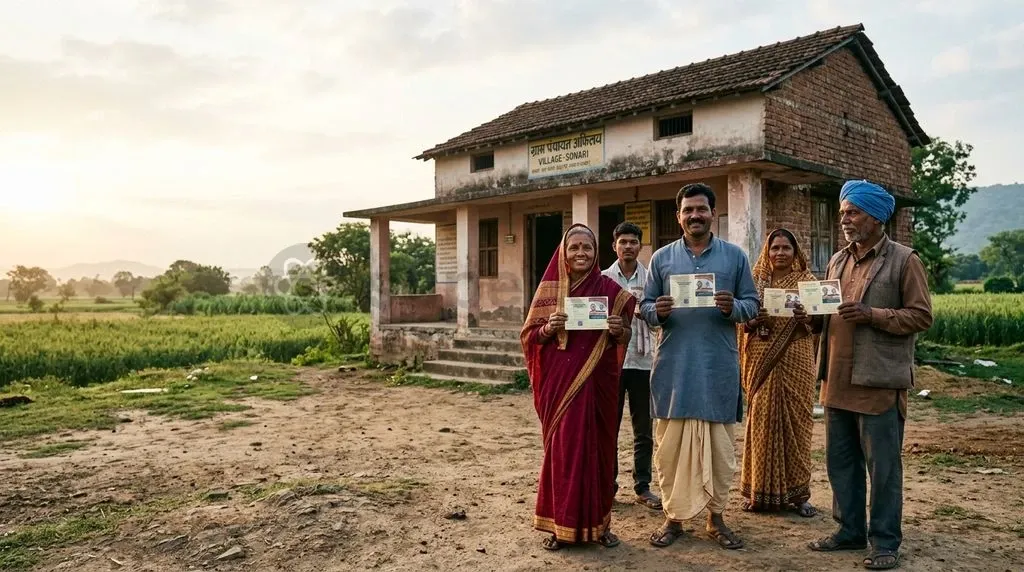
The nationwide rollout of the Viksit Bharat–Guarantee for Rozgar and Ajeevika Mission (Gramin) (VB-G RAM G) Act, 2025 marks a structural transition from an open-ended safety net to a fiscally shared public works architecture. While expanding the statutory guarantee from 100 to 125 days per household, the framework transfers 40% of unskilled wage financing onto state exchequers. It also confines permissible projects to four national priority domains, testing whether central asset planning can support counter-cyclical rural employment.
Why in the News: The August 2026 Performance Divergence
The Viksit Bharat–Guarantee for Rozgar and Ajeevika Mission (Gramin) (VB-G RAM G) Act, 2025 took effect nationwide on 1 July 2026. It formally repealed the Mahatma Gandhi National Rural Employment Guarantee Act (MGNREGA), 2005. The institutional shift prompted immediate delivery challenges during the 2026 monsoon cycle.
Work generation contracted sharply in the first month before showing partial recovery:
- July 2026 Contraction: The Ministry of Rural Development Rural Employment MIS Portal recorded a 48.01% year-on-year drop in persondays generated compared to July 2025, falling from 17.65 crore to 9.18 crore persondays.
- August 2026 Stabilisation: As of September 2026, performance data showed early signs of recovery. As reported by the Ministry of Rural Development Rural Employment Dashboard via The Hindu on 16 September 2026, VB-G RAM G generated 11.03 crore persondays in August 2026, narrowing the deficit to 9.01% below the 12.12 crore persondays generated in August 2025.
Discuss with Superkalam
Can you recall the exact statutory work entitlement in days per household provided under the VB-G RAM G Act, 2025 compared to the repealed MGNREGA?
Ask NowUnderstanding the Shift: Core Architecture of VB-G RAM G and MGNREGS
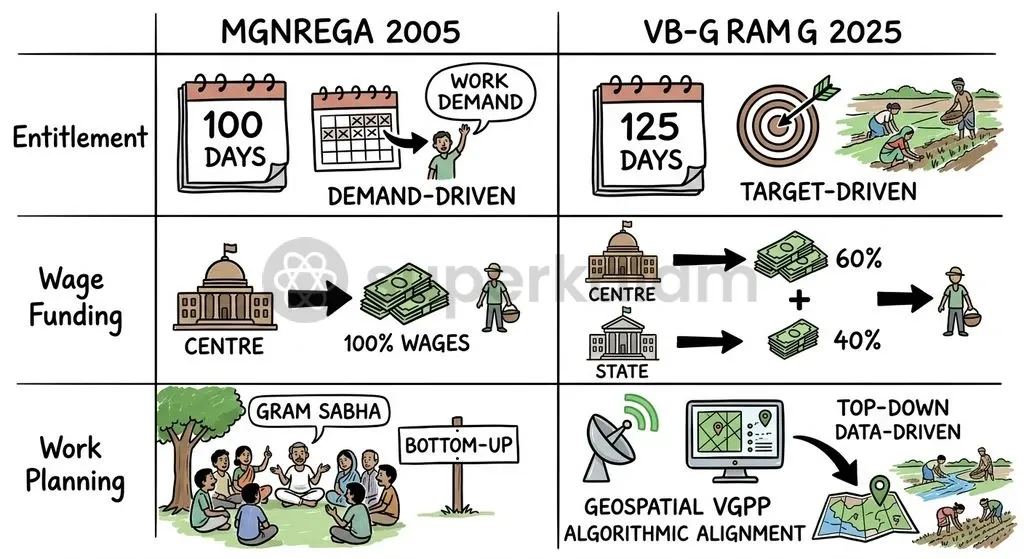
The transition reshapes how India finances and delivers rural safety-net work. Under the repealed MGNREGA 2005, the scheme functioned as an uncapped legal entitlement where the Union Government bore 100% of unskilled wage costs, releasing funds against local demand.
The VB-G RAM G framework introduces key structural revisions across legal entitlements and fiscal sharing:
- Expanded Work Entitlement: The statutory guarantee increases from 100 days to 125 days per rural household each financial year.
- Shared Fiscal Responsibility: According to the Ministry of Rural Development Draft Rules on Fund Devolution under VB-G RAM G Act, 2025, financing shifts to a 60:40 Centre-State cost-sharing ratio for standard states, 90:10 for North Eastern and Himalayan States, and 100% Central funding for Union Territories without legislatures.
- Interim Budgetary Support: To cushion this fiscal shift, the Union Ministry of Rural Development approved an interim allocation of ₹95,692.31 crore as the Centre's share for FY 2026-27.
Comparison: Legal Entitlements, Work Planning, and Fund Flows
The operational friction between both architectures stems from divergent approaches to decentralisation, fiscal devolution, and project identification.
| Dimension | MGNREGA, 2005 (Repealed) | VB-G RAM G Act, 2025 |
|---|---|---|
| Statutory Guarantee | 100 days of unskilled manual work per rural household | 125 days of unskilled manual work per rural household |
| Wage Cost Sharing | 100% borne by the Central Government | 60:40 Centre-State ratio (90:10 for NE/Himalayan States) |
| Allocation Mechanism | Demand-driven, open-ended budgeting | Horizontal devolution parameters linked to 16th Finance Commission |
| Planning Mechanism | Gram Sabhas hold statutory discretion on shelf-of-works | Geospatial pre-generation via Yuktdhara and PM Gati Shakti |
| Permissible Works | Broad list across natural resource management and individual assets | Restricted to four priority domains |
| Agricultural Seasonality | Continuous availability based on worker demand | Statutory provision permitting up to a 60-day state-notified pause |
Under Section 16 of the repealed MGNREGA 2005, Gram Sabhas possessed statutory authority to recommend and prioritise local works. The law mandated that at least 50% of works in cost terms be executed by Gram Panchayats.
In contrast, Schedule I of the VB-G RAM G Act, 2025 restricts asset creation strictly to four priority domains: water security, core rural infrastructure, livelihood-related assets, and climate resilience projects.
Discuss with Superkalam
How does shifting from demand-driven Central outlays to 16th Finance Commission horizontal devolution formulas affect a district facing sudden localized economic distress?
Ask NowFive Structural Reasons Behind the Performance Lag
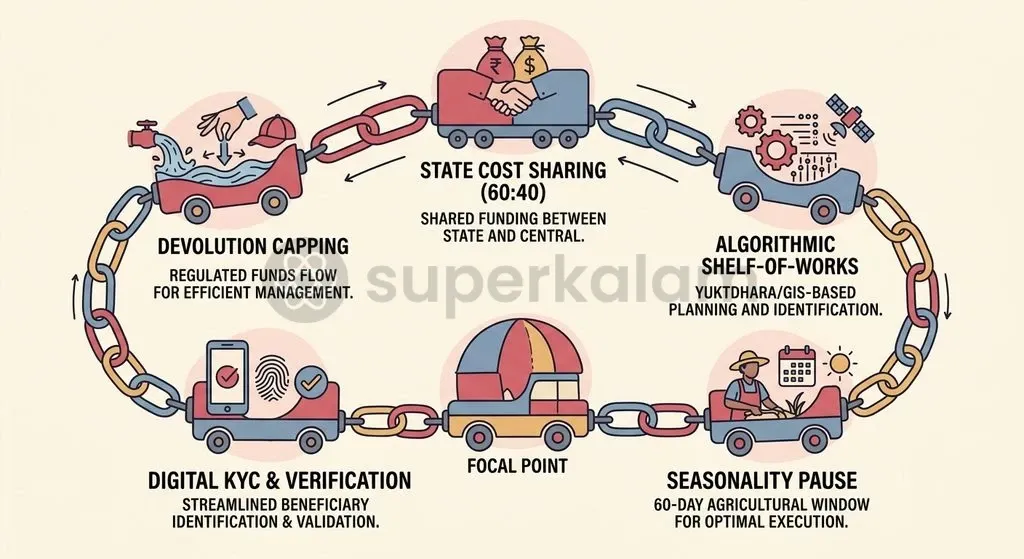
The initial divergence in work generation between the two programmes reflects five distinct institutional and operational bottlenecks.
| Pillar | Structural Bottleneck | Core Operational Mechanism |
|---|---|---|
| 1. Fiscal Burden | 60:40 matching ratio | Requires state co-funding before Central tranche release |
| 2. Top-Down GIS | Yuktdhara portal pre-generation | Algorithmic site selection slows local shelf approvals |
| 3. Sowing Pause | 60-day seasonal halt | State-wide application dampens peak monsoon work |
| 4. Onboarding | e-KYC and ABPS compliance | Administrative transition causes muster roll delays |
| 5. Allocation Caps | Formula-based devolution | 16th Finance Commission metrics cap fiscal elasticity |
1. The Fiscal Reorientation and State Matching Constraints
The transition from full Central funding of unskilled wages to a 60:40 matching requirement introduces significant fiscal friction. State governments facing revenue deficits or borrowing caps struggle to release their 40% share in tandem with Central tranches.
As noted in civil society representations reported by Business Standard on 17 June 2026, moving away from demand-driven Central outlays risks exposing rural wage seekers to state budgetary constraints and mid-year liquidity freezes.
2. Algorithmic Shelf-of-Works vs Local Gram Sabha Discretion
Under the Viksit Gram Panchayat Plan (VGPP) workflow, machine learning algorithms and satellite mapping via the Yuktdhara portal pre-generate candidate work sites prior to Gram Sabha ground-truthing. The Ministry of Rural Development justified this geospatial integration to curb ghost assets and coordinate village projects with national transport corridors.
Similarly, the Parliamentary Standing Committee on Rural Development supported saturation-focused GIS planning to ensure watershed works match macro-hydrology. However, shifting from bottom-up manual planning to portal-driven approvals initially slowed shelf-of-works sanctions in remote panchayats.
3. Statutory Provisions for Agricultural Seasonality Pauses
Under Section 8 of the VB-G RAM G Act, 2025, State Governments are legally empowered to notify an operational pause of up to 60 days on public works during peak agricultural sowing and harvesting cycles.
This statutory mechanism aims to prevent farm labour shortages. However, its broad application during the July–August 2026 monsoon window directly suppressed public employment figures across several agrarian states.
4. Digital Onboarding and Verification Mandates
The administrative transition required universal re-verification of the rural workforce on updated software platforms. As of September 2026, the Ministry of Rural Development National MIS Update indicated that 94.74% of active workers (10.27 crore out of 10.84 crore) completed e-KYC compliance, with 6,40,779 new Gramin Rozgar Guarantee cards issued.
While onboarding reached near-saturation, administrative bottlenecks during June and July forced the deployment of over 100 Central Area Officers across states to resolve digital muster roll and biometric tracking glitches.
5. Transition to Horizontal Formula-Based Devolution
Central fund allocation under VB-G RAM G draft rules relies on the 16th Finance Commission's horizontal devolution parameters rather than uncapped real-time demand registrations.
Capping central disbursements based on normative state formulas limits programme elasticity. Consequently, districts experiencing sudden local economic distress or uneven rainfall find it harder to draw immediate supplementary funds.
Discuss with Superkalam
Analyse the structural trade-offs between implementing a statutory 60-day agricultural seasonality pause and maintaining an uninterrupted social protection floor for rural landless labourers.
Ask NowImplications for Rural Wages, Women Workers, and Local Governance
The architectural redesign of the rural employment guarantee carries structural consequences for the rural economy, social protection floors, and grass-roots federalism.
On rural wages, the Union Government took steps to lift the compensation baseline. Effective 1 July 2026, the Centre notified a minimum interim daily wage baseline of ₹300 across 21 States and UTs, with peak wages reaching ₹409 in Haryana and ₹450 in Sikkim's high-altitude Gram Panchayats. Bi-weekly payment reconciliation has also been mandated through the DBT-SPARSH platform and the Aadhaar-Based Payment System (ABPS) to curb disbursement delays.
| Key Dimension | Core Structural Effect |
|---|---|
| Wage Floors & Cash Flow | Baseline of ₹300/day across 21 States/UTs; bi-weekly reconciliation via DBT-SPARSH platform. |
| Female Labour Force Participation | Affects primary safety net where women formed 58.8%–62% of person-days generated (FY25–FY26). |
| Grass-roots Panchayati Raj Autonomy | Replaces untied shelf-of-works discretion with geospatial validation under four national domains. |
The gender dimension remains critical. Women accounted for 58.8% to 62% of total person-days generated under the national employment guarantee framework during FY 2024–25 and FY 2025–26. Because women rural workers depend heavily on predictable, localised public works to supplement household income without out-migrating, procedural delays or work pauses disproportionately affect female workforce participation.
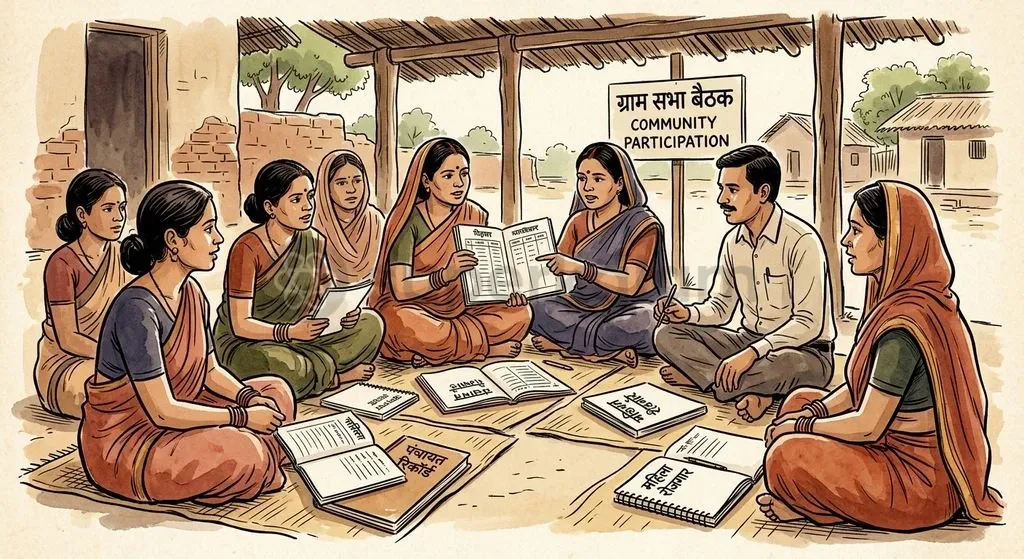
For Panchayati Raj Institutions (PRIs), the operational model curtails traditional planning autonomy. While Section 16 of the repealed MGNREGA guaranteed Gram Panchayats the right to determine at least half of all local projects, the new framework channels local works through pre-determined geospatial mapping and four national priority sectors. This tension tests the balance between top-down infrastructure convergence and decentralised local governance guaranteed under the 73rd Constitutional Amendment Act.
Way Forward: Rebalancing Rights-Based Guarantees and Rural Asset Creation
A sustainable rural employment architecture must preserve statutory social protection floors while pursuing durable, climate-resilient capital formation.
- Establish an Automated State Wage Equalisation Fund: To prevent state liquidity shortages from halting work under the 60:40 formula, the Centre should establish an automated revolving credit window to bridge temporary state contribution delays.
- Enforce Statutory Unemployment Allowances: The Parliamentary Standing Committee on Rural Development highlighted that under Section 7(1) of the employment guarantee architecture, less than 3% of eligible wage seekers historically received statutory unemployment allowances during administrative delays. Automating allowance payouts via the DBT-SPARSH engine when work is not provided within 15 days will restore demand-side accountability.
- Calibrate Agricultural Pauses at the Block Level: Rather than blanket state-wide 60-day work pauses, state administrations should decentralise notification powers to District Programme Coordinators to reflect micro-climatic sowing variations.
- Preserve Gram Sabha Primacy in Ground-Truthing: Geospatial tools like Yuktdhara should serve purely as technical decision-support mechanisms rather than restrictive filters, leaving the final right of veto and project ranking to the Gram Sabha.
Discuss with Superkalam
Evaluate whether transitioning 40% of unskilled wage financing to State exchequers strengthens cooperative federalism or undermines rural safety nets during regional fiscal stress.
Ask NowKey Takeaways
- The VB-G RAM G Act, 2025 officially replaced MGNREGA, 2005 on 1 July 2026, raising the statutory guarantee from 100 to 125 days while introducing a 60:40 Centre-State wage cost-sharing ratio.
- Work generation experienced initial operational friction, dropping 48.01% year-on-year in July 2026 (9.18 crore vs 17.65 crore persondays) before narrowing to a 9.01% gap in August 2026 (11.03 crore persondays).
- Central funding allocations have shifted toward horizontal devolution parameters linked to the 16th Finance Commission, limiting open-ended budget flexibility during localised economic distress.
- Asset creation is now confined to four national priority domains, utilising satellite validation via Yuktdhara and PM Gati Shakti alongside a statutory 60-day agricultural season pause.
- Protecting the rural safety net requires automated unemployment compensation, flexible block-level agricultural pauses, and safeguarding Gram Sabha autonomy in approving the shelf-of-works.
Mains Question
"The transition from an open-ended safety net to a formula-based, co-funded public works architecture presents complex trade-offs between fiscal discipline and rights-based guarantees." In light of the replacement of MGNREGA with the VB-G RAM G Act, 2025, critically analyse the implications of this shift for rural social security. (15 Marks)
Evaluate NowMains Question
Examine how the integration of geospatial planning tools like the Yuktdhara portal and PM Gati Shakti under the VB-G RAM G Act, 2025 alters the decentralised decision-making mandate of Panchayati Raj Institutions. (10 Marks)
Evaluate NowPractice MCQs
QUESTION 1
With reference to the Viksit Bharat–Guarantee for Rozgar and Ajeevika Mission (Gramin) (VB-G RAM G) Act, 2025, consider the following statements:
- It enhances the statutory rural employment guarantee to 125 days per household in a financial year.
- The Central Government finances 100% of the unskilled wage expenditure across all standard States.
- State Governments are legally permitted to notify an operational pause on works for up to 60 days during peak agricultural seasons. Which of the statements given above is/are correct?
QUESTION 2
Consider the following statements regarding the structural differences between the repealed MGNREGA, 2005 and the VB-G RAM G Act, 2025:
- Under the repealed MGNREGA, Gram Sabhas held statutory discretion over shelf-of-works, requiring at least 50% of works in cost terms to be executed by Gram Panchayats.
- Under VB-G RAM G, candidate works are pre-generated via satellite mapping and machine learning on the Yuktdhara portal prior to Gram Sabha ground-truthing.
- VB-G RAM G restricts permissible asset creation exclusively to four national priority domains. Which of the statements given above are correct?
QUESTION 3
Consider the following statements regarding fund allocation and wage delivery mechanisms under the VB-G RAM G Act, 2025:
- Central fund allocation is linked to the 16th Finance Commission's horizontal devolution parameters rather than uncapped real-time demand registrations.
- Bi-weekly wage reconciliation is mandated through the DBT-SPARSH platform and the Aadhaar-Based Payment System (ABPS).
- The Act eliminates the requirement for biometric tracking and e-KYC compliance for active workers. Which of the statements given above is/are correct?
QUESTION 4
Under Schedule I of the Viksit Bharat–Guarantee for Rozgar and Ajeevika Mission (Gramin) (VB-G RAM G) Act, 2025, asset creation is confined to which of the following priority domains?
QUESTION 5
With reference to the fiscal sharing architecture under the VB-G RAM G framework, consider the following pairs:
- Standard States: 60:40 Centre-State ratio
- North Eastern and Himalayan States: 90:10 Centre-State ratio
- Union Territories without legislatures: 100% Central funding How many of the pairs given above are correctly matched?