US Sanctioning Act: India's Russian Oil Trade and Energy Security
As secondary sanctions target discounted Russian oil, India must balance strategic autonomy with domestic inflation risks and energy security imperatives.
Sep, 2026
•8 min read
Context
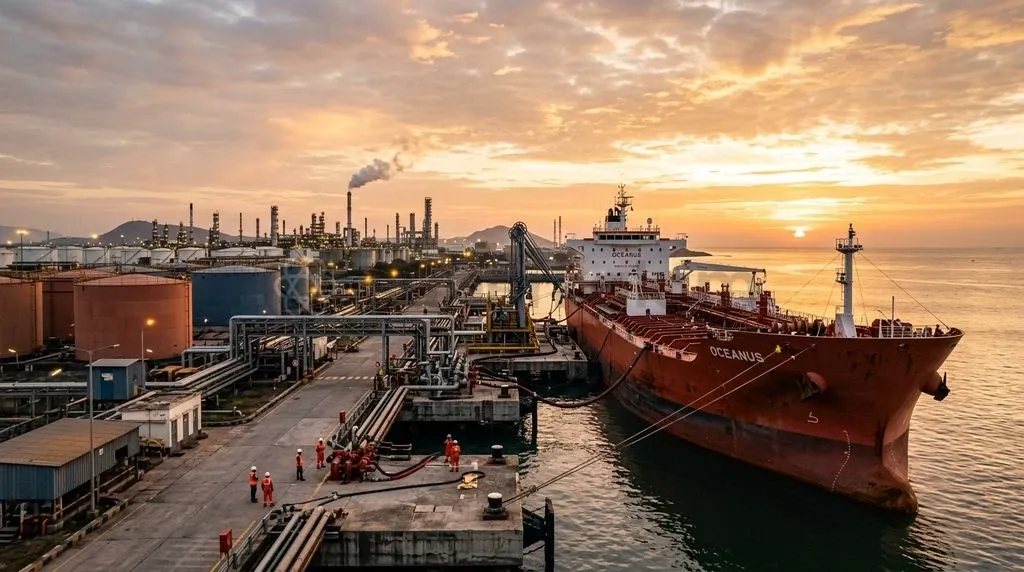
India faces a delicate geopolitical test as proposed Western secondary sanctions threaten to curb discounted Russian crude supplies. According to the Petroleum Planning & Analysis Cell (PPAC) Monthly Report, India's crude import dependency reached 88.3% on a consumption basis in the April–August period of FY 2026-27.
Navigating unilateral sanctions requires balancing domestic welfare with international diplomatic partnerships. This structural reliance means external price shocks and maritime curbs directly threaten fiscal stability and macroeconomic growth.
Why Sanctions on Russian Crude Challenge India's Energy Security
The Ministry of Petroleum and Natural Gas (MoPNG) manages an energy ecosystem heavily reliant on foreign crude to power domestic growth. India prioritises access to affordable hydrocarbons to meet the basic developmental needs of its population.
According to the Ministry of Statistics and Programme Implementation (MoSPI), India's per capita energy consumption remains approximately one-third of the global average. This structural baseline shapes New Delhi's energy policy in several distinct ways:
- Developmental Imperative: Affordable energy procurement directly advances poverty alleviation and UN Sustainable Development Goal 7.
- Secondary Sanctions Threat: Secondary sanctions penalise third-party sovereign importers by restricting access to Western banking networks, maritime logistics, and clearing systems.
- Diplomatic Position: External Affairs Minister S. Jaishankar publicly stated that unilateral non-UN sanctions lack international legal legitimacy, noting Western powers had previously encouraged Indian crude purchases to maintain global energy market equilibrium.
Discuss with Superkalam
What proportion of global maritime tanker traffic is traditionally insured by G7-based Protection and Indemnity (P&I) clubs?
Ask NowHow India's Crude Oil Import Basket Shifted Post-2022
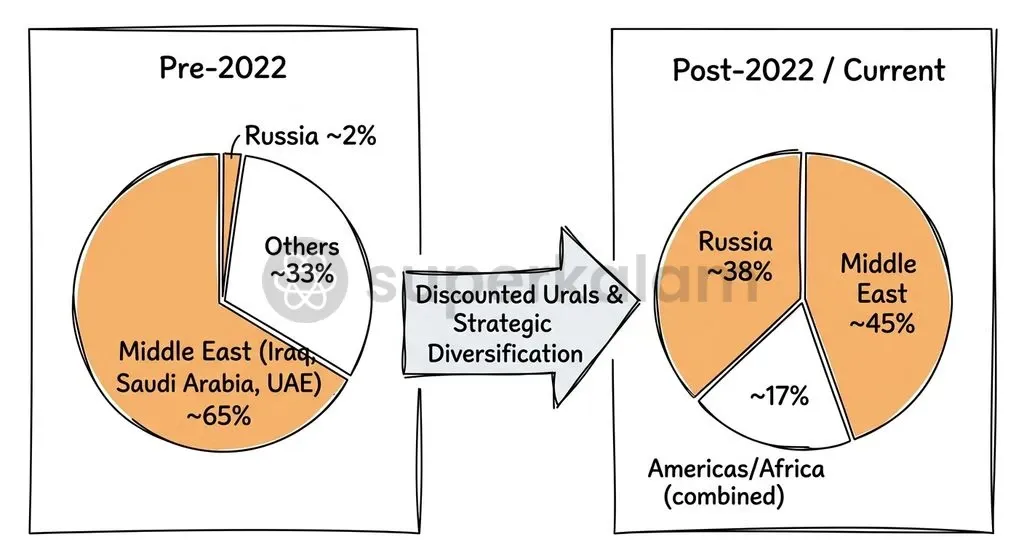
India altered its crude procurement strategy substantially after the Russia-Ukraine conflict began in 2022. Trade data from the Petroleum Planning & Analysis Cell and DGCIS Trade Returns demonstrates that Russia accounted for approximately 48% to 50.8% of total crude imports by mid-2026, making Moscow India's single largest crude supplier.
Discounted Urals crude provided major input cost savings for domestic refiners. These discounts shielded end-consumers from volatile spikes in global retail fuel prices.
| Sourcing Dimension | Pre-2022 Procurement Pattern | Mid-2026 Import Architecture |
|---|---|---|
| Primary Source Region | Middle East (Iraq, Saudi Arabia) | Russia (Urals and ESPO blends) |
| Russian Import Share | Less than 2% of total intake | 48.0% to 50.8% of total volume |
| Settlement Currency | US Dollar-dominated clearing | UAE Dirham, Ruble, and Rupee SRVA |
| Pricing Structure | Standard Official Selling Prices | Discounted Brent-linked parity |
This rapid reorientation reflects the commercial agility of Indian refiners. The Ministry of External Affairs affirmed in an official press statement that market dynamics guide procurement, securing predictable supply lines for 1.4 billion citizens.
The Mechanics of Secondary Sanctions: Shipping, Insurance, and Payment Networks
The Office of Foreign Assets Control (OFAC) enforces compliance through financial screening, maritime service prohibitions, and restrictive tariffs. Enforcement relies on G7-based Protection and Indemnity (P&I) clubs, which traditionally insure over ninety percent of global maritime tanker traffic. When sanctions prohibit Western insurers from underwriting vessels carrying oil priced above statutory caps, shipping lines face severe legal exposure.
To circumvent Western maritime services bans and price-cap restrictions, Indian refiners rely on three operational pillars:
- Alternative Maritime Logistics: As reported by The Hindu and the Directorate General of Shipping in an August 2026 regulatory assessment, refiners rely on non-Western P&I clubs and sovereign-supported tanker fleets operating under Cost, Insurance, and Freight (CIF) arrangements.
- De-Dollarised Settlement Architecture: The Reserve Bank of India implemented non-dollar transaction mechanisms, routing payments through Special Rupee Vostro Accounts (SRVA), the UAE Dirham (AED), and the Russian Ruble.
- Intermediary Trading Hubs: Procurement contracts increasingly use third-party jurisdictions outside Western regulatory oversight to maintain trade continuity.
Proposed legislative initiatives in the United States, such as the draft US Sanctions and Tariffs Act reported in the US Senate Congressional Record, propose secondary tariffs of up to 100% on countries maintaining heavy Russian crude imports. This measure creates diplomatic friction within the Quad strategic framework and broader Indo-Pacific trade negotiations.
Discuss with Superkalam
How do Special Rupee Vostro Accounts (SRVA) and non-dollar settlements help domestic refiners circumvent Western financial clearing restrictions?
Ask NowEconomic Fallout: Evaluating Inflation, the Current Account Deficit, and Rupee Stability
The Reserve Bank of India (RBI) monitors crude price fluctuations as a primary determinant of domestic macroeconomic stability. India's crude oil import bill climbed by 48.4% to $74.8 billion across the April–August period in 2026, compared to $50.4 billion in the corresponding period of 2025. Elevated baseline crude prices drove this sharp fiscal expansion rather than higher consumption volume.
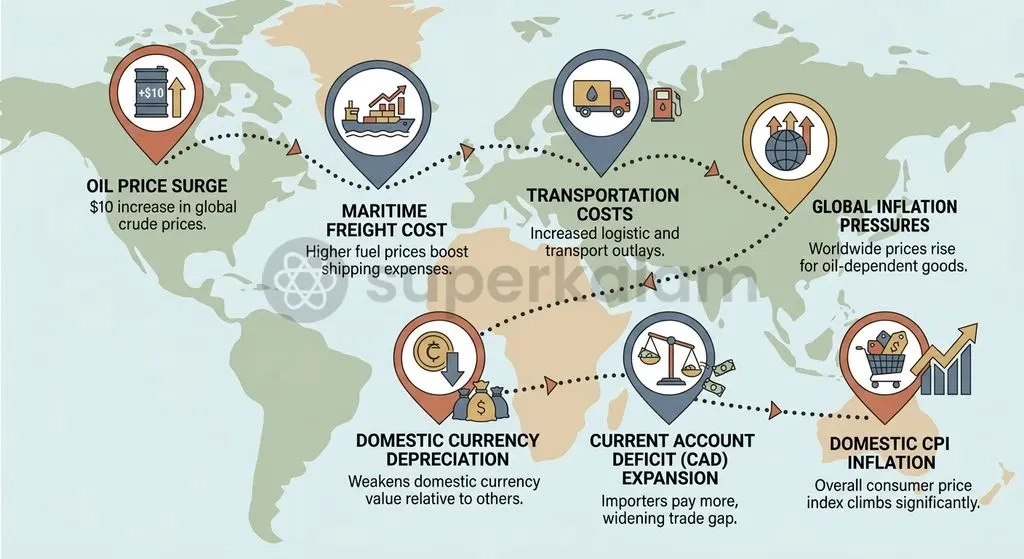
A sudden restriction on discounted supplies triggers imported inflation across transport logistics and petrochemical supply chains. Reserve Bank of India macroeconomic reviews show that a sustained $10 per barrel increase in global crude oil prices typically widens India's Current Account Deficit (CAD) by 0.3 to 0.5% of GDP.
Furthermore, that same price escalation transmits roughly 30 to 40 basis points of upward pressure into headline Consumer Price Index (CPI) inflation.
| Macroeconomic Variable | Transmission Mechanism | Estimated Impact ($10/bbl Surge) |
|---|---|---|
| Current Account Deficit (CAD) | Outflow of foreign exchange | Expands by 0.3% to 0.5% of GDP |
| Headline CPI Inflation | Input costs and freight rates | Increases by 30 to 40 basis points |
| Fiscal Deficit Pressure | Fuel and fertiliser subsidies | Constrains capital expenditure |
Exchange rate stability weakens when higher crude costs trigger sustained dollar demand from commercial oil importers. Rupee depreciation increases landing costs for essential commodities, squeezing fiscal headroom for central infrastructure programmes.
Supply Diversification: Assessing Sourcing Options from the Middle East, Africa, and the Americas
The Organization of the Petroleum Exporting Countries (OPEC) and traditional regional suppliers provide alternative procurement options if Russian volumes face disruption. Data from the Ministry of Petroleum and Natural Gas indicates that India maintains an active crude import matrix spanning more than 35 to 40 supplier nations.
Traditional Middle Eastern partners, specifically Iraq, Saudi Arabia, and the United Arab Emirates, offer high-volume crude grades tailored for Indian refinery configurations.
Geographic diversification requires evaluating regional constraints and trade-offs across global suppliers:
- Middle Eastern Suppliers: Iraq and Saudi Arabia possess substantial spare production capacity, but production quotas set by OPEC+ restrict immediate volume expansion.
- West African Producers: Exporters such as Nigeria and Angola provide sweet crude grades, though domestic infrastructure bottlenecks and theft regularly constrain export stability.
- North and South American Exporters: The United States, Brazil, and Guyana offer growing export volumes, but extended maritime transit durations significantly elevate freight and landing costs.
Discuss with Superkalam
How do OPEC+ production quotas and geographical transit distances limit India's ability to swiftly replace Russian crude with Middle Eastern or American alternatives?
Ask NowStrategic Petroleum Reserves and Domestic Buffers: How Prepared Is India?
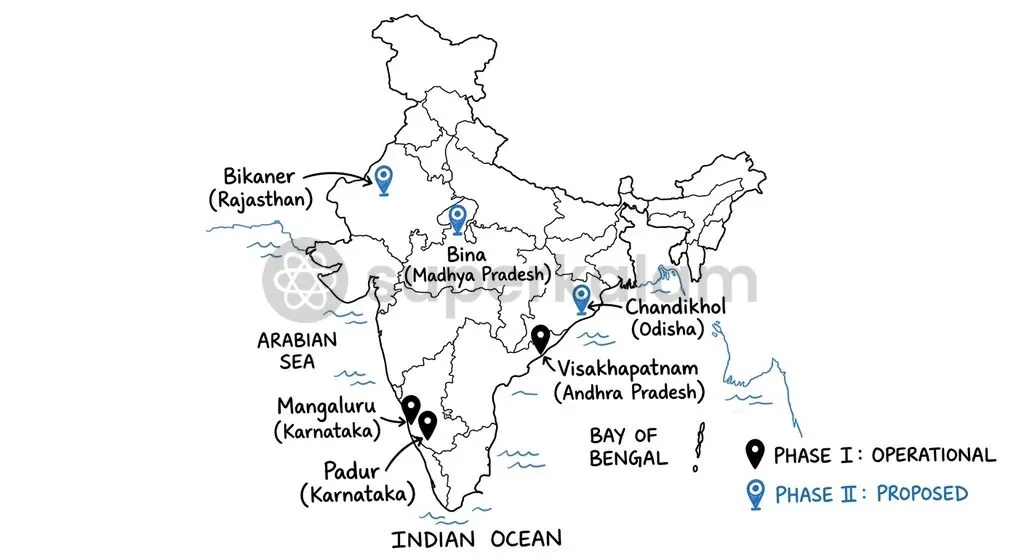
Indian Strategic Petroleum Reserves Limited (ISPRL) manages underground crude cavern facilities designed to insulate the national economy against supply emergencies. Under Phase I of the Strategic Petroleum Reserve programme, ISPRL operates 5.33 Million Metric Tonnes (MMT) of storage across Visakhapatnam (1.33 MMT), Mangaluru (1.5 MMT), and Padur (2.5 MMT), securing approximately 9.5 days of net crude requirements.
| Strategic Petroleum Storage Site | Phase Status | Capacity (MMT) | Commercial Model |
|---|---|---|---|
| Visakhapatnam, Andhra Pradesh | Phase I (Active) | 1.33 MMT | Sovereign Operated |
| Mangaluru, Karnataka | Phase I (Active) | 1.50 MMT | Sovereign Operated |
| Padur, Karnataka | Phase I (Active) | 2.50 MMT | Sovereign Operated |
| Chandikhol, Odisha | Phase II (Appr.) | 4.00 MMT | PPP Model |
| Padur Expansion, Karnataka | Phase II (Appr.) | 2.50 MMT | PPP Model |
The Union Government approved Phase II of the Strategic Petroleum Reserves programme, adding 6.5 MMT of cumulative capacity at Chandikhol (4 MMT) and Padur (2.5 MMT) under a Public-Private Partnership (PPP) model at an estimated cost of ₹14,527 crore.
To approach the International Energy Agency (IEA) 90-day emergency benchmark, the Parliamentary Standing Committee on Petroleum and Natural Gas flagged feasibility studies for additional storage caverns at Bikaner in Rajasthan, Bina in Madhya Pradesh, and a 1.7 MMT expansion at Mangaluru.
Way Forward: Balancing Strategic Autonomy with National Energy Needs
The Ministry of External Affairs (MEA) must coordinate with economic ministries to protect domestic energy security while preserving core international partnerships. Policy responses must balance bilateral diplomatic commitments with economic risk mitigation.
Key policy priorities include:
- Expanding Non-Dollar Bilateral Trade: Deepening institutional arrangements for the Rupee-Dirham settlement mechanism and resolving non-convertibility bottlenecks within Special Rupee Vostro Accounts.
- Accelerating Phase II Storage Infrastructure: Fast-tracking construction at Chandikhol and Padur under the ₹14,527 crore PPP framework to expand emergency strategic crude coverage.
- Deepening Supplier Diversification: Securing long-term term-contracts with producers across Latin America and Africa to reduce concentration risks.
- Domestic Energy Transition: Expanding biofuel blending, green hydrogen adoption, and domestic exploration under the Open Acreage Licensing Policy (OALP) to structurally moderate import dependence from 88.3%.
Discuss with Superkalam
How should India weigh the trade-off between purchasing discounted Russian crude for domestic poverty alleviation (SDG 7) and managing potential secondary tariff risks within the Quad?
Ask NowKey Takeaways
- India's crude oil import dependency reached 88.3% on a consumption basis in early FY 2026-27, leaving the macroeconomy vulnerable to global geopolitical disruptions.
- Russia supplied 48% to 50.8% of India's crude imports by mid-2026, establishing itself as the primary baseline crude source over traditional Gulf suppliers.
- Secondary sanctions threaten maritime logistics and non-dollar payment clearing, compelling refiners to use Special Rupee Vostro Accounts (SRVA) and non-Western P&I insurance cover.
- A sustained $10 per barrel increase in crude prices widens India's Current Account Deficit by 0.3 to 0.5% of GDP and adds 30 to 40 basis points to CPI inflation.
- Phase I Strategic Petroleum Reserves hold 5.33 MMT (9.5 days of net cover), with Phase II adding 6.5 MMT across Chandikhol and Padur at ₹14,527 crore to progress toward international emergency standards.
Mains Question
"Unilateral secondary sanctions targeting energy supply chains present a critical test for India's strategic autonomy and macroeconomic equilibrium." In light of this statement, evaluate the efficacy of the trade settlement and logistics mechanisms adopted by India to secure affordable crude supplies. (15 Marks)
Evaluate NowMains Question
India's Strategic Petroleum Reserves (SPR) programme serves as a crucial cushion against geopolitical shocks, yet structural gaps persist relative to global energy security benchmarks. Elucidate. (10 Marks)
Evaluate NowPractice MCQs
QUESTION 1
With reference to India's Strategic Petroleum Reserve (SPR) programme, consider the following statements:
- Phase I underground crude storage caverns located at Visakhapatnam, Mangaluru, and Padur are operated under a sovereign model.
- Phase II expansion approved storage at Chandikhol and Padur is planned under a Public-Private Partnership (PPP) model.
- The current storage capacity under Phase I fulfills the International Energy Agency's (IEA) 90-day emergency reserve benchmark. Which of the statements given above is/are correct?
QUESTION 2
According to Reserve Bank of India macroeconomic reviews cited in energy security studies, what is the estimated impact of a sustained $10 per barrel increase in global crude oil prices on India's economy?
QUESTION 3
Consider the following statements regarding the mechanics of secondary sanctions and India's crude import architecture:
- Protection and Indemnity (P&I) clubs based in G7 nations traditionally insure over ninety percent of global maritime tanker traffic.
- Following the 2022 Russia-Ukraine conflict, Russia's share in India's total crude imports expanded to approximately 48% to 50.8% by mid-2026.
- Special Rupee Vostro Accounts (SRVA) and the UAE Dirham have been utilized as alternative settlement mechanisms to mitigate dollar-clearing restrictions. Which of the statements given above are correct?
QUESTION 4
Consider the following statements regarding India's crude oil supply diversification constraints:
- Immediate volume expansion from traditional Middle Eastern suppliers like Iraq and Saudi Arabia is constrained by OPEC+ production quotas.
- Sweet crude imports from West African producers such as Nigeria and Angola face domestic infrastructure bottlenecks and theft.
- Crude sourcing from the Americas involves extended maritime transit durations that elevate freight and landing costs. Which of the statements given above are correct?
QUESTION 5
According to the Petroleum Planning & Analysis Cell (PPAC), what was India's crude oil import dependency on a consumption basis during the April–August period of FY 2026-27?