Urban Heat in Indian Cities: Why Master Plans Must Drive Thermal Resilience
Without statutory integration into city master plans, emergency heat advisories cannot protect vulnerable urban populations from lethal microclimates.
Oct, 2026
•11 min read
Overview
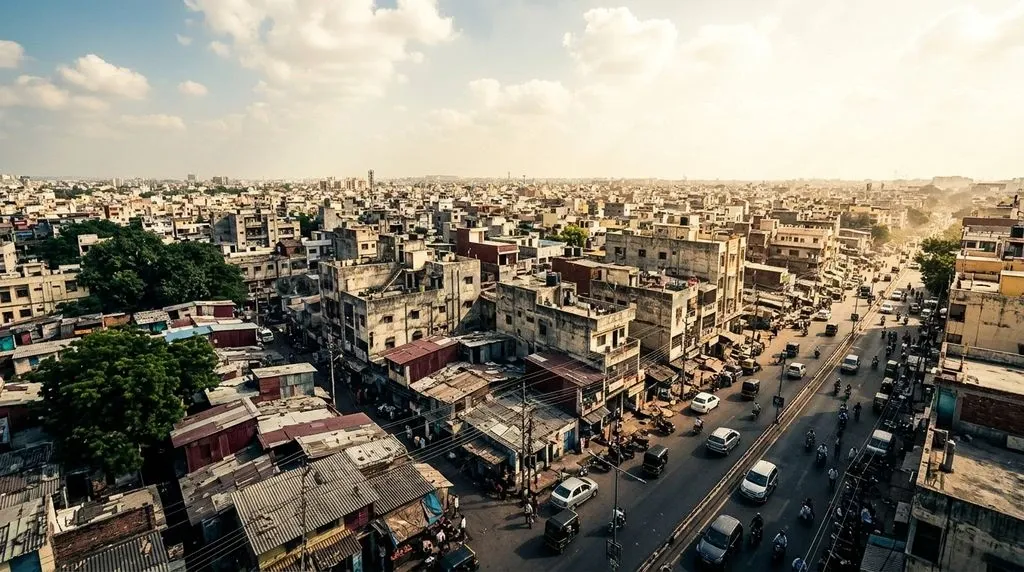
Indian municipal planning tools treat urban heat as an acute public health emergency rather than a structural spatial crisis. This leaves millions of vulnerable urban residents trapped in hazardous microclimates created by concrete-heavy zoning and depleted green cover.
Heat Action Plans provide temporary emergency advisories during summer spikes, yet they lack legal statutory backing under municipal development frameworks. To build lasting thermal resilience, urban local bodies must formally integrate high-albedo cool roofs, passive building ventilation, permeable pavements, and urban green cover mandates directly into statutory Master Plans and local building bye-laws.
Why Extreme Heat is Making Indian Cities Unlivable
Extreme heat in Indian cities is no longer a seasonal inconvenience. It has rapidly escalated into a systemic development crisis threatening public health and economic productivity.
As of July 2026, Heat Action Plans have been formulated across 23 states, 195 districts, and 64 cities following the National Disaster Management Authority's 2019 guidelines, according to a PIB release on urban heat mitigation. Despite this administrative rollout, surface temperatures across dense urban wards routinely outpace regional rural baselines.
Standard heat monitoring suffers from two operational blind spots:
- Centralised observatories: Official heatwave declarations by the India Meteorological Department rely on dry-bulb temperature anomalies recorded at regional airport observatories. This centralised monitoring systematically overlooks ward-level microclimatic heat variations and humidity spikes within packed neighbourhoods.
- Lethal wet-bulb thresholds: The IPCC Sixth Assessment Report highlights that when ambient temperatures combine with high humidity to push wet-bulb temperatures beyond the critical physiological threshold of approximately 35°C, human metabolic heat dissipation through perspiration becomes physically impossible.
In dense urban informal settlements, this physiological ceiling is approached far more rapidly. Emergency sirens and hydration advisories alone cannot protect urban populations from lethal microclimates without structural interventions in the physical built environment.
Discuss with Superkalam
What physiological wet-bulb temperature threshold did the IPCC identify as preventing human metabolic heat dissipation through sweating?
Ask NowWhat the Urban Heat Island Effect Is and Why It Happens
The Urban Heat Island effect occurs when dense built environments experience significantly higher daytime and nocturnal surface temperatures than surrounding rural fringes due to trapped radiative energy. This thermal disparity stems from fundamental alterations in the urban energy balance, physical land cover, and local geometry.
Dark impervious surfaces—such as conventional asphalt roads, stone pavements, and bitumen roofing—possess a low solar reflectance, known as albedo, ranging from 0.05 to 0.20. According to the Ministry of Housing and Urban Affairs URDPFI Guidelines (2014), these low-albedo surfaces absorb up to 90% of incident solar radiation during the day. Urban materials store this absorbed radiation and slowly re-radiate it after dusk as nocturnal sensible heat, preventing municipal areas from cooling overnight.
| Physical Factor | Underlying Mechanism | Impact on Urban Microclimate |
|---|---|---|
| Surface Albedo | Dark, impervious paving absorbs solar radiation (albedo 0.05–0.20) | Surfaces absorb up to 90% of solar energy, releasing nocturnal sensible heat |
| Vegetation Deficit | Rapid loss of tree canopy, vegetative soil, and natural wetlands | Eliminates natural evaporative cooling, elevating surface and ambient temperatures |
| Street Canyon Geometry | Tall building envelopes with low Sky View Factors (SVF) | Traps reflected radiation and obstructs natural wind corridors and heat dissipation |
| Anthropogenic Emissions | Concentrated vehicular exhaust, industrial processing, and HVAC condensers | Injects artificial sensible heat directly into street-level microenvironments |
The rapid replacement of natural vegetation and urban wetlands disrupts natural evaporative cooling. As noted in the Ministry of Housing and Urban Affairs Urban Green Guidelines (2014), the depletion of vegetative cover shifts the surface energy balance, curtailing latent heat dissipation and driving daytime land surface temperatures higher.
Compounding this loss, the geometry of deep urban street canyons traps heat between towering concrete facades. The Ministry of Housing and Urban Affairs Model Building Bye-Laws (2016) note that street canyons with low Sky View Factors trap reflected radiation while choking natural breeze corridors.
Observer Research Foundation findings show that outdoor condensing units of air conditioners, industrial machinery, and vehicular exhaust pump concentrated anthropogenic heat directly into pedestrian-level air.
The Gap Between Emergency Heat Plans and City Planning
The National Disaster Management Authority established municipal heat guidelines in 2019, yet local Heat Action Plans operate in total administrative isolation from statutory urban planning instruments. Municipal health departments manage Heat Action Plans primarily as disaster-response documents. Meanwhile, state urban development authorities continue to govern long-term spatial development.
A nationwide critical evaluation of 37 Heat Action Plans conducted by the Centre for Policy Research revealed deep operational gaps in current practice:
- Absence of statutory power: None of the 37 evaluated plans possess legal statutory backing or formal integration with statutory city Master Plans and Development Control Regulations. Consequently, municipal town planners approving high-density layouts are under no legal obligation to comply with heat mitigation strategies.
- Missing vulnerability mapping: Only 2 out of 37 plans conducted localised vulnerability assessments to identify at-risk populations.
- Unfunded mandates: Only 11 out of 37 plans identified dedicated funding streams to carry out proposed interventions.
Emergency heat plans focus almost exclusively on short-term reactionary protocols:
- Broadcasting public awareness warnings.
- Setting up temporary drinking water kiosks.
- Expanding hospital casualty ward capacities.
These measures bypass the core structural drivers of urban heat, including floor area ratios, surface permeability standards, and building setbacks that dictate airflow. Until spatial planning frameworks legally bind climate resilience into land-use allocations, cities will continue subsidising heat-trapping real estate while funding reactive disaster relief.
Discuss with Superkalam
How does a low Sky View Factor in dense urban canyons trap heat and impede natural night-time cooling?
Ask NowHow to Build Heat Resilience into Master Plans and Zoning Codes
Municipal Master Plans and local building bye-laws represent the most potent statutory levers for systematically cooling Indian cities over multi-decade planning horizons. Incorporating mandatory thermal standards into zoning laws transforms heat mitigation from an ad-hoc health intervention into a permanent condition of physical development.
Telangana established a precedent in April 2023 by notifying the 'Cool Roof Policy 2023-2028', becoming the first state in India to implement a dedicated thermal-mitigation building mandate. According to the state's Municipal Administration and Urban Development Department, the policy mandates high-albedo roofs with a Solar Reflectance Index of 90 or above for all government structures, commercial properties, and residential plots measuring 600 square yards and above.
The policy targets covering 300 square kilometres of roof area across the state by 2028—including 200 square kilometres within the Hyderabad metropolitan region—projecting annual electricity savings of 600 million units.
Building codes must expand such targeted interventions into universal baseline mandates across three spatial scales:
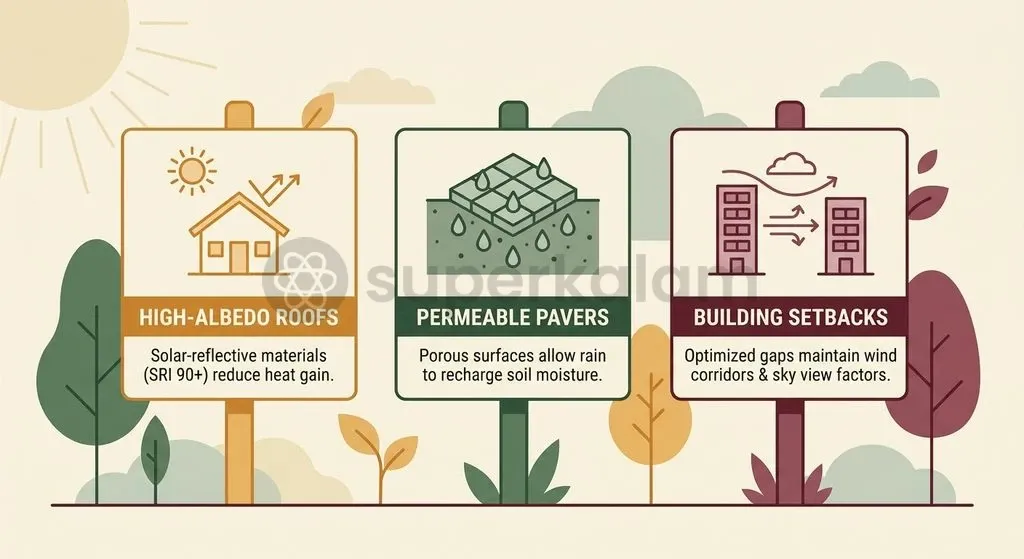
- Roofing and Envelope Regulations: Update municipal bye-laws to make high-albedo materials, solar-reflective paints, or vegetative green roofs mandatory for all new commercial and multi-unit residential structures.
- Permeable Ground Cover Mandates: Introduce minimum porous paving quotas for surface parking lots, walkways, and road shoulders to recharge groundwater and prevent excessive ground-level heat absorption.
- Passive Urban Design Ratios: Enforce maximum building-height-to-street-width ratios to preserve Sky View Factors, ensuring unimpeded nocturnal heat radiation and natural urban ventilation corridors.
Although the Ministry of Housing and Urban Affairs included sustainable design measures within Chapter 10 of the Model Building Bye-Laws (2016), the framework omits mandatory Solar Reflectance Index thresholds and permeable paving mandates for standard residential zoning codes. Amending these national model codes would provide cities with a ready template to enact binding, heat-resilient development rules.
Discuss with Superkalam
If you were framing municipal bye-laws for a rapidly expanding tier-2 city, how would you incorporate the 90 Solar Reflectance Index threshold seen in Telangana's Cool Roof Policy?
Ask NowKey Obstacles: Weak Local Bodies, Density Demands, and Lost Green Spaces
The Twelfth Schedule of the Constitution of India places urban planning and land-use regulation under the direct authority of State Governments and Urban Local Bodies. However, constitutional assignment of responsibility has not translated into administrative capacity or enforcement power on the ground.
Under the constitutional division of powers in the Seventh Schedule, 'Local government' and 'Town planning' fall under Entry 5 of the State List. As a consequence, the Union Ministry of Housing and Urban Affairs cannot unilaterally enforce building codes, leaving its Model Building Bye-Laws purely advisory until state assemblies legislate and notify them.
This federal structure creates substantial legislative inertia. State governments often hesitate to impose strict environmental bye-laws that real estate developers perceive as compliance burdens. In addition, state-level Urban Development Authorities draft master plans with little municipal coordination, splintering long-term land-use zoning from day-to-day municipal building regulation.
A comprehensive assessment by NITI Aayog revealed that 65% of the 7,933 urban settlements across India operate without any statutory master plan to guide spatial growth. Compounding this void, India faces an acute institutional deficit of qualified town planners. NITI Aayog reported that only approximately 17,000 town planners are available nationally to serve hundreds of growing urban centres, while domestic planning schools produce just a few hundred graduates each year.
| Urban Planning Dimension | Current Baseline Reality | Structural Barrier to Heat Resilience |
|---|---|---|
| Statutory Coverage | 65% of 7,933 urban settlements lack a statutory master plan | Unregulated spatial expansion locks in heat-trapping grey infrastructure |
| Planning Workforce | Acute shortage with only ~17,000 professional town planners nationwide | Urban Local Bodies lack technical capacity to run microclimate simulations |
| Informal Settlements | Uninsulated tin/asbestos roofs yield indoor heat 3°C to 6°C over ambient | High built density leaves zero spatial margin for tree canopy or setbacks |
| Municipal Finance | Most municipal bodies lack dedicated capital allocations for climate resilience | Heat interventions remain donor-reliant or restricted to small pilot zones |
This regulatory and spatial vacuum falls most heavily on informal settlements and low-income outdoor workforces. An advisory from the National Disaster Management Authority notes that uninsulated corrugated tin or asbestos roofing in slum settlements causes indoor surface temperatures to surge 3°C to 6°C above ambient air. These communities frequently lack basic electrical cooling, compounding physical distress.
Recognising the uneven burden of thermal exposure, the National Disaster Management Authority issued a national advisory directing state authorities to protect informal workers during severe heatwaves through shaded vending zones, public drinking water stations, and restructured work hours for outdoor and gig labourers. Even so, reconciling rapid urban densification with open green buffers remains an unaddressed spatial challenge across municipal jurisdictions.
Discuss with Superkalam
Why do Heat Action Plans fail to curtail the Urban Heat Island effect despite being adopted across nearly 200 districts?
Ask NowThe Way Forward: Designing Cool, Climate-Ready Urban Spaces
Urban transformation in India over the coming decades must treat heat mitigation as foundational municipal infrastructure rather than an occasional public health disaster. According to the Report of the Technical Group on Population Projections, India's urban population is projected to exceed 600 million by 2036, absorbing over 70% of total national population growth. Accommodating this demographic expansion without triggering unbearable thermal stress requires structural changes to city governance, municipal budgeting, and design standards.
Urban Local Bodies must first bridge the gap between financial planning and climate adaptation. In 2024, the Brihanmumbai Municipal Corporation introduced India's first municipal climate budget, allocating 32 percent of its capital expenditure toward climate mitigation and adaptation programmes aligned with Mumbai's Development Plan 2034, as documented by the Observer Research Foundation. Emulating this model would allow cities to secure multi-year funding for cool infrastructure projects rather than relying on discretionary disaster relief.
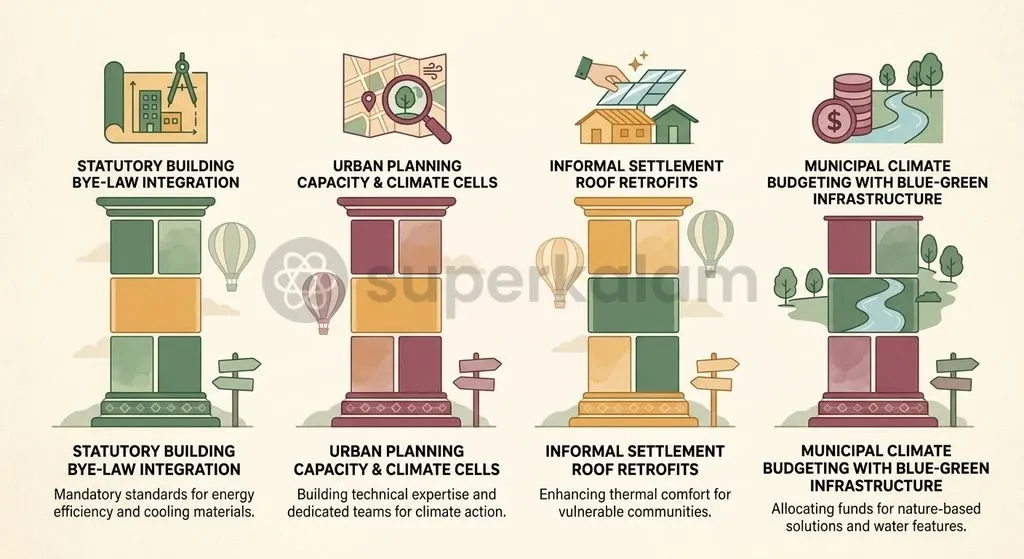
To deliver equitable cooling, municipal administrations should pursue structural reforms across four strategic pillars:
- Statutory Integration of Building Codes: State legislatures should amend municipal corporation acts to integrate high-albedo cool roofs and permeable paving mandates into local Development Control Regulations, drawing upon Telangana's Cool Roof Policy framework.
- Institutional Capacity Building: Follow NITI Aayog's recommendations by recruiting qualified spatial planners into Urban Local Bodies and establishing municipal climate cells capable of running ward-level microclimate and thermal vulnerability models.
- Targeted Thermal Retrofits for Informal Housing: Prioritise low-cost cool roof coatings and insulation retrofits for slums and informal settlements, mitigating internal temperature spikes under tin and asbestos roofs.
- Decentralised Blue-Green Networks: Mandate strict green cover minimums in all new urban master plans, treating urban tree canopies, neighbourhood parks, and water bodies as protective infrastructure against severe heat.
Discuss with Superkalam
Given that 65% of Indian towns lack master plans, assess whether national building codes should remain advisory or be tied to central municipal fiscal transfers.
Ask NowKey Takeaways
- Urban Heat Islands are driven primarily by dark, low-albedo impervious surfaces (reflectance of 0.05–0.20) absorbing up to 90% of solar radiation, combined with diminished vegetation, narrow street canyons, and concentrated anthropogenic heat emissions.
- Although 23 states, 195 districts, and 64 cities have adopted Heat Action Plans as of July 2026, research by the Centre for Policy Research shows that none carry statutory legal backing or integration with binding city Master Plans.
- Constitutional placement of urban planning under Entry 5 of the State List limits central authorities to advisory roles, requiring individual state assemblies and municipal corporations to enact binding cool building bye-laws.
- NITI Aayog assessments highlight structural planning deficits across urban India, where 65% of 7,933 urban settlements lack a statutory master plan and the country faces an acute shortfall with only approximately 17,000 town planners.
- Telangana's Cool Roof Policy 2023-2028 provides a scalable regulatory model, mandating high-albedo roofs with a Solar Reflectance Index of 90 or above for larger plots to cool indoor environments and curb energy consumption.
- Vulnerable informal settlements face severe thermal risks, with uninsulated tin and asbestos roofing elevating indoor surface temperatures 3°C to 6°C above ambient levels, demanding dedicated municipal retrofits and worker protection measures.
Mains Question
"Current municipal planning tools treat urban heat as an acute public health emergency rather than a structural spatial crisis." In light of this observation, critically examine the efficacy of Heat Action Plans (HAPs) in tackling the Urban Heat Island effect in India. (15 Marks)
Evaluate NowMains Question
Highlighting the institutional and spatial governance challenges identified by NITI Aayog, elucidate the measures needed to integrate thermal resilience into statutory city master plans. (10 Marks)
Evaluate NowPractice MCQs
QUESTION 1
With reference to the Urban Heat Island (UHI) effect and building design, consider the following statements:
- Low-albedo surfaces like conventional asphalt roads absorb up to 90% of incident solar radiation and slowly re-radiate it after dusk as nocturnal sensible heat.
- Deep street canyons with high Sky View Factors (SVF) trap reflected radiation and obstruct natural breeze corridors.
- The replacement of vegetative cover and urban wetlands reduces latent heat dissipation by curtailing evaporative cooling.
Which of the statements given above are correct?
QUESTION 2
Consider the following statements regarding Heat Action Plans (HAPs) in India:
- HAPs formulated under the National Disaster Management Authority (NDMA) guidelines possess statutory backing under municipal development frameworks.
- Official heatwave declarations by the India Meteorological Department rely on centralised dry-bulb temperature observations that often overlook ward-level microclimatic heat variations.
- A critical evaluation of 37 HAPs by the Centre for Policy Research found that a majority of them included dedicated funding streams and localised vulnerability mapping.
Which of the statements given above is/are correct?
QUESTION 3
Regarding the constitutional and institutional architecture of urban planning in India, consider the following statements:
- 'Local government' and 'Town planning' are subjects listed under Entry 5 of the State List in the Seventh Schedule of the Constitution.
- The Model Building Bye-Laws issued by the Union Ministry of Housing and Urban Affairs are legally binding on all urban local bodies upon notification by the Central Government.
- According to NITI Aayog, a majority of urban settlements across India function without any statutory master plan.
Which of the statements given above is/are correct?
QUESTION 4
With reference to the physiological impact of urban heat mentioned in the IPCC Sixth Assessment Report, what is the critical wet-bulb temperature threshold beyond which human metabolic heat dissipation through perspiration becomes physically impossible?
QUESTION 5
Consider the following statements regarding the 'Cool Roof Policy 2023-2028' notified by Telangana:
- It is the first state policy in India to mandate a dedicated thermal-mitigation building standard.
- It mandates high-albedo roofs with a minimum Solar Reflectance Index (SRI) of 90 for specified commercial, government, and large residential properties.
- It sets a target of covering 300 square kilometres of roof area across the state by 2028.
Which of the statements given above are correct?