Union Public Service Commission at 100: History, Articles, and Reforms
UPSC completes 100 years on 1 October 2026. Trace its 1926 origins, constitutional role under Articles 315-323, safeguards and recruitment reforms.
Oct, 2026
•10 min read
Overview
The Union Public Service Commission marks the culmination of its centenary on 1 October 2026. This milestone commemorates a century of merit-based civil service recruitment that began with the establishment of the Public Service Commission on 1 October 1926.
Originating from the recommendations of the 1924 Lee Commission and later reconstituted under the Government of India Act 1935, the Commission transitioned into its constitutional form under Part XIV of the Constitution of India on 26 January 1950. Operating under Articles 315 to 323, the Commission is an independent constitutional watchdog of the merit system. It conducts competitive examinations and advises the Union government on disciplinary and recruitment matters.
As civil administration encounters twenty-first-century complexities—including lateral entry, technological security, and prolonged exam cycles—the institutional evolution of the Commission remains vital for Indian governance.
Why in the News: UPSC Marks 100 Years of Merit-Based Selection
The Union Public Service Commission marks the culmination of its centenary observance on 1 October 2026, celebrating a century of merit-based recruitment since its inception in 1926. Centenary events commenced on 1 October 2025, charting the institutional journey from a colonial-era body to a premier constitutional recruiting agency.
This milestone offers an opportunity to examine the constitutional balance between executive staffing needs and meritocratic independence. In an era requiring domain-specialised governance and advanced digital examination integrity, the Commission’s constitutional safeguards under Part XIV continue to serve as the watchdog of the merit system.
Discuss with Superkalam
On which statutory provision was the concept of a Public Service Commission first outlined prior to the 1924 Lee Commission?
Ask NowHistorical Evolution: From the Lee Commission to Post-Independence India
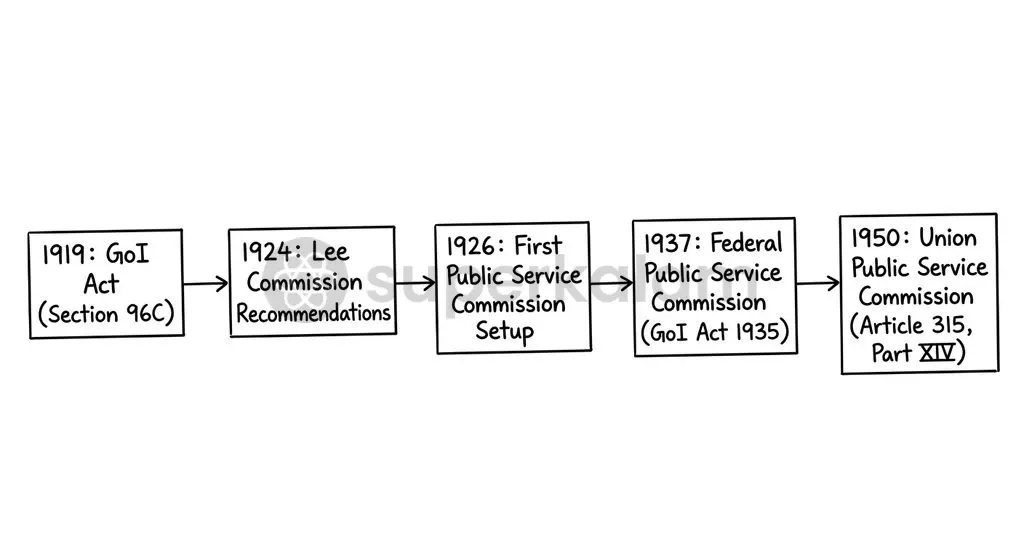
The modern Union Public Service Commission traces its statutory lineage to the Government of India Act 1919 and the subsequent recommendations of the Lee Commission in 1924. Section 96C of the Government of India Act 1919 first provided for the establishment of a Public Service Commission to regulate recruitment and control public services.
The Royal Commission on the Superior Civil Services in India, chaired by Viscount Lee of Fareham (1923–24), urged the immediate setup of this statutory authority. Consequently, on 1 October 1926, the first Public Service Commission was established with Sir Ross Barker as its Chairman alongside four other members.
The Government of India Act 1935 replaced this body with the Federal Public Service Commission, which became operational on 1 April 1937 and introduced separate Provincial Public Service Commissions. With the adoption of the Constitution on 26 January 1950, the Federal Commission was rechristened the Union Public Service Commission under Article 378, acquiring independent constitutional status under Article 315.
| Historical Phase | Governing Statute / Commission | Structural Form & Key Milestone |
|---|---|---|
| First Statutory Provision | Government of India Act 1919 (Section 96C) | Proposed a permanent body to manage civil service recruitment |
| Establishment (1926) | Lee Commission Recommendations (1923–24) | Public Service Commission established under Sir Ross Barker with 4 members |
| Federal Reconstitution (1937) | Government of India Act 1935 | Federal Public Service Commission established with provincial commissions |
| Constitutional Transition (1950) | Constitution of India (Part XIV, Article 315) | Renamed Union Public Service Commission with constitutional status |
Constitutional Architecture: Key Provisions from Article 315 to 323
Articles 315 to 323 in Part XIV of the Constitution of India establish the institutional architecture, operational independence, and mandate of the Union Public Service Commission. The constitutional framework governs appointment, tenure, removal, functions, and financial independence to insulate the Commission from executive interference.
- Article 315: Establishes the Public Service Commission for the Union and separate Public Service Commissions for the States, along with provisions for Joint State Public Service Commissions (JSPSC).
- Article 316: Governs appointment and tenure. Members are appointed by the President for a term of six years or until age 65, whichever is earlier. Under Article 316(1), as nearly as may be one-half of the members must be persons who have held office for at least ten years under the Government of India or a State Government.
- Article 317: Details removal procedures. The President can remove the Chairman or any member on grounds of misbehaviour only after the Supreme Court conducts an inquiry under Article 145 and recommends removal.
- Article 318: Authorises the President to determine the number of members and their conditions of service through regulations, which cannot be varied to their disadvantage after appointment.
- Article 319: Enforces strict post-retirement employment prohibitions to preserve impartiality.
- Article 320: Defines the core functions, making the Commission responsible for conducting examinations for appointments to the services of the Union.
- Article 321: Permits Parliament to extend the functions of the Commission to include additional services or corporate bodies established by law.
- Article 322: Specifies that the expenses of the Commission, including salaries and pensions, are charged on the Consolidated Fund of India, rendering them non-votable by Parliament.
- Article 323: Mandates the submission of an annual performance report to the President, who lays it before Parliament with an explanatory memorandum for any instances of non-acceptance of advice.
Discuss with Superkalam
Why does the Constitution mandate that UPSC expenses are charged on the Consolidated Fund of India under Article 322 rather than voted upon?
Ask NowCore Functions, Mandate, and the Advisory Nature of the Commission
Article 320 of the Constitution entrusts the Union Public Service Commission with conducting examinations for appointments to the services of the Union and advising on personnel management. The Commission conducts competitive examinations, including the Civil Services Examination, Engineering Services Examination, Combined Medical Services Examination, and the National Defence Academy Examination.
Under Article 320(3), the Union government is constitutionally required to consult the Commission on major service matters:
- Methods of Recruitment: Principles governing selection and suitability of candidates for civil posts.
- Promotions and Transfers: Appointments on promotion and transfers from one service to another, including departmental promotion committees.
- Disciplinary Matters: Disciplinary cases affecting a person serving in a civil capacity, including memorials or petitions relating to penalties.
- Legal and Pension Claims: Claims for reimbursement of legal costs incurred by civil servants in defending official acts and claims for injury pensions.
The role of the Commission is advisory and not executive. While the Union government is not legally bound by the Commission's recommendations, constitutional accountability is enforced through Article 323.
If the government rejects the Commission's advice, it must present a memorandum to Parliament explaining the reasons for non-acceptance. This legislative scrutiny deters arbitrary executive departures from the Commission’s advice.
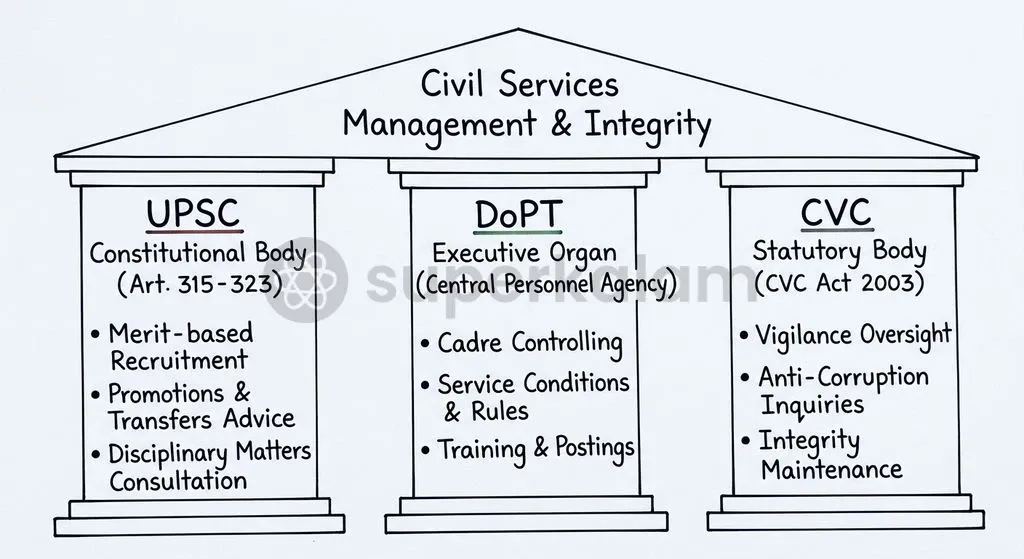
Institutional Division of Labour in Civil Services
- Union Public Service Commission (UPSC) (Constitutional Body, Arts 315–323): Conducts merit assessment and entrance examinations, advises on recruitment rules, and handles disciplinary consultations under Article 320.
- Department of Personnel and Training (DoPT) (Executive Department under MoPPG&P): Manages cadres, formulates service allocation and reservation rules, and sets conditions of service and pay.
- Central Vigilance Commission (CVC) (Statutory Body under CVC Act 2003): Oversees vigilance administration and investigates corruption allegations across public departments.
The table below contrasts the distinct roles of the Commission with executive personnel agencies:
| Dimension | Union Public Service Commission (UPSC) | Department of Personnel and Training (DoPT) | Central Vigilance Commission (CVC) |
|---|---|---|---|
| Legal Character | Constitutional Body (Part XIV, Article 315) | Executive Department (Ministry of Personnel) | Statutory Body (CVC Act 2003) |
| Primary Mandate | Testing merit, entrance exams, and disciplinary advice | Cadre management, training, service conditions, reservations | Vigilance administration and integrity oversight |
| Nature of Decisions | Advisory recommendations (tabled in Parliament under Art 323) | Executive orders and binding service rules | Advisory on vigilance penalties and anti-corruption |
Safeguards for Institutional Autonomy and Impartiality
The Constitution of India protects the autonomy of the Union Public Service Commission through security of tenure, financial independence, and stringent post-retirement employment prohibitions. These institutional guarantees isolate the selection process from political patronage.
Tenure security under Article 317 prevents arbitrary executive dismissal. Article 317(3) allows the President to remove a member for insolvency, paid employment outside official duties, or being unfit to continue in office because of infirmity of mind or body. Removal for misbehaviour under Article 317(1) requires a Supreme Court inquiry on a reference from the President and a report that the member ought to be removed. The President must abide by the Supreme Court’s findings, ensuring judicial review over removals.
Post-tenure employment bars under Article 319 prevent members from seeking executive favours during their tenure:
- The Chairman of the UPSC is ineligible for further employment under the Government of India or any State Government under Article 319(a).
- Under Article 319(c), a member of the UPSC (other than the Chairman) is eligible only for appointment as the Chairman of the UPSC or as the Chairman of a State Public Service Commission, but cannot accept any other government post.
- Members cannot serve a second term in the same office, ruling out incentives for executive reappointment.
Financial independence is reinforced by Article 322, which mandates that administrative costs and member pensions are charged directly upon the Consolidated Fund of India. Furthermore, the conditions of service cannot be altered to a member's detriment after appointment.
Discuss with Superkalam
If the Union Government disagrees with a disciplinary penalty recommended by the UPSC, what constitutional procedure must it follow under Article 323?
Ask NowCurrent Structural Challenges: Lateral Entry, Exam Integrity, and Delays
Contemporary administrative demands have introduced complex challenges for the Union Public Service Commission, ranging from lateral entry recruitment debates to lengthy examination cycles and technological security. As governance expands into technical and economic domains, recruitment systems face growing operational pressures.
- Lateral Entry Integration: Inducting domain specialists at Joint Secretary, Director, and Deputy Secretary levels bypasses traditional career progression. While the Commission conducts these selections on requisition from the Department of Personnel and Training, integrating contractual experts while addressing reservation mandates remains a significant policy debate.
- Lengthy Examination Cycles: The Civil Services Examination spans nearly twelve months across the Preliminary, Main, and Personality Test stages. This extended cycle causes severe opportunity costs for aspirants and delays the deployment of civil servants into government cadres.
- Technological and Document Verification Security: Public examinations across the country face threats from impersonation and fraudulent caste, disability, or economic quota certificates. Verifying credentials and securing biometric screening without compromising speed requires continuous technological upgrades.
- Interview Subjectivity Concerns: Ensuring consistency and eliminating subconscious bias across multiple interview boards during the Personality Test requires ongoing methodological refinement.
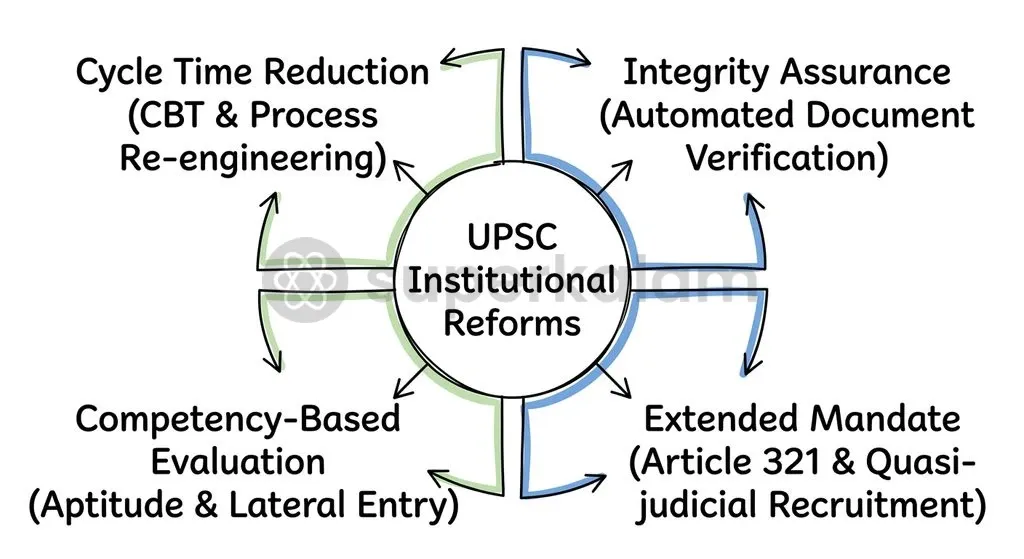
Way Forward: Modernising India's Premier Recruiting Body for the Next Century
Modernising the Union Public Service Commission requires reducing examination cycle durations, upgrading computer-based testing infrastructure, and aligning recruitment with the specialised needs of twenty-first-century governance. Structural reforms must protect constitutional impartiality while accelerating recruitment workflows.
First, the Commission should rationalise its examination timeline. Adopting computer-based testing (CBT) for preliminary screenings and deploying digital evaluation tools for descriptive answer scripts could help shorten the examination cycle.
Second, verification pipelines must be digitised. Integrating candidate verification with automated government databases (such as digital caste and disability registries) will prevent document fraud and streamline scrutiny before the interview stage.
Third, the Commission's advisory footprint can expand under Article 321. Entrusting the Commission with standardised recruitment for central autonomous bodies and regulatory authorities would standardise merit selection across public institutions.
Finally, testing methods must balance generalist administrative capability with domain-specific competencies. Incorporating psychometric tools, situational judgment assessments, and adaptive testing will ensure civil servants are equipped for modern public administration.
Discuss with Superkalam
How do the post-retirement restrictions under Article 319 compare between the Chairman of the UPSC and other members?
Ask NowKey Takeaways
- The Union Public Service Commission traces its origins to the Lee Commission (1923–24) and was established on 1 October 1926 under Sir Ross Barker with four other members, marking 100 years of merit recruitment on 1 October 2026.
- Articles 315 to 323 in Part XIV of the Constitution govern the Commission's structure, independence, functions, and reporting mechanisms.
- Members serve a term of six years or until age 65 under Article 316, and as nearly as may be one-half must have at least ten years of service under the Government of India or a State Government.
- Under Article 317, removal for misbehaviour requires a mandatory Supreme Court inquiry under Article 145, ensuring judicial protection against arbitrary dismissal.
- Article 319(c) restricts retired UPSC members from future government employment, permitting them only to become the Chairman of the UPSC or a State PSC.
- Article 320 gives the Commission an advisory mandate, with accountability enforced by Article 323 through the mandatory tabling of non-acceptance memoranda before Parliament.
Mains Question
"The Union Public Service Commission is an independent constitutional watchdog of the merit system, yet its mandate remains predominantly advisory in nature." In light of Article 320 and Article 323 of the Constitution, critically examine the institutional efficacy of this arrangement in safeguarding meritocracy. (15 Marks)
Evaluate NowMains Question
Trace the historical evolution of the Union Public Service Commission from the recommendations of the 1924 Lee Commission to its constitutional institutionalisation under Part XIV. Elucidate. (10 Marks)
Evaluate NowPractice MCQs
QUESTION 1
With reference to the constitutional provisions governing the Union Public Service Commission (UPSC), consider the following statements:
- The administrative expenses of the Commission, including salaries and pensions of its members, are charged upon the Consolidated Fund of India.
- The President can remove a member of the UPSC on grounds of misbehaviour only after receiving a recommendation following an inquiry by the Supreme Court.
- The Chairman of the UPSC is eligible for appointment as the Chairman of a State Public Service Commission upon ceasing to hold office.
Which of the statements given above are correct?
QUESTION 2
Consider the following statements regarding the historical evolution of the Public Service Commission in India:
- Section 96C of the Government of India Act 1919 first provided for the statutory establishment of a Public Service Commission.
- The Public Service Commission was established on 1 October 1926 based on the recommendations of the Viscount Lee Commission.
- Sir Ross Barker served as the first Chairman of the Public Service Commission set up in 1926.
Which of the statements given above are correct?
QUESTION 3
Under the Constitution of India, in which of the following matters is consultation with the Union Public Service Commission mandatory under Article 320(3)?
- Methods of recruitment to civil services and for civil posts.
- Principles to be followed in making promotions and transfers from one service to another.
- Disciplinary matters affecting a person serving under the Government of India in a civil capacity.
- Claims for the reimbursement of legal expenses incurred by a civil servant in defending official acts.
Select the correct answer using the code given below:
QUESTION 4
With reference to the composition and terms of office of members of the Union Public Service Commission under Article 316, consider the following statements:
- A member of the UPSC holds office for a term of six years or until attaining the age of 65 years, whichever is earlier.
- As nearly as may be one-half of the members of the Commission must have held office for at least ten years under the Government of India or a State Government.
- A member of the Commission is eligible for reappointment to the same office for a second term.
Which of the statements given above is/are correct?
QUESTION 5
Under Article 323 of the Constitution of India, the annual report on the work done by the Union Public Service Commission is submitted directly to: