UPI Zero MDR Policy Explained: Who Pays for Free Digital Payments
Zero merchant fees made UPI free for users and merchants, but banks and fintechs now bear rising infrastructure costs, reviving the debate over who pays for India's digital payment rails.
Sep, 2026
•10 min read

Context
India's Unified Payments Interface has democratised retail transactions across the subcontinent, but the underlying Zero-MDR mandate has turned digital payments into a policy trade-off between universal public access and the commercial sustainability of banking intermediaries. While consumers enjoy zero transaction costs, the statutory ban on merchant fees has deprived payment aggregators and acquiring banks of direct revenue. This dynamic has forced payment companies into auxiliary monetization channels like unsecured digital lending, hardware subscription rentals, and government budgetary reimbursements. Evaluating this payment model requires examining statutory provisions, market structures, and the economic balance necessary to sustain critical digital public infrastructure.
Why Merchant Fees on UPI Are Back in the News
Merchant fee structures across India's digital payments architecture face recurring scrutiny as the Union Government balances digital adoption with fintech commercial viability. As of September 2026, that debate has become policy: NPCI has notified a revised framework reintroducing a Merchant Discount Rate of 0.4% on person-to-merchant UPI transactions above ₹2,000, effective October 15, 2026, partially rolling back the zero-MDR regime in force since January 2020.
The legal anchor of this regime rests on Section 10A of the Payment and Settlement Systems Act, 2007, which was inserted via the Finance (No. 2) Act, 2019. Under this provision, banks and system providers are prohibited from levying any charge or Merchant Discount Rate (MDR) on payers or merchants using prescribed electronic modes.
To operationalise this framework, the Central Board of Direct Taxes issued CBDT Notification No. 105/2019 under Section 269SU of the Income-tax Act, 1961, formally mandating a zero-MDR regime starting January 1, 2020, for RuPay debit cards, BHIM-UPI QR codes, and BHIM-UPI.
MDR Returns from October 15, 2026: The New Framework
After six years of zero-MDR, merchant fees are returning to UPI in a targeted form. Key features of the new NPCI framework:
- A 0.4% MDR applies to person-to-merchant (P2M) UPI transactions above ₹2,000, capped at ₹300 for transactions of ₹75,000 and above; essential sectors (railways, telecom, insurance, fuel and agricultural inputs) pay a flat ₹5 on payments over ₹2,000.
- P2P transfers and P2M transactions up to ₹2,000 stay free; small merchants receiving up to ₹1 lakh per month via UPI QR codes (P2PM category) are exempt.
- The levy is projected to raise about ₹15,000 crore a year, split among the payer's bank (40%), the merchant's bank (30%), UPI app providers (20%) and payment service providers (10%); a dedicated fund receives 5% of collections to promote UPI adoption among small merchants.
- Transactions above ₹2,000 account for only 4% of merchant-payment volume but 67% of value.
- The Finance Ministry has advised banks to ensure merchants do not pass MDR on to customers; the government will monitor this daily, and UPI apps are barred from adding platform fees. The government rejected claims that the move came under US pressure, and all RuPay debit card transactions remain MDR-free.
- Scale check: UPI processed 2,451 crore transactions worth ₹29.9 lakh crore in August 2026.
Discuss with Superkalam
Which statutory section of the Payment and Settlement Systems Act, 2007 prohibits levying MDR on prescribed digital payment modes?
Ask NowWhat Is NPCI and How Does the UPI System Move Money?
The National Payments Corporation of India operates as the foundational utility architect for retail settlement across the Indian economy. Incorporated in December 2008, NPCI was established as a not-for-profit company under Section 25 of the Companies Act, 1956 (now Section 8 of the Companies Act, 2013) as a joint initiative of the Reserve Bank of India and the Indian Banks' Association.
Statutory authority to operate retail payment rails—including Unified Payments Interface (UPI), Immediate Payment Service (IMPS), RuPay, and the National Automated Clearing House (NACH)—is granted by the Reserve Bank of India under Section 4 of the Payment and Settlement Systems Act, 2007.
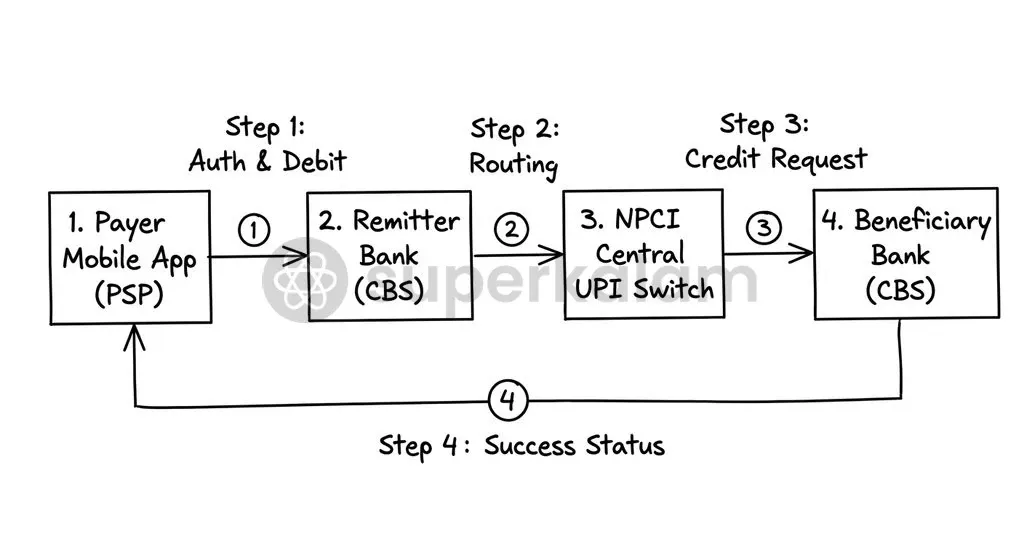
A standard UPI transaction relies on a four-party structural workflow that moves funds instantly between disparate core banking systems:
- Payer and Payer PSP (Payment Service Provider): The end-user initiates an authentication request via a Third-Party Application Provider (TPAP) or bank application, prompting the Payer PSP to route debits to the remitter bank.
- Remitter Bank: The issuing bank verifies the user's secure credentials, executes an internal ledger debit, and transmits an encrypted payment message to the central switch.
- NPCI Central Switch: The system operates as the central routing hub, validating routing metadata, securing settlement records, and directing instructions to the beneficiary's institution.
- Beneficiary Bank and Payee PSP: The acquiring institution receives transaction instructions, credits the recipient's bank account, and sends an automated cryptographic confirmation back through the payment network.
Understanding MDR: Who Pays for Digital Transactions?
Merchant Discount Rate represents the processing fee charged to a commercial merchant for accepting payments via electronic clearing channels. According to the Reserve Bank of India, MDR compensates acquiring banks, network switches, and payment facilitators for terminal deployment, switch maintenance, risk management, and clearing infrastructure.
In standard global electronic transactions, MDR is split across three distinct operational segments:
- Interchange Fee: The largest share of MDR, paid by the merchant's acquiring bank directly to the card- or account-issuing bank to offset account servicing, credit risk, and customer maintenance costs.
- Acquirer Processing Margin: The operational fee retained by the merchant's acquiring bank and payment aggregators for onboarding merchants, providing point-of-sale hardware, and managing settlements.
- Network Switching Fee: A minor fee paid to the transaction switch (such as NPCI, Visa, or Mastercard) for routing, cryptographic validation, and ledger settlement.
| Payment Component | Primary Recipient | Functional Purpose in Transaction Lifecycle |
|---|---|---|
| Interchange Fee | Issuing Bank (Remitter) | Offsets capital outlays for account onboarding, fraud controls, and customer servicing. |
| Acquirer Markup | Acquiring Bank / Payment Aggregator | Covers POS/QR deployment, merchant onboarding verification, and gateway server bandwidth. |
| Switching Fee | Network Switch (e.g., NPCI) | Funds central message routing, clearing house infrastructure, and switch uptime redundancy. |
| Merchant Discount Rate (MDR) | Composite Merchant Levy | Total fee collected from merchants to fund all three network components above. |
Prior to the zero-MDR policy, the Reserve Bank of India rationalised debit card fees on December 6, 2017, establishing tiered fee caps: small merchants with turnover up to ₹20 lakh were charged a maximum MDR of 0.40% capped at ₹200 per transaction, while standard merchants paid up to 0.90% capped at ₹1,000 per transaction.
Discuss with Superkalam
Explain how the four-party UPI transaction workflow processes a payment from the payer's bank account to the beneficiary's account.
Ask NowThe New Merchant Fee Rules: What Changes for Wallets and QR Codes?
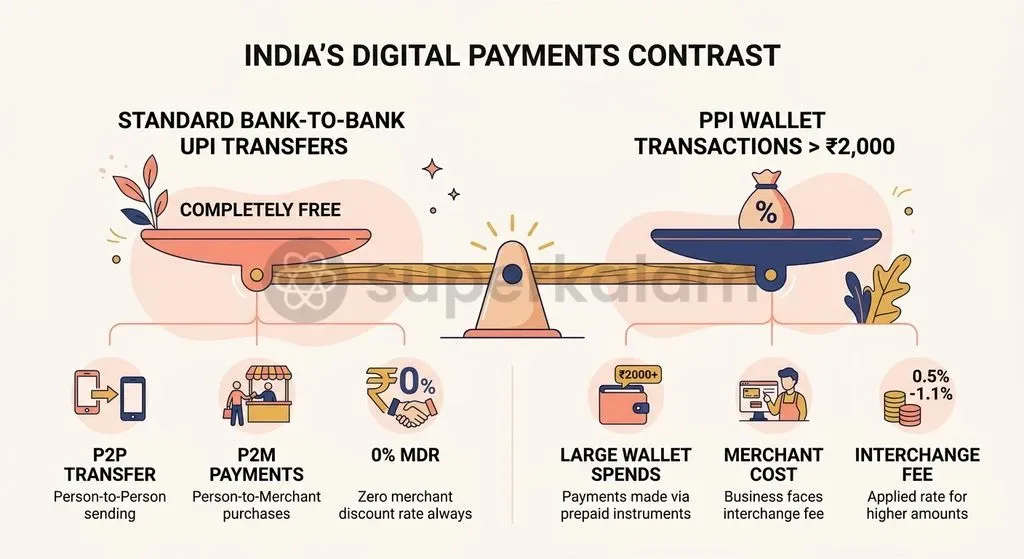
To introduce targeted financial sustainability into payment routing without burdening retail users, NPCI updated its fee framework for Prepaid Payment Instruments (PPIs). Effective April 1, 2023, NPCI introduced an interchange fee ranging from 0.5% to 1.1% on Person-to-Merchant (P2M) transactions above ₹2,000 executed via interoperable PPI wallets across UPI rails.
The operational mechanics of this PPI interchange rule operate across specific technical boundaries:
- P2M Wallet Transactions Exceeding ₹2,000: When a consumer uses a prepaid wallet (e.g., a digital wallet app) to scan a merchant's standard UPI QR code for a transaction above ₹2,000, the merchant's acquiring bank pays an interchange fee to the wallet provider.
- Wallet-Loading Service Charge: PPI issuers must remit a 15-basis-point (0.15%) loading charge to the remitter bank when customers load wallet balances exceeding ₹2,000 via account transfers.
- Total Consumer Exemption: Normal consumers pay zero fees when making retail payments from wallets or bank accounts.
- Complete Exemption for Account-to-Account UPI: Peer-to-Peer (P2P) transfers and standard bank-account-to-bank-account Person-to-Merchant (P2M) transactions remain completely exempt from MDR and interchange charges.
Free Payments vs Business Survival: The Big Economic Debate
The statutory abolition of merchant fees has generated structural tensions across India's digital economy. The framework functions as an institutional debate between treating digital rails as a utility versus maintaining the commercial solvency of market intermediaries.
The Economic Rationale for Free Payments (Digital Public Good)
Framed under the G20 India Digital Public Infrastructure architecture, digital payments operate as a Digital Public Good (DPG) exhibiting high upfront fixed development costs, near-zero marginal cost per additional transaction, and universal access.
Advocates argue that maintaining zero MDR creates distinct public-welfare advantages:
- Elimination of Cash-Handling Externalities: Moving retail volume to traceable digital ledgers reduces cash-printing expenses, suppresses informal black-money velocity, and lowers physical currency transit risks.
- Rapid Bottom-of-the-Pyramid Onboarding: Removing acceptance fees enables small street vendors and micro-enterprises to adopt QR-code payments without denting narrow trade margins.
- Expanded Formalisation and Direct Tax Visibility: Digital audit trails generate transaction records, broadening the direct tax base under Section 269SU of the Income-tax Act, 1961.
The Structural Risks to Intermediaries and Financial Stability
Conversely, the absence of commercial transaction revenue creates vulnerabilities across the domestic payment architecture. According to the Reserve Bank of India's 2022 Discussion Paper on Charges in Payment Systems, suppressing direct fee recovery poses operational risks:
- Infrastructure Under-Investment: Deprived of organic transaction revenues, acquiring banks face margin pressure, risking under-investment in server capacity, cybersecurity defences, and dispute resolution systems.
- Distorted Monetization Models: Third-Party Application Providers face asymmetric unit economics, driving them to cross-sell retail credit, merchant working capital loans, insurance, and investment products using customer digital footprint data.
- Alternative Hardware Levies: To secure cash flow, fintech aggregators have deployed subscription-based monthly rental fees on audio payment confirmation boxes ("Soundboxes") and point-of-sale hardware.
- Fiscal Dependency on State Subsidies: Between FY 2021-22 and FY 2024-25, the Ministry of Finance allocated approximately ₹8,730 crore in budgetary financial incentives to reimburse acquiring and issuing banks for processing zero-MDR UPI and RuPay transactions.
- Market Concentration Risks: Market share concentration has grown on UPI rails. In response, NPCI proposed a 30% volume market-share cap on individual TPAP applications, extending the compliance deadline to December 2026.
Discuss with Superkalam
If a consumer purchases goods worth ₹3,500 using an interoperable prepaid digital wallet via a merchant's UPI QR code, how do the April 2023 interchange rules apply?
Ask NowHow Other Countries Charge for Digital Payments
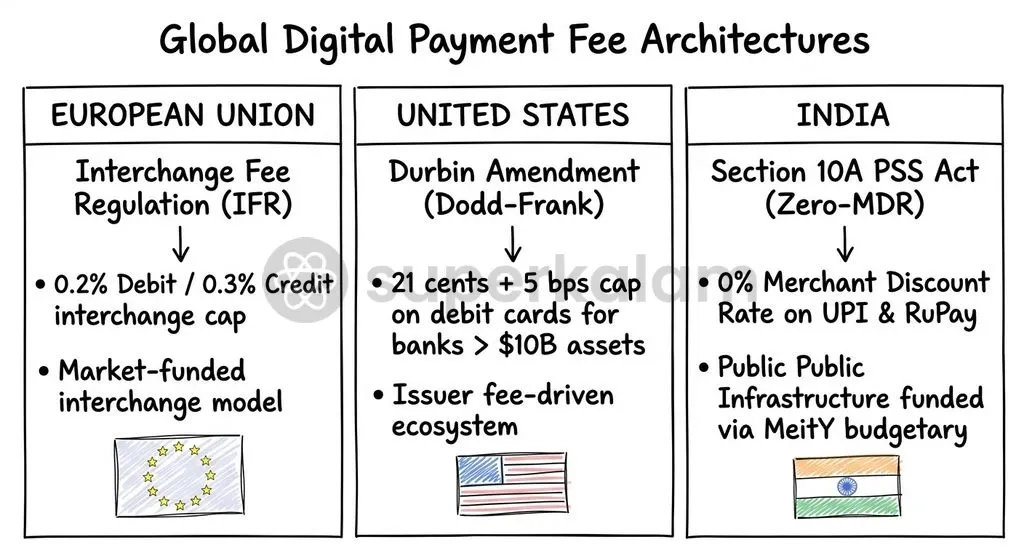
Cross-border central banking frameworks approach retail electronic interchange by enforcing statutory fee caps rather than absolute bans. This approach balances payment system security with consumer cost protection.
| Jurisdiction | Primary Legal / Regulatory Instrument | Mechanism and Enforced Caps |
|---|---|---|
| European Union | Regulation (EU) 2015/751 (Interchange Fee Regulation) | Capped interchange fees for consumer debit card payments at 0.2% and consumer credit card transactions at 0.3% of transaction value across member states since December 2015. |
| United States | Durbin Amendment (Dodd-Frank Act 2010 / Fed Regulation II) | Capped debit interchange for banks with assets of $10 billion or more at 21 cents plus 5 basis points of transaction value, plus an optional 1-cent fraud-prevention adjustment. |
| India | Section 10A, PSS Act, 2007 read with Section 269SU IT Act | Imposes a 0.00% Zero-MDR mandate on prescribed retail electronic modes (BHIM-UPI, RuPay debit), supported by central budgetary incentive grants. |
Way Forward: Building a Financially Viable Digital Public Infrastructure
Resolving India's digital payment trilemma—balancing financial inclusion, commercial viability, and systemic risk mitigation—requires calibrated policy reforms.
- Graduated, Tiered MDR for High-Turnover Merchants: Policy makers could introduce a low, tiered MDR structure on large commercial enterprises while preserving absolute zero-MDR protection for small and micro-merchants, mirroring the Reserve Bank of India's 2017 debit card tiered framework.
- Dedicated Digital Infrastructure Resilience Fund: Transitioning from discretionary annual MeitY budget allocations to a statutory development fund financed by minor interchange levies on corporate transactions would guarantee funding for cybersecurity and core banking switch upgrades.
- Enforcing Market Share Diversification: Implementing NPCI's 30% TPAP volume cap will reduce systemic single-point-of-failure risks and encourage public and private sector banks to invest in native UPI applications.
- Strengthening Algorithmic Consumer Protections: As payment intermediaries monetize non-fee payment workflows through retail lending and financial distribution, the Reserve Bank of India must maintain regulatory oversight on digital lending apps to protect consumer data privacy.
Discuss with Superkalam
Analyse the unintended economic distortions created when fintech payment aggregators lose transaction fee revenue under a zero-MDR regime.
Ask NowKey Takeaways
- Statutory Foundation: Section 10A of the Payment and Settlement Systems Act, 2007, inserted via the Finance (No. 2) Act, 2019, prohibits banks and system providers from levying MDR on prescribed digital payment modes.
- Corporate Structure: NPCI operates retail systems under Section 4 of the PSS Act, 2007, and is incorporated as a not-for-profit entity under Section 8 of the Companies Act, 2013.
- PPI Interchange Scope: Effective April 1, 2023, an interchange fee of 0.5% to 1.1% applies to merchant (P2M) UPI transactions above ₹2,000 made via Prepaid Payment Instruments (wallets), while standard bank-to-bank UPI remains free.
- Fiscal Compensations: To offset the zero-MDR policy, the Ministry of Finance allocated approximately ₹8,730 crore between FY 2021-22 and FY 2024-25 to support acquiring and issuing banks.
- Global Precedents: Unlike India's statutory ban, the European Union (Regulation 2015/751) and the United States (Durbin Amendment) regulate digital payment margins via interchange caps rather than complete fee prohibitions.
Mains Question
"The statutory enforcement of a zero-MDR regime under Section 10A of the Payment and Settlement Systems Act, 2007 highlights a critical policy trade-off between universal financial inclusion and the commercial viability of payment intermediaries." Critically analyse. (150 words) (10 Marks)
Evaluate NowMains Question
Framed as a Digital Public Good under India's Digital Public Infrastructure architecture, digital retail payments face significant challenges regarding long-term financial sustainability. In light of the Reserve Bank of India's Discussion Paper on Charges in Payment Systems and recent PPI interchange reforms, evaluate the measures required to balance public access with commercial viability. (250 words) (15 Marks)
Evaluate NowPractice MCQs
QUESTION 1
With reference to the regulatory and statutory framework governing digital payments in India, consider the following statements:
- Section 10A of the Payment and Settlement Systems Act, 2007 prohibits banks and system providers from imposing any Merchant Discount Rate on prescribed electronic modes.
- The National Payments Corporation of India (NPCI) was incorporated as a for-profit commercial entity under the Companies Act, 1956.
- The zero-MDR mandate was operationalised through CBDT Notification No. 105/2019 under Section 269SU of the Income-tax Act, 1961.
Which of the statements given above are correct?
QUESTION 2
Consider the following statements regarding the Merchant Discount Rate (MDR) structure in electronic transactions:
- The interchange fee forms the largest component of MDR and is paid to the issuing (remitter) bank.
- The acquirer processing margin is retained by the network switch to fund central message routing redundancy.
- The network switching fee compensates clearing house switches such as NPCI for routing and validation.
Which of the statements given above is/are correct?
QUESTION 3
Regarding the updated interchange fee rules for Prepaid Payment Instruments (PPIs) on UPI effective April 1, 2023, consider the following statements:
- An interchange fee ranging between 0.5% and 1.1% applies to Person-to-Merchant (P2M) transactions above ₹2,000 executed via interoperable PPI wallets.
- Normal consumers are required to pay a 15-basis-point service fee when loading wallet balances exceeding ₹2,000 via account transfers.
- Standard bank-account-to-bank-account UPI transactions remain completely exempt from interchange and MDR charges.
Which of the statements given above are correct?
QUESTION 4
In the standard four-party structural workflow of a UPI transaction, which entity performs the primary function of routing debits to the remitter bank following authentication via a Third-Party Application Provider?
QUESTION 5
Consider the following statements regarding the economic rationale of treating digital payments as Digital Public Infrastructure (DPI):
- Digital payment rails exhibit high upfront fixed development costs and near-zero marginal cost per additional transaction.
- The zero-MDR policy was aimed at suppressing cash-handling externalities and encouraging micro-merchant onboarding.
- The Reserve Bank of India highlighted that the suppression of organic transaction revenue poses risks of under-investment in server capacity and dispute resolution.
Which of the statements given above is/are correct?