UPI 0.4% Merchant Fee Above Rs 2,000: What Changes
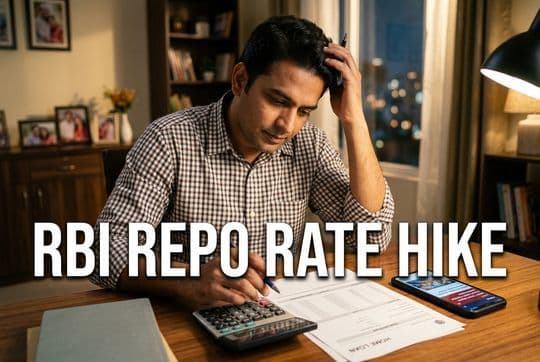
From October 15, merchants face a 0.4% fee on UPI payments above Rs 2,000, while person-to-person transfers remain exempt.
Sep, 2026
•8 min read
Overview
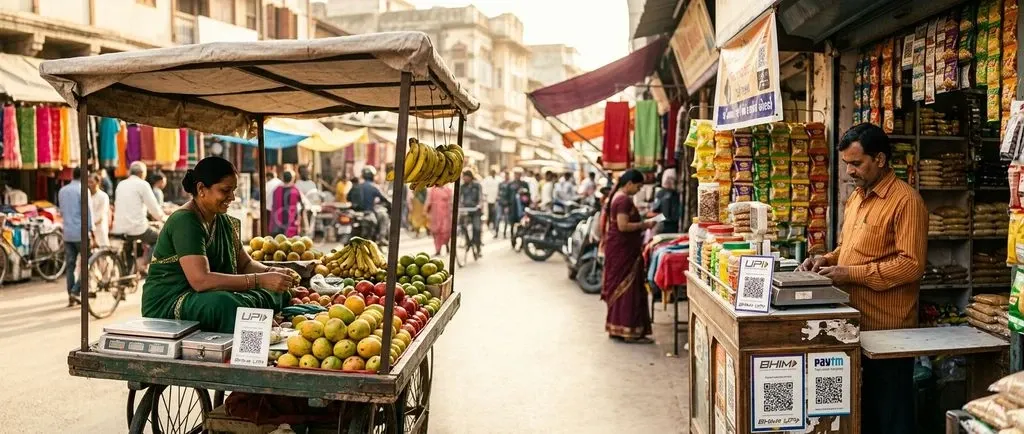
India is reforming its digital payment architecture. The policy moves away from a blanket statutory zero-MDR mandate toward an enabling regulatory framework that permits targeted, cost-reflective merchant fees while keeping consumer transactions permanently free.
The Unified Payments Interface processed approximately 241.6 billion transactions worth ₹314.2 lakh crore in FY 2025–26, representing over 80% of India's retail digital payments. Uncompensated server expansions, fraud detection overheads, and cyber-defence costs have strained the acquiring banks and payment aggregators maintaining these rails. The reform protects micro-merchant inclusion while restoring commercial incentives to safeguard India's critical Digital Public Infrastructure.
Why Merchant Discount Rate on UPI is Back in the News
Parliament has moved to reform digital payment pricing across retail networks. The legislative shift focuses on four key dimensions:
- Statutory Amendment: The Parliament of India introduced The Taxation and Other Laws (Amendment) Bill, 2026 to amend Section 10A of the Payment and Settlement Systems Act, 2007.
- Enabling Framework: This replaces the absolute legislative prohibition on Merchant Discount Rate (MDR) with an enabling regulatory mechanism, empowering the Central Government to notify specific exempt or chargeable digital modes.
- Consumer Protection: As of August 2026, the Ministry of Finance clarified that ordinary retail consumers and all Person-to-Person (P2P) transfers will remain completely free of charges.
- Targeted Scope: Any future payment charges will be strictly nominal and confined to high-value commercial transactions, responding to long-standing financial stress across acquiring banks and payment service providers.
Discuss with Superkalam
Which statutory provision was inserted by the Finance (No. 2) Act, 2019 to mandate the Zero-MDR policy on UPI and RuPay?
Ask NowWhat is MDR and How Does UPI Pricing Actually Work?
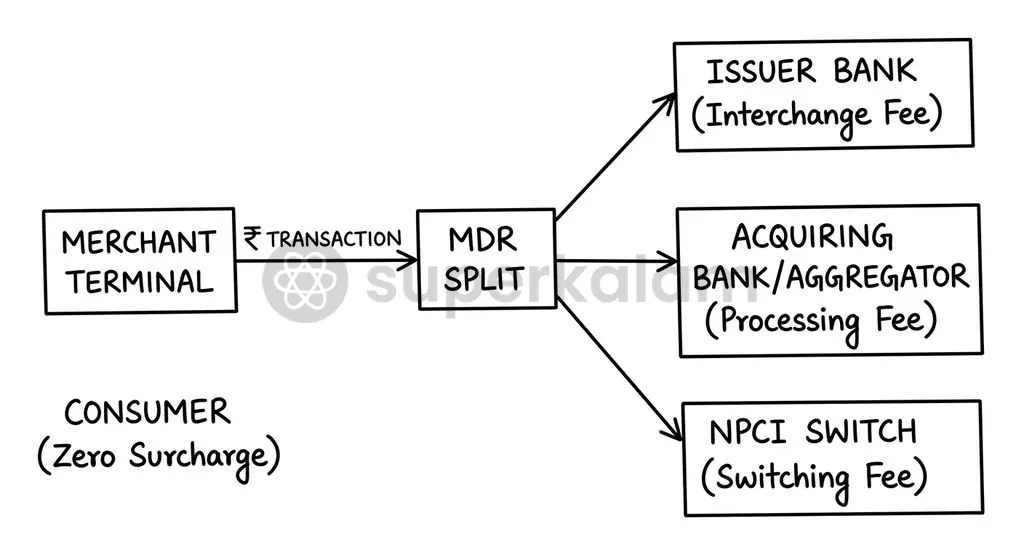
The Merchant Discount Rate is the operational fee deducted from a merchant by the acquiring bank to process electronic payment transactions over retail payment rails. According to the Reserve Bank of India Discussion Paper on Charges in Payment Systems, standard MDR is apportioned among three primary payment intermediaries:
- The Issuing Bank: Receives an interchange fee to cover account maintenance, fraud monitoring, and capital costs.
- The Acquiring Bank and Aggregator: Retains a processing margin for onboarding merchants, providing soundboxes or QR hardware, and maintaining merchant settlement gateways.
- The Network Switch: Receives a switching fee collected by the National Payments Corporation of India (NPCI) to operate central routing servers.
When a consumer scans a Quick Response (QR) code, these back-end institutions execute complex routing, authentication, and core banking handshakes within milliseconds.
In standard two-sided payment markets, merchants absorb this fractional MDR because digital acceptance reduces cash handling risks, eliminates counterfeit exposure, and accelerates sales velocity.
A Brief History: The Zero-MDR Policy and the Cost of Free Payments
The Government of India enacted the statutory Zero-MDR policy through the Finance (No. 2) Act, 2019 to rapidly drive nationwide digital payment adoption. The regulatory framework evolved through distinct legislative steps:
- Statutory Prohibition: Parliament inserted Section 10A into the Payment and Settlement Systems Act, 2007, barring banks and system providers from levying any charges on customers or merchants using prescribed electronic modes.
- Notified Modes: The Central Board of Direct Taxes subsequently notified RuPay Debit Cards, Unified Payments Interface (BHIM-UPI), and BHIM-UPI QR codes under Rule 119AA of the Income-tax Rules pursuant to Section 269SU of the Income-tax Act, 1961.
- Rapid Onboarding: The regulatory mandate onboarded tens of millions of street vendors and unorganised retailers who previously resisted Point-of-Sale terminal rental fees. However, eliminating merchant revenue broke the traditional cost-recovery mechanism for acquiring institutions.
- Incentive Scheme: To offset operational shortfalls, the Union Cabinet established the Digital Payments Incentive Scheme, providing an incentive rate of approximately 0.15% on low-value BHIM-UPI Person-to-Merchant (P2M) transactions up to ₹2,000.
- Strict Conditions: Disbursing the final 20% of this government incentive is strictly conditioned on banks maintaining system uptime above 99.5% and technical decline rates below 0.75%.
Discuss with Superkalam
How does standard MDR get apportioned among the issuing bank, acquiring bank, and payment network switch?
Ask NowWhat Changed in the Rules: Who Pays What Across Transactions?
The National Payments Corporation of India clarified transaction pricing in 2023 by introducing interchange fees specifically on high-value Prepaid Payment Instrument transactions:
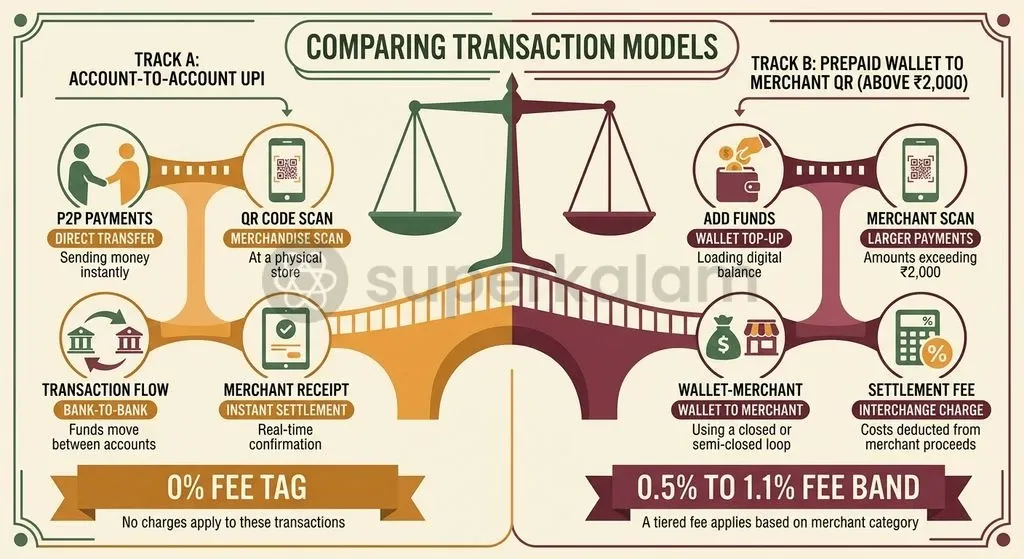
- PPI Interchange Rates: Under National Payments Corporation of India (NPCI) guidelines, an interchange fee ranging from 0.5% to 1.1% applies when a consumer pays a merchant using an interoperable PPI wallet for amounts exceeding ₹2,000.
- Account Transfers: Standard account-to-account UPI transfers remain entirely free of interchange fees.
- Enabling Statutory Powers: The Taxation and Other Laws (Amendment) Bill, 2026 establishes an enabling statutory framework rather than an immediate price imposition.
- Protection for the Public: The Ministry of Finance affirmed that ordinary retail consumers will not pay fees for personal payments or basic retail purchases, ensuring that zero-fee protection continues for the public.
Comparing Transaction Types: P2P, P2M, and Prepaid Payment Instruments
The Unified Payments Interface classifies electronic transactions into three distinct institutional workflows to apply differentiated operational standards and pricing controls. According to NPCI Circular No. 70, payment routing differentiates between pure retail transfers and commercial activity based on merchant onboarding protocols.
| Transaction Category | Structural Mechanism | Current Fee Status | Primary Use Case |
|---|---|---|---|
| Person-to-Person (P2P) | Direct bank account-to-account transfer between individual retail users | 0% (Completely Free) | Splitting household bills, family remittances |
| Person-to-Peer-Merchant (P2PM) | Transfer from an individual account to a small, unorganised merchant's personal QR | 0% (Supported via budgetary incentives) | Small tea stalls, street vendors, vegetable kiosks |
| Person-to-Merchant (P2M) | Transfer from a customer account to a formally acquired commercial merchant account | 0% for bank transfers (Under enabling review for high values) | Supermarkets, e-commerce, formal retail chains |
| Prepaid Payment Instruments (PPI on UPI) | Wallet-to-merchant transaction processed over the UPI interoperable rail | 0.5% to 1.1% interchange on transactions > ₹2,000 | Digital wallets loaded via card or net banking |
These distinct classifications enable the Reserve Bank of India to shield vulnerable micro-enterprises while developing tailored charging models for large formal retailers.
Discuss with Superkalam
If you were a merchant processing ₹5,000 via an interoperable PPI wallet on UPI, what fee structure would apply under NPCI rules?
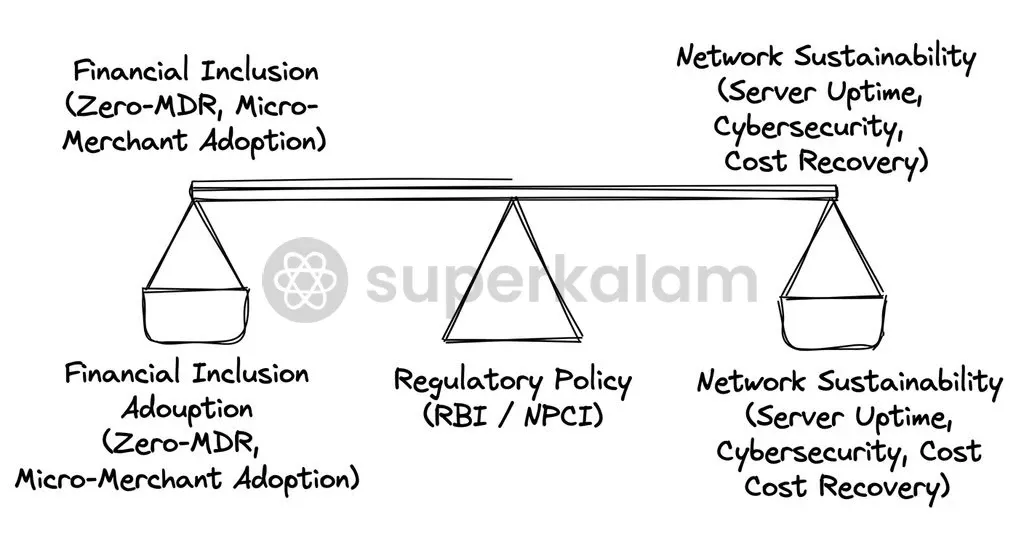
Ask NowThe Core Policy Dilemma: Financial Inclusion vs Network Sustainability
The Reserve Bank of India faces a trade-off between sustaining digital financial inclusion and funding the capital expenditure of expanding payment infrastructure:
- The Inclusion Argument (Digital Public Good): Free payment rails eliminate cash handling costs for the exchequer, formalise unorganised commerce, expand the tax base, and bring micro-enterprises into the formal credit net.
- The Viability Argument (Commercial Sustainability): The payments industry faces severe financial strain from processing over 240 billion annual transactions without commercial returns. Payments Council of India submissions to parliamentary panels indicate that industry infrastructure costs exceed annually, with budgetary subsidies covering less than 10% to 15% of actual expenses.
Expert committees have repeatedly warned that uncompensated infrastructure threatens network resilience.
The Report of the High-Level Committee on Deepening of Digital Payments, chaired by Nandan Nilekani, recommended that the central bank leave MDR to market competition rather than mandating zero caps. Furthermore, the Reserve Bank of India Discussion Paper on Charges in Payment Systems emphasised that continuous investments in fraud prevention algorithms, cybersecurity, and server capacity require reliable revenue streams.
Global Perspective: How Other Nations Price Fast Payment Systems
International central banks operating national fast payment systems have maintained free peer transfers while permitting reasonable commercial merchant processing fees:
- Brazil (Pix): The central bank (Banco Central do Brasil) established Pix, keeping individual and P2P transfers free while allowing acquiring banks to charge merchants a market-determined fee averaging 0.22% to 0.33% per transaction. This funded aggressive bank onboarding of small enterprises without suppressing consumer adoption.
- Singapore (PayNow): The PayNow network operated over the Fast and Secure Transfers (FAST) rail enables free retail P2P payments, whereas PayNow Corporate charges merchant acquirers between 0.65% and 1.30% plus fixed processing fees.
These international frameworks prove that market-viable commercial MDR can co-exist with universal digital financial inclusion when consumer-facing transfers remain strictly uncharged.
Way Forward: Building a Financially Viable Digital Public Infrastructure
The Ministry of Finance and the Reserve Bank of India must adopt a calibrated, tiered pricing architecture to ensure long-term payment system resilience. To reconcile ecosystem sustainability with inclusive growth, policymakers should implement the following targeted structural measures:
- Implement Tiered Merchant Pricing: Retain complete zero-MDR exemptions for micro-merchants and P2PM categories up to ₹2,000, while permitting a capped, transparent MDR (such as 0.2% to 0.3%) for large corporate retailers and high-turnover merchants.
- Unbundle Interchange and Network Fees: Mandate explicit cost disclosure across issuing banks, acquiring aggregators, and NPCI switching rails, preventing monopolistic pricing while ensuring infrastructure cost recovery.
- Formalise Budgetary Support for Critical DPI: If zero-MDR is preserved across broader categories, replace ad-hoc annual incentive grants with a predictable, statutory DPI funding mechanism tied to cybersecurity audit benchmarks.
- Encourage Value-Added Financial Services: Facilitate the integration of cash-flow-based micro-lending, merchant insurance, and credit lines on UPI to help fintech aggregators monetise value-added services rather than relying purely on transaction fees.
Discuss with Superkalam
Compare the economic arguments for treating digital payment infrastructure as a subsidised public good versus an open market-priced service.
Ask NowKey Takeaways
- Statutory Revision: The Taxation and Other Laws (Amendment) Bill, 2026 amends Section 10A of the Payment and Settlement Systems Act, 2007, replacing the blanket zero-MDR mandate with an enabling provision for government-notified charging models.
- Consumer Protection: Retail consumers and all Person-to-Person (P2P) UPI transactions will remain completely free of any transaction charges.
- PPI vs Bank Transfers: Account-to-account UPI transactions incur zero fees, whereas commercial wallet transactions (PPI on UPI) above ₹2,000 carry an interchange fee between 0.5% and 1.1%.
- Infrastructure Strains: The Nandan Nilekani Committee and the RBI have highlighted that sustained investments in cybersecurity, server uptime above 99.5%, and low decline rates require balanced, cost-reflective pricing mechanisms.
- International Precedents: Global systems such as Brazil's Pix and Singapore's PayNow prove that market-determined commercial merchant fees can support digital payment infrastructure while maintaining free consumer transfers.
Mains Question
'A blanket statutory Zero-MDR mandate treats digital payment rails as a pure public good, but risks compromising backend infrastructure, cybersecurity investments, and network resilience.' Critically analyse in the context of recent legislative reforms to Section 10A of the Payment and Settlement Systems Act, 2007. (15 Marks)
Evaluate NowMains Question
The High-Level Committee on Deepening of Digital Payments recommended market-determined pricing for payment systems to balance financial inclusion with commercial viability. Examine how international models like Brazil's Pix and Singapore's PayNow reconcile this trade-off. (10 Marks)
Evaluate NowPractice MCQs
QUESTION 1
With reference to the Merchant Discount Rate (MDR) and digital payments in India, consider the following statements:
- MDR is an operational fee deducted from the merchant by the acquiring bank to process electronic payment transactions.
- Under standard three-party payment intermediary models, MDR is apportioned among the issuing bank, the acquiring bank/aggregator, and the network switch.
- The statutory Zero-MDR mandate was introduced by inserting Section 10A into the Payment and Settlement Systems Act, 2007.
Which of the statements given above are correct?
QUESTION 2
Regarding the pricing framework for the Unified Payments Interface (UPI) and Prepaid Payment Instruments (PPI), consider the following statements:
- Person-to-Person (P2P) transfers over UPI incur a nominal interchange fee of 0.15%.
- Interoperable PPI wallet-to-merchant transactions over ₹2,000 attract an interchange fee ranging from 0.5% to 1.1%.
- Standard account-to-account UPI transfers remain exempt from interchange fees.
Which of the statements given above is/are correct?
QUESTION 3
Consider the following statements regarding the Digital Payments Incentive Scheme for low-value BHIM-UPI transactions:
- It provides an incentive rate of approximately 0.15% on low-value Person-to-Merchant (P2M) transactions up to ₹2,000.
- The disbursement of the final 20% of the incentive is linked to banks maintaining system uptime above 99.5%.
- Technical decline rates must remain below 0.75% to qualify for the full incentive payout.
Which of the statements given above is/are correct?
QUESTION 4
The High-Level Committee on Deepening of Digital Payments, which recommended market competition rather than statutory zero caps on MDR, was chaired by:
QUESTION 5
With reference to the global pricing models of fast payment systems cited in central banking frameworks, consider the following pairs:
- Brazil (Pix) — Free P2P transfers with market-determined merchant fees averaging 0.22% to 0.33%
- Singapore (PayNow) — Free retail P2P transfers with PayNow Corporate charging merchant acquirers
Which of the pairs given above is/are correctly matched?