UNSC Veto Reform: France-Mexico Initiative and Why Abolition Is Nearly Impossible
While Article 108 makes formal P5 veto abolition nearly impossible, emerging powers and General Assembly initiatives are forging new paths to accountability.
Sep, 2026
•11 min read
Context
The United Nations Security Council veto power under Article 27(3) of the UN Charter remains immune to formal abolition. Any constitutional amendment requires unanimous ratification by the P5 themselves under Article 108. Repeated diplomatic deadlocks during humanitarian crises have pushed international reform strategies away from statutory repeal.
Member states now pursue behavioural restraint mechanisms, such as the France-Mexico initiative and the ACT Code of Conduct. They also leverage procedural oversight led by the General Assembly under UNGA Resolution 76/262. Emerging powers like the G4 advocate expanding permanent representation with deferred veto privileges, yet competing diplomatic coalitions sustain the prevailing institutional architecture.
Why the UNSC Veto Debate Is Back in the Spotlight
As of 2026, recurrent geopolitical paralysis in the United Nations Security Council has intensified global demands to reform permanent member voting privileges. The executive body has repeatedly stalled during major international crises. This gridlock has renewed scrutiny over the original 1945 institutional framework.
When the United Nations was established after the Second World War, the five permanent members—China, France, the Russian Federation, the United Kingdom, and the United States—secured special voting prerogatives. This mechanism intended to keep major powers invested in multilateralism, preventing direct great-power confrontation. In practice, unilateral vetoes have created structural roadblocks.
Key drivers keeping the debate alive include:
- Frequent Council Gridlock: Inability to act decisively during armed conflicts, territorial aggressions, and human rights emergencies.
- Shifting Power Balances: A post-1945 design that excludes major regional powers and developing economies.
- Erosion of Institutional Legitimacy: Growing frustration that has led the wider General Assembly to seek alternative accountability avenues.
Discuss with Superkalam
Recall the voting threshold required under Article 27(2) and Article 27(3) of the UN Charter.
Ask NowHow the Veto Works Under the UN Charter (Article 27)
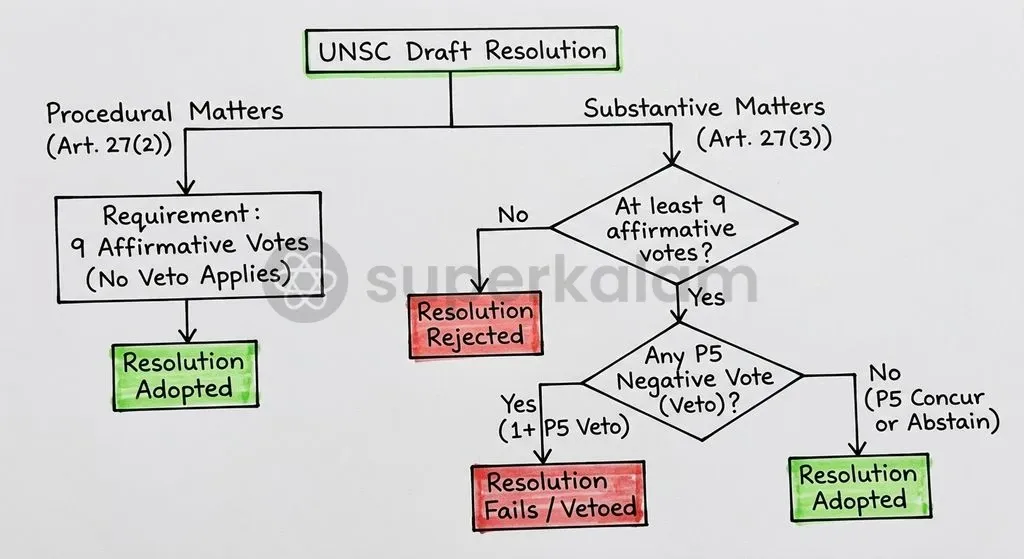
Article 27 of the United Nations Charter establishes the voting procedure for the fifteen-member Security Council, distinguishing procedural from substantive decisions.
Under Article 27(2), decisions on procedural matters require the affirmative vote of any nine members. In contrast, Article 27(3) mandates that decisions on non-procedural matters require nine affirmative votes, including the concurring votes of permanent members. A single negative vote cast by any permanent member defeats a non-procedural draft resolution, regardless of wider numerical support.
| Provision | Procedural Matters | Non-Procedural (Substantive) Matters |
|---|---|---|
| Charter Basis | Article 27(2) of the UN Charter | Article 27(3) of the UN Charter |
| Required Majority | 9 affirmative votes out of 15 | 9 affirmative votes including all P5 concurring votes |
| Veto Applicability | Negative P5 vote does not block adoption | Single negative P5 vote vetoes the resolution |
| Mandatory Abstention Rule | Not applicable | Parties to a dispute must abstain under Chapter VI and Article 52(3) |
Article 27(3) also contains a mandatory abstention rule. In decisions under Chapter VI (Pacific Settlement of Disputes) and Article 52(3), a party to a dispute must abstain from voting. However, permanent members frequently use procedural manoeuvres to bypass Chapter VI classification.
Regarding absences and abstentions, the International Court of Justice clarified the scope of Article 27(3) in its 1971 Namibia Advisory Opinion. The Court ruled that voluntary abstention or absence by a permanent member does not constitute a veto. This confirmed that voluntary abstention permits adoption provided nine affirmative votes are met.
France-Mexico Initiative: Voluntary Restraint in Mass Atrocities
The France-Mexico Political Declaration provides a non-statutory mechanism urging permanent members to voluntarily suspend their veto power during mass atrocity crimes. Launched in 2015, the proposal bypasses the legal hurdles of Charter amendment. It frames veto restraint as a voluntary and collective commitment among the P5.
The declaration applies specifically to three categories of international crimes:
- Genocide, as defined in international humanitarian law.
- Crimes against humanity, involving systematic attacks against civilian populations.
- Large-scale war crimes, involving grave breaches of the Geneva Conventions.
Under this framework, permanent members agree not to block draft resolutions meant to halt atrocities once the UN Secretary-General or a designated threshold of member states identifies an ongoing crisis. As of 2026, the France-Mexico Political Declaration has secured formal endorsements from more than 115 member states.
Because the declaration is non-binding, its implementation relies entirely on political will. Permanent members that regularly use the veto to protect strategic allies have declined to adopt the pledge.
Discuss with Superkalam
Explain how UNGA Resolution 76/262 creates reputational costs for P5 veto use without legally amending the Charter.
Ask NowLiechtenstein Proposal: Bringing Veto Decisions to the General Assembly
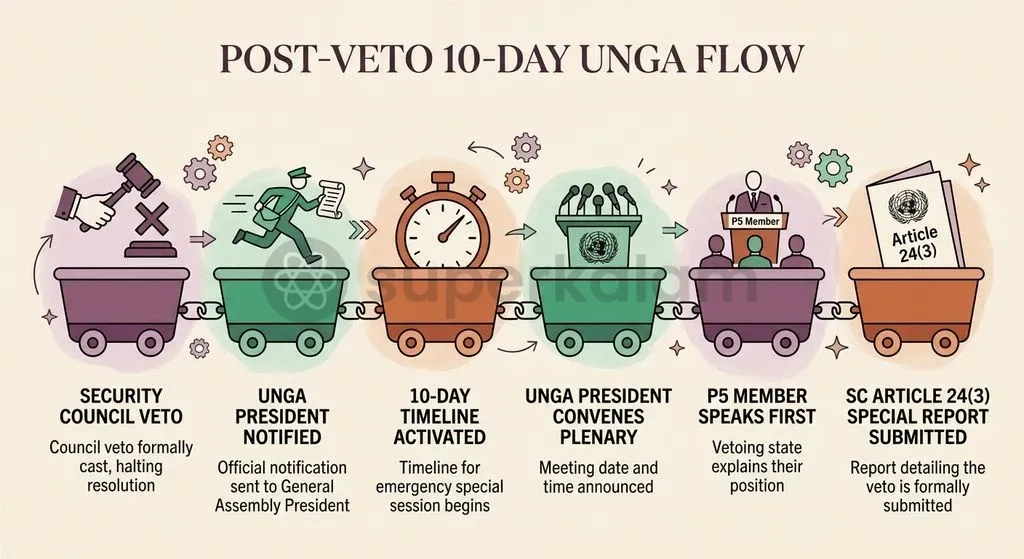
United Nations General Assembly Resolution 76/262 establishes a mandatory accountability mechanism requiring a formal assembly debate whenever a veto is cast in the Security Council. Adopted by consensus on 26 April 2022, the initiative—spearheaded by Liechtenstein—aims at subjecting vetoes to multilateral scrutiny.
The operational framework of Resolution 76/262 includes three core provisions:
- Mandatory Assembly Convocations: The President of the General Assembly must convene a formal meeting within 10 working days of a veto being cast in the Security Council.
- P5 Speaking Priority: The permanent member that exercised the negative vote receives priority on the General Assembly floor to explain its rationale.
- Institutional Reporting: The Security Council is expected to submit a special report to the General Assembly under Article 24(3) of the UN Charter, detailing the circumstances of the vetoed text.
Resolution 76/262 cannot legally overturn a Security Council veto. However, it establishes an open forum for collective debate, increasing the reputational and political costs of casting unilateral vetoes.
The ACT Code of Conduct: Pledging Action Against War Crimes
The ACT Group Code of Conduct commits signatory states to support timely Security Council intervention against genocide, crimes against humanity, and widespread war crimes. Formulated in October 2015 by the Accountability, Coherence and Transparency (ACT) cross-regional group, the code acts as a pledge for decisive intervention during humanitarian emergencies.
Key operational features of the Code of Conduct include:
- Universal Scope: It applies to permanent and elected members of the Security Council, alongside prospective future members.
- Voting Pledge: Signatories explicitly commit not to vote against credible draft resolutions aimed at preventing or ending mass atrocities.
- Cross-Regional Support: According to records maintained by the Global Centre for the Responsibility to Protect, the ACT Code of Conduct has been signed by over 120 member states and observers, including two permanent members: France and the United Kingdom.
By widening this commitment beyond the P5, the ACT initiative establishes a normative duty of protection for all Council members during mass humanitarian crises.
Discuss with Superkalam
How might the mandatory abstention rule of Article 27(3) be applied if a permanent member is directly involved in a Chapter VI dispute?
Ask NowWhy Abolition Is Hard: The Catch-22 of Article 108 and P5 Realities
Article 108 of the United Nations Charter creates an insurmountable legal barrier to veto abolition by granting every permanent member a statutory negative vote over Charter amendments. Any proposed structural modification must navigate a strict two-stage approval process.
Under Article 108, an amendment must first be adopted by a two-thirds vote of the General Assembly. It must then be ratified by two-thirds of all UN member states according to their respective constitutional processes. Crucially, the text explicitly stipulates that this ratification threshold must include all permanent members of the Security Council.
| Reform Coalition / Mechanism | Key Member States | Core Position on UNSC Structure | Position on Veto Power |
|---|---|---|---|
| G4 Nations | Brazil, Germany, India, Japan | Expansion from 15 to 25/26 seats (6 new permanent, 4 non-permanent) | Seek permanent seats; willing to defer veto rights pending review |
| Uniting for Consensus (UfC) | Italy, Pakistan, Mexico, Argentina | Oppose new permanent seats; add only non-permanent or long-term rotational seats | Oppose creation or expansion of veto privileges |
| Ezulwini Consensus (AU) | African Union member states | Demand at least 2 permanent seats and 5 non-permanent seats for Africa | Demand full veto rights for new permanent members as long as veto exists |
| Article 108 / 109 Review | All UN Member States | Requires two-thirds UNGA vote and ratification by two-thirds of states | Requires unanimous ratification by all five P5 members |
Article 109 provides an alternative track, allowing member states to convene a General Conference to review the Charter via a two-thirds General Assembly vote and nine Security Council votes. Nevertheless, Article 109(2) mandates that any alteration emerging from such a conference must also be ratified by all P5 members.
The historical record illustrates this constraint. The sole successful structural expansion of the Security Council occurred under General Assembly Resolution 1991A (XVIII) in 1963 (entering into force in 1965), which expanded the non-permanent membership from six to ten seats. That reform left the permanent membership, Article 27 voting rules, and the veto privilege entirely untouched.
Where India and the G4 Stand on Veto Rights
The Group of Four alliance comprising India, Brazil, Germany, and Japan seeks permanent Security Council expansion while offering a pragmatic interim compromise on exercising veto rights. The G4 framework proposes expanding the Council from 15 to 25 or 26 members by creating six new permanent seats—allocated as two for Africa, two for Asia, one for Latin America, and one for Western Europe—alongside four new non-permanent seats.
To resolve the diplomatic deadlock surrounding veto expansion, the G4 tabled an interim compromise during the Intergovernmental Negotiations (IGN). Under this proposal, newly admitted permanent members would not exercise veto rights until a formal review conference is conducted, proposed after fifteen years.
This compromise directly contrasts with competing regional blocs:
- The African Union Position: The 2005 Ezulwini Consensus and Sirte Declaration demand that Africa receive at least two permanent seats with full veto rights and five non-permanent seats, asserting that as long as the veto exists, it must be extended to all permanent members equally.
- Uniting for Consensus (UfC): Led by states such as Italy, Pakistan, Mexico, and Argentina, this coalition opposes any expansion of permanent seats, advocating instead for additional elected, non-permanent, or rotational seats without veto rights.
India maintains that expanding permanent membership to include developing nations is necessary to restore representation. It treats the temporary deferral of the veto as a pragmatic interim concession to advance text-based negotiations.
Discuss with Superkalam
Compare the core positions of the G4, the Uniting for Consensus group, and the Ezulwini Consensus regarding veto privileges.
Ask Now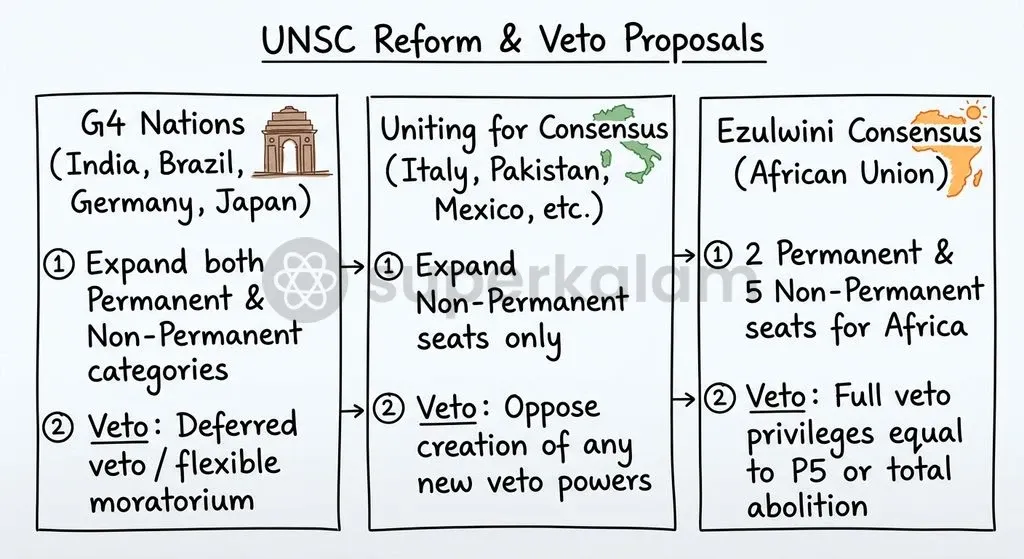
The Ethical Crisis of Global Governance
The International Commission on Intervention and State Sovereignty highlighted the fundamental ethical conflict between narrow national interests and collective security during humanitarian catastrophes. When permanent members exercise the veto to shield strategic partners or advance unilateral geopolitical goals, the Security Council fails its primary responsibility under Article 24 of the UN Charter.
This institutional failure exposes deep normative fault lines:
- Sovereignty vs. Humanitarian Duty: The tension between Westphalian state sovereignty and the universal duty to protect human populations from mass atrocities.
- Structural Inequality: An ethical paradox where five states possess permanent institutional privileges that can override the collective will of the remaining 188 member states.
- Moral Hazard of Inaction: The risk that systematic vetoes normalize inaction, prompting regional coalitions to intervene outside the UN legal framework and eroding international law.
From an ethical perspective, the veto functions as an unchecked instrument of power, divorcing institutional authority from accountability and creating severe governance deficits during crises.
Discuss with Superkalam
Evaluate whether voluntary restraint pledges like the France-Mexico initiative can effectively deter veto use during major humanitarian crises.
Ask NowWay Forward: Realistic Steps Toward UNSC Accountability
Reforming the United Nations Security Council requires prioritising procedural accountability, General Assembly empowerment, and normative constraints over statutory Charter revisions. Because Article 108 gives the P5 a definitive veto over constitutional amendments, incremental pathways offer the most viable route to mitigate Council paralysis.
A comprehensive strategy for progressive reform includes:
- Expanding Non-Amendment Accountability: Member states can leverage existing mechanisms, such as General Assembly Resolution 377A(V) ('Uniting for Peace'), to authorise collective measures when the Security Council is deadlocked by a veto.
- Deepening Normative Restraints: Expanding international endorsements for the France-Mexico Political Declaration and the ACT Code of Conduct increases diplomatic pressure on permanent members to refrain from blocking action during atrocity crimes.
- Strengthening General Assembly Oversight: Fully utilising the Liechtenstein Veto Initiative (Resolution 76/262) ensures that every negative vote incurs a mandatory, public justification on the General Assembly floor.
- Pursuing Text-Based Intergovernmental Negotiations: Transitioning the IGN process into formal text-based negotiations can consolidate support behind the G4 compromise of deferred veto rights, isolating obstructionist stances.
- Requesting Advisory Opinions: Seeking legal clarifications from the International Court of Justice regarding procedural obligations, such as the mandatory abstention rule under Article 27(3), can delineate the legal boundaries of Council voting.
Through these combined procedural, normative, and legal instruments, the international community can build practical checks on veto power without requiring immediate Charter amendments.
Key Takeaways
- Charter Grounding: Article 27(3) of the UN Charter requires nine affirmative votes including all P5 concurring votes for non-procedural matters, legally establishing the veto power.
- The Amendment Barrier: Amending the UN Charter under Article 108 or 109 requires a two-thirds UNGA vote and ratification by two-thirds of member states, which must include all five permanent members.
- Procedural Accountability: UNGA Resolution 76/262 (the Liechtenstein Initiative) requires the General Assembly to convene a formal debate within 10 working days of any Security Council veto.
- Voluntary Restraint Models: The France-Mexico Declaration and the ACT Code of Conduct advocate voluntary suspension of the veto during mass atrocity crimes (genocide, war crimes, crimes against humanity).
- Competing Reform Blocs: The G4 (India, Brazil, Germany, Japan) supports permanent expansion with deferred veto rights, contrasting with the African Union's demand for full veto rights under the Ezulwini Consensus and the UfC coalition's opposition to new permanent seats.
Mains Question
The procedural barrier enshrined in Article 108 of the UN Charter has rendered statutory reform of the Security Council's veto power virtually unattainable. In this context, examine the efficacy of behavioural restraint mechanisms and General Assembly oversight as alternative pathways to accountability. (10 Marks)
Evaluate NowMains Question
'Divergent positions among reform coalitions, combined with the veto prerogative of the P5, have entrenched institutional inertia in the UN Security Council.' Critically analyse the competing frameworks of the G4, Uniting for Consensus, and Ezulwini Consensus, and assess the prospects of breaking this deadlock. (15 Marks)
Evaluate NowPractice MCQs
QUESTION 1
With reference to the voting procedure under Article 27 of the United Nations Charter and its judicial interpretations, consider the following statements:
- Under Article 27(2), decisions on procedural matters require nine affirmative votes, and a negative vote by a permanent member does not block adoption.
- In the 1971 Namibia Advisory Opinion, the International Court of Justice ruled that voluntary abstention or absence by a permanent member does not constitute a veto.
- Under Article 27(3), a mandatory abstention rule applies to parties to a dispute in decisions under Chapter VI and Article 52(3). Which of the statements given above are correct?
QUESTION 2
Consider the following statements regarding United Nations General Assembly Resolution 76/262 (Liechtenstein Proposal):
- It mandates the President of the General Assembly to convene a formal debate within 10 working days of a veto being cast in the Security Council.
- It legally overturns a Security Council veto if supported by a two-thirds majority in the General Assembly.
- The permanent member casting the veto is accorded priority on the General Assembly floor to explain its rationale. Which of the statements given above is/are correct?
QUESTION 3
Consider the following statements regarding reform positions and Charter amendment provisions for the UN Security Council:
- Any amendment under Article 108 requires adoption by a two-thirds vote of the UNGA and ratification by two-thirds of member states, including all P5 members.
- The Ezulwini Consensus of the African Union demands permanent seats with full veto rights as long as the veto exists.
- The G4 coalition advocates expanding Council membership to 25 or 26 seats while expressing willingness to defer veto privileges pending review. Which of the statements given above is/are correct?
QUESTION 4
With reference to the France-Mexico Political Declaration and the ACT Code of Conduct, consider the following statements:
- The France-Mexico initiative proposes voluntary suspension of the veto specifically during genocide, crimes against humanity, and large-scale war crimes.
- The ACT Code of Conduct is restricted solely to the five permanent members of the Security Council. Which of the statements given above is/are correct?
QUESTION 5
With reference to the history of United Nations Charter amendments, General Assembly Resolution 1991A (XVIII), adopted in 1963 and entering into force in 1965, resulted in which of the following?