Digi Yatra for International Departures: 5-Airport Pilot from October 2026
Digi Yatra facial-recognition travel goes international: an October-December 2026 pilot at five airports brings e-passport enrolment and selfie verification to outbound flyers.
Sep, 2026
•9 min read
Overview
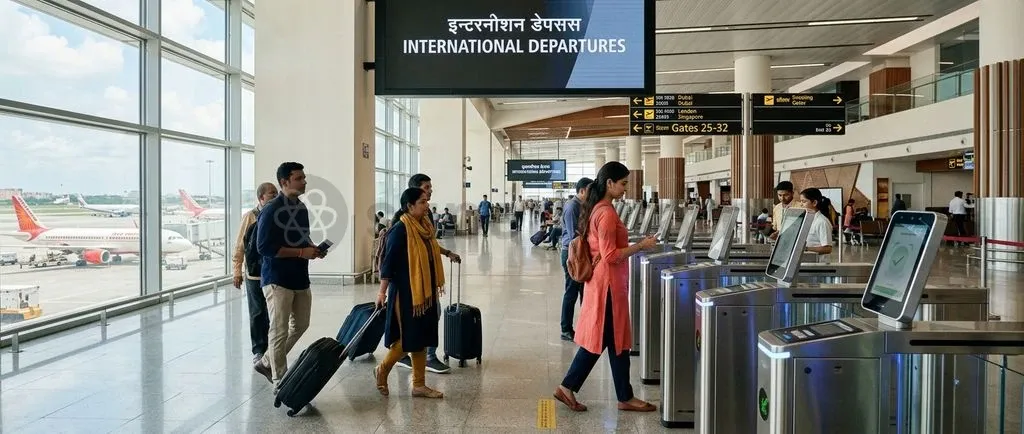
The Ministry of Civil Aviation is piloting the expansion of Digi Yatra to international departures across major Indian airports, transitioning the biometric system from domestic identity validation to cross-border travel facilitation. This initiative combines Near Field Communication passport scanning with facial recognition technology to expedite terminal entry, security checkpoints, and boarding procedures. By separating civil aviation passenger facilitation from statutory immigration control under the Ministry of Home Affairs, the initiative tests how decentralised identity frameworks can reduce airport congestion without compromising national border security.
Why Digi Yatra International Is in the News
The Ministry of Civil Aviation and the Digi Yatra Foundation have initiated a pilot project to extend facial recognition boarding to international outbound passengers at select Indian airports. As of September 2026, the domestic Digi Yatra system operates across 39 airports, with the central government planning to expand the infrastructure to 64 airports by March 2027, as reported by The Hindu citing an official Ministry review.
The operational landscape received regulatory backing on 1 September 2026, when the Bureau of Immigration formally authorised the acceptance of digital electronic boarding passes at all airport immigration counters. This reform eliminated the historical requirement for physical stamping on paper boarding passes. The international pilot enables outbound travellers to navigate entry gates, Central Industrial Security Force security screening, and airline boarding points using automated biometric e-Gates.
Discuss with Superkalam
What international standard governs the Logical Data Structure used in electronic Machine Readable Travel Documents?
Ask NowHow Digi Yatra Works: The Core Facial Recognition Technology
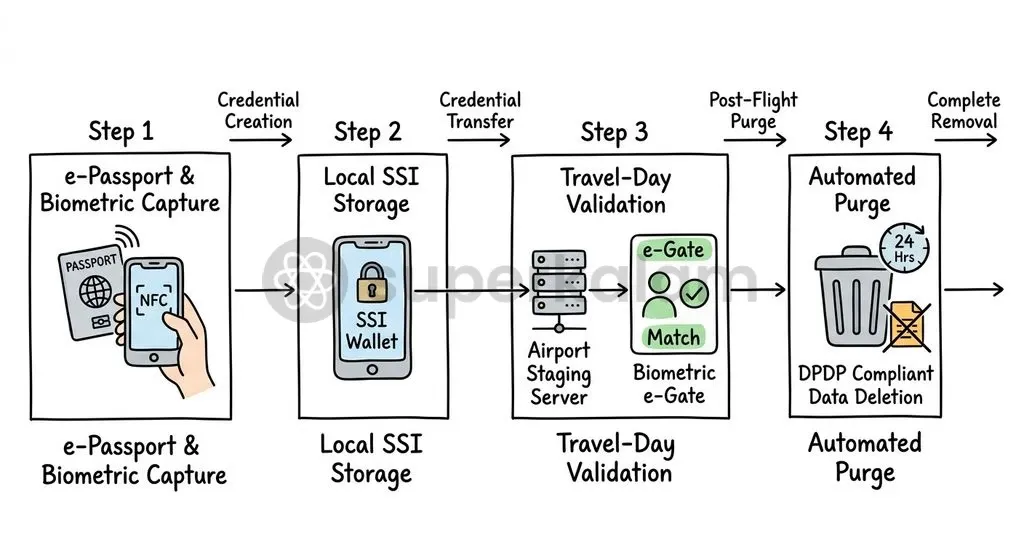
The Digi Yatra ecosystem operates on the Self-Sovereign Identity framework, adhering strictly to World Wide Web Consortium standards. This architectural design relies on Decentralised Identifiers and Verifiable Credentials, ensuring that personal records remain under the direct custody of the individual rather than residing in a permanent central database.
A passenger's facial template and travel identity reside exclusively in an encrypted mobile wallet on their personal device. When preparing for a flight, the traveller shares a cryptographically signed token with the departure airport's local staging server. The local server temporarily holds the data to execute biometric 1:1 facial matching at terminal access points.
Airport staging systems must execute automatic data purging within 24 hours of flight departure. To prevent spoofing through photographs or deepfake projections, airport biometric cameras integrate Presentation Attack Detection compliant with ISO/IEC 30107 standards.
Domestic vs International Digi Yatra: What Changes at Immigration and Customs?
The technical architecture of international Digi Yatra differs fundamentally from domestic processing by shifting its validation anchor from Aadhaar e-KYC to electronic passports. Domestic processing validates identity against national identity databases, whereas international enrollment reads the contactless chip of an electronic Machine Readable Travel Document.
International enrollment uses Near Field Communication to access the chip embedded in biometric passports, matching the stored high-resolution facial portrait against a live selfie. This procedure complies with ICAO Document 9303 specifications, which standardize the Logical Data Structure across international biometric travel credentials.
| Operational Dimension | Domestic Digi Yatra | International Digi Yatra Pilot |
|---|---|---|
| Primary Identity Anchor | Aadhaar e-KYC validation | e-Passport chip via NFC scanning |
| Data Specification | Unique Identification Authority of India standards | ICAO Doc 9303 Logical Data Structure |
| Immigration Touchpoint | None (Domestic travel only) | Structurally segregated; handled by Bureau of Immigration |
| Jurisdictional Control | Ministry of Civil Aviation | Civil Aviation (terminals) and Ministry of Home Affairs (border control) |
| Parallel Fast-Track Scheme | Standard domestic Digi Yatra gates | Fast Track Immigration - Trusted Traveller Programme (FTI-TTP) |
Statutory border control remains structurally segregated from the civil aviation boarding process during the pilot rollout. While Digi Yatra manages terminal entry, security checkpoints, and boarding gates, passport control remains under the sovereign oversight of the Bureau of Immigration. Eligible Indian citizens and Overseas Citizen of India cardholders clear immigration separately through manual booths or the automated e-Gates of the Fast Track Immigration - Trusted Traveller Programme.
Discuss with Superkalam
How does a Self-Sovereign Identity framework differ from a centralized database model in protecting citizen privacy?
Ask NowKey Security and Border Control Challenges for International Rollout
Algorithmic accuracy represents a primary operational challenge for facial recognition deployments in high-throughput international transit hubs. Facial Recognition Technology is vulnerable to False Match Rates and False Non-Match Rates, which can vary across demographic cohorts depending on ambient lighting, facial wear, and physical alterations.
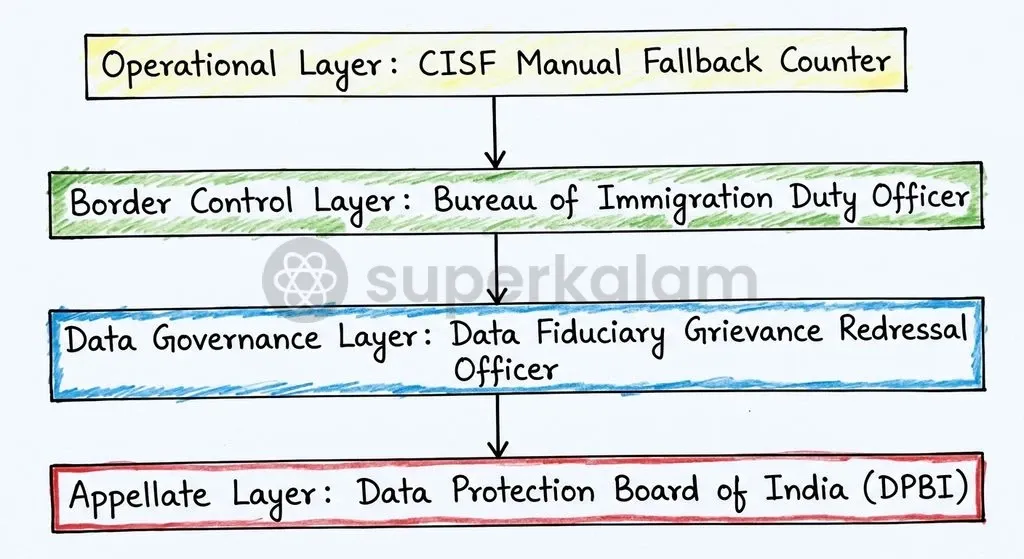
Institutional coordination between the Ministry of Civil Aviation and the Ministry of Home Affairs demands clear functional boundaries. If an e-Gate camera fails to authenticate an outbound traveller, airport operational protocols mandate manual clearance lanes staffed by Central Industrial Security Force personnel to prevent stranded passengers.
When authentication issues involve travel documentation or immigration clearance, passengers escalate directly to on-duty Bureau of Immigration officers. For broader issues involving personal data inaccuracies or unlawful retention, the Digital Personal Data Protection Act establishes a formal redressal pathway. The passenger may file a grievance with the Data Fiduciary Grievance Officer, followed by an appeal to the Data Protection Board of India if the issue is not resolved.
Discuss with Superkalam
How do algorithmic error metrics like False Match Rates and False Non-Match Rates affect airport throughput and border security?
Ask NowData Privacy, Consent, and the Digital Personal Data Protection Act
The legal framework governing biometric passenger identification in India derives from the landmark Supreme Court judgment in Justice K.S. Puttaswamy (Retd.) v. Union of India (2017). The Supreme Court ruled that state-mandated biometric systems impacting the right to privacy under Article 21 must satisfy a fourfold test:
- Legality: The action must have an explicit statutory backing.
- Legitimate State Aim: The measure must serve an identifiable public interest or state objective.
- Suitability: The technological mechanism must be rationally connected to that objective.
- Necessity: The system must adopt the least intrusive means available, ensuring the intrusion is proportionate to the purpose.
The statutory implementation of these principles is governed by the Digital Personal Data Protection Act, 2023. Under Section 6, a Data Fiduciary must obtain consent that is free, specific, informed, unconditional, and unambiguous, supported by a clear purpose notice. Section 8 requires Data Fiduciaries to enforce strict security safeguards and mandate data erasure once the processing purpose concludes.
Institutional governance of the platform is managed by the Digi Yatra Foundation, a non-profit Section 8 company. Public sector representation is anchored by the Airports Authority of India, which holds a 26% equity stake. The remaining 74% equity is distributed among major private airport operators, including DIAL, MIAL, BIAL, GHIAL, and CIAL.
Global Best Practices: How Other Countries Handle Biometric e-Gates
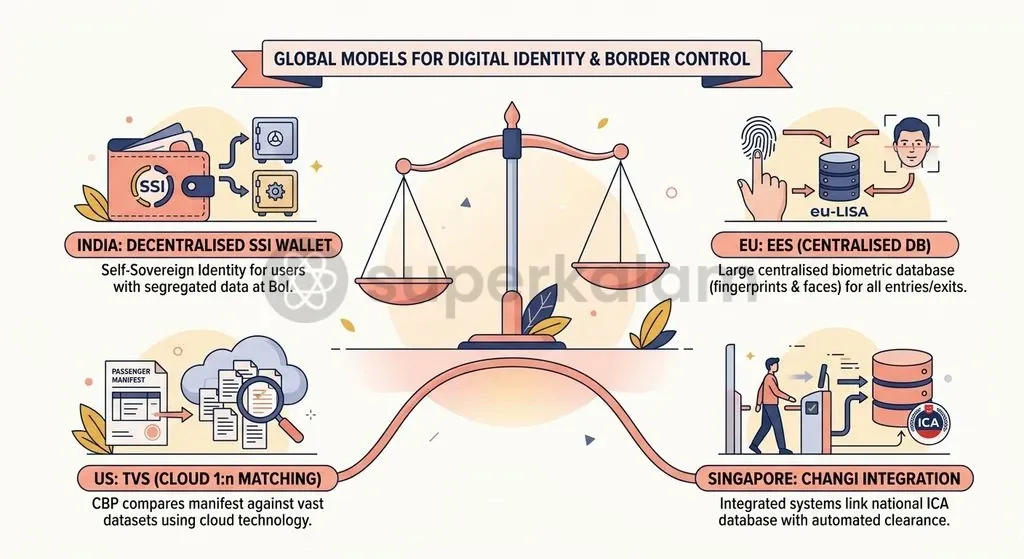
Biometric identity processing across global international hubs operates through diverse institutional and technological models. The International Air Transport Association guides international airline integrations through its One ID initiative, establishing global technical standards under Resolution 753 and Recommended Practice 1741.
| Jurisdiction / System | Governing Entity | Technological Architecture | Centralised Biometric Database? |
|---|---|---|---|
| India: Digi Yatra Pilot | Digi Yatra Foundation & Ministry of Civil Aviation | W3C Self-Sovereign Identity, decentralized mobile wallet | No (Purged from local airport staging servers within 24 hours) |
| European Union: Entry/Exit System (EES) | European Union (eu-LISA) | Centralised matching of facial images and 4 fingerprints | Yes (Centralised EU biometric database for third-country nationals) |
| United States: Biometric Exit (TVS) | US Customs and Border Protection | Cloud-based 1:n facial matching against airline flight manifests | Yes (Government cloud-hosted Traveler Verification Service) |
| Singapore: Changi Airport | Immigration and Checkpoints Authority (ICA) | Integrated facial and iris biometric departure clearance | Yes (Direct backend link to national immigration register) |
The European Union implements its Entry/Exit System across external Schengen borders to automatically capture facial images and fingerprint data from non-EU short-stay visitors. In the United States, Customs and Border Protection uses the Traveler Verification Service, running 1:n cloud-based facial matching against pre-compiled airline passenger departure manifests. Meanwhile, Singapore Changi Airport deploys passport-free departure clearance by integrating facial and iris recognition directly with the national immigration database.
Discuss with Superkalam
To what extent does the Section 8 corporate structure of Digi Yatra Foundation balance public oversight with private airport operational efficiency?
Ask NowWay Forward: Balancing Border Security with Seamless Passenger Mobility
Sustainable expansion of international biometric clearance requires robust technical safeguards, clear statutory boundaries, and transparent administrative oversight.
- Harmonise Aviation Facilitation with Sovereign Border Control: Integrate Digi Yatra terminal e-Gates with the Bureau of Immigration's Fast Track Immigration - Trusted Traveller Programme across all international terminals.
- Enforce Strict Purpose Limitation: Ensure data flows conform to Section 6 and Section 8 of the Digital Personal Data Protection Act, 2023, preventing unnotified secondary processing.
- Standardise Algorithmic Audits: Establish independent benchmarking to maintain minimal False Match and False Non-Match rates across diverse demographic groups.
- Strengthen Hardware Defences: Deploy presentation attack detection certified under ISO/IEC 30107 to protect physical gates against sophisticated spoofing attempts.
- Guarantee Inclusive Fallback Channels: Maintain physical verification counters managed by the Central Industrial Security Force to ensure that non-enrolled passengers and those experiencing biometric non-matches travel without disruption.
Key Takeaways
- The international Digi Yatra pilot expands facial recognition to terminal entry, security screening, and boarding for outbound international flights.
- International enrollment relies on e-Passport NFC chip scanning adhering to ICAO Doc 9303 standards, replacing the Aadhaar e-KYC validation used for domestic flights.
- Identity credentials reside locally in the passenger's mobile wallet using Self-Sovereign Identity protocols, with temporary airport staging data purged within 24 hours of flight departure.
- Sovereign immigration checks remain structurally separated from civil aviation boarding, operating via Bureau of Immigration counters or automated FTI-TTP e-Gates.
- System deployment must adhere to the proportionality standard established in the Puttaswamy (2017) ruling and comply with consent and data erasure mandates under the Digital Personal Data Protection Act, 2023.
Mains Question
"The transition of biometric boarding systems from domestic travel to cross-border facilitation necessitates a delicate equilibrium between passenger mobility and sovereign border control." In the light of the international Digi Yatra rollout, examine the technical and jurisdictional safeguards adopted to maintain this balance. (10 Marks)
Evaluate NowMains Question
Evaluate the compliance of the Digi Yatra framework with the constitutional principles laid down in Justice K.S. Puttaswamy (2017) and the statutory mandates of the Digital Personal Data Protection Act, 2023. (15 Marks)
Evaluate Now