Registered Unrecognised Political Parties (RUPPs): Funding Rules, Tax Exemption and ECI Powers
While dormant political parties claim full Section 13A tax relief, the Election Commission lacks explicit statutory power to deregister fraudulent entities.
Sep, 2026
•9 min read
Overview
Registered Unrecognised Political Parties receive full tax exemptions under Section 13A of the Income Tax Act, 1961. Yet over seventy percent remain electorally dormant while facing minimal regulatory scrutiny following the invalidation of the Electoral Bond Scheme.
The Representation of the People Act, 1951 entitles every registered political formation to collect voluntary donations. It also provides statutory relief on house property, capital gains, and voluntary contributions. However, the Election Commission of India possesses no statutory power to deregister fraudulent or non-functional entities under current judicial precedents.
This structural disconnect enables non-compliant entities to claim hundred percent income-tax exemptions while bypassing strict public disclosure standards. Reforming political finance requires bridging the enforcement gap between statutory tax exemptions and institutional deregistration powers.
Why Registered Unrecognised Political Parties Are in the News
The Election Commission of India initiated proceedings in June 2025 to administratively delist 345 Registered Unrecognised Political Parties that failed to contest elections since 2019. Field verifications by electoral authorities confirmed that these entities operated with untraceable or non-existent physical registered offices.
As of mid-2026, the Election Commission of India maintains over 2,800 Registered Unrecognised Political Parties on its national register. Scrutiny of these formations intensified after the Supreme Court invalidated anonymous electoral instruments, redirecting regulatory attention toward unrecognised political entities claiming statutory tax relief.
What Is a Registered Unrecognised Political Party?
A Registered Unrecognised Political Party is an association registered under Section 29A of the Representation of the People Act, 1951 that has not secured recognised status. Any association of Indian citizens seeking registration must submit an application affirming allegiance to the Constitution of India, socialism, secularism, and democracy.
Under the Election Symbols (Reservation and Allotment) Order, 1968, these associations fall into two functional groups:
- Newly formed outfits that have never contested general elections.
- Established entities that failed to secure the minimum threshold of votes or legislative seats required for State or National recognition.
Although newly registered entities enjoy statutory legitimacy to field candidates, registration alone does not confer permanent privileges like exclusive symbol reservations.
Discuss with Superkalam
Can you name the section of the Representation of the People Act, 1951 under which associations register as political parties?
Ask NowHow RUPPs Differ from Recognised National and State Parties
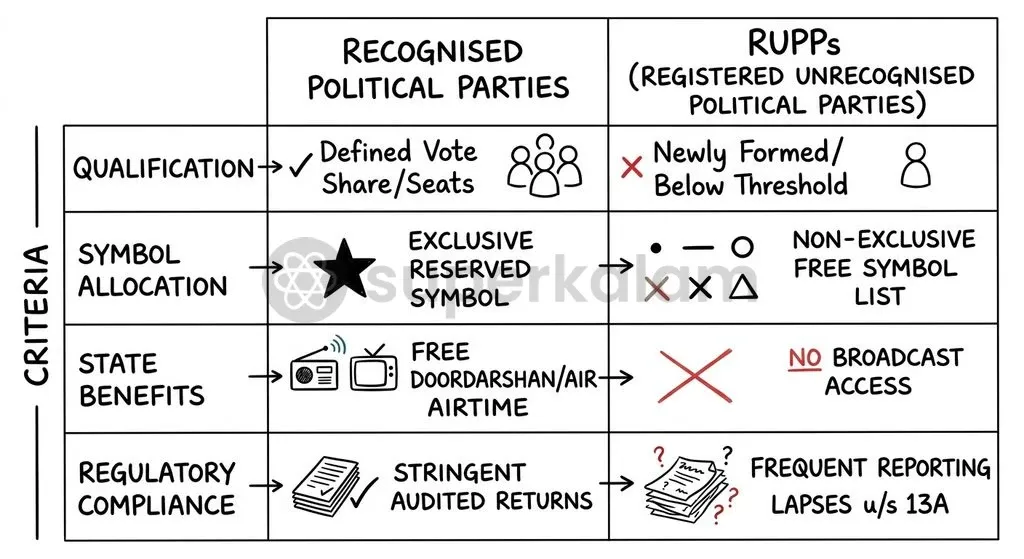
Recognised political parties must meet strict electoral performance benchmarks specified under the Election Symbols (Reservation and Allotment) Order, 1968. A party gains State or National recognition solely by securing prescribed percentages of valid votes or seats in Parliamentary or Legislative Assembly elections. In contrast, Registered Unrecognised Political Parties retain their registered status irrespective of whether they contest an election.
| Parameter | Recognised National / State Party | Registered Unrecognised Political Party (RUPP) |
|---|---|---|
| Legal Basis | Section 29A, RPA 1951 read with Election Symbols Order, 1968 | Section 29A, The Representation of the People Act, 1951 |
| Electoral Threshold | Must secure specified vote share (e.g., 6%) or legislative seats | No mandatory vote share or seat requirement |
| Election Symbol | Exclusive, reserved symbol across designated State or nation | Allotted a free symbol on a common application basis |
| Star Campaigners | Entitled to deploy up to 40 star campaigners | Limited to a maximum of 20 star campaigners under Section 77, RPA 1951 |
| Tax Exemption | Available under Section 13A of the Income Tax Act, 1961 | Available under Section 13A of the Income Tax Act, 1961 |
| Submitting Accounts | Subject to strict annual audit disclosures | High non-compliance rates in statutory reporting |
How Political Funding and Tax Exemptions Work Under the Law
Section 29B of the Representation of the People Act, 1951 permits any registered political party to accept voluntary contributions from individuals and non-governmental companies. The statute strictly bars political parties from accepting donations from government corporations and foreign sources governed by the Foreign Contribution (Regulation) Act, 2010.
| Provision / Area | Statutory Rule & Exemption Threshold |
|---|---|
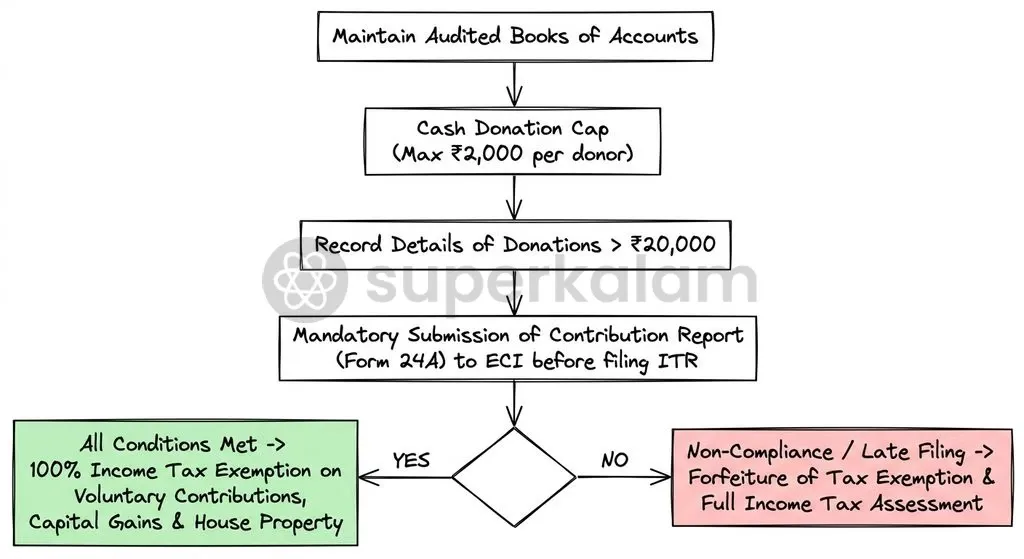
| Section 13A Income Exemption | 100% tax exemption on house property, capital gains, other sources, and voluntary contributions. |
| Audit & Record Limits | Must maintain audited books of account and record all individual donations exceeding ₹20,000. |
| Cash Donation Cap | Cash contributions are strictly capped at ₹2,000 per donor under the Finance Act, 2017 proviso. |
| Reporting Mandate | Must submit annual contribution reports in Form 24A under Section 29C before filing ITR under Section 139(4B). |
| Donor Deductions | 100% tax deduction under Section 80GGB and 80GGC for banking-channel donations; zero deduction for cash. |
Discuss with Superkalam
Explain how the Supreme Court's ruling in the 2002 Institute of Social Welfare case restricts the Election Commission's deregistration powers.
Ask NowKey Loopholes: Money Laundering Risks and Misuse of Section 13A
The Central Board of Direct Taxes has uncovered widespread operations where dormant political entities facilitate tax evasion and cash round-tripping. Multi-state search operations revealed that certain entities issue bogus donation receipts to commercial donors under Section 80GGB or 80GGC, retain a commission, and funnel the remaining funds back as unaccounted cash.
Data published by the Election Commission of India highlights extreme financial concentration among dormant entities. In financial year 2023–24, six unrecognised parties based in Gujarat reported aggregate donations of approximately ₹1,700 crore, surpassing the ₹1,480 crore received by five recognised national parties combined.
The illicit round-tripping mechanism typically operates through three steps:
- A commercial entity donates via cheque or RTGS and claims a full tax deduction under Section 80GGB or Section 80GGC.
- The non-operational party receives the funds tax-free under Section 13A exemptions and deducts a 5% to 10% bogus handling commission.
- The party returns the balance to the donor as unaccounted cash kickbacks.
Compliance among unrecognised formations remains exceedingly poor across the country. Per the Association for Democratic Reforms (as reported, March 2024), only 26% to 27% of registered unrecognised parties routinely submit their audited financial statements and contribution reports within statutory deadlines.
Impact of the Electoral Bonds Verdict on RUPP Financing
The Supreme Court invalidated the Electoral Bond Scheme in Association for Democratic Reforms v. Union of India (2024). A five-judge Constitution Bench held that anonymous electoral bonds and related amendments to the Representation of the People Act, 1951 violated the voter's fundamental right to information under Article 19(1)(a) of the Constitution.
| Pre-2024 Funding Landscape | Post-Verdict Regulatory Shift |
|---|---|
| Anonymous Electoral Bonds enabled opaque donations. | Contributions shifted to direct banking transactions (RTGS). |
| Unlimited corporate contributions without entity transparency. | Reliance on the registered Electoral Trusts Scheme 2013. |
| Minimal disclosure rules shielded major political donors. | Direct cheque donations with statutory reporting to ECI. |
| Opaque primary funding pipeline across formal politics. | Heightened surveillance over small-donor claims and RUPP routes. |
Invalidating anonymous bonds shifted corporate donations back to banking transactions, declared trusts under the Electoral Trusts Scheme 2013, and statutory reporting channels. With opacity removed from the banking bond route, regulatory agencies have increased surveillance over small-donor claims and unrecognised entities.
Discuss with Superkalam
If a donor contributes ₹10,000 in cash to a political party, can they claim a tax deduction under Section 80GGC? Apply statutory funding rules to justify your answer.
Ask NowWhy the Election Commission Cannot Easily Deregister Parties
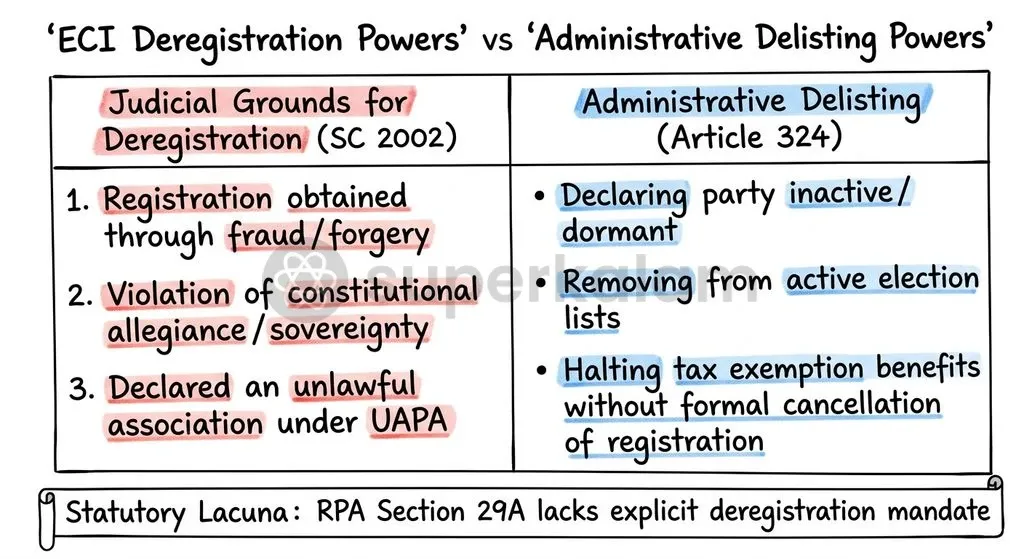
The Supreme Court established in Indian National Congress v. Institute of Social Welfare (2002) that the Election Commission cannot cancel political registrations at will. The apex court ruled that the Commission exercises quasi-judicial power under Section 29A of the Representation of the People Act, 1951, which lacks express provisions for deregistration.
The Supreme Court restricted the Commission's power to deregister a party to three narrow exceptions:
- Proven fraud or forgery: Where the association obtained its original registration through forged documents or deceit.
- Constitutional breach: Where the party amends its internal constitution to abandon its allegiance to the Constitution of India.
- Statutory ban: Where the Central Government declares the association unlawful under the Unlawful Activities (Prevention) Act.
To manage dormant entities, the Commission uses administrative delisting under Article 324 of the Constitution. Delisting strips a party of its common symbol eligibility, removes its quota of twenty star campaigners under Section 77 of the RPA 1951, and triggers formal intimations to the Central Board of Direct Taxes to deny Section 13A exemptions.
Ethical Issues: Shell Parties, Black Money, and Democratic Trust
The Second Administrative Reforms Commission emphasised that clean political funding forms the core foundation of democratic governance. Public subsidies provided through tax exemptions must advance genuine democratic representation rather than private wealth concealment.
| Ethical Dimension | Impact on Democratic Integrity |
|---|---|
| Democratic Deficit | Inactive shell parties consume public subsidies without participating in the electoral process. |
| Systemic Fraud | Bogus donation receipts and cash-back kickbacks divert public tax revenue into private conduits. |
| Corrosion of Trust | Genuine political competition is distorted when illicit cash enters campaigns unmonitored. |
When shell political formations launder unaccounted capital, they corrode public trust in electoral integrity and fair competition. Probity demands that public revenue exemptions remain strictly tied to real civic participation and absolute financial transparency.
Key Recommendations and the Way Forward for Electoral Reform
The Law Commission of India recommended in its 255th Report that Parliament amend the Representation of the People Act, 1951. The report urged lawmakers to grant the Election Commission explicit statutory authority to deregister parties that fail to contest elections for ten consecutive years.
Key structural recommendations include:
- Statutory Amendment: Amend Section 29A of the RPA 1951 to grant explicit ECI deregistration powers for prolonged electoral inactivity and reporting defaults.
- Reforming Section 13A: Condition income-tax exemptions on contesting elections and uploading audited annual balance sheets to public portals on time.
- Inter-Agency Collaboration: Establish automated data-sharing between the ECI, CBDT, and the Financial Intelligence Unit to identify bogus donation patterns.
The Election Commission reiterated this requirement across its 47 electoral reform proposals submitted to the Ministry of Law and Justice. The Commission sought explicit powers to register, regulate, and deregister non-compliant political associations. Enacting these statutory reforms alongside automated data sharing between tax authorities and the Election Commission will safeguard political finance against systemic misuse.
Discuss with Superkalam
Compare the transparency mechanisms governing recognised national parties with those typically observed among dormant RUPPs.
Ask NowKey Takeaways
- Section 29A of the Representation of the People Act, 1951 governs party registrations, while Section 13A of the Income Tax Act, 1961 provides 100% tax exemptions on house property, capital gains, other sources, and voluntary contributions.
- Political parties cannot accept cash contributions exceeding ₹2,000 from any individual donor under the Finance Act, 2017 amendments to Section 13A.
- The Supreme Court ruled in Indian National Congress v. Institute of Social Welfare (2002) that the Election Commission lacks statutory power to deregister parties, restricting cancellation to fraud, constitutional disloyalty, or a statutory ban.
- The Election Commission exercises administrative delisting under Article 324 to strip inactive parties of common symbol privileges, star campaigner quotas under Section 77 of the RPA 1951, and Section 13A tax benefits.
- In Association for Democratic Reforms v. Union of India (2024), the Supreme Court invalidated the Electoral Bond Scheme under Article 19(1)(a), redirecting intense regulatory scrutiny back to unrecognised political party donation channels.
- Research caveats indicate a data gap regarding the specific regional breakdown of the 345 entities delisted in mid-2025, alongside civil society reports showing that only 26% to 27% of RUPPs routinely file statutory annual audit disclosures.
Mains Question
"The asymmetry between liberal tax exemptions under Section 13A of the Income Tax Act and the lack of statutory deregistration powers under Section 29A of the RPA, 1951 has turned many unrecognised parties into conduits for financial impropriety." Critically analyse. (15 Marks)
Evaluate NowMains Question
Examine the legal and administrative constraints faced by the Election Commission of India in checking the proliferation of non-functional Registered Unrecognised Political Parties (RUPPs). (10 Marks)
Evaluate NowPractice MCQs
QUESTION 1
With reference to Registered Unrecognised Political Parties (RUPPs) in India, consider the following statements:
- A political party is registered by the Election Commission of India under Section 29A of the Representation of the People Act, 1951.
- RUPPs are entitled to deploy up to 40 star campaigners during election campaigns under Section 77 of the RPA, 1951.
- RUPPs are eligible for a 100% tax exemption on voluntary contributions under Section 13A of the Income Tax Act, 1961.
Which of the statements given above are correct?
QUESTION 2
Regarding the deregistration and delisting of political parties in India, consider the following statements:
- The Supreme Court in Indian National Congress v. Institute of Social Welfare (2002) ruled that the Election Commission possesses inherent powers to deregister a party at its own discretion.
- Under current legal precedent, the Election Commission can deregister a political party if the party secured registration through fraud or forgery.
- Administrative delisting of inactive political parties is carried out under Article 324 of the Constitution.
Which of the statements given above is/are correct?
QUESTION 3
With reference to the statutory norms governing political party finances and tax provisions in India, consider the following statements:
- Cash donations to political parties are statutorily capped at ₹2,000 per donor.
- Under Section 29B of the RPA, 1951, political parties are permitted to accept contributions from government companies.
- Individual and corporate donations made through banking channels to registered political parties are 100% tax-deductible under Sections 80GGB and 80GGC of the Income Tax Act, 1961.
Which of the statements given above is/are correct?
QUESTION 4
In the landmark judgment Association for Democratic Reforms v. Union of India (2024), on what constitutional ground did the Supreme Court invalidate the Electoral Bond Scheme?
QUESTION 5
Consider the following statements regarding the regulatory framework for political parties:
- To claim tax exemption under Section 13A, political parties must submit an annual contribution report in Form 24A before filing their income tax returns.
- Parties must maintain audited books of account and record details of all donations exceeding ₹20,000.
- Recognised State and National political parties and RUPPs receive identical privileges regarding exclusive symbol reservations across the country.
Which of the statements given above are correct?