Tata Sons Listing: Why RBI Is Forcing the Holding Company to Go Public
RBI classified Tata Sons as an upper-layer NBFC in 2022, mandating listing within three years; after rejecting its CIC deregistration on September 12, the board agreed to list.
Sep, 2026
•8 min read

Overview
The Reserve Bank of India's mandate compelling Tata Sons Private Limited to list its equity marks a decisive shift in shadow-banking oversight. Systemic scale and interconnectedness now take regulatory precedence over private ownership forms. Under the central bank's Scale-Based Regulatory framework, any non-banking financial entity placed in the Upper Layer must list publicly within three years.
This policy curtails regulatory arbitrage between banks and shadow lenders. In doing so, it enforces public market discipline and transparency across India's largest corporate holding institutions.
Why in the News: The Listing Deadline Faced by Tata Sons
The Reserve Bank of India designated Tata Sons Private Limited as an Upper-Layer non-banking financial company (NBFC-UL) on 30 September 2022. This classification triggered a statutory obligation to list its equity shares on a recognised stock exchange within three years. As of September 2025, Tata Sons reached the close of this three-year compliance window while pursuing regulatory exemptions.
Tata Sons is the principal holding company and promoter for the Tata Group's operating businesses. Key developments in this regulatory timeline include:
- NBFC-UL Classification: Designated on 30 September 2022, initiating a strict three-year compliance clock.
- Deregistration Effort: The group cleared substantial debt and applied to surrender its Certificate of Registration to step outside the framework.
- Application Rejection: The central bank rejected the surrender application on 11 September 2026, upholding the Upper-Layer status and listing mandate.
- Protective Legal Step: The central bank filed a caveat before the Bombay High Court in September 2026 to guarantee a hearing prior to any interim relief.
Understanding the Basics: What is a Core Investment Company?
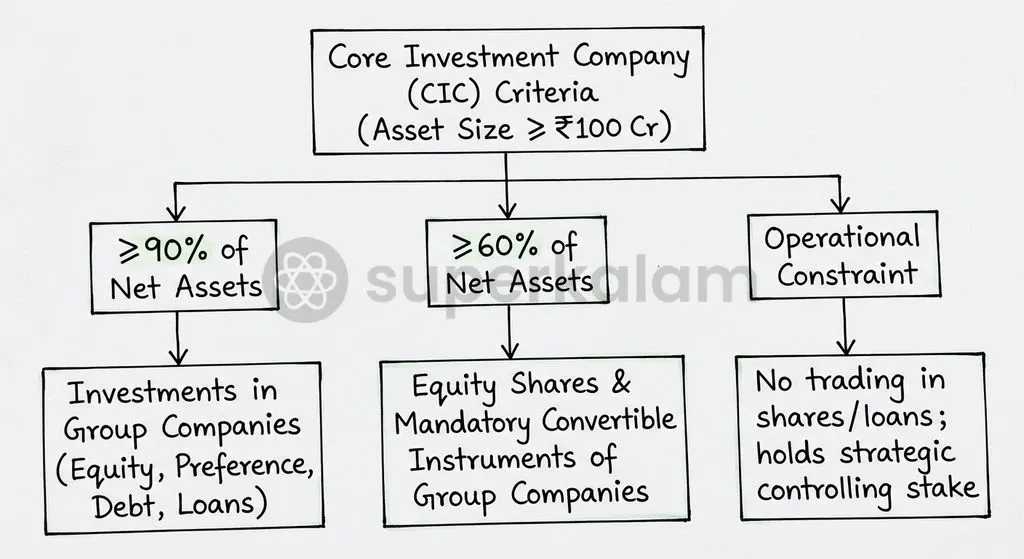
A Core Investment Company (CIC) is a specialised non-banking financial company focused on holding shares and securities under defined regulatory thresholds. Under the Reserve Bank of India (Core Investment Companies) Directions, 2025, an institution qualifies as a CIC based on three core conditions:
- Asset Threshold: It must hold total assets of at least ₹100 crore.
- Group Investment Share: It must maintain not less than 90% of net assets in group companies.
- Equity Deployment: At least 60% of net assets must be held in equity shares or compulsorily convertible instruments of group firms.
Systemically Important Core Investment Companies (CIC-ND-SI) are non-deposit-taking CICs with an asset size of ₹100 crore or more that access public funds. Because they channel capital from the financial system to downstream operations, they face mandatory registration and supervision under Chapter III B of the Reserve Bank of India Act, 1934.
Holding entities also come under central bank regulation if they meet the 50-50 Principal Business Test. Under this test, an entity must register as an NBFC if its financial assets exceed 50% of total assets (net of intangibles) and its financial income exceeds 50% of gross income. This statutory standard applies even when the holding entity maintains zero debt on its balance sheet.
Discuss with Superkalam
What is the minimum percentage of net assets that a Core Investment Company must invest in group companies?
Ask NowThe 2021 Scale-Based Regulatory Framework for NBFCs Explained
The Reserve Bank of India issued the Scale-Based Regulatory (SBR) framework on 22 October 2021, making it effective on 1 October 2022. The architecture links regulatory intensity directly to entity size, operational complexity, and systemic risk.
This structural reform followed severe financial disruptions in the shadow-banking system:
- The 2018 IL&FS Default: The sudden collapse of Infrastructure Leasing & Financial Services triggered a severe credit crunch across debt markets.
- The DHFL Insolvency: The failure of Dewan Housing Finance Corporation Limited revealed widespread contagion risks from interconnected shadow lenders.
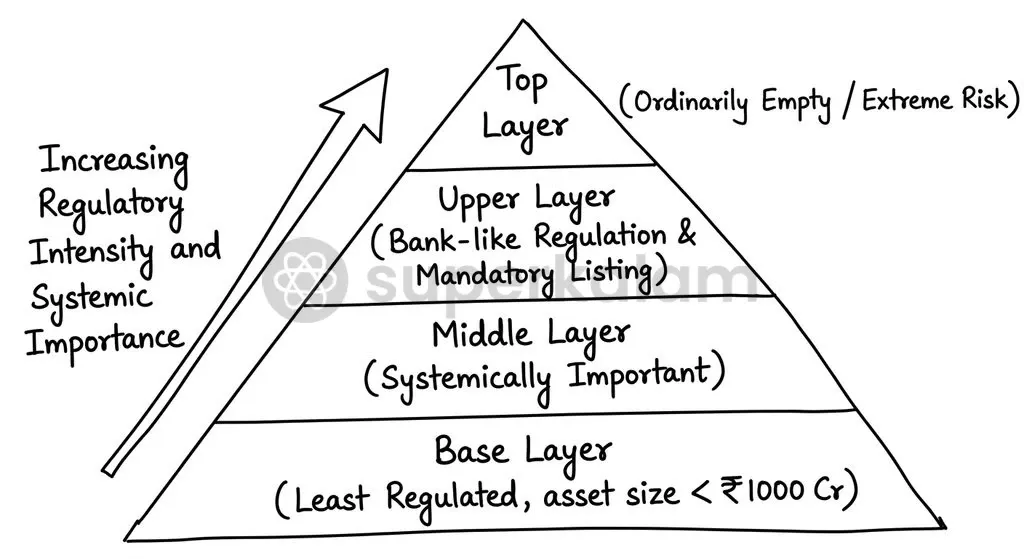
The framework organises non-banking lenders into a four-tiered pyramid: Base Layer (NBFC-BL), Middle Layer (NBFC-ML), Upper Layer (NBFC-UL), and Top Layer (NBFC-TL). The Top Layer remains unoccupied by default. It is populated only when an Upper-Layer lender produces exceptional systemic risk.
Comparison: The Four Tiers of RBI's Scale-Based Regulation
The SBR architecture applies progressively tighter prudential norms across its four regulatory tiers.
| Regulatory Layer | Covered Entities | Key Prudential & Governance Mandates |
|---|---|---|
| Base Layer (NBFC-BL) | Non-deposit taking NBFCs with assets below ₹1,000 crore, peer-to-peer lenders, account aggregators, and non-operative financial holding companies. | Basic entry norms, fit and proper criteria, transparent customer grievance redressal. |
| Middle Layer (NBFC-ML) | Deposit-taking NBFCs irrespective of asset size, and non-deposit taking NBFCs with assets of ₹1,000 crore and above, including Systemically Important CICs. | Stricter capital adequacy, asset classification norms, mandatory board-level risk management committees. |
| Upper Layer (NBFC-UL) | Top entities identified by RBI through parametric scoring of size, leverage, interconnectedness, and group complexity. | Mandatory stock exchange listing, bank-like capital buffers (9% CET1 within 15% CRAR), Large Exposure Framework limits. |
| Top Layer (NBFC-TL) | Ordinarily empty; populated if an Upper-Layer NBFC poses extreme systemic risk. | Bespoke prudential requirements, higher capital surcharges, intensive continuous supervision. |
Discuss with Superkalam
How does the 50-50 Principal Business Test bring debt-free holding companies under the regulatory umbrella of the Reserve Bank of India?
Ask NowWhy RBI Mandates Compulsory Listing for Upper-Layer NBFCs
Under Chapter V, Paragraph 43 of the SBR Master Direction, an NBFC placed in the Upper Layer must list its equity on a recognised bourse within three years of identification. The requirement enforces market discipline, mandatory continuous disclosure, and public price discovery for systemically significant institutions.
Once designated as an NBFC-UL, a company remains subject to enhanced supervision for at least five consecutive years. This regulatory lock-in applies even if its balance sheet subsequently shrinks below qualification thresholds.
Upper-Layer entities must maintain strict prudential capital standards:
- CET1 Capital: A minimum Common Equity Tier 1 ratio of 9% within a total CRAR of 15%.
- Large Exposure Framework (LEF): Single-counterparty exposure is capped at 20% of eligible capital (expandable to 25% with board approval).
- Group Exposure Limits: Total exposure to interconnected group entities is strictly capped at 25% of capital funds.
The Core Conflict: Why Tata Sons Resisted Public Listing
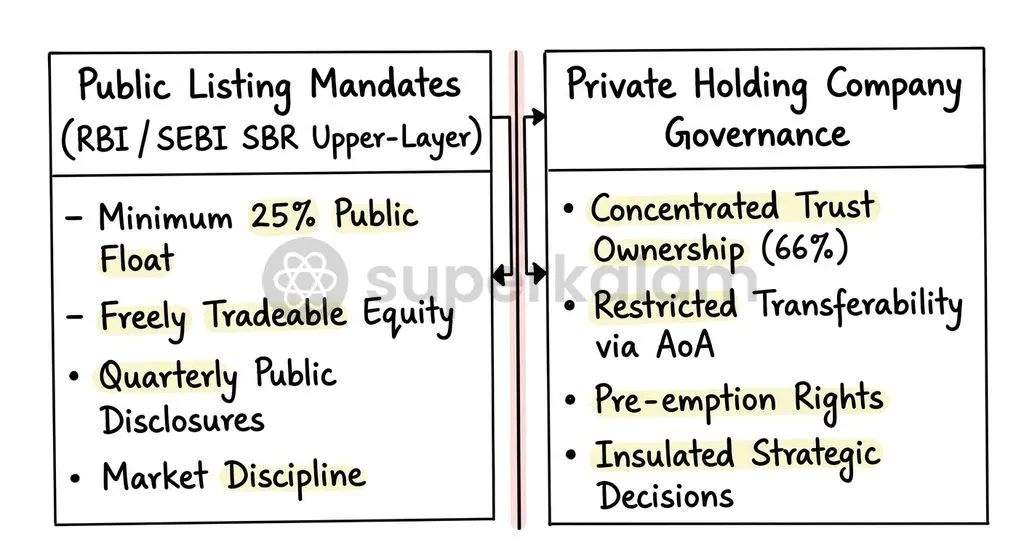
The public listing mandate directly challenges the corporate structure and governance model of Tata Sons. Philanthropic entities, primarily the Sir Dorabji Tata Trust and Sir Ratan Tata Trust (collectively Tata Trusts), own approximately 66% of the equity share capital. The Shapoorji Pallonji Group holds approximately 18.4% of equity through Cyrus Investments and Sterling Investment.
Tata Sons converted from a deemed public company into a private limited company in September 2017 under Section 14 of the Companies Act, 2013, following approval at its 99th Annual General Meeting. That step aimed to shield board decisions from outside interference and preserve strategic direction across operating subsidiaries.
Public listing triggers two critical statutory conflicts:
- Minimum Public Float: SEBI (LODR) Regulations, 2015, and Rule 19A of the Securities Contracts (Regulation) Rules, 1957, mandate a public float of at least 25%.
- Share Transfer Restrictions: Article 75 of Tata Sons' Articles of Association enforces pre-emption rights on share sales, restricting free equity transfers. This constitutional clause directly conflicts with capital-market laws requiring listed shares to trade freely.
Discuss with Superkalam
If an Upper-Layer NBFC clears all external debt and reduces its balance sheet size, how does the mandatory five-year supervisory lock-in affect its regulatory classification?
Ask NowAvailable Strategic Paths: De-registration, Debt Payoff, or IPO
To navigate the listing mandate, corporate holding entities evaluate three principal strategies:
- Complete De-leveraging and Registration Surrender: In FY2023-24, Tata Sons cleared approximately ₹21,813 crore of debt and applied in March 2024 to surrender its CIC registration. However, eliminating debt does not bypass the 50-50 Principal Business Test, leaving the central bank free to deny deregistration.
- Initial Public Offering (IPO): The company can dilute existing promoter and trust holdings to issue public shares. This complies with RBI and SEBI rules but requires amending the restrictive share-transfer clauses in its Articles of Association.
- Corporate Demerger and Group Restructuring: The group could hive off financial assets from operational brand holdings into separate non-financial entities. This restructuring reduces group financial concentration below systemic thresholds, though it involves complex legal procedures.
Discuss with Superkalam
Compare the systemic vulnerabilities exposed by the 2018 IL&FS collapse with the regulatory rationale for establishing the Upper-Layer tier in the SBR framework.
Ask NowSystemic Risk vs Corporate Control: Lessons for Financial Regulation
The regulatory encounter between the RBI and Tata Sons underscores the central tension in financial supervision: balancing established corporate control models against systemic risk containment.
- Eliminating Shadow Arbitrage: Large holding firms are central funding conduits for operating subsidiaries. Subjecting them to stock exchange listing prevents unmonitored leverage accumulation.
- Prudential Primacy: Becoming a private firm under the Companies Act, 2013, does not exempt an institution from oversight under the Reserve Bank of India Act, 1934, once it reaches systemic scale.
- Stakeholder Transparency: Mandatory reporting provides debt investors and market participants with clear visibility into intra-group loans and subsidiary dividend flows.
- Independent Price Discovery: Public listing establishes transparent valuations for conglomerate holding firms, reducing private valuation disputes.
Way Forward: Balancing Conglomerate Governance with Public Market Discipline
Financial stability requires the regulatory perimeter to expand alongside economic scale. The central bank's firm enforcement of the Scale-Based Regulatory framework shows that macroeconomic scale requires public market accountability.
Resolving the tension between trust ownership and market rules requires corporate holding entities to modernise internal charters. Removing restrictive share-transfer rules, honouring public float norms, and adopting bank-like capital buffers are essential adjustments. For the regulator, consistent supervision without ad-hoc exemptions ensures that India's shadow-banking sector remains protected against liquidity stress.
Key Takeaways
- The Reserve Bank of India's SBR framework organises non-banking lenders into a four-tiered pyramid: Base, Middle, Upper, and Top Layers.
- Identified Upper-Layer NBFCs are mandatorily required to list their equity shares on a recognised stock exchange within three years.
- Tata Sons was classified as an Upper-Layer NBFC on 30 September 2022, facing an initial compliance listing deadline of 30 September 2025.
- Repaying debt does not exempt a holding company from registration if its financial assets and income meet the 50-50 Principal Business Test.
- Public listing requires compliance with SEBI's 25% Minimum Public Shareholding rule, creating structural friction with Tata Sons' private company status and share-transfer curbs.
- Upper-Layer NBFCs must maintain a minimum 9% Common Equity Tier 1 capital ratio and comply with the 5-year regulatory lock-in period.
Mains Question
The Reserve Bank of India's Scale-Based Regulatory (SBR) framework establishes a four-tiered architecture to supervise non-banking financial entities based on size, operational complexity, and systemic risk. In this context, examine how this regulatory framework addresses systemic risk and curtails regulatory arbitrage in the shadow-banking sector. (10 Marks)
Evaluate NowMains Question
"Compelling systemically significant private holding companies to list on public bourses prioritises financial stability and market discipline over traditional promoter autonomy." Critically analyse this statement with reference to the Reserve Bank of India's Upper-Layer regulations and Core Investment Company (CIC) norms. (15 Marks)
Evaluate NowPractice MCQs
QUESTION 1
With reference to Core Investment Companies (CICs) under the Reserve Bank of India Directions, consider the following statements:
- An institution must hold total assets of at least ₹100 crore to qualify as a Core Investment Company.
- It must maintain not less than 90% of its net assets in group companies.
- At least 60% of its net assets must be deployed in equity shares or compulsorily convertible instruments of group firms.
Which of the statements given above are correct?
QUESTION 2
Consider the following statements regarding the Reserve Bank of India's Scale-Based Regulatory (SBR) framework for Non-Banking Financial Companies (NBFCs):
- Deposit-taking NBFCs irrespective of asset size are classified under the Middle Layer (NBFC-ML).
- Any NBFC placed in the Upper Layer (NBFC-UL) is statutorily required to list its equity shares on a recognised stock exchange within three years of identification.
- Once classified as an Upper-Layer NBFC, an entity remains subject to enhanced supervision for a mandatory lock-in period of at least five consecutive years.
Which of the statements given above is/are correct?
QUESTION 3
Under the prudential guidelines governing Upper-Layer Non-Banking Financial Companies (NBFC-UL), consider the following statements:
- NBFC-UL entities must maintain a minimum Common Equity Tier 1 (CET1) ratio of 9% within a total Capital to Risk-Weighted Assets Ratio (CRAR) of 15%.
- Under the Large Exposure Framework, single-counterparty exposure is capped at 20% of eligible capital, expandable to 25% with board approval.
- Group exposure limits cap total exposure to interconnected group entities at 50% of capital funds.
Which of the statements given above is/are correct?
QUESTION 4
Under the Reserve Bank of India's '50-50 Principal Business Test', an entity is required to register as a Non-Banking Financial Company (NBFC) if:
QUESTION 5
Consider the following statements regarding the institutional oversight of shadow banking in India:
- Systemically Important Core Investment Companies (CIC-ND-SI) are regulated and supervised under Chapter III B of the Reserve Bank of India Act, 1934.
- The Top Layer (NBFC-TL) of the Scale-Based Regulatory framework remains unoccupied by default and is populated only when an Upper-Layer NBFC poses extreme systemic risk.
Which of the statements given above is/are correct?