Collegium System: Justice Datta Defends Judge Appointments, Hits Out at Centre
Justice Dipankar Datta defended the collegium system and called the judges-appointing-judges charge a myth, criticising the Centre for piecemeal approvals and years-long delays on recommendations.
Sep, 2026
•9 min read
Overview
India's Collegium system is a unique judicial mechanism where the Chief Justice of India and senior Supreme Court judges select constitutional court judges without explicit textual backing in the Constitution. The mechanism emerged through three landmark Supreme Court rulings between 1981 and 1998 to protect judicial independence from executive dominance. While defenders view judicial primacy as vital to the Basic Structure doctrine, critics highlight systemic issues such as lack of transparency, low diversity, and executive delays in processing appointments. Resolving this institutional tension requires institutionalising merit-based screening and formalising clear timelines within the Memorandum of Procedure.
Why the Judicial Appointment Debate Matters Today
The appointment of constitutional court judges in India remains one of the most contested questions of institutional balance between the judiciary and the Union Executive. The debate balances two fundamental constitutional imperatives: ensuring an independent judiciary free from political influence, and maintaining democratic accountability through public oversight.
As of September 2026, the institutional friction has manifested in administrative delays and selective clearances of recommended candidates. In a September 2026 judicial opinion, Supreme Court Justice Dipankar Datta observed that the notion of judges appointing judges is a myth, noting that the Union Executive exercises decisive vetting through intelligence reports and selective clearances per reports in The Hindu and The Times of India. Justice Datta noted that the sanctity of recommendations is undermined whenever the Executive approves select names while withholding others.
This structural tussle directly affects case pendency across constitutional courts and tests the constitutional convention of executive deference to reiterated judicial recommendations.
Discuss with Superkalam
Recall the composition and size of the Supreme Court Collegium established under the Third Judges Case (1998).
Ask NowConstitutional Roots: What Articles 124 and 217 Originally Intended
Articles 124 and 217 of the Constitution established a collaborative appointment architecture founded on mutual consultation between the Union Executive and the higher judiciary.
Under Article 124(2), the President of India appoints Supreme Court judges by warrant under hand and seal after mandatory consultation with such judges of the Supreme Court and High Courts as deemed necessary, with the Chief Justice of India (CJI) always consulted for puisne appointments. Similarly, Article 217(1) mandates that the President appoint High Court judges after consultation with the CJI, the State Governor, and the Chief Justice of the respective High Court.
The constituent framework did not vest an absolute veto in either branch. The drafting assembly chose the word "consultation" over "concurrence" to ensure institutional dialogue without creating single-branch supremacy in judicial selection.
From Executive Dominance to Judicial Primacy: The Three Judges Cases
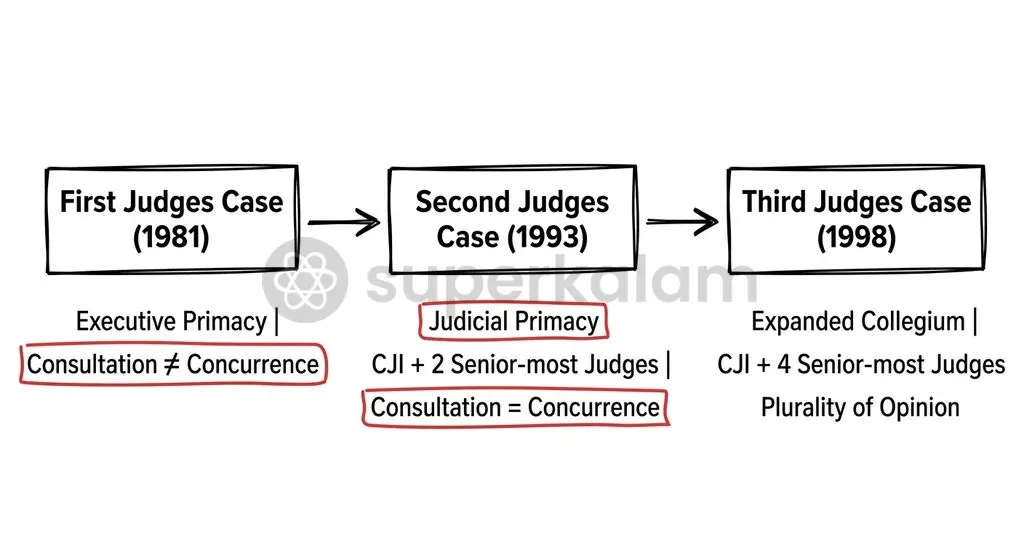
The Supreme Court transformed the judicial appointment process across three decades through judicial interpretation of the constitutional term "consultation".
The shift occurred across three landmark Constitution Bench verdicts that redefined the balance of power between the Union Executive and the Chief Justice of India:
- The First Judges Case (S.P. Gupta v. Union of India, 1981): A 7-judge Constitution Bench ruled that "consultation" under Articles 124 and 217 does not mean "concurrence". The verdict granted executive primacy, allowing the Central Government to disagree with the CJI's opinion for cogent reasons.
- The Second Judges Case (SCAORA v. Union of India, 1993): A 9-judge Constitution Bench overruled S.P. Gupta, ruling that "consultation" implies concurrence and judicial primacy. The court established the initial Collegium comprising the CJI and two senior-most Supreme Court judges. The ruling also established that a unanimous reiteration by the Collegium is constitutionally binding on the President.
- The Third Judges Case (In re Special Reference No. 1 of 1998): In an advisory opinion under Article 143, the Supreme Court expanded the Supreme Court Collegium to a five-member body consisting of the CJI and the four senior-most puisne judges. The court ruled that an appointment recommendation made without consulting the four senior-most judges does not constitute valid consultation.
| Dimension | First Judges Case (1981) | Second Judges Case (1993) | Third Judges Case (1998) |
|---|---|---|---|
| Bench Size | 7-judge Constitution Bench | 9-judge Constitution Bench | 9-judge Constitution Bench (Advisory) |
| Meaning of Consultation | Consultation does not mean concurrence | Consultation means concurrence | Consultation requires broad consensus |
| Primacy | Central Executive | Chief Justice of India and Collegium | Plurality of judges (CJI + 4 senior judges) |
| Body Structure | Individual consultation with CJI | CJI + 2 senior-most SC judges | CJI + 4 senior-most SC judges |
| Executive Role | Decisive authority | Bound by unanimous reiteration | Bound by unanimous reiteration |
Discuss with Superkalam
Explain how the judicial interpretation of the term 'consultation' in Article 124 changed between 1981 and 1993.
Ask NowThe NJAC Experiment: Why the Supreme Court Struck Down Parliament's Reform
Parliament enacted the Constitution (Ninety-Ninth Amendment) Act, 2014 alongside the National Judicial Appointments Commission (NJAC) Act, 2014 to replace the Collegium with a broad-based commission.
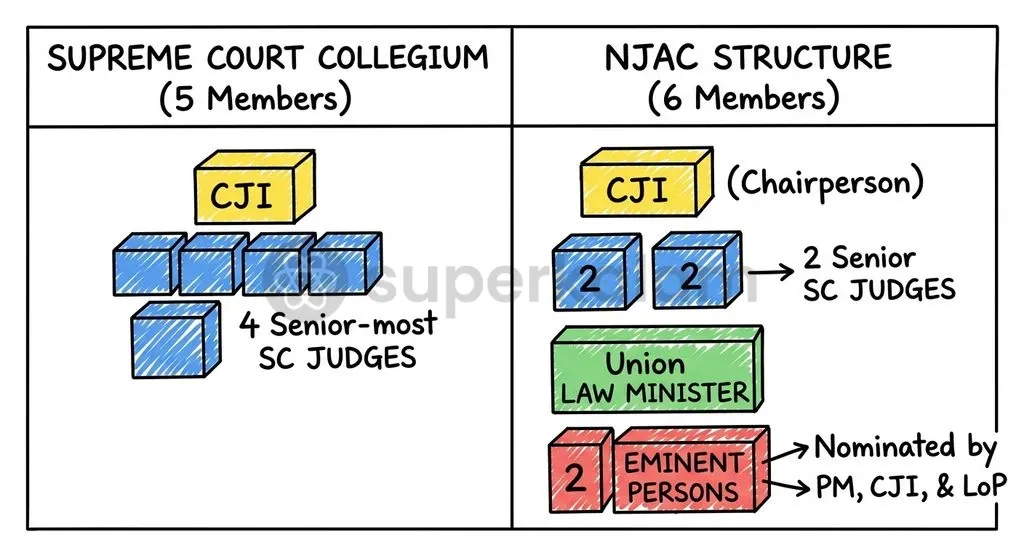
The NJAC was designed as a six-member statutory body comprising the Chief Justice of India as Chairperson, two senior-most Supreme Court judges, the Union Minister of Law and Justice, and two eminent persons. A committee comprising the Prime Minister, the CJI, and the Leader of the Opposition in the Lok Sabha was mandated to nominate the two eminent persons. The statute gave any two members the power to veto any proposed recommendation.
In the Fourth Judges Case (SCAORA v. Union of India, 2015), a 5-judge Constitution Bench struck down the 99th Constitutional Amendment and the NJAC Act by a 4:1 majority. The majority held that judicial primacy in appointments forms an essential facet of judicial independence, which is an inviolable part of the Basic Structure doctrine. The court ruled that executive participation with veto powers compromised judicial independence.
How the Current Collegium Works: Supreme Court and High Courts
The Memorandum of Procedure (MoP) governs the operational workflow for judicial appointments and transfers across constitutional courts in India.
The selection process follows distinct tracks depending on whether vacancies arise in the High Courts or the Supreme Court:
- Supreme Court Appointments: The Supreme Court Collegium consists of the Chief Justice of India and four senior-most judges. The body evaluates sitting High Court Chief Justices, senior High Court judges, and distinguished advocates for elevation based on merit, integrity, and regional representation.
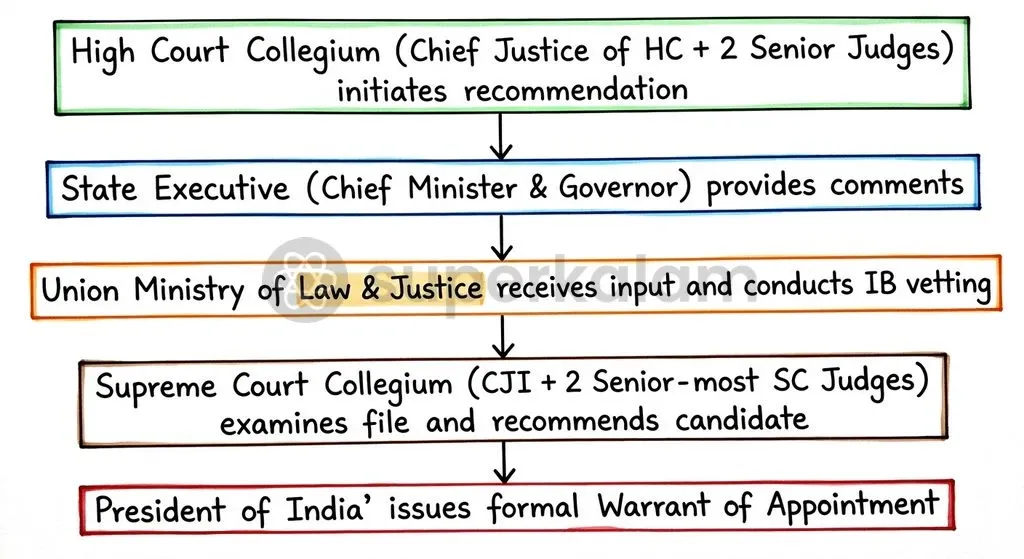
- High Court Appointments: Proposals originate from the High Court Collegium, comprising the Chief Justice of the High Court and two senior-most judges. The recommendation passes through the State Chief Minister and Governor to the Union Law Ministry, which conducts background checks before forwarding the file to the Supreme Court Collegium (CJI and two senior-most SC judges) for final approval.
- High Court Transfers: Under Article 222(1) and the Memorandum of Procedure, transfers are decided by the CJI and four senior-most judges, in consultation with the Chief Justices of both the transferring and receiving High Courts.
Discuss with Superkalam
How does selective executive clearance of Collegium recommendations impact judicial administration and case pendency?
Ask NowKey Fault Lines: Transparency, Representation, and the Stalled Memorandum of Procedure
The Collegium system faces major institutional critiques regarding opacity, social representation, and procedural friction between the judiciary and executive.
Legal scholars and public bodies point to three structural vulnerabilities:
- Opacity and 'Uncle Judge' Syndrome: The selection process operates without published evaluation criteria, recorded minutes, or structured interviews. The Law Commission of India, in its 230th Report (2009), highlighted the 'Uncle Judge' syndrome, recommending that persons whose relatives practice in a High Court should not be appointed as judges in that court to avoid conflicts of interest.
- Inadequate Social Diversity: The Parliamentary Standing Committee on Personnel, Public Grievances, Law and Justice, in its 133rd Report (August 2023), highlighted inadequate representation of Scheduled Castes, Scheduled Tribes, Other Backward Classes, and women in the higher judiciary.
- The Stalled Memorandum of Procedure: In December 2015, following the NJAC verdict, the Supreme Court directed the Union Government to finalise a revised Memorandum of Procedure (MoP) in consultation with the CJI. The revision remains unresolved due to disagreements over government veto powers on national security grounds.
Global Models: How Other Major Democracies Select Their Highest Judges
Major constitutional democracies use structured executive and commission-based mechanisms to appoint top judges rather than closed judicial panels.
The comparative models demonstrate alternative methods for balancing independence and public accountability:
- United Kingdom (Independent Commission Model): The Constitutional Reform Act 2005 established the Judicial Appointments Commission (JAC), an independent 15-member body composed of judges, legal professionals, and lay members. The commission selects candidates through open merit competition, limiting the executive Lord Chancellor to approving, rejecting, or requesting reconsideration of a candidate once.
- United States (Executive Nomination and Legislative Confirmation): Under Article II, Section 2, Clause 2 of the US Constitution (Appointments Clause), federal and Supreme Court judges are nominated by the President and confirmed by the US Senate via simple majority. This model ensures direct legislative scrutiny of judicial philosophy.
| Dimension | India (Collegium System) | United Kingdom (JAC Model) | United States (Senate Confirmation) |
|---|---|---|---|
| Nominating Authority | Judicial Collegium (CJI + senior judges) | Independent Judicial Appointments Commission | President of the United States |
| Executive Role | Background vetting; bound by reiteration | Limited power to reject or ask for review | Complete discretion to nominate candidates |
| Legislative Role | No role in selection | No confirmation role | Mandatory 'Advice and Consent' confirmation |
| Composition of Panel | Exclusively serving judges | Mixed (judges, lawyers, laypersons) | None (political appointment system) |
| Selection Criteria | Closed-door seniority and merit assessment | Open competition and advertised criteria | Public hearings and political evaluation |
Discuss with Superkalam
Evaluate whether judicial primacy in judge appointments is indispensable for safeguarding the Basic Structure doctrine.
Ask NowReforming the Process: Balancing Judicial Independence with Accountability
Judicial reform in India requires institutionalising transparency and objective vetting without diluting the independence of the higher judiciary.
Constructive reform can proceed along three actionable tracks:
- Institutionalising a Search and Evaluation Secretariat: Establishing a permanent, institutionalised Search and Evaluation Secretariat would assist the Collegium by evaluating judgments, case disposal rates, and candidate integrity before nominations reach senior judges.
- Codifying Binding Timelines: The absence of statutory deadlines in the Memorandum of Procedure enables administrative delays. While the Supreme Court attempted to lay down vacancy schedules in Malik Mazhar Sultan (2006/2008), formalising fixed response periods in the MoP is necessary to prevent pocket vetos.
- Finalising the Revised MoP: The Union Government and the Supreme Court must resolve the stalemate over the Memorandum of Procedure by establishing objective eligibility parameters, formal grievance redressal, and transparent disclosure of vacancies.
Key Takeaways
- Articles 124(2) and 217(1) of the Constitution established a collaborative framework requiring Presidential consultation with the judiciary for judicial appointments.
- The Collegium system evolved through the Three Judges Cases (1981, 1993, 1998), transitioning the appointment process from executive dominance to judicial primacy.
- The Supreme Court struck down the 99th Constitutional Amendment and the NJAC Act in 2015, ruling that judicial primacy in appointments forms an integral part of the Basic Structure.
- The 230th Report of the Law Commission flagged the 'Uncle Judge' syndrome, while the 133rd Parliamentary Standing Committee Report highlighted the lack of social diversity in the higher judiciary.
- Sustainable reform requires finalising the revised Memorandum of Procedure, establishing an objective Search and Evaluation Secretariat, and enforcing strict timelines for processing judicial nominations.
Mains Question
'The drafting assembly chose the word consultation over concurrence to ensure institutional dialogue without creating single-branch supremacy in judicial selection.' In light of the Three Judges Cases, elucidate how judicial interpretation transformed the constitutional balance between the Executive and the Judiciary. (10 Marks)
Evaluate NowMains Question
While the Supreme Court in the Fourth Judges Case affirmed judicial primacy as an essential facet of the Basic Structure doctrine, the Collegium system faces continuous criticism over opacity and accountability. Critically examine the structural fault lines in the judicial appointment process and the reasons for the stalled Memorandum of Procedure (MoP). (15 Marks)
Evaluate NowPractice MCQs
QUESTION 1
With reference to the evolution of the judicial appointments mechanism in India, consider the following statements:
- In the First Judges Case (1981), the Supreme Court ruled that 'consultation' does not mean 'concurrence', establishing executive primacy.
- The Second Judges Case (1993) established that a unanimous reiteration by the Collegium is constitutionally binding on the President.
- The Third Judges Case (1998) expanded the Supreme Court Collegium to a three-member body consisting of the Chief Justice of India and the two senior-most puisne judges.
Which of the statements given above are correct?
QUESTION 2
Regarding the National Judicial Appointments Commission (NJAC) Act, 2014 and the Fourth Judges Case (2015), consider the following statements:
- The NJAC was designed as a six-member body with the Union Minister of Law and Justice acting as its Chairperson.
- Under the NJAC framework, any two members of the commission held the power to veto a proposed recommendation.
- In the Fourth Judges Case (2015), the Supreme Court struck down the NJAC Act on the grounds that judicial primacy in appointments is an inviolable facet of the Basic Structure doctrine.
Which of the statements given above is/are correct?
QUESTION 3
Consider the following statements regarding the procedure for judicial appointments and transfers under the Collegium system:
- Proposals for High Court appointments originate from a High Court Collegium comprising the Chief Justice of the High Court and two senior-most judges.
- Transfers of High Court judges under Article 222(1) are decided by the CJI and the two senior-most Supreme Court judges.
- The Supreme Court Collegium recommending appointments to the Supreme Court consists of the Chief Justice of India and the four senior-most puisne judges.
Which of the statements given above are correct?
QUESTION 4
With reference to the institutional critiques of the Collegium system, consider the following statements:
- The Law Commission of India's 230th Report highlighted the 'Uncle Judge' syndrome and recommended barring the appointment of judges to High Courts where their relatives practice.
- The Parliamentary Standing Committee on Personnel, Public Grievances, Law and Justice in its 133rd Report highlighted inadequate representation of Scheduled Castes, Scheduled Tribes, Other Backward Classes, and women in the higher judiciary.
Which of the statements given above is/are correct?
QUESTION 5
Under Article 124(2) of the Constitution of India, whose consultation is mandatory for the President of India when appointing any puisne judge of the Supreme Court?