SAT-SAAW: MoD Signs Rs 811 Crore BDL Deal for 160 Anti-Airfield Weapons
The MoD has signed a Rs 810.79 crore contract with BDL for 160 DRDO-designed SAT-SAAW precision glide bombs for the IAF, with 60% indigenous content and deliveries from 2027-28.
Sep, 2026
•7 min read

Context
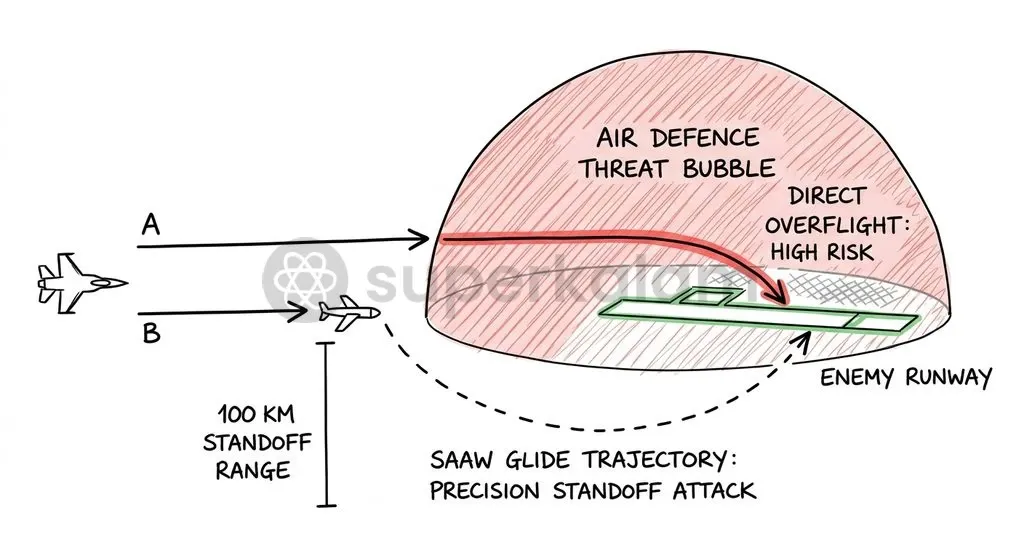
The Smart Anti-Airfield Weapon (SAAW) is an indigenous, unpowered 125 kg class precision-guided glide bomb designed by the Defence Research and Development Organisation. It neutralises high-value runway infrastructure from a standoff range of up to 100 kilometres.
This standoff capability lets Indian Air Force strike aircraft hit runways, taxiways, and reinforced bunkers without entering heavily defended enemy airspace. Procured under the Buy (Indian-IDDM) framework, SAAW marks a transition from expensive foreign munitions to scalable, locally built glide weapons.
Why in the News?
The Ministry of Defence signed an ₹810.79 crore contract with Bharat Dynamics Limited on 23 September 2026 for the supply of 160 Satellite Smart Anti-Airfield Weapons (SAT-SAAW) to the Indian Air Force.
Key contractual and technical highlights include:
- Procurement Category: Classified under the Buy (Indian - IDDM) category as of September 2026, the highest-priority acquisition channel in the Defence Acquisition Procedure.
- Delivery Timeline: Bharat Dynamics Limited will deliver the 160 SAT-SAAW units between fiscal years 2027-2028 and 2028-2029.
- Indigenous Content: The weapon features 60% domestic sub-assemblies, including the Inertial Measurement Unit, the Long Impact Delay Fuse, and the Twin Store Carrier.
What is the Smart Anti-Airfield Weapon (SAAW)?
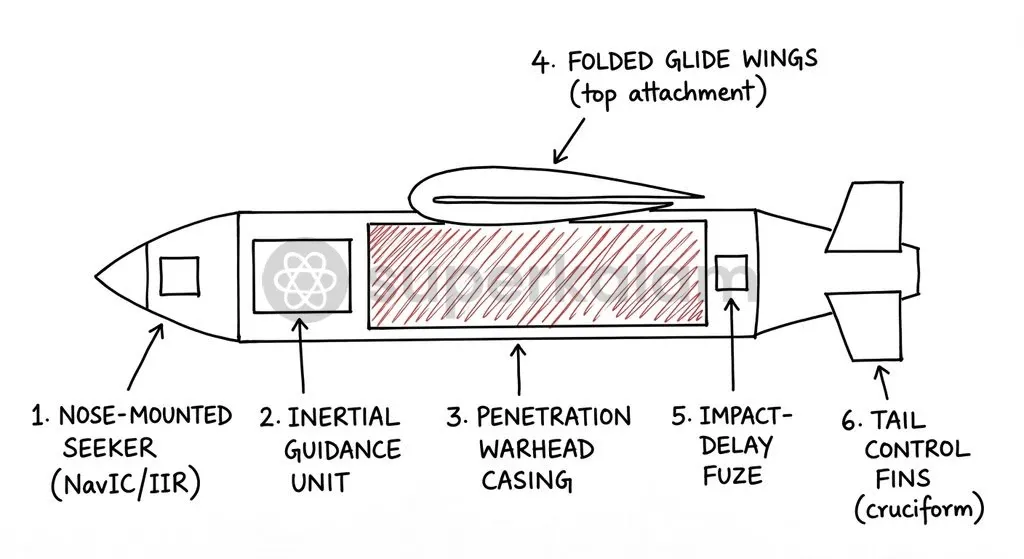
The Smart Anti-Airfield Weapon is an air-to-ground precision glide bomb engineered by DRDO's Research Centre Imarat (RCI), Hyderabad, in partnership with other DRDO laboratories and the Indian Air Force. The munition is unpowered and aerodynamically optimised. Once released from the aircraft, it deploys foldable wings to glide directly toward target coordinates.
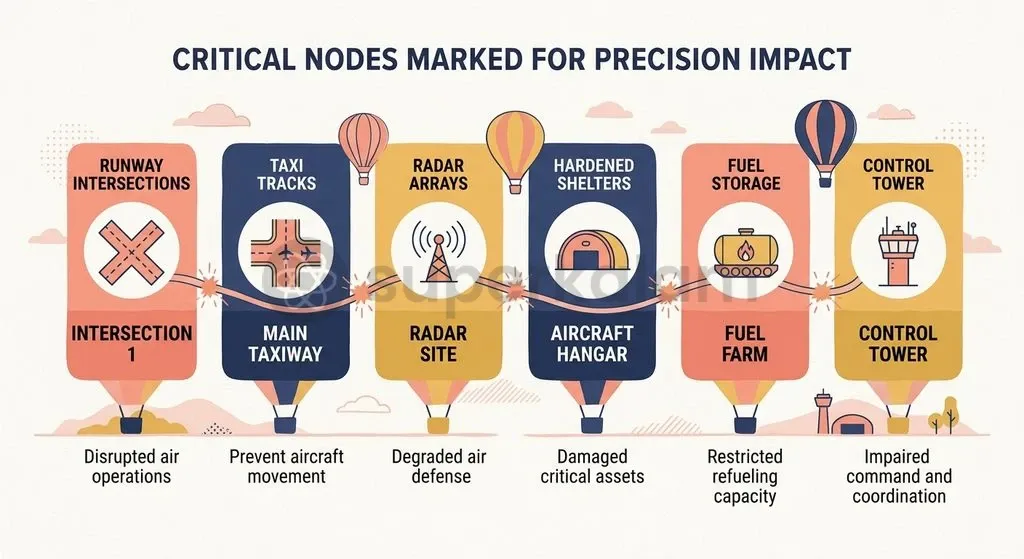
SAAW falls into the 125 kg lightweight weapon class and measures 1.85 metres in length. Its operational mission focuses on degrading key enemy ground assets:
- Runways and Taxiways: Cratered and fractured to prevent enemy fighter takeoffs and landings.
- Hardened Aircraft Shelters (HAS): Penetrated to neutralise frontline aircraft parked inside blast-proof hangars.
- Radar and Command Posts: Struck to blind local air surveillance and disrupt operational sortie generation.
- Aircraft Aprons and Fuel Dumps: Targeted to paralyse auxiliary ground handling infrastructure.
Discuss with Superkalam
Which DRDO laboratory served as the lead designer for the Smart Anti-Airfield Weapon?
Ask NowHow SAAW Works: Guidance Systems, Range, and Warhead Design
The SAAW architecture combines aerodynamic glide efficiency with multi-sensor guidance to achieve tight terminal accuracy over long distances. The munition delivers an operational standoff glide range of up to 90 to 100 kilometres, depending on release altitude and launch speed.
The Defence Research and Development Organisation developed SAAW in two guidance configurations to suit varying mission demands:
- Satellite-Guided Variant (SAT-SAAW): Employs an on-board Inertial Navigation System integrated with multi-constellation satellite navigation inputs (including NavIC and GPS). This configuration delivers all-weather operational capability with a Circular Error Probable of less than 7 metres.
- Electro-Optical Variant (EO-SAAW): Uses an Imaging Infrared (IIR) seeker that captures thermal signatures of target infrastructure during terminal approach. This sensor configuration provides day-and-night targeting with an enhanced terminal accuracy of less than 3 metres Circular Error Probable.
The Indian Air Force and DRDO validated these systems across multiple flight trials. In January 2021, DRDO and Hindustan Aeronautics Limited conducted the 9th flight trial of SAAW from a Hawk-i trainer aircraft off the Odisha coast at the Integrated Test Range, Chandipur. Later in November 2021, joint teams conducted dual test firings at the Chandan firing range in Jaisalmer, demonstrating both satellite-guided and electro-optical seeker configurations.
The munition integrates across multiple frontline aircraft, with trials completed on the SEPECAT Jaguar, Sukhoi Su-30MKI, and Hawk-i. Strike fighters can carry multiple SAAW munitions using dedicated racks like the Smart Quad Rack and Twin Store Carrier to saturate runway intersections in a single pass (as reported on 23 September 2026).
Comparing SAAW with Conventional Runway-Busting Munitions
Conventional airfield denial weapons traditionally required strike aircraft to fly directly above or near enemy airfields, exposing flight crews to dense short-range air defence batteries. Modern standoff weapons such as SAAW fundamentally alter this strike profile.
| Parameter | Conventional Gravity Bombs (e.g. Matra Durandal) | Smart Anti-Airfield Weapon (SAAW) | Heavy Standoff PGMs (e.g. SPICE-2000) |
|---|---|---|---|
| Launch Profile | Low-altitude overflight directly above target | High-altitude standoff release | Standoff launch from medium to high altitude |
| Standoff Range | Negligible (direct drop over runway) | Up to 90–100 km | Up to 60–100 km |
| Weight Category | ~200 kg to ~450 kg | 125 kg class | 900 kg to 1,000 kg class |
| Terminal Accuracy | Unguided ballistic trajectory (wide CEP) | <7 m (SAT-SAAW) / <3 m (EO-SAAW) | <3 m (Electro-optical / GPS guided) |
| Aircraft Risk | Extreme exposure to point-defence artillery and MANPADS | Aircraft remains outside short-range air defence envelopes | Aircraft remains outside local point defences |
| Carriage Capacity | Moderate (heavy physical drag) | High density (multi-store carriage per pylon) | Limited (1–2 heavy weapons per fighter) |
| Cost Profile | Low per unit | Cost-effective indigenous production | High per-unit import cost |
Discuss with Superkalam
Explain how deploying foldable wings enables an unpowered munition like SAAW to achieve an extended glide range of up to 100 kilometres.
Ask NowStrategic Significance: How Standoff Weapons Reshape Air Warfare
Standoff precision munitions change the tactical calculus of modern offensive counter-air campaigns. By allowing delivery from up to 100 kilometres away, SAAW permits Indian strike packages to degrade enemy airbase operations while staying clear of short- and medium-range Ground-Based Air Defence Systems (GBADS).
The operational value of SAAW within India's broader deterrence architecture encompasses several dimensions:
- Tactical Air Superiority: Disabling enemy operating surfaces during opening hours of a conflict grounds combat squadrons, disrupting planned defensive air sweeps and counter-strike missions.
- Saturation Strike Economics: Heavy standoff missiles like the Israeli SPICE-2000 or SCALP cruise missiles are inventory-constrained due to high unit costs; lightweight precision glide munitions provide a cost-effective standoff alternative for distributed infrastructure targets (as reported on 23 September 2026).
- Two-Front Force Multiplier: SAAW expands rapid response options for counter-air base suppression along forward border sectors, multiplying the operational throughput of multirole fighter wings (as reported on 23 September 2026).
Discuss with Superkalam
Analyse the trade-offs between deploying lightweight glide munitions like SAAW versus heavy standoff missiles like SPICE-2000 in counter-air operations.
Ask NowDefence Indigenisation: The Role of DRDO, BDL, and Private Industry
The SAT-SAAW production contract reflects the institutional maturity of India's defence manufacturing ecosystem under the Buy (Indian - IDDM) framework. Design leadership by the Research Centre Imarat combined with serial production by Bharat Dynamics Limited bridges the gap between laboratory prototyping and industrial-scale weapon assembly.
Achieving 60% indigenous content relies on domestic supply chains for vital subsystems:
- Inertial Measurement Unit: Engineered domestically to ensure accurate mid-course guidance without vulnerability to external electronic signal disruptions.
- Long Impact Delay Fuse: Custom-built to survive high-speed impact through reinforced concrete before detonating, creating deep subsurface craters beneath runway surfaces.
- Twin Store Carrier: Developed to double the weapons carriage payload per aircraft hardpoint.
Domestic manufacturing of precision guidance assemblies reduces reliance on foreign supply chains during active conflict scenarios, shielding weapon replenishment rates from international export controls and supply bottlenecks.
Way Forward for India's Precision Munition Arsenal
Expanding the Indian Air Force's standoff strike envelope requires sustained technological enhancements across seeker capability, platform integration, and electronic counter-countermeasures. Future development tracks must build on the validated baseline of the SAT-SAAW design.
- Broadened Fleet Integration: Accelerate operational clearance across additional frontline combat aircraft, including the LCA Tejas Mk1A and Rafale fleets, to standardise precision glide munitions across all strike wings.
- Dual-Mode Seeker Integration: Combine satellite navigation with terminal imaging infrared guidance on a single airframe to create high-accuracy hybrid seekers resilient against active GNSS jamming environments.
- Swarm and Networked Standoff Tactics: Implement collaborative data links across glide munitions, allowing salvos of SAAW weapons to dynamically allocate individual runway aim-points mid-flight.
- Scaling Industrial Output: Ensure Bharat Dynamics Limited and associated MSME tier suppliers meet contracted delivery schedules across the 2027–2029 operational window.
Discuss with Superkalam
Assess the operational impact of integrating 60% indigenous sub-assemblies into precision munitions on India's strategic autonomy during conflicts.
Ask NowKey Takeaways
- SAAW is an indigenous, unpowered 125 kg class precision glide bomb developed by DRDO's Research Centre Imarat to destroy runways, taxiways, and reinforced bunkers.
- The Ministry of Defence signed an ₹810.79 crore contract with BDL in September 2026 for 160 SAT-SAAW units under the Buy (Indian - IDDM) route, with deliveries scheduled for FY 2027-28 to FY 2028-29.
- The weapon offers an operational standoff range of up to 100 kilometres, keeping launch aircraft outside the envelope of enemy short- and medium-range ground-based air defences.
- SAAW operates in two variants: a satellite-guided version (CEP < 7 m) and an electro-optical seeker version (CEP < 3 m).
- Flight trials have validated weapon integration across the SEPECAT Jaguar, Sukhoi Su-30MKI, and Hawk-i aircraft.
Mains Question
'Standoff precision glide munitions represent a paradigm shift in offensive counter-air campaigns by decoupling target neutralisation from aircraft exposure.' In the context of the Smart Anti-Airfield Weapon (SAAW), elucidate how indigenous glide weapons transform airfield-denial operations. (10 Marks)
Evaluate NowMains Question
The procurement of the Satellite Smart Anti-Airfield Weapon (SAT-SAAW) under the 'Buy (Indian - IDDM)' category marks a significant milestone in defence indigenisation. Evaluate the strategic, operational, and industrial implications of this induction for India's national security architecture. (15 Marks)
Evaluate NowPractice MCQs
QUESTION 1
With reference to the Smart Anti-Airfield Weapon (SAAW), consider the following statements:
- It is an unpowered, lightweight precision-guided glide bomb falling in the 125 kg class.
- The Satellite-Guided variant (SAT-SAAW) integrates an Inertial Navigation System with satellite navigation inputs including NavIC and GPS.
- The weapon requires an active onboard turbojet engine to achieve its 90 to 100 kilometre operational range. Which of the statements given above is/are correct?
QUESTION 2
Consider the following statements regarding the guidance and performance parameters of the Smart Anti-Airfield Weapon (SAAW):
- The Electro-Optical variant (EO-SAAW) employs an Imaging Infrared seeker to achieve a Circular Error Probable of less than 3 metres.
- The Satellite-Guided variant (SAT-SAAW) provides an all-weather Circular Error Probable of less than 7 metres.
- The munition incorporates a Long Impact Delay Fuse designed to penetrate reinforced concrete surfaces before detonation. Which of the statements given above are correct?
QUESTION 3
Consider the following statements regarding the development and procurement of the Smart Anti-Airfield Weapon (SAAW):
- SAAW was designed by DRDO's Research Centre Imarat (RCI), Hyderabad.
- The Ministry of Defence contracted Bharat Dynamics Limited for the supply of 160 SAT-SAAW units under the Buy (Indian-IDDM) category.
- Flight trials of SAAW have been successfully conducted from platforms including the Hawk-i trainer aircraft and Sukhoi Su-30MKI. Which of the statements given above are correct?
QUESTION 4
In the context of airfield denial munitions, which of the following best describes the primary tactical advantage of the Smart Anti-Airfield Weapon (SAAW) over conventional runway-busting gravity bombs?
QUESTION 5
Consider the following statements regarding the indigenisation profile of the Smart Anti-Airfield Weapon:
- The SAT-SAAW features 60% domestic sub-assemblies.
- Critical indigenous components include the Inertial Measurement Unit, Long Impact Delay Fuse, and Twin Store Carrier. Which of the statements given above is/are correct?