Super El Niño: India Faces 15,800 Extra Heat Deaths by February, Warns Report
A Climate Impact Lab report projects 15,800 additional heat deaths in India between September 2026 and February 2027 as a Super El Niño pushes Pacific temperatures 3°C above normal.
Sep, 2026
•9 min read
Overview
A global study by the Climate Impact Lab projects that the ongoing Super El Niño will drive approximately 15,800 excess heat-related deaths across India between September 2026 and February 2027 compared to historical baselines. This extreme climatic phenomenon supercharges ambient temperatures and suppresses convective precipitation. It pushes wet-bulb thresholds beyond safe physiological limits for outdoor workers.
Because extreme heat intersects with widespread informal employment, water scarcity, and unnotified disaster funding mechanisms, India faces a compounding socio-economic emergency. Mitigating these risks requires integrating legally mandated Heat Action Plans, targeted parametric insurance, and climate-resilient urban cooling infrastructure.
Why in the News? The Climate Impact Lab Findings
The Climate Impact Lab released a global assessment quantifying the mortal toll of extreme climatic anomalies induced by the Super El Niño. As of September 2026, research indicates that the ongoing Super El Niño will cause approximately 15,800 (±1,600) additional heat-related excess deaths in India between September 2026 and February 2027 compared to the 1996–2025 baseline.
Key findings from the assessment include:
- Global Mortality Toll: The study projects 451,000 additional heat-related fatalities worldwide between June 2026 and February 2027, with 239,000 occurring in the September to February window alone.
- Elevated Global Temperatures: Land surface temperatures globally are estimated to stay 1.2°C above normal during this event, driving a 44% surge in extremely hot days.
- Winter Mortality Spike: Nearly half of India's projected excess mortalities—approximately 7,400 lives—are expected to occur during the winter months of December to February.
This winter surge shows that the Super El Niño operates as an extended thermodynamic crisis. It elevates baseline mortality well before typical pre-monsoon heatwaves begin.
Discuss with Superkalam
What sea surface temperature anomaly threshold in the Niño 3.4 region officially classifies an ENSO event as a Super El Niño?
Ask NowWhat is a Super El Niño and How Does It Drive Extreme Heat?
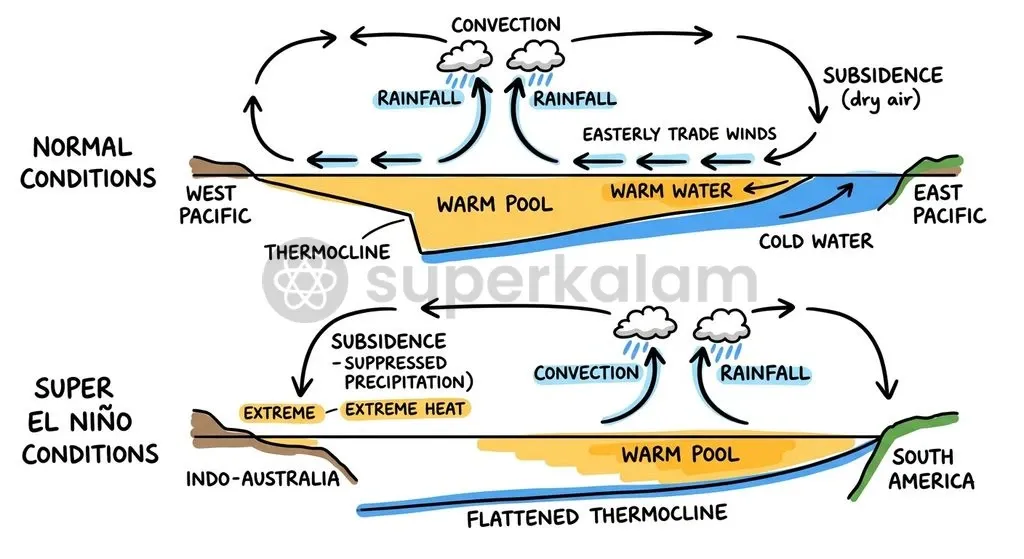
A Super El Niño is an extreme atmospheric-oceanic event characterised by severe sea surface warming across the central and eastern equatorial Pacific Ocean. According to the NOAA Climate Prediction Center ENSO Technical Documentation, meteorologists classify an event as a Super El Niño when sea surface temperature anomalies in the equatorial Pacific Niño 3.4 region (5°N–5°S, 120°W–170°W) equal or exceed +2.0°C above baseline averages.
Under standard conditions, the Pacific Walker Circulation features warm surface waters pooled in the western Pacific, driving ascending moist air and convective rainfall. During a Super El Niño, the India Meteorological Department notes that the Walker Circulation weakens and shifts its rising convective limb eastward towards the central Pacific.
This displacement forces broad atmospheric subsidence over the Indian subcontinent. Descending air compresses, suppresses cloud formation, reduces monsoon precipitation, and accelerates severe surface heat accumulation.
| Feature / Metric | Regular El Niño | Super El Niño |
|---|---|---|
| Niño 3.4 SST Anomaly | +0.5°C to +1.9°C above baseline | Equal to or exceeding +2.0°C anomaly |
| Atmospheric Circulation Shift | Moderate eastward shift of Pacific convective zone | Severe Walker Circulation disruption with intense subsidence over India |
| Global Heat Wave Frequency | Moderate regional spikes in extreme thermal anomalies | 44% global surge in extremely hot days |
| Subcontinental Impact | Intermittent dry spells during the summer monsoon | Compounding winter and summer heatwaves with elevated mortality |
Breaking Down the Study: Heat Mortality Projections and Methodology
The Climate Impact Lab combines high-resolution econometric climate-mortality models with global temperature projections to estimate sub-national excess deaths. The methodology establishes that extreme heat impacts mortality non-linearly across demographic groups.
The research reveals three critical dynamics:
- Direct and Indirect Pathways: The research captures both direct mortalities, such as fatal heat strokes, and indirect mortalities from cardiovascular and respiratory failure exacerbated by thermal stress.
- Non-Linear Vulnerability: Populations lacking access to artificial space cooling or clean drinking water exhibit sharp increases in mortality once local temperatures cross historical percentiles.
- Off-Season Winter Strain: Warmer winters prevent physiological recovery and disrupt cardiovascular homeostasis in vulnerable cohorts. Consequently, the December–February window claims 7,400 additional lives before summer even begins.
Discuss with Superkalam
How does the eastward displacement of the Pacific Walker Circulation lead to atmospheric subsidence and suppressed precipitation over India?
Ask NowWhy India is Uniquely Vulnerable to Extreme Heat Waves
India faces distinct socio-economic and physiological vulnerabilities that amplify the deadly impacts of extreme thermal events. The India Meteorological Department officially declares a heatwave in plain regions when maximum temperatures reach at least 40°C and depart from normal climatological averages by 4.5°C to 6.4°C.
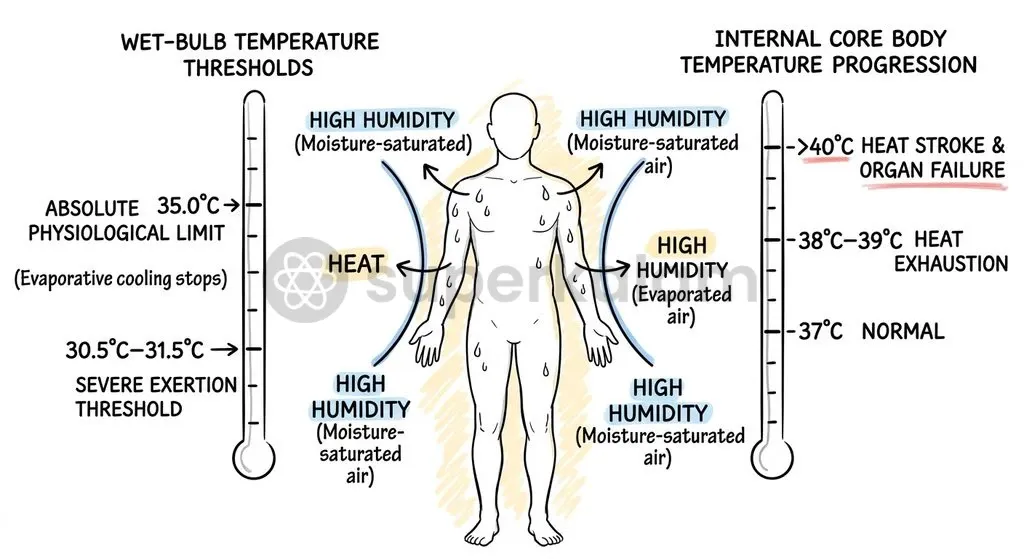
Human survivability depends heavily on humidity alongside dry-bulb temperature. The National Disaster Management Authority highlights that while the theoretical upper limit for human survival is a wet-bulb temperature of 35°C (where the body can no longer cool itself via sweat evaporation), sustained physical labour causes severe metabolic heat stress at wet-bulb thresholds as low as 30.5°C to 31.5°C.
Physiological Stages of Heat Stress:
- Environmental Thermal Load: Wet-bulb temperatures exceed 30.5°C, impairing effective sweat evaporation.
- Thermoregulatory Failure: Internal core body temperature rises past 40.0°C (104°F).
- Clinical Complications: Onset of systemic inflammatory response syndrome and rhabdomyolysis.
- Critical Organ Shock: Progression towards multi-organ collapse without immediate active cooling.
The Ministry of Health and Family Welfare emphasises that clinical heat stroke occurs when internal core body temperatures surpass 40.0°C (104°F). Without rapid clinical intervention and active cooling, this threshold triggers systemic inflammatory response syndrome, rhabdomyolysis (muscle tissue breakdown), and fatal multi-organ collapse.
Socio-economic structures heighten this physiological danger. According to the Periodic Labour Force Survey 2023-24 from the Ministry of Statistics and Programme Implementation, over 88% of India's non-agricultural workforce operates in the informal sector. Tens of millions of construction labourers, street vendors, and delivery workers must work outdoors daily without cooling facilities or social protections.
Assessing Heat Action Plans: Progress, Gaps, and Implementation Challenges
Indian municipalities and states have initiated targeted disaster risk frameworks, but structural shortcomings impede nationwide resilience. The Ahmedabad Municipal Corporation pioneered South Asia's first Heat Action Plan in 2013. It incorporated colour-coded early warnings, public drinking water stations, dedicated hospital cooling wards, and reflective roofs to avert an estimated 1,190 excess deaths annually.
An assessment of 37 municipal and state Heat Action Plans conducted by the Centre for Policy Research revealed significant structural weaknesses across the country:
- Lack of Dedicated Financing: Most plans do not possess standalone budgetary allocations, relying instead on ad-hoc municipal funds.
- Absence of Statutory Backing: Heat Action Plans operate primarily as voluntary administrative guidelines and are not legally anchored under the Disaster Management Act, 2005.
- Omission of Localised Vulnerability Mapping: Plans frequently apply uniform temperature thresholds across diverse urban wards, ignoring high-risk informal settlements and urban heat islands.
Under current statutory disaster finance rules, heatwaves are not included in the Ministry of Home Affairs' list of 12 notified natural disasters eligible for financial compensation under the National Disaster Response Fund (NDRF) and State Disaster Response Fund (SDRF). Consequently, district administrations cannot automatically draw down dedicated statutory disaster funds to establish emergency cooling centres or disburse wage compensation during acute heat episodes.
Discuss with Superkalam
How can municipal authorities adapt the Ahmedabad Heat Action Plan model to protect informal outdoor workers who cannot afford to lose daily wages during extreme heat?
Ask NowThe Broader Threat: Economic Impact, Labour Productivity, and Food Security
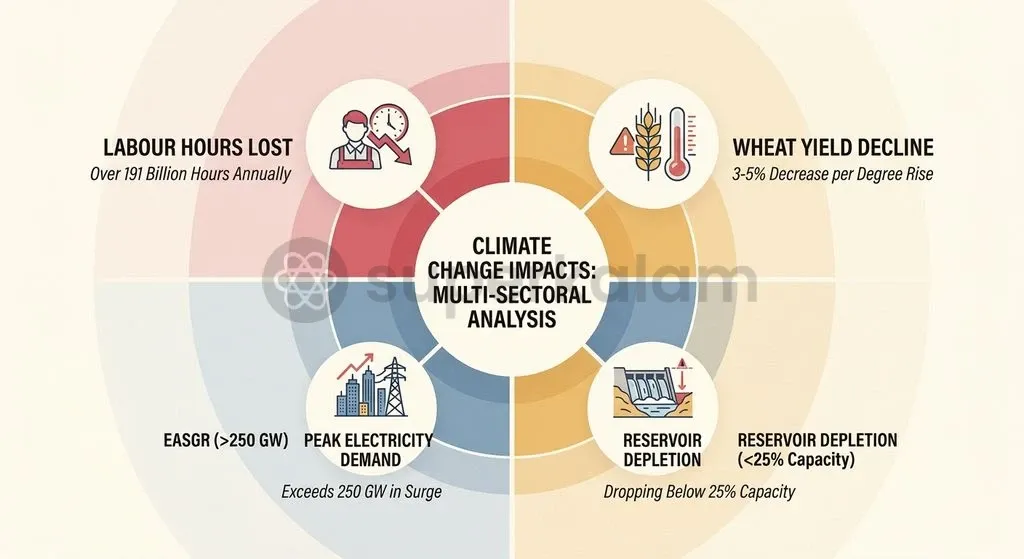
Extreme heat waves trigger wide-ranging shocks across the national economy, undermining labour productivity, agricultural output, and utility infrastructure. The Lancet Countdown on Health and Climate Change reported that India lost approximately 191 billion potential labour hours in 2022 due to extreme heat exposure, with the agricultural sector bearing 64% of this total loss.
Agricultural stability faces acute risks during warmer winter and spring seasons. Technical evaluations by the Indian Council of Agricultural Research demonstrate that terminal heat stress during reproductive and grain-filling stages decreases rabi wheat yields by 3% to 5% for every 1°C increase above normal temperatures.
Utility infrastructure experiences simultaneous operational strain during prolonged heatwaves:
- Grid Overload: The Central Electricity Authority recorded national peak electricity demand surpassing 250 gigawatts (GW), driven by surges in air conditioning and agricultural irrigation pumping.
- Hydrological Stress: The Central Water Commission reported that live storage across 150 major reservoirs fell below 25% of total capacity during severe El Niño and pre-monsoon heat conditions, worsening urban drinking water supply and farm distress.
Way Forward: Building Resilient Heat Governance and Urban Cooling Strategies
Transforming heat wave governance requires moving from reactive relief advisories to institutional, statutory, and urban design reforms. The central government should amend the statutory disaster relief guidelines under the Disaster Management Act, 2005 to include heatwaves among notified natural disasters, enabling direct fund allocation from the NDRF and SDRF.
States must follow the regulatory precedent set by Telangana, which notified a dedicated Cool Roof Policy (2023–2028) mandating solar-reflective roofs across commercial and residential buildings to achieve 300 square kilometres of cool roof area by 2028. Expanding passive urban cooling standards reduces indoor temperatures significantly and curbs the urban heat island effect.
Labour protection standards also require rigorous implementation:
- Worksite Adjustments: State labour departments must enforce the Ministry of Rural Development's advisory to shift MGNREGA work hours to early morning shifts and provide mandatory shaded shelters alongside oral rehydration salts.
- Parametric Social Safety Nets: State governments and financial institutions should scale models like the Self-Employed Women's Association (SEWA) parametric heat micro-insurance, which automatically releases digital cash transfers to informal female workers when satellite data detects extreme local heat thresholds.
Discuss with Superkalam
Analyze why relying solely on dry-bulb temperature thresholds is insufficient for assessing physiological heat stress in humid regions.
Ask NowKey Takeaways
- Projected Subcontinental Mortality: The Climate Impact Lab projects that the Super El Niño will cause 15,800 (±1,600) excess heat-related deaths in India between September 2026 and February 2027.
- Winter Heat Vulnerability: Approximately 7,400 excess deaths—nearly half of India's total projected mortality—are estimated to occur during the winter months of December to February.
- Meteorological Mechanism: Super El Niño conditions (Niño 3.4 SST anomaly ≥ +2.0°C) disrupt the Pacific Walker Circulation, causing atmospheric subsidence and intense heat accumulation over India.
- Physiological Limits: While 35°C wet-bulb temperature is the absolute survival threshold, metabolic heat stress starts at wet-bulb levels of 30.5°C to 31.5°C during physical exertion.
- Informal Sector Exposure: Over 88% of non-agricultural workers in India are informal, leaving them vulnerable to severe heat stress without statutory workplace cooling protections.
- Statutory Funding Deficit: Heatwaves remain excluded from the 12 notified disasters eligible for automatic funding under the SDRF/NDRF frameworks, limiting local emergency response capacity.
Mains Question
"Heat Action Plans in India operate primarily as voluntary administrative advisories without dedicated financial envelopes or statutory anchoring." In light of the findings of the Centre for Policy Research, critically examine the structural and legal limitations hindering effective heatwave governance in India. (15 Marks)
Evaluate NowMains Question
Elucidate the geophysical mechanisms through which a Super El Niño triggers extended thermodynamic stress over the Indian subcontinent, and explain why its impact extends beyond traditional summer heatwaves. (10 Marks)
Evaluate NowPractice MCQs
QUESTION 1
With reference to the atmospheric and oceanic dynamics of a 'Super El Niño', consider the following statements:
- It is meteorologically classified when sea surface temperature anomalies in the equatorial Pacific Niño 3.4 region equal or exceed +2.0°C above baseline averages.
- It weakens the Pacific Walker Circulation and causes broad atmospheric subsidence over the Indian subcontinent.
- The resulting atmospheric subsidence enhances convective precipitation and cloud formation over peninsular India. Which of the statements given above are correct?
QUESTION 2
Consider the following statements regarding heat stress thresholds and heatwave criteria in India:
- The India Meteorological Department declares a heatwave in plain regions when maximum temperatures reach at least 40°C with a departure of 4.5°C to 6.4°C from normal climatological averages.
- Sustained outdoor physical labour can induce severe metabolic heat stress at wet-bulb temperatures between 30.5°C and 31.5°C.
- Clinical heat stroke occurs when internal core body temperature surpasses 37.0°C, initiating rhabdomyolysis. Which of the statements given above is/are correct?
QUESTION 3
According to the assessment of state and municipal Heat Action Plans (HAPs) highlighted in the study by the Centre for Policy Research, what are the primary institutional bottlenecks in India's heat governance?
- Absence of legal anchoring of Heat Action Plans under the Disaster Management Act, 2005.
- Lack of dedicated, standalone budgetary allocations for implementing heat mitigation strategies.
- Over-reliance on hyper-local ward-level vulnerability mapping rather than uniform regional temperature thresholds. Select the correct answer using the code given below:
QUESTION 4
Consider the following statements regarding the findings of the Climate Impact Lab assessment on Super El Niño:
- The study projects approximately 15,800 additional heat-related excess deaths in India between September 2026 and February 2027.
- Nearly half of India's projected excess mortalities are estimated to occur during the winter months of December to February.
- Global land surface temperatures are estimated to stay 1.2°C above normal, driving a 44% surge in extremely hot days. Which of the statements given above are correct?
QUESTION 5
Which municipal corporation in India pioneered South Asia's first Heat Action Plan (HAP) in 2013, incorporating early warnings, reflective roofs, and dedicated cooling wards?