Kavach 4.0: Indian Railways Commissions First Deployment on 108 Km of SCR
Kavach 4.0, the latest version of India indigenous automatic train protection system, is live on 108 km of South Central Railway - its first commissioning, with SIL-4 safety certification.
Sep, 2026
•8 min read
Overview
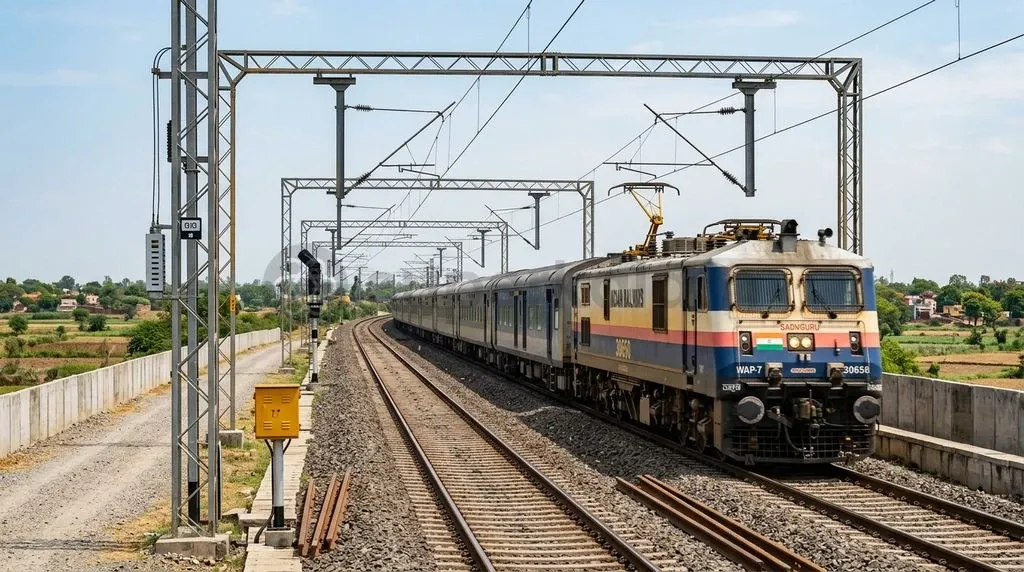
Kavach 4.0 is India's indigenously developed Automatic Train Protection system designed to prevent railway collisions. The system continuously monitors train movements, transmits in-cab signalling, and automatically applies service or emergency brakes when loco pilots miss danger signals or exceed speed limits.
Engineered by the Research Designs and Standards Organisation with domestic manufacturers, the platform represents a structural upgrade over previous iterations. By achieving full multi-vendor interoperability and direct electronic interlocking interfaces, the technology transitions railway operations toward comprehensive automation.
The modernised architecture supervises train control at speeds up to 160 kmph across complex station yards, tunnels, and steep gradients. As Indian Railways scales high-density passenger corridors and expands semi-high-speed rolling stock, deploying this certified fail-safe technology provides the operational foundation required to eliminate catastrophic human errors.
Why in the News?
Indian Railways marked a major technical milestone by commissioning Kavach Version 4.0 across 108 Route Kilometres on the Malkajgiri–Kamareddi section of South Central Railway's Hyderabad Division. This operational rollout followed the formal approval of technical specifications by the Research Designs and Standards Organisation (RDSO) on July 16, 2024.
As of September 2026, the deployment demonstrates the field readiness of upgraded computing hardware and real-time signalling interfaces. It transitions indigenous collision-prevention technology from trial sections to high-density operational corridors across the national network.
What is Kavach? Architecture and Core Mechanics
Kavach is an indigenous Automatic Train Protection (ATP) system that prevents collisions through continuous track-to-train wireless telemetry and automated braking. Originally developed as the Train Collision Avoidance System (TCAS), the platform operates on a closed-loop control model. Trackside inputs constantly update the locomotive's onboard computer regarding track occupancy, movement authority, and temporary speed restrictions.
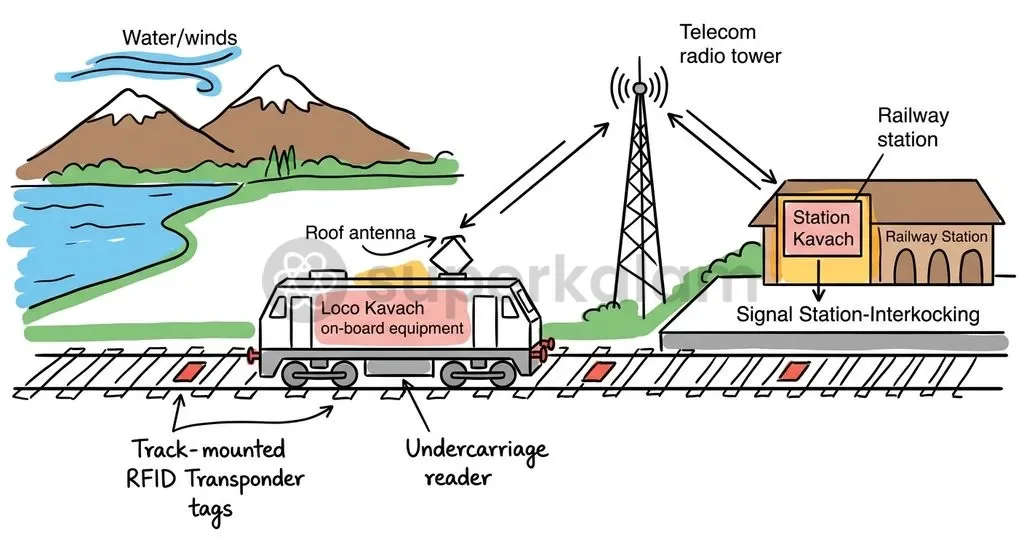
According to official parliamentary disclosures by the Ministry of Railways, the system functions through four integrated pillars:
- Loco Kavach: The onboard vital computer, brake interface unit, and driver-machine interface installed within the locomotive cab to supervise speed limits and enforce automatic braking.
- Station Kavach: The centralised yard processor situated at railway stations, connected directly to station signalling inputs to compute movement authorities for all trains in the section.
- Trackside RFID Tags: Passive Radio Frequency Identification transponders fitted between rail tracks at designated intervals to calibrate exact train location, direction of travel, and track identification.
- Wireless Communication Backbone: Ultra High Frequency (UHF) radio towers and Long-Term Evolution for Railways (LTE-R) systems providing full-duplex communication between station units and passing locomotives.
The operational mechanics centre on mitigating Signal Passing at Danger (SPAD), which historically constitutes a primary cause of railway accidents. When a loco pilot fails to decelerate ahead of a red signal, Loco Kavach calculates the braking curve and activates service or emergency brakes.
Beyond SPAD mitigation, the system detects conflicting track occupancies via radio telemetry to prevent head-on and rear-end collisions. It also initiates automatic whistling at Level Crossing (LC) gates during dense fog.
Discuss with Superkalam
Which organization approved the technical specifications of Kavach Version 4.0 in July 2024?
Ask NowKey Upgrades: How Kavach 4.0 Improves Upon Version 3.2
Kavach Version 4.0 resolves operational and hardware limitations that restricted the nationwide scalability of Version 3.2. While Version 3.2 proved the core concept of radio-based train protection, it faced significant integration hurdles when handling complex yard layouts, multi-aspect electronic interlocking, and diverse geographic terrain.
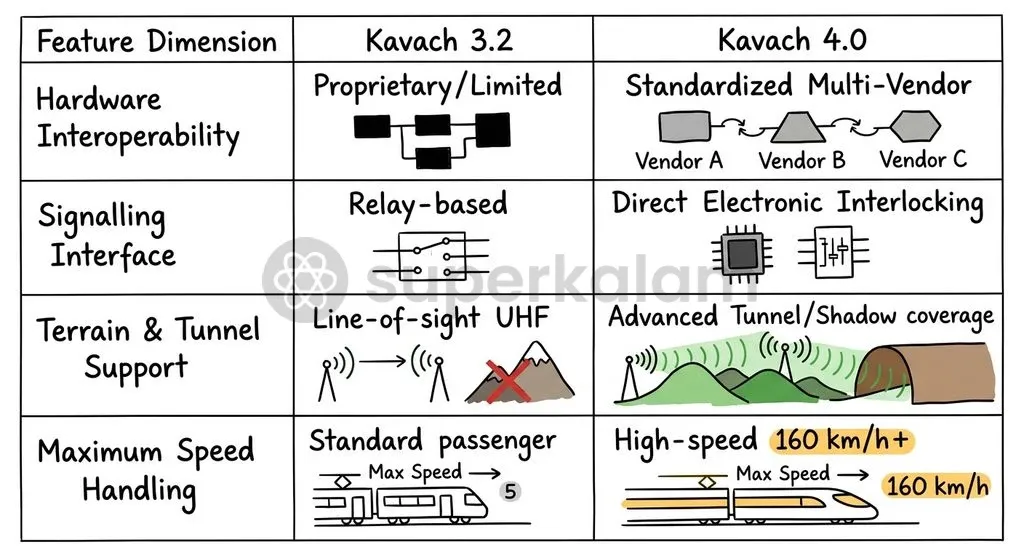
Technical evaluations by the Ministry of Railways highlight three major functional enhancements introduced in Version 4.0:
- Multi-Vendor Interoperability: Kavach 4.0 establishes universal communication and logic protocols across certified equipment manufacturers. Onboard units supplied by one vendor interact seamlessly with station units and trackside equipment from another, eliminating vendor lock-in.
- Direct Electronic Interlocking (EI) Interface: Version 4.0 replaces relay-heavy external wiring with direct digital interfacing to Electronic Interlocking systems. Station-to-station communication across dual Optical Fibre Cable (OFC) networks enables real-time signal aspect processing across complex station yards.
- High-Speed and Dynamic Terrain Handling: The processing algorithms in Version 4.0 supervise train movements at speeds up to 160 kmph. Upgraded radio frequency architectures ensure uninterrupted signal transmission through deep cuttings, mountain gradients, and long tunnels.
Discuss with Superkalam
How does the closed-loop telemetry between Loco Kavach, Station Kavach, and trackside RFID tags prevent Signal Passing at Danger (SPAD)?
Ask NowComparative Breakdown: Kavach 3.2 vs Kavach 4.0
The transition from Version 3.2 to Version 4.0 shifts India's train protection framework from isolated pilot projects into a standardized mainline infrastructure standard.
| Technical Parameter | Kavach Version 3.2 | Kavach Version 4.0 |
|---|---|---|
| Vendor Interoperability | Partial; vendor-specific hardware dependencies | Full multi-vendor interoperability across all certified OEMs |
| Maximum Operating Speed | Certified up to 120–130 kmph | Engineered for speeds up to 160 kmph |
| Signalling Interfacing | Dependent on external relays and auxiliary wiring | Direct digital integration with Electronic Interlocking (EI) systems |
| Yard and Layout Handling | Restricted signal aspect processing in dense yards | Comprehensive yard coverage with station-to-station OFC networking |
| Geographic Adaptability | Prone to radio shadowing in deep cuts and tunnels | Enhanced transceivers for tunnels and hilly gradients |
| Network Communication | UHF radio infrastructure | UHF radio integrated with LTE-R communication backbone |
Why Nationwide Deployment Faces Delays: Trackside, Loco, and Radio Hurdles
The execution of Kavach across India's broad-gauge network requires simultaneous upgrades across track infrastructure, telecommunication backbones, and locomotive fleets. Installing the system requires extensive physical interventions rather than a simple software deployment.
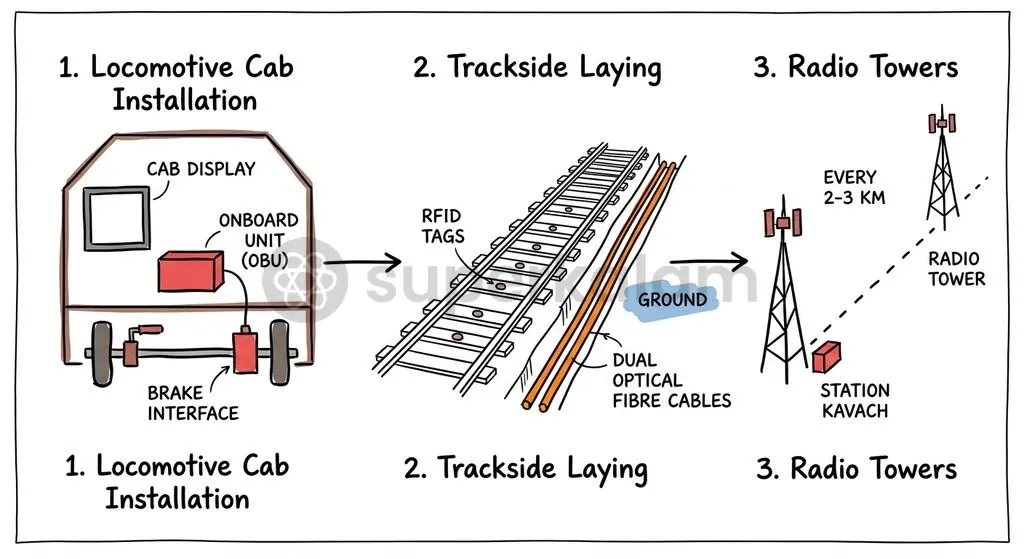
Ministry of Railways deployment assessments indicate three distinct structural bottlenecks:
- Locomotive Retrofitting Turnaround: Integrating Loco Kavach requires taking operating locomotives out of active revenue service to install sensory probes, driver display units, and pneumatic brake interface valves inside compact cab spaces.
- Trackside Linear Infrastructure: Trackside coverage requires laying continuous dual 2×48 core Optical Fibre Cables along track beds and erecting communication towers at intervals of 2 to 3 kilometres.
- Vendor and Component Ecosystem: Developing certified production capacity among domestic manufacturers requires extensive testing and calibration under RDSO supervision before mass rollouts can proceed.
Safety audit findings underline the operational urgency of overcoming these delays. Following the June 2023 train disaster at Bahanaga Bazar station in Balasore, the Commission of Railway Safety determined that the accident was caused by lapses during signalling-circuit alterations in a section lacking Automatic Train Protection.
Furthermore, the Comptroller and Auditor General (CAG) Report No. 22 of 2022 on Derailments in Indian Railways revealed that the share of Rashtriya Rail Sanraksha Kosh (RRSK) funds directed toward Priority-I safety works dropped from 81.55% in 2017-18 to 73.76% in 2019-20.
To eliminate capital allocation hurdles, the Railway Board issued a policy exemption in June 2023 that removed the mandatory 10% Rate of Return requirement for safety-related projects. This policy change expedites financial clearances for electronic interlocking and Kavach tenders.
Discuss with Superkalam
If deploying Kavach across a high-altitude, tunnel-heavy railway section, how do the upgraded transceivers of Version 4.0 address previous radio shadowing limitations?
Ask NowGlobal Benchmarks: How Kavach Matches European Standards
Kavach delivers safety parameters comparable to international train control technologies while costing a fraction of global procurement alternatives. The system complies with European standards established by the European Committee for Electrotechnical Standardization (CENELEC EN 50126, EN 50128, and EN 50129).
Key safety and functional benchmarks include:
- Safety Integrity Level 4 (SIL-4): Kavach attains the highest certification for railway signalling systems, mandating an error probability of less than 1 in 10,000 operational years (failure rate below 10⁻⁸ per operating hour).
- Equivalence to ETCS Level-2: Operates on functional parity with the European Train Control System Level-2 (ETCS-2), using continuous track-to-train radio telemetry, trackside transponders for position calibration, and dynamic speed supervision.
- Tailored Operational Design: Engineered to handle Indian environmental and operating realities, including dense atmospheric fog, open track corridors, and mixed high-density traffic.
Way Forward: Accelerating Infrastructure Laying and Network Coverage
The institutional roadmap for railway modernisation prioritises rapid Kavach deployment across high-density passenger and freight corridors. Indian Railways has targeted trackside installation across more than 15,000 route kilometres spanning the High-Density Network (HDN), Highly Utilized Network (HUN), Golden Quadrilateral (GQ), and Golden Diagonal (GD) corridors.
Discuss with Superkalam
Compare the operational risks of relying on relay-based signalling modifications versus adopting direct digital Electronic Interlocking integrated with Kavach.
Ask NowTo sustain this capital-intensive expansion, the Ministry of Railways sanctioned an umbrella programme titled 'Provision of Kavach with communication backbone of Long-Term Evolution (LTE)' with an overall outlay of ₹27,693 crore under Plan Head 33.
Accelerating this deployment requires a coordinated three-pronged strategy:
- Vendor Base Expansion: Multiplying the number of RDSO-approved manufacturing partners to resolve supply chain deficits in locomotive onboard units and station controllers.
- Civil and Electrical Integration: Bundling trackside optical fibre laying, electronic interlocking migrations, and telecommunication tower construction into composite EPC (Engineering, Procurement, and Construction) contracts.
- Dedicated Rolling Stock Lines: Integrating Loco Kavach units at the factory production stage across locomotive manufacturing units like Chittaranjan Locomotive Works and Banaras Locomotive Works, avoiding downstream retrofit bottlenecks.
Key Takeaways
- Technological Shift: Kavach 4.0 upgrades India's indigenous Automatic Train Protection platform with direct Electronic Interlocking interfaces, multi-vendor interoperability, and operational support up to 160 kmph.
- Pillars of Architecture: The system relies on four components: Loco Kavach, Station Kavach, trackside RFID tags, and a UHF/LTE-R wireless communication backbone.
- Global Safety Benchmark: Certified under Safety Integrity Level 4 (SIL-4), Kavach maintains an error probability benchmark under 1 in 10,000 operational years.
- Deployment Hurdles: Rapid expansion requires addressing locomotive retrofit downtime, laying dual 2×48 core optical fibre cables, and setting up radio towers at 2 to 3 km intervals.
- Policy and Finance: The Railway Board removed the 10% Rate of Return threshold for safety works, backing the expansion with a ₹27,693 crore umbrella project across the Golden Quadrilateral and High-Density Networks.
Mains Question
"Deploying certified fail-safe technology like Kavach 4.0 provides the operational foundation required to eliminate catastrophic human errors such as Signal Passing at Danger (SPAD)." Elucidate the technological architecture of Kavach 4.0 and evaluate the structural hurdles faced in its nationwide implementation. (15 Marks)
Evaluate NowMains Question
Highlighting the safety audit findings following recent railway accidents and the CAG Report No. 22 of 2022, examine the critical role of signalling modernization and Automatic Train Protection systems in Indian railway operations. (10 Marks)
Evaluate NowPractice MCQs
QUESTION 1
With reference to the indigenous Automatic Train Protection system 'Kavach 4.0', consider the following statements:
- It integrates direct digital interfacing with Electronic Interlocking (EI) systems to replace relay-heavy external wiring.
- It achieves Safety Integrity Level 4 (SIL-4) certification with an error probability of less than 1 in 10,000 operational years.
- Its operational architecture provides multi-vendor interoperability and supervises train control at speeds up to 160 kmph.
Which of the statements given above are correct?
QUESTION 2
Consider the following statements regarding the architectural components of Kavach:
- Station Kavach is installed within the locomotive cab to calculate the braking curve and activate pneumatic brakes.
- Passive RFID tags are placed along rail tracks at designated intervals to calibrate train location and direction of travel.
- The wireless telemetry relies on Ultra High Frequency (UHF) radio towers and Long-Term Evolution for Railways (LTE-R).
Which of the statements given above is/are correct?
QUESTION 3
In the context of Indian Railways safety modernization, which of the following policy and technical measures was introduced to eliminate financial hurdles in executing Kavach and Electronic Interlocking projects?
QUESTION 4
With reference to the comparison between Kavach Version 3.2 and Kavach Version 4.0, consider the following statements:
- Kavach 3.2 relied on external relays and auxiliary wiring, whereas Kavach 4.0 utilizes direct digital integration with Electronic Interlocking.
- Kavach 3.2 offered full multi-vendor interoperability, whereas Kavach 4.0 introduced vendor-specific hardware dependencies.
- Kavach 4.0 incorporates enhanced transceivers designed to prevent radio shadowing in deep cuts and tunnels.
Which of the statements given above is/are correct?
QUESTION 5
Consider the following statements regarding international safety standards and Kavach:
- Kavach complies with European standards established by CENELEC (EN 50126, EN 50128, and EN 50129).
- Kavach operates on functional parity with European Train Control System Level-2 (ETCS-2).
Which of the statements given above is/are correct?