Drought Declaration Criteria: Why Maharashtra Must Wait Until October 5
NDRF rules allow kharif drought assessment only after monsoon withdrawal (October 5); declaration needs sowing below 50% of area, up to 70% rainfall deficit and other indicators.
Sep, 2026
•8 min read
Overview
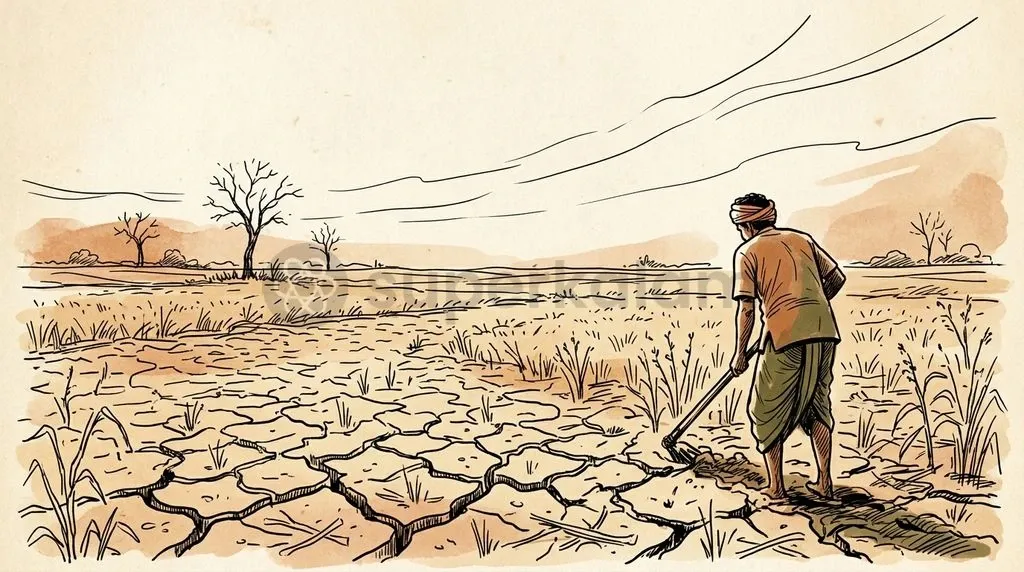
India requires State Governments to follow a rigid three-step scientific matrix under the Manual for Drought Management to assess meteorological deficits, crop stress, and geotagged ground data before declaring a severe Kharif drought. While states hold primary statutory responsibility for disaster response under the Disaster Management Act, 2005, accessing non-budgetary fiscal aid from the National Disaster Response Fund demands rigorous empirical verification. This multi-tiered assessment prevents arbitrary fiscal demands, but it forces agrarian states to wait until late October when satellite vegetation indices and post-monsoon crop-cutting experiments conclude.
Why in the News: Maharashtra's Assessment Process and Central Norms
Maharashtra's multi-tiered taluka-level drought evaluation highlights the administrative waiting period states face before notifying severe agricultural stress. As of August 2023, state administrations across the Deccan plateau had to compile granular field observations while managing mounting rural distress under strict central guidelines.
The Department of Agriculture and Farmers Welfare mandates adherence to the Manual for Drought Management, which was updated in 2020. This statutory document establishes the technical procedures states must complete before seeking central assistance. Although state cabinets face political pressure to declare relief during early monsoon dry spells, premature notifications risk rejection during central scrutiny.
State revenue departments must synchronize ground-level revenue circle records with national satellite passes to establish legally admissible claims. This inter-governmental verification system forms the foundation of modern disaster governance in India.
The Statutory Framework: Who Declares Drought in India?
The primary legal authority to declare a drought rests entirely with State Governments under the constitutional and statutory framework of the Disaster Management Act, 2005.
State administrations issue formal gazette notifications defining the geographic units experiencing moderate or severe distress. The Union Government does not issue unilateral drought declarations for any state territory. Instead, central administrative authorities act as an evaluative and funding body when disaster intensity outstrips local resources.
A formal drought notification issued by a state remains operational for a maximum duration of six months unless denotified earlier. During this validity window, the declaration unlocks statutory powers to suspend land revenue collection, restructure agricultural credit, and deploy emergency drinking water relief.
Discuss with Superkalam
For how many months does a formal drought notification issued by a State Government remain legally valid?
Ask NowThe Assessment Matrix: Scientific Triggers and Impact Indicators
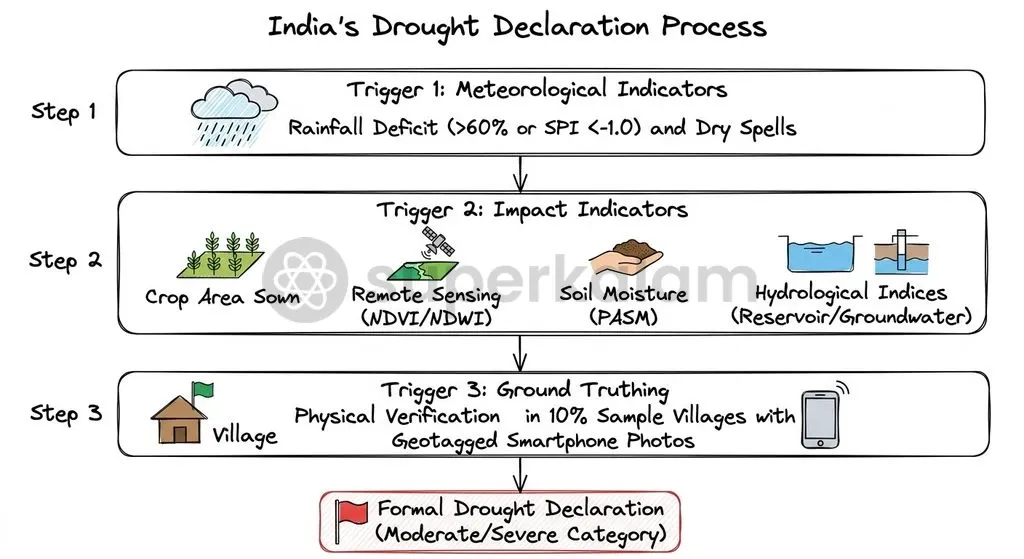
The Manual for Drought Management enforces a rigid three-step matrix to eliminate subjective administrative declarations.
Step 1 evaluates two mandatory meteorological triggers during the monsoon season:
- Rainfall Deviation (RFD): Rainfall deficit equal to or greater than 60 percent, or categorized as deficient/scanty.
- Standardised Precipitation Index (SPI): An index value equal to or less than -1.0, accompanied by a continuous dry spell lasting at least three to four consecutive weeks.
If a spatial unit meets Step 1, the assessment proceeds to Step 2, which examines four impact indicator sectors:
| Indicator Sector | Parameters Examined | Primary Measurement Tool |
|---|---|---|
| Agriculture | Extent of crop area sown | State Department of Agriculture sowing reports |
| Remote Sensing | Vegetation stress indices | Normalised Difference Vegetation Index (NDVI) and Normalised Difference Water Index (NDWI) |
| Soil Moisture | Available moisture and root stress | Percentage Available Soil Moisture (PASM) and Moisture Adequacy Index (MAI) |
| Hydrology | Water table and surface storage | Reservoir storage levels and groundwater table depletion |
Step 3 requires mandatory field ground-truthing to validate the remote-sensing indicators before finalizing the classification. Field officers must conduct sample surveys across 10 percent of affected villages selected randomly within the administrative unit.
These field verification surveys require geotagged smartphone applications to document crop damage directly from agricultural plots. If 80 percent of ground-truthing surveys in a unit record crop loss exceeding 50 percent, the state can upgrade the drought classification from moderate to severe.
The Kharif Timelines: Explaining the October Window for Ground Truthing
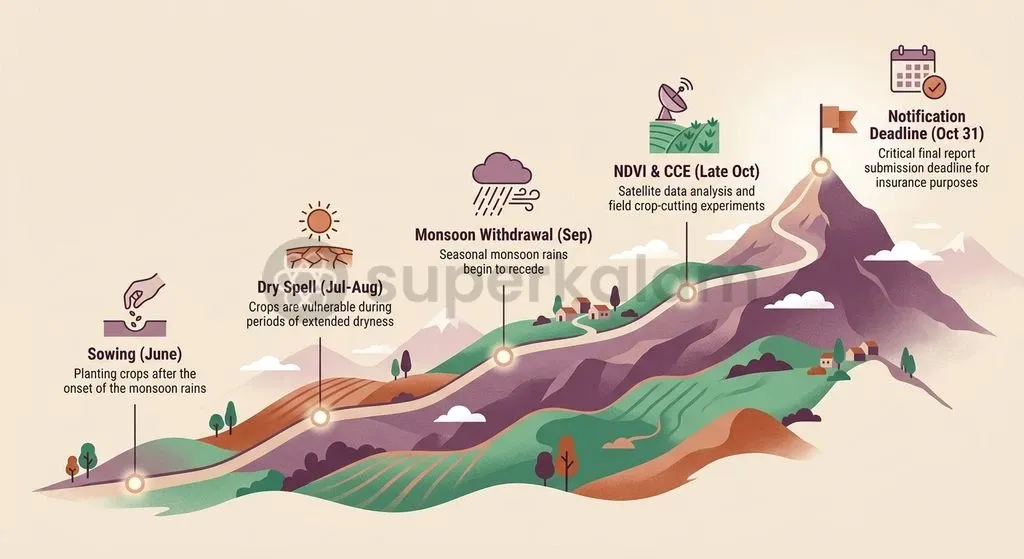
The Manual for Drought Management mandates that the final formal notification for a Kharif drought must be issued by October 31.
States cannot conclude Kharif drought assessments during early monsoon months because agricultural damage remains scientifically unverified until the southwest monsoon ends in late September. Remote-sensing satellites require full canopy development cycles to capture conclusive vegetation anomaly data. Furthermore, field agencies must wait for crop-cutting experiments to measure true yield losses against historical averages.
The regulatory framework permits an early season drought declaration in August under tightly restricted conditions. This early window applies only when severe rainfall deficits in June and July cause widespread sowing failure or substantial reduction in total cropped area. For Rabi season crops, the statutory cut-off date for drought declaration is March 31.
Discuss with Superkalam
Explain why satellite vegetation indices (NDVI/NDWI) and crop-cutting experiments cannot provide conclusive drought data during the early monsoon months.
Ask NowSDRF vs NDRF: How Disaster Financing Reaches Affected Farmers
The Disaster Management Act, 2005 creates a two-tiered fiscal architecture distinguishing initial relief from supplementary central assistance.
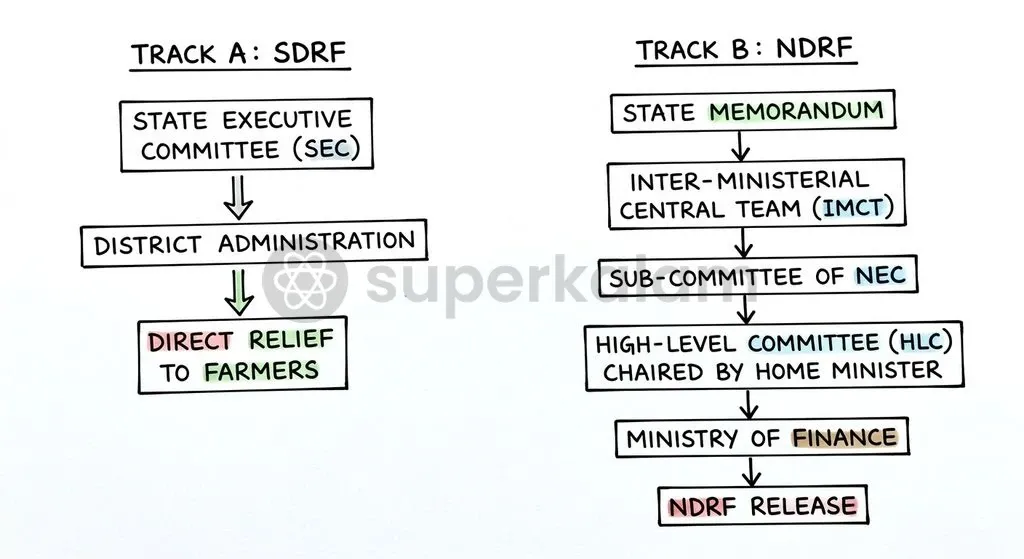
The State Disaster Response Fund operates as the primary fiscal mechanism readily available to state administrations. State Governments possess autonomous statutory authority to spend SDRF balances immediately for both moderate and severe droughts without prior central concurrence.
The National Disaster Response Fund supplements state resources only when a natural calamity is classified as severe and available SDRF funds are demonstrably inadequate.
Securing assistance from the NDRF requires a multi-stage central verification workflow:
- Submission of Memorandum: The State Government must submit a detailed financial memorandum to the Department of Agriculture and Farmers Welfare within one week of notifying severe drought.
- Field Inspection by IMCT: The Union Government constitutes an Inter-Ministerial Central Team led by a Joint Secretary in the Department of Agriculture and Farmers Welfare to verify ground losses.
- Scrutiny by SC-NEC: The IMCT assessment report is examined by the Sub-Committee of the National Executive Committee chaired by the Secretary, DA&FW.
- High-Level Committee Approval: Final financial allocations are approved by the High-Level Committee chaired by the Union Home Minister, alongside the Finance Minister, Agriculture Minister, and Vice Chairman of NITI Aayog.
| Dimension | State Disaster Response Fund (SDRF) | National Disaster Response Fund (NDRF) |
|---|---|---|
| Legal Basis | Section 48(1)(a), DM Act 2005 | Section 46(1), DM Act 2005 |
| Trigger Level | Moderate and Severe droughts | Strictly calamities of a Severe nature |
| Spending Authority | State Executive Committee autonomy | High-Level Committee central approval |
| Funding Requirement | Budgetary state-centre allocation | Supplementary grant when SDRF is exhausted |
Centre-State Federal Friction over Drought Relief Memorandums
Fiscal relations between the Union and State Governments often face friction during severe drought cycles due to rigid procedural timelines.
State Governments argue that the 2016 Manual enforces unrealistic meteorological thresholds that fail to capture micro-climatic variations. Dry spells lasting three weeks can destroy shallow-rooted dryland crops even if total seasonal rainfall appears statistically normal. States contend that waiting for October satellite composites delays immediate input subsidies and wage employment expansion when rural distress peaks in August.
Union authorities maintain that standardized parameters are essential to safeguard the federal fiscal framework against inflated expenditure claims. Without objective remote sensing indices and mandatory ground-truthing, central disaster funds risk being diverted to routine agrarian shortfalls. This institutional tension highlights the challenge of balancing scientific verification against rapid humanitarian relief.
Discuss with Superkalam
How would you apply the 80 percent ground-truthing threshold to determine if a drought-affected taluka qualifies for an upgrade from moderate to severe classification?
Ask NowAgrarian Vulnerability and Ethical Imperatives of Timely Relief
Drought triggers deep socio-economic distress across rural communities, creating acute ethical imperatives for responsive public governance.
Delayed relief declarations undermine the fundamental socio-economic entitlements of small and marginal farmers. When crop failure goes formally unrecognised through the monsoon months, cultivators are pushed toward informal moneylenders at usurious interest rates. This dynamic compounds structural agrarian debt and accelerates distress migration across arid regions.
Public administration ethics require disaster frameworks to balance procedural auditing against the human cost of administrative delay. Administrative systems must prevent procedural compliance from superseding immediate human welfare during catastrophic climate events.
Discuss with Superkalam
Analyze the core reasons why standardized central meteorological triggers create federal friction with state administrations during three-week dry spells.
Ask NowWay Forward: Reforming Drought Triggers and Parametric Relief
Modernising India's drought governance requires integrating real-time environmental monitoring with automated relief mechanisms to bridge the administrative time gap.
Policy experts recommend leveraging advanced automated platforms, such as the Indian Space Research Organisation's VEDAS portal, to process high-resolution satellite imagery in real time. Automated remote sensing can continuously track soil moisture anomalies and vegetation health at the gram panchayat level, reducing reliance on manual ground surveys.
The integration of parametric insurance mechanisms under the Pradhan Mantri Fasal Bima Yojana (PMFBY) offers a transparent path forward. Linking meteorological indices directly to automated banking transfers ensures financial liquidity reaches distressed cultivators without waiting for multi-tiered central inspections. Establishing dynamic regional rainfall baselines will make India's disaster management framework resilient and equitable.
Key Takeaways
- Statutory Jurisdiction: Drought declaration remains an exclusive State subject under the Disaster Management Act, 2005, with formal state notifications remaining valid for six months.
- Scientific Matrix: Declarations require satisfying three sequential stages: mandatory meteorological triggers (RFD and SPI), secondary impact indicators (crop sowing, NDVI/NDWI, soil moisture), and 10 percent sample field ground-truthing.
- Kharif October Deadline: States must wait until October 31 to finalize Kharif drought declarations because satellite vegetation cycles and crop-cutting yield estimates conclude only after the monsoon withdraws.
- Fiscal Architecture: States can immediately deploy SDRF balances for moderate or severe droughts, whereas supplementary NDRF assistance requires IMCT verification and High-Level Committee approval.
- Policy Imperative: Future reforms focus on integrating real-time automated remote-sensing portals like ISRO's VEDAS with index-based parametric insurance to eliminate administrative delays in rural relief.
Mains Question
The scientific matrix under the Manual for Drought Management aims to eliminate administrative subjectivity, yet procedural timelines often accentuate agrarian distress. In this context, critically examine the challenges faced by states in declaring Kharif drought. (10 Marks)
Evaluate NowMains Question
"The two-tiered disaster financing mechanism under the Disaster Management Act, 2005 establishes clear fiscal boundaries between initial relief and central assistance, but operational workflows can strain Centre-State relations." Discuss. (15 Marks)
Evaluate NowPractice MCQs
QUESTION 1
With reference to the legal framework for drought declaration in India, consider the following statements:
- The primary statutory authority to declare a drought rests entirely with the respective State Government.
- The Union Government does not issue unilateral drought declarations for any state territory.
- A formal drought notification issued by a state remains operational for a maximum duration of twelve months unless denotified earlier. Which of the statements given above is/are correct?
QUESTION 2
According to the Manual for Drought Management, which of the following conditions must be satisfied under Step 1 (Meteorological Triggers) before proceeding to impact indicators?
- Rainfall deficit equal to or greater than 60 percent, or categorized as deficient/scanty.
- Standardised Precipitation Index (SPI) equal to or less than -1.0 accompanied by a continuous dry spell of at least three to four consecutive weeks.
- Mandatory crop loss exceeding 50 percent across 80 percent of surveyed villages. Select the correct answer using the code given below:
QUESTION 3
Consider the following pairs regarding the impact indicator sectors examined under Step 2 of the drought assessment matrix:
- Remote Sensing: Normalised Difference Vegetation Index (NDVI) and Normalised Difference Water Index (NDWI)
- Soil Moisture: Percentage Available Soil Moisture (PASM) and Moisture Adequacy Index (MAI)
- Hydrology: Extent of crop area sown Which of the pairs given above is/are correctly matched?
QUESTION 4
With reference to the statutory deadlines for drought notifications under the Manual for Drought Management, consider the following statements:
- The final formal notification for a Kharif drought must be issued by October 31.
- For Rabi season crops, the statutory cut-off date for drought declaration is March 31.
- An early season Kharif drought declaration can be made in August if severe rainfall deficits in June and July lead to widespread sowing failure. Which of the statements given above are correct?
QUESTION 5
Regarding the financial architecture of disaster relief under the Disaster Management Act, 2005, which body is responsible for granting final financial approval for National Disaster Response Fund (NDRF) assistance?