Motor Accident Claims: How MACT Calculates Compensation in India
MACT compensation follows Supreme Court formulas from Sarla Verma and Pranay Sethi: income, multiplier, future prospects and conventional heads, plus Rs 5 lakh no-fault liability for death.
Sep, 2026
•10 min read

Context
Motor accident claim adjudication in India relies on a structured multiplier method to calculate fair, standardised financial compensation for victims and their dependants. By synthesising statutory mandates under the Motor Vehicles Act, 1988 with landmark judicial formulas, tribunals quantify economic dependency loss and functional disability.
This framework balances immediate financial relief against long-term socio-economic vulnerability for bereaved families across India.
Why Motor Accident Compensation Framework Matters in India
Road traffic injuries create severe economic shocks that disproportionately hit lower-income households. The statutory compensation mechanism under the Motor Vehicles Act, 1988 acts as a vital social security buffer. It ensures that surviving dependants do not slip into sudden poverty following the death or incapacitation of an earning member.
Effective compensation administration directly influences judicial efficiency and insurance solvency in India. According to empirical findings reviewed by the Supreme Court of India in Shishu Pal v. Surjeet, claim petitions encounter an average pendency of six years before tribunals and approximately eight years during appellate stages before High Courts.
As of July 2026, an estimated 10.73 lakh claims involving nearly ₹96,257 crore in contested relief remained pending across judicial forums, per reports in the Insurance Litigation Digest citing the Supreme Court Judicial Administration Review.
What is the Motor Accidents Claims Tribunal (MACT)?
The Motor Accidents Claims Tribunal is a specialised statutory forum created under Section 165 of the Motor Vehicles Act, 1988 to adjudicate third-party insurance claims. State governments establish these tribunals to bypass cumbersome civil court procedures and provide expedited summary adjudication for victims of vehicular crashes.
Tribunals possess civil court powers to summon witnesses, enforce discovery, and execute recovery awards against vehicle owners and insurance companies. Rather than treating claims as adversarial commercial litigation, tribunals are mandated to adopt an inquisitorial, welfare-oriented approach to determine "just compensation" based on objective socio-economic evidence.
Discuss with Superkalam
Which section of the Motor Vehicles Act, 1988 empowers State governments to establish Motor Accidents Claims Tribunals?
Ask NowThe Legal Foundation: Motor Vehicles Act and Tribunal Powers
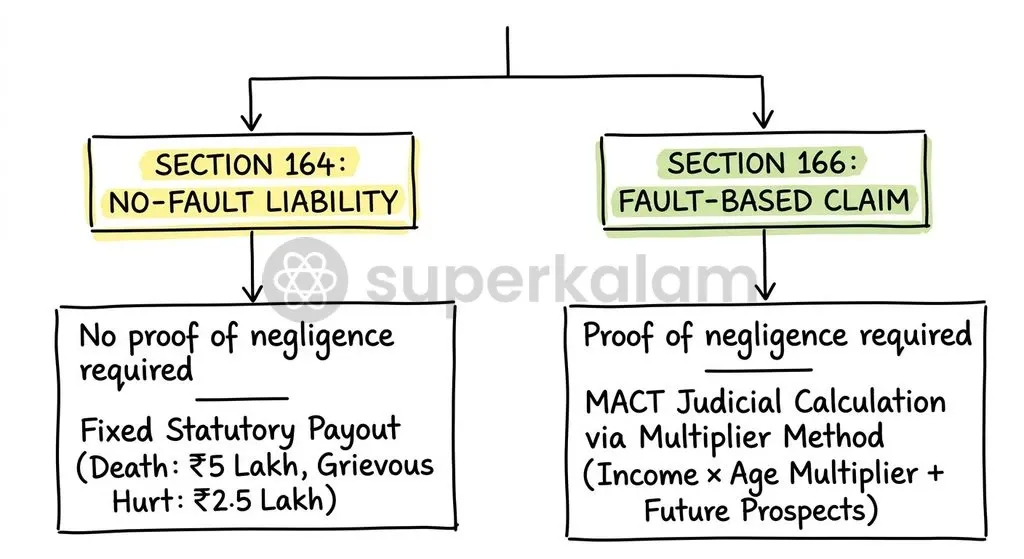
The Motor Vehicles Act, 1988 provides the statutory bedrock for third-party liability and accident claims adjudication across Indian courts. Section 166 of the statute allows victims or surviving legal representatives to seek compensation based on fault liability, requiring proof of actionable negligence against the offending vehicle.
Parliament amended the framework through the Motor Vehicles (Amendment) Act, 2019 to introduce critical systemic simplifications. The amendment substituted Section 164 to establish fixed no-fault compensation, removing the burdensome requirement to establish driver negligence for statutory minimum payouts.
| Statutory Dimension | Section 164 (No-Fault Claim) | Section 166 (Fault-Based Claim) |
|---|---|---|
| Evidentiary Standard | No requirement to prove negligence or wrongful act | Claimant must establish actionable negligence |
| Statutory Payout Cap | Fixed ₹5,00,000 for death; ₹2,50,000 for grievous hurt | Uncapped; computed using the structured multiplier method |
| Adjudication Nature | Summary settlement designed for immediate social relief | Comprehensive evidentiary trial on income and dependency |
| Applicable Forum | Motor Accidents Claims Tribunal | Motor Accidents Claims Tribunal |
How Compensation is Calculated: The Multiplier Method Explained
The Supreme Court of India structured accident compensation into a mathematical assessment known as the multiplier method. In National Insurance Co. Ltd. v. Pranay Sethi (2017), a Constitution Bench affirmed that compensation must reflect the deceased person's actual annual financial dependency multiplied by an age-indexed factor.
Judicial computation begins by ascertaining the victim's net income. Under the rules settled in Pranay Sethi, taxable gross earnings must be adjusted by deducting the actual income tax paid before applying prospective earnings additions and personal expense deductions.
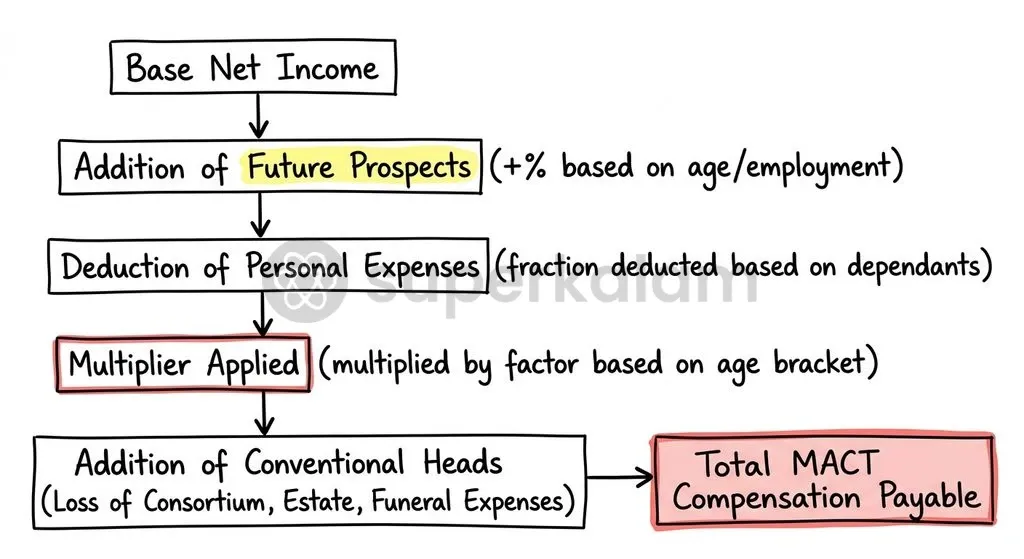
Total Compensation = (Annual Income + Future Prospects - Personal Expenses) × Age Multiplier + Conventional Heads
Conventional heads represent non-pecuniary losses standardised by the Supreme Court to eliminate arbitrary discretionary awards. Under the Pranay Sethi directives, tribunals award standard baseline amounts of ₹15,000 for Loss of Estate, ₹40,000 for Loss of Consortium, and ₹15,000 for Funeral Expenses, subject to a 10% upward revision every three years.
The Sarla Verma Multiplier Table and Age Brackets
The Supreme Court ruling in Sarla Verma v. Delhi Transport Corporation (2009) standardised the operational multiplier scale across all Indian tribunals. Prior to this judgment, conflicting High Court precedents created wide regional disparities in compensation awards for identical demographic profiles.
The standardised scale anchors the highest multiplier value of 18 for young victims and gradually reduces the multiplier as age increases:
| Age Bracket of Victim | Applicable Multiplier Value | Rationale & Legal Basis |
|---|---|---|
| 15 to 25 Years | 18 | Highest active career longevity |
| 26 to 30 Years | 17 | Standard working-age career trajectory |
| 31 to 35 Years | 16 | Established professional phase |
| 36 to 40 Years | 15 | Mid-career evaluation |
| 41 to 45 Years | 14 | Progressive decline in remaining active service years |
| 46 to 50 Years | 13 | Pre-retirement transitional decade |
| 51 to 55 Years | 11 | Multiplier reduces by 2 units per 5-year bracket |
| 56 to 60 Years | 9 | Late-career stage |
| 61 to 65 Years | 7 | Post-retirement dependency assessment |
| 66 to 70 Years | 5 | Minimum standard bracket for elderly victims |
Discuss with Superkalam
Why does the multiplier calculation require deducting actual income tax paid from gross income before computing dependency?
Ask NowAdding Future Prospects and Deductions: The Pranay Sethi Guidelines
The Constitution Bench judgment in National Insurance Co. Ltd. v. Pranay Sethi (2017) resolved long-standing inconsistencies regarding future earnings increments. Tribunals must adjust baseline income upwards to account for anticipated career progression, drawing a clear distinction between permanent salaried employment and unorganised self-employment.
Standard additions for future prospects operate across tiered age thresholds:
- Permanent Salaried Employees: Add 50% for victims aged below 40 years; add 30% for ages 40 to 50; add 15% for ages 50 to 60.
- Self-Employed / Fixed Wage Earners: Add 40% for victims aged below 40 years; add 25% for ages 40 to 50; add 10% for ages 50 to 60.
Living expense deductions account for what the deceased would have spent on personal maintenance had they lived. Under the Sarla Verma guidelines, tribunals apply standard deductions based on family dependency size:
- Bachelor / Unmarried Victim: 50% (one-half) deduction, presuming the remaining half supported parents or siblings.
- 2 to 3 Dependent Family Members: One-third (1/3rd) deduction from computed annual earnings.
- 4 to 6 Dependent Family Members: One-fourth (1/4th) deduction, reflecting higher family commitments.
- More than 6 Dependants: One-fifth (1/5th) deduction from gross computed earnings.
Discuss with Superkalam
Apply the Pranay Sethi rules to determine the future prospects percentage addition for a 44-year-old self-employed shopkeeper.
Ask NowWorked Calculation Examples: Fatal Accidents vs Permanent Disability
Applying the multiplier formula requires a structured step-by-step assessment of dependency loss or vocational impairment. In fatal cases, the formula aggregates lost dependency, whereas non-fatal injury claims evaluate vocational functional disability under the principles laid down in Raj Kumar v. Ajay Kumar (2011).
Standard MACT Compensation Workflow:
- Establish Baseline Net Income: Gross earnings minus actual income tax paid.
- Add Future Prospects: Increase by 10% to 50% depending on age and employment nature per Pranay Sethi.
- Deduct Personal Living Expenses: Subtract 1/5th to 1/2 of income based on family dependency size.
- Apply Age Multiplier: Multiply annual dependency loss by the Sarla Verma age factor (5 to 18).
- Include Conventional Heads: Add standardised amounts for Loss of Estate, Loss of Consortium, and Funeral Expenses.
Scenario 1: Fatal Accident Claim (Salaried Professional)
Consider a 30-year-old salaried engineer earning ₹30,000 monthly (net of tax) who dies in a crash, leaving behind a spouse, one child, and a parent (3 dependants):
- Monthly Income: ₹30,000
- Future Prospects Addition: Since the victim was in salaried employment and aged below 40 years, add 50% (+₹15,000) = ₹45,000 monthly.
- Personal Living Deductions: With 3 dependants, deduct 1/3rd (-₹15,000), leaving ₹30,000 monthly or ₹3,60,000 annually.
- Multiplier Application: For age 30, the Sarla Verma multiplier is 17. Total Dependency Loss = ₹3,60,000 × 17 = ₹61,20,000.
- Conventional Heads: Add ₹15,000 (Loss of Estate) + ₹40,000 (Loss of Consortium) + ₹15,000 (Funeral Expenses) = ₹70,000.
- Total Award: ₹61,90,000 (plus statutory interest).
Scenario 2: Permanent Disability Claim (Self-Employed Driver)
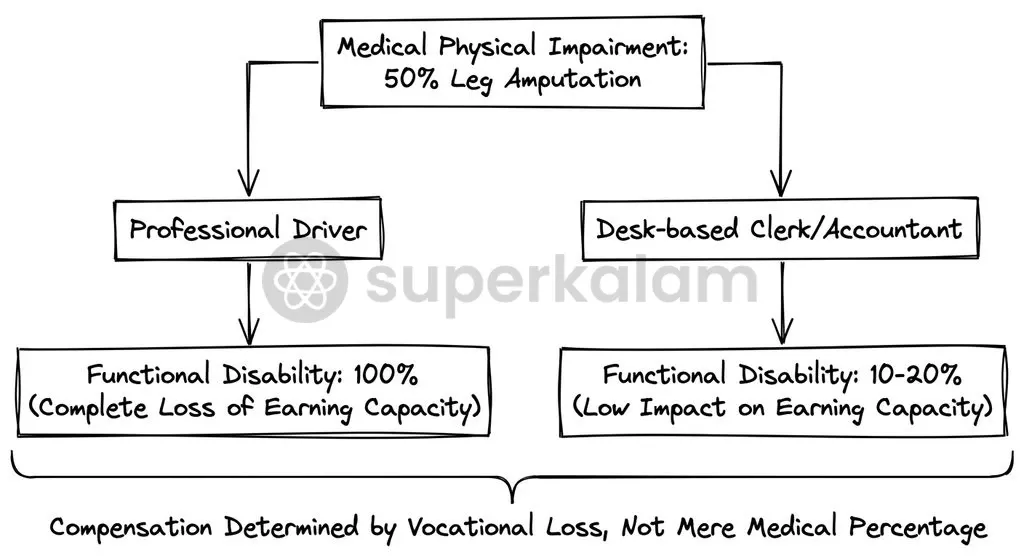
In Raj Kumar v. Ajay Kumar, the Supreme Court held that medical physical impairment does not automatically equate to economic earning loss. Tribunals must evaluate the actual functional impact on the claimant's specific livelihood.
Consider a 25-year-old self-employed commercial driver earning ₹20,000 monthly who suffers an amputation resulting in a 50% functional disability:
- Monthly Income: ₹20,000
- Future Prospects Addition: For self-employed individuals under 40 years, add 40% (+₹8,000) = ₹28,000 monthly (₹3,36,000 annually).
- Loss of Earning Capacity: 50% functional disability equals an annual loss of ₹1,68,000.
- Multiplier Application: For age 25, the Sarla Verma multiplier is 18. Total Future Earning Loss = ₹1,68,000 × 18 = ₹30,24,000.
- Additional Heads: Add medical treatment costs, pain and suffering, and loss of amenities based on medical evidence.
Key Issues in Accident Claims: Delays, Under-Reporting, and Legal Hurdles
The Indian motor accident claims system faces persistent administrative bottlenecks and severe judicial delays. Protracted litigation often forces destitute families to accept undervalued out-of-court settlements from insurance companies to meet immediate medical and household expenses.
Key institutional challenges include:
- Excessive Adjudication Timelines: Average disposal timelines spanning six years before tribunals and eight years in High Courts undermine the statutory objective of speedy socio-economic restitution.
- Hit-and-Run Investigation Gaps: Unidentified vehicles historically left victims with negligible financial support. Under the Compensation to Victims of Hit and Run Motor Accidents Scheme, 2022, statutory solatium was increased to ₹2,00,000 for death and ₹50,000 for grievous hurt via the Motor Vehicles Accident Fund, though awareness remains limited.
- Evidentiary Barriers for Unorganised Workers: Proving verifiable monthly earnings for agricultural labourers, gig workers, and informal daily-wage earners remains challenging, leading tribunals to apply arbitrary minimum-wage benchmarks.
Way Forward: Digitisation, Interim Relief, and Road Safety Reforms
The Ministry of Road Transport and Highways rolled out the Electronic Detailed Accident Report (e-DAR) application to modernise accident compensation across India. By connecting police stations, state hospitals, tribunals, and insurance companies on a central digital portal, e-DAR simplifies documentation pipelines.
In Gohar Mohammed v. UP State Road Transport Corporation (2022), the Supreme Court mandated that investigating police officers must upload the Detailed Accident Report via the e-DAR system within 90 days of an accident. Enforcing this ninety-day ceiling enables tribunals to treat the digital report as a claim petition, accelerating interim awards.
Structural improvements require expanding institutional capacity, operationalising cashless treatment for golden-hour trauma care, and establishing dedicated settlement benches within Lok Adalats to resolve uncontested claims rapidly.
Discuss with Superkalam
Analyse how the introduction of fixed no-fault compensation under Section 164 alters the litigation strategy of claimants compared to Section 166.
Ask NowKey Takeaways
- Section 166 of the Motor Vehicles Act, 1988 enables fault-based compensation claims, while Section 164 provides no-fault fixed compensation of ₹5,00,000 for death and ₹2,50,000 for grievous hurt.
- The standard compensation formula established in Pranay Sethi (2017) multiplies annual dependency (annual income plus future prospects minus personal deductions) by an age-determined multiplier and adds conventional non-pecuniary heads.
- The Supreme Court in Sarla Verma (2009) standardised the multiplier scale from a maximum factor of 18 (ages 15–25) down to 5 (ages 66–70).
- Future prospects must be added at 50%, 30%, or 15% for salaried individuals, and 40%, 25%, or 10% for self-employed victims depending on age brackets.
- In disability cases, Raj Kumar v. Ajay Kumar (2011) mandates assessing actual functional earning loss relative to the claimant's vocation rather than relying solely on medical disability percentages.
- Digital reforms like the e-DAR portal and mandatory ninety-day police filings under Gohar Mohammed (2022) aim to curtail severe judicial pendency across tribunals.
Mains Question
"The substitution of Section 164 in the Motor Vehicles Act represents a shift towards immediate social security, yet Section 166 remains essential for comprehensive restitution." Elucidate the differences in the legal architecture and evidentiary burdens between fault-based and no-fault accident claims in India. (10 Marks)
Evaluate NowMains Question
"Despite judicial standardization of the multiplier method in Sarla Verma and Pranay Sethi, the administration of motor accident compensation continues to face acute structural challenges." Critically examine this statement in light of tribunal pendency and institutional procedures. (15 Marks)
Evaluate NowPractice MCQs
QUESTION 1
With reference to claim mechanisms under the Motor Vehicles Act, 1988 (as amended in 2019), consider the following statements:
- Under Section 164, a claimant is not required to plead or establish driver negligence to claim statutory compensation.
- Compensation awarded under Section 164 is capped at fixed amounts of ₹5,00,000 for death and ₹2,50,000 for grievous hurt.
- Section 166 mandates an uncapped compensation calculation using the structured multiplier method based on proof of actionable negligence. Which of the statements given above are correct?
QUESTION 2
Regarding the calculation of personal living expense deductions under the Sarla Verma (2009) guidelines, consider the following statements:
- A 50% deduction is applied to the computed income of a bachelor or unmarried deceased victim.
- When the deceased leaves behind 2 to 3 dependent family members, a one-third (1/3rd) deduction is made.
- If the number of dependent family members exceeds 6, the standard deduction is one-fourth (1/4th). Which of the statements given above is/are correct?
QUESTION 3
Consider the following statements regarding the addition of 'Future Prospects' settled by the Constitution Bench in National Insurance Co. Ltd. v. Pranay Sethi (2017):
- For permanent salaried employees aged below 40 years, an addition of 50% to actual income is mandated.
- For self-employed or fixed wage earners aged below 40 years, the income addition is 40%.
- Taxable gross earnings are adjusted by deducting the actual income tax paid prior to computing prospective additions. Which of the statements given above are correct?
QUESTION 4
Under the standardised multiplier scale established in Sarla Verma v. Delhi Transport Corporation (2009), what are the maximum and minimum multiplier values applied to age brackets?
QUESTION 5
With reference to 'Conventional Heads' awarded in motor accident fatal claims under the Pranay Sethi (2017) judgment, consider the following pairs:
- Loss of Estate : ₹15,000
- Loss of Consortium : ₹40,000
- Funeral Expenses : ₹15,000 How many of the pairs given above are correctly matched?
Discuss with Superkalam
Evaluate whether standardizing conventional heads to fixed sums adequately compensates families for non-pecuniary emotional trauma.
Ask Now