Unpaid E-Challans: SC Mandates Service Freeze on RC, DL, and Fitness
As unpaid e-challans reach about ₹49,194 crore, the Supreme Court ties vehicle services and licence renewal to clearing dues.
Oct, 2026
•9 min read
Overview
The Supreme Court of India has ordered all States and Union Territories to block vehicle services and impound vehicles with unpaid traffic e-challans. This intervention enforces statutory compliance under the Motor Vehicles Act, 1988.
Behind this judicial directive lies an uncollected penalty backlog exceeding ₹23,000 crore nationwide. By integrating the VAHAN and SARATHI digital registries, the Court directly tied penalty clearance to driving licence renewals, ownership transfers, and vehicle fitness certificates.
This shift transforms passive digital ticketing into an active administrative barrier. The core objective is curtailing non-compliance to lower India's toll of over 1.5 lakh annual road fatalities while safeguarding procedural rights.
Why Is the Supreme Court Ruling on E-Challans in the News?
The Supreme Court of India issued binding directions to all States and Union Territories in S. Rajaseekaran v. Union of India and Others to enforce unpaid traffic e-challans. The ruling targets an enforcement deficit where motorists routinely ignore automated digital fines without facing administrative consequences.
Judicial proceedings revealed that outstanding traffic fines across India total approximately ₹49,194.05 crore, of which authorities have recovered only ₹26,175.05 crore. This leaves over ₹23,000 crore in uncollected penalties, representing an unpaid rate of nearly 47%.
Automated enforcement loses its deterrent value when non-compliance carries no practical friction. The bench held that road safety enforcement directly protects the right to life under Article 21 of the Constitution.
Discuss with Superkalam
What total value of uncollected traffic fines nationwide prompted the Supreme Court to intervene in S. Rajaseekaran v. Union of India?
Ask NowUnderstanding the E-Challan System and the Vahan-Sarathi Integration
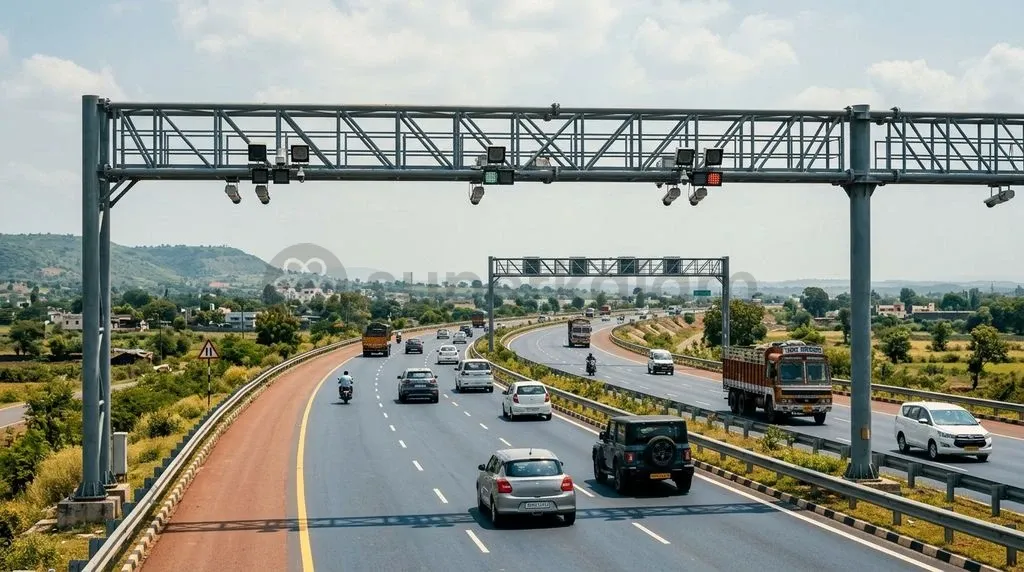
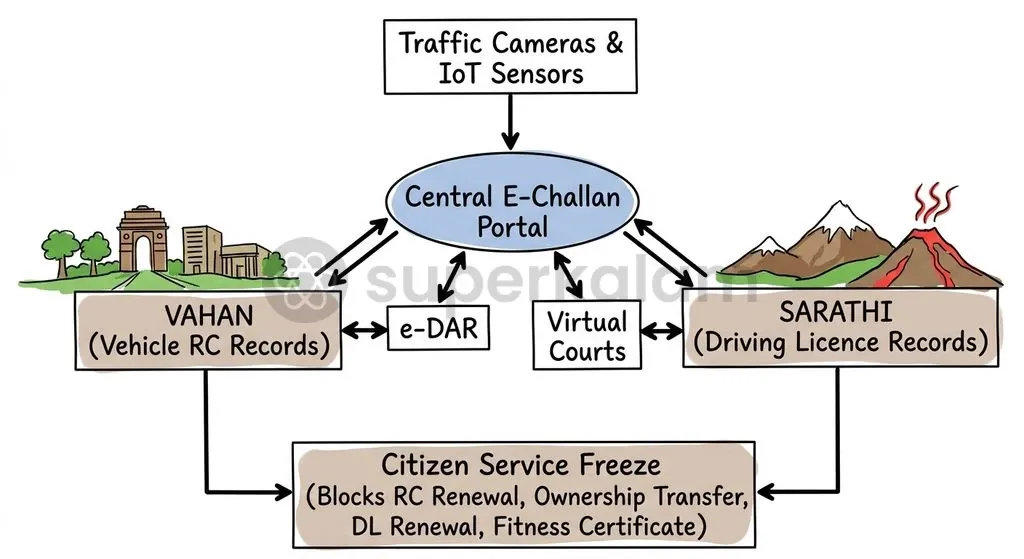
The Ministry of Road Transport and Highways operates the e-Challan ecosystem through integration with the central VAHAN-4 and SARATHI digital registries. This architecture connects roadside surveillance devices directly to vehicle and driver records.
Automated Number Plate Recognition (ANPR) and speed cameras capture traffic infractions in real time. The e-Challan system queries the central VAHAN database to match registration numbers with vehicle owners. It then fetches licensing information from SARATHI to generate an electronic penalty notice.
To establish an end-to-end enforcement loop, the Supreme Court ordered the unified integration of VAHAN-4, SARATHI, e-Challan, the Electronic Detailed Accident Report (e-DAR), the Integrated Road Accident Database (iRAD), and municipal traffic control rooms into the National Road Safety System. This linkage ensures that an infraction recorded by an urban traffic camera reflects across all national transport portals.
| System / Registry | Institutional Role | Integrated Function Under Court Order |
|---|---|---|
| VAHAN-4 | Central vehicle registration repository | Flags and blacklists vehicles with unpaid penalties to block registry actions. |
| SARATHI | National driving licence database | Withholds licence renewals and processes driving privilege suspensions. |
| e-Challan | Digital penalty issuance platform | Transmits violation records to transport registries and Virtual Courts. |
| e-DAR / iRAD | Accident data and road safety analytics | Feeds crash analysis into the unified National Road Safety System. |
What Does the Supreme Court Order Mandate for Unpaid Challans?
The Supreme Court of India mandated a nationwide enforcement strategy to recover unpaid traffic penalties and curb non-compliance. The order establishes concrete operational directives for regional transport authorities and traffic police forces:
- Blacklisting on Parivahan: Transport authorities must blacklist non-compliant vehicles, freezing administrative records until all pending fines are settled.
- Licence Sanctions: For chronic violators, authorities must initiate proceedings to suspend existing driving licences and reject renewal requests.
- Impounding Vehicles: Law enforcement agencies are authorised to conduct physical road checks to seize or impound vehicles operating with unhonoured e-challans.
- National Oversight Dashboard: The Ministry of Road Transport and Highways must publish a monthly online dashboard detailing State-wise surveillance functionality and fine recovery metrics.
Discuss with Superkalam
How does the unified integration of VAHAN-4 and SARATHI turn passive digital fines into active administrative barriers?
Ask NowWhich Vehicle and Transport Services Are Blocked by Pending Fines?
Transport departments across all States must blacklist offending vehicles on the Parivahan portal to block essential administrative transactions until penalties are cleared. This administrative freeze restricts standard citizen services at regional transport offices.
The freeze applies across both vehicular and driver-centric services, preventing motorists from updating or transferring legal documentation:
- Vehicle Ownership Transfer: Regional Transport Offices (RTOs) cannot process the transfer of vehicle titles between buyers and sellers.
- No-Objection Certificate (NOC) Issuance: Authorities cannot issue an NOC required for inter-state or inter-district vehicle re-registration.
- Duplicate Registration Documentation: Portals will reject applications for duplicate Registration Certificates (RC) for blacklisted vehicles.
- Address Update Requests: Vehicle owners cannot alter their registered postal or residential address in the VAHAN database while fines remain active.
- Commercial Vehicle Permits: Transport departments can restrict the issuance or renewal of commercial transport permits for non-compliant fleet operators.
Registration Certificate Renewal, Ownership Transfer, and Fitness Checks
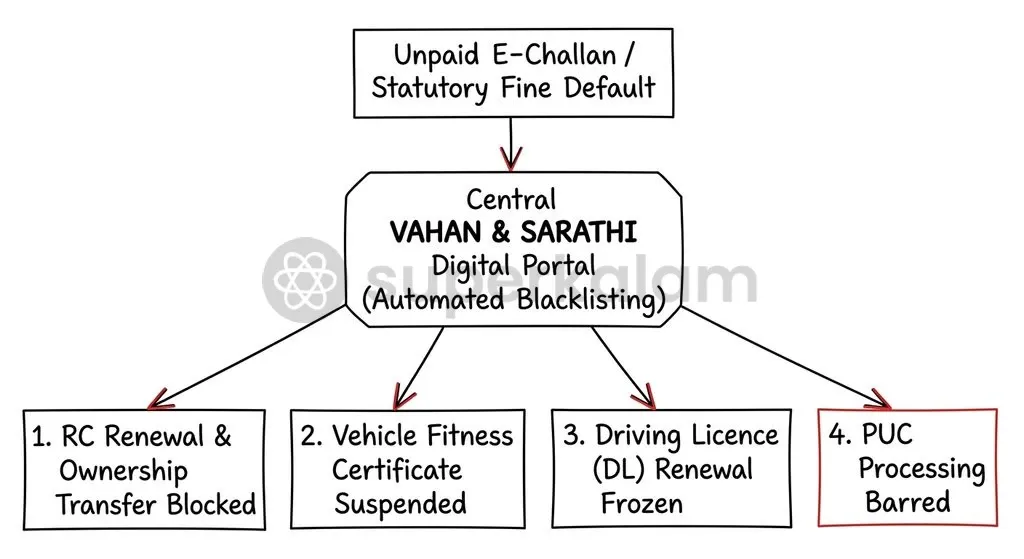
The VAHAN portal restricts vehicle life-cycle services whenever unhonoured traffic penalties remain active against a registration record. These restrictions prevent vehicle owners from regularising vehicular documentation.
Under the Supreme Court's order, an active fine flag automatically halts Registration Certificate renewals, leaving the vehicle legally unroadworthy once its existing registration term expires. Potential buyers receive protection during resale transactions because the system disallows ownership transfers until the seller discharges all historical liabilities.
The Court specifically ordered that testing centres shall not issue a vehicle fitness certificate to any commercial or private vehicle carrying outstanding e-challans. This intervention ensures that fleet operators and private owners cannot secure mandatory roadworthiness certifications without clearing their electronic enforcement record.
Driving Licence Renewal and Pollution Under Control (PUC) Processing
The Supreme Court directed testing centres and regional transport offices to withhold Pollution Under Control certificates and driving licence renewals for non-compliant motorists. This expands enforcement from vehicular documentation to individual driving privileges.
Authorised emissions testing centres cannot issue a Pollution Under Control (PUC) certificate if the VAHAN database displays pending challans against the tested vehicle. Because a valid PUC is mandatory for operating a motor vehicle in public spaces, this restriction creates an immediate operational hurdle during regular compliance checks.
For individual motorists, the SARATHI platform blocks driving licence renewals when chronic or multiple offences remain unresolved. Transport commissioners are instructed to initiate licence suspension proceedings against repeat offenders, establishing individual accountability rather than restricting only the asset.
Discuss with Superkalam
Break down the procedural challenges a citizen faces when an erroneous algorithmic challan is generated by an ANPR camera before their vehicle is blacklisted.
Ask NowLegal Framework: Motor Vehicles Amendment Act and Statutory Powers
Section 136A of the Motor Vehicles Act, 1988 provides the statutory foundation for electronic monitoring and traffic safety enforcement across India. Inserted via the Motor Vehicles (Amendment) Act, 2019, this provision mandates State Governments to deploy automated enforcement technology.
The administrative rules governing this digital setup are detailed under Rule 167A of the CMVR, 1989. This rule specifies the operational standards for speed cameras, CCTV systems, ANPR technology, body-worn cameras, and weigh-in-motion devices, while formally designating 12 distinct traffic violations subject to electronic ticketing.
For judicial enforcement, Section 208 of the Motor Vehicles Act, 1988 provides the statutory framework for the summary disposal of petty traffic offences. It empowers transport authorities and courts to issue special electronic summons to violators, allowing them to plead guilty and remit fines digitally without a physical trial.
| Statute / Rule | Core Provision | Operational Mandate |
|---|---|---|
| Section 136A, MV Act, 1988 | Electronic monitoring and enforcement | Mandates States to place automated electronic surveillance on National Highways, State Highways, and urban roads. |
| Rule 167A, CMVR, 1989 | Guidelines for electronic enforcement | Regulates ANPR, CCTV, and speed cameras, establishing procedures for 12 specified electronic offences. |
| Section 208, MV Act, 1988 | Summary disposal of petty offences | Enables electronic summons and non-custodial monetary settlement of minor traffic infractions. |
Key Governance Issues: Erroneous Fines, Notice Delays, and Due Process
Automated electronic enforcement creates significant procedural bottlenecks when technical precision and citizen notifications fail.
According to a review by the Ministry of Road Transport and Highways on vehicle blacklisting, electronic enforcement suffers from substantial operational hurdles.
- Outdated Contact Information: SMS delivery failures occur frequently because vehicle owners often do not update their mobile numbers on the VAHAN portal, leaving motorists unaware of issued challans until services are blocked.
- Flawed Optical Recognition: ANPR systems occasionally generate wrongful algorithmic fines due to damaged number plates, non-standard fonts, or camera misidentifications.
- Lack of Pre-Litigation Redressal: When automated penalties trigger immediate service blockages, citizens face administrative disruption without an accessible mechanism to contest erroneous tickets before their records are blacklisted.
Dispute Redressal Mechanisms: Virtual Courts and Lok Adalats
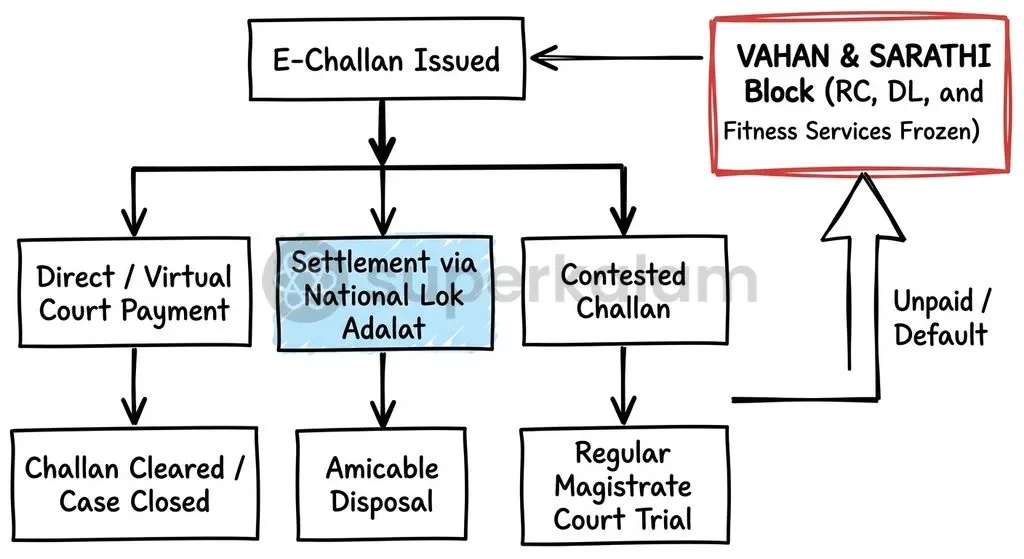
The judicial system uses digital and alternative dispute mechanisms to manage the massive volume of traffic violations:
- Virtual Courts under e-Courts: Digital magistrate courts allow litigants to examine photographic violation records online, plead guilty, and remit fines through a 24x7 online portal without entering a physical courtroom.
- Regular Jurisdictional Courts: When a motorist contests an electronic challan, the Virtual Court portal transfers the contested matter to the jurisdictional magistrate court for conventional trial.
- National Lok Adalats: Organised quarterly by the National Legal Services Authority (NALSA) under the Legal Services Authorities Act, 1987, these forums offer consensual pre-litigation settlement to compound pending challans at negotiated terms.
Discuss with Superkalam
Do you think blocking essential citizen services like PUC and RC renewals without prior pre-litigation hearings violates the principles of natural justice? Justify your stance.
Ask NowWay Forward: Balancing Road Safety Enforcement with Citizen Ease
Sustainable road safety governance under the Motor Vehicles Act requires pairing automated punitive enforcement with accessible administrative grievance redressal. Automated enforcement is essential to curb over-speeding and dangerous driving, which contribute heavily to over 1.5 lakh annual road deaths across India.
To balance compliance with fairness, transport administration must adopt key safeguards:
- Pre-Litigation Dispute Portals: Transport departments should deploy automated online dispute portals where citizens can contest clear optical camera errors within a fixed window before blacklisting occurs.
- Mandatory Contact Updates: States should mandate mobile number and address verification during annual motor vehicle insurance renewals to prevent notice delivery failures.
- Fair Procedural Timelines: Enforcement agencies must establish reasonable grace periods and verified SMS/email notifications prior to freezing critical citizen services on VAHAN and SARATHI.
Key Takeaways
- The Supreme Court directed States and UTs in S. Rajaseekaran v. Union of India to block vehicle services and impound vehicles with unhonoured e-challans.
- Outstanding traffic penalties nationwide exceed ₹23,000 crore, with nearly 47% of total fines remaining uncollected by authorities.
- Pending e-challans result in the blacklisting of vehicles on VAHAN, halting RC renewals, ownership transfers, PUC processing, and fitness certificates.
- Persistent violators face driving licence suspensions and renewal freezes on the central SARATHI database.
- Electronic traffic surveillance is statutorily governed by Section 136A of the Motor Vehicles Act, 1988 and Rule 167A of the CMVR, 1989.
- Virtual Courts under the e-Courts Project and quarterly National Lok Adalats under NALSA provide the primary avenues for summary dispute adjudication and settlement.
Mains Question
'Automated digital enforcement loses its deterrence when non-compliance carries no administrative friction.' In the light of the Supreme Court's ruling in S. Rajaseekaran v. Union of India, evaluate the efficacy of integrating digital transport databases like VAHAN and SARATHI to enforce road discipline. (15 Marks)
Evaluate NowMains Question
While automated enforcement under Section 136A of the Motor Vehicles Act promotes road safety, it poses significant procedural and governance challenges for citizens. Critically examine. (10 Marks)
Evaluate NowPractice MCQs
QUESTION 1
With reference to electronic traffic surveillance and enforcement under the Motor Vehicles Act, 1988, consider the following statements:
- Section 136A of the Act mandates State Governments to ensure automated electronic enforcement on National Highways, State Highways, and urban roads.
- Rule 167A of the Central Motor Vehicles Rules (CMVR), 1989 establishes operational guidelines and designates specified traffic violations subject to electronic ticketing.
- Section 208 of the Motor Vehicles Act, 1988 provides the statutory framework for the summary disposal of petty traffic offences via electronic summons.
Which of the statements given above are correct?
QUESTION 2
Consider the following statements regarding the integration of transport registries in India:
- The VAHAN database serves as the national driving licence repository, whereas SARATHI manages central vehicle registrations.
- In S. Rajaseekaran v. Union of India, the Supreme Court ordered the unified integration of VAHAN-4, SARATHI, e-Challan, e-DAR, and iRAD into the National Road Safety System.
- The Supreme Court tied the enforcement of road safety measures directly to the Right to Life under Article 21 of the Constitution.
Which of the statements given above is/are correct?
QUESTION 3
Under the Supreme Court directives regarding unpaid e-challans, which of the following vehicular and administrative services are blocked on the Parivahan portal when fines remain pending?
- Transfer of vehicle ownership
- Issuance of No-Objection Certificates (NOC) for inter-state re-registration
- Issuance of Pollution Under Control (PUC) certificates
- Renewal of vehicle fitness certificates
Select the correct answer using the code given below:
QUESTION 4
Which of the following portals/systems is primarily tasked with integrating accident data and crash analytics into India's unified National Road Safety System?
QUESTION 5
Consider the following statements regarding governance challenges in automated e-challan systems:
- Flawed optical character recognition in ANPR systems can generate wrongful algorithmic fines due to non-standard number plates.
- SMS notice delivery failures frequently arise because vehicle owners do not update their contact details on the VAHAN database.
- Automatic service freezes without accessible pre-litigation redressal mechanisms raise procedural due process concerns.
Which of the statements given above are correct?