PM E-DRIVE Scheme: Why India Is Shifting Its EV Subsidies
PM E-DRIVE backs e-buses, e-2Ws, e-3Ws and charging stations with ₹11,900 crore till March 2028. Key figures and UPSC takeaways.
Oct, 2026
•11 min read
Overview
The Ministry of Heavy Industries notified the PM Electric Drive Revolution in Innovative Vehicle Enhancement (PM E-DRIVE) Scheme on September 29, 2024. It commits an outlay of ₹11,900 crore through March 31, 2028, to replace FAME-II.
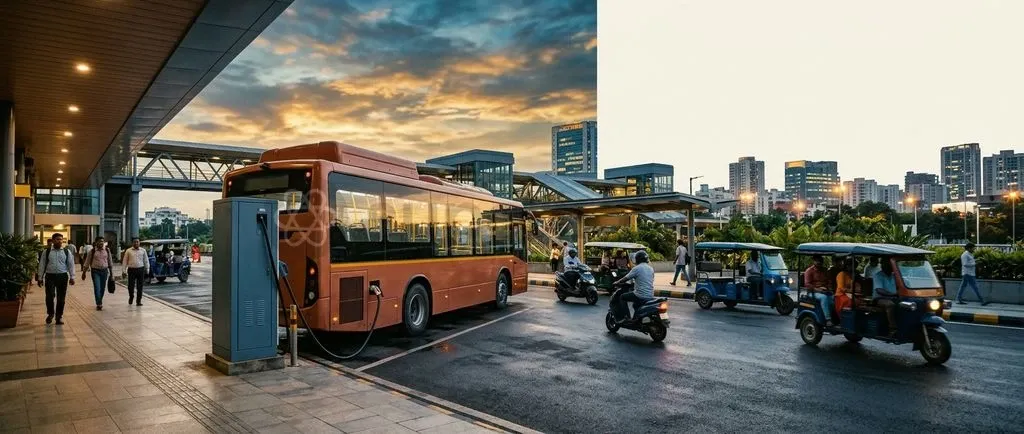
The scheme decisively shifts India's clean mobility strategy toward public transportation, charging infrastructure, and strict domestic value addition. Unlike previous initiatives that subsidised private passenger cars, the new scheme reallocates fiscal support directly to mass transit. It deploys 14,028 electric buses alongside targeted incentives for commercial two-wheelers, three-wheelers, and specialised emergency fleets.
Operating alongside the Production Linked Incentive frameworks for Auto Components and Advanced Chemistry Cells, the initiative targets supply chain vulnerabilities. It also implements digital verification systems to eliminate past regulatory compliance gaps.
Why in the News: The Launch of the PM E-DRIVE Scheme
The Ministry of Heavy Industries launched the PM E-DRIVE Scheme to recalibrate India's clean transportation subsidies. Notified on September 29, 2024, the scheme officially succeeded the Faster Adoption and Manufacturing of Electric Vehicles Phase II (FAME-II) framework and subsumed the interim Electric Mobility Promotion Scheme (EMPS) 2024, as confirmed in the [PIB Press Release: PM E-DRIVE Scheme].
Key parameters of the rollout include:
- Expanded Budgetary Envelope: The Union Government originally cleared the programme with a ₹10,900 crore allocation over two years. It later expanded the outlay to ₹11,900 crore and extended implementation through March 31, 2028.
- Deployment Progress: As of June 2026, cumulative vehicle sales supported under PM E-DRIVE and its subsumed components reached 26.59 lakh electric vehicles, advancing toward the overall programme target of approximately 28.30 lakh units.
- Strategic Realignment: This recalibration signals a clear transition from broad purchase price support toward systemic ecosystem creation, prioritising commercial fleets, mass transit systems, and nationwide charging grids.
Discuss with Superkalam
Which Ministry notified the PM E-DRIVE Scheme, and what is its total approved financial outlay through March 2028?
Ask NowFrom FAME to PM E-DRIVE: Tracing the Evolution of India's EV Push
The evolution of India's electric vehicle policy reflects a shift from exploratory subsidisation to targeted industrial restructuring. The initial FAME-I initiative, introduced in 2015 with an outlay of ₹895 crore, focused on pilot demand and technological feasibility across urban clusters.
FAME-II followed in 2019 with a significantly expanded budget of ₹10,000 crore (later revised to ₹11,500 crore). It aimed to achieve economies of scale by subsidising commercial segments alongside private two-wheelers and passenger vehicles.
The transition to PM E-DRIVE addresses structural limitations exposed during the execution of FAME-II. Earlier schemes relied heavily on imported sub-assemblies and suffered from fragmented charging networks. When FAME-II expired in March 2024, the government deployed the interim EMPS 2024 to prevent market disruption while designing a comprehensive successor framework.
| Phase | Timeline | Outlay | Strategic Focus |
|---|---|---|---|
| FAME-I | 2015–2019 | ₹895 crore | Pilot demand push and feasibility testing |
| FAME-II | 2019–2024 | ₹11,500 crore | Scale expansion and PMP localisation mandate |
| EMPS 2024 | 2024 (Interim) | ₹500 crore | Bridge support for e-2W and e-3W segments |
| PM E-DRIVE | 2024–2028 | ₹11,900 crore | Mass transit, charging grid, and strict compliance |
The progression across these phases highlights key structural policy shifts:
- Scope of Support: Shifted from subsidising private personal electric four-wheelers to focusing exclusively on public, commercial, and shared mobility fleets.
- Verification Mechanisms: Evolved from manual, dealer-led documentation checks to real-time, Aadhaar-linked digital validation systems.
- Industrial Linkages: Transitioned from standalone purchase subsidies to integrated manufacturing incentives aligned with domestic cell and component manufacturing.
Core Outlay and Segment Allocations: Where the Capital Is Directed
The PM E-DRIVE Scheme allocates its expanded ₹11,900 crore budget across targeted vehicle segments, testing facilities, and infrastructure. Rather than spreading financial resources evenly, the scheme concentrates funding where vehicular emissions and daily running mileage are highest.
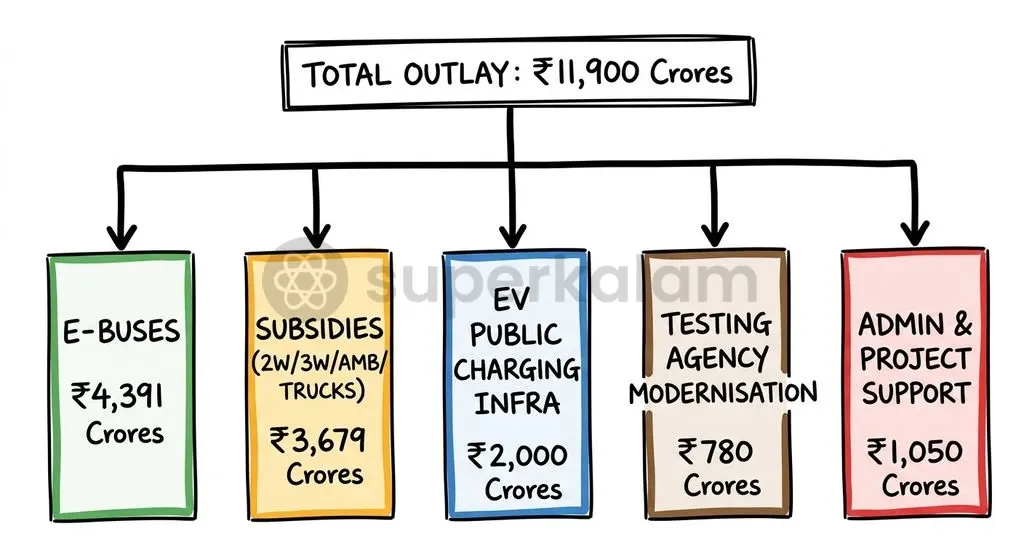
According to official disclosures by the Ministry of Heavy Industries in the [Lok Sabha Unstarred Question No. 396 Answer (Ministry of Heavy Industries)], the financial outlay is structured across specific programmatic components:
- Electric Public Buses: The scheme allocates ₹4,391 crore (the single largest component, representing roughly 40% of the initial outlay) as capital grants to support the procurement and operational deployment of 14,028 electric buses managed by State Transport Undertakings.
- Upfront Demand Incentives: A dedicated allocation of ₹3,679 crore supports high-volume commercial and consumer electric vehicles, as detailed in the [PIB Release: PM e-DRIVE AND PLI SCHEMES (Ministry of Heavy Industries)]. This funding covers:
- Electric Two-Wheelers (e-2Ws): ₹1,772 crore targeted to support 24.79 lakh units.
- Electric Three-Wheelers (e-3Ws): ₹907 crore allocated for 3.15 lakh units, including L5 cargo and passenger variants.
- Electric Ambulances: ₹500 crore earmarked to incentivise dedicated zero-emission emergency response vehicles.
- Electric Trucks: ₹500 crore set aside to promote heavy commercial fleet electrification.
- Public Charging Infrastructure: The scheme earmarks ₹2,000 crore to establish electric vehicle public charging stations (EV PCS) nationwide across major highway corridors and high-density urban nodes.
- Testing Infrastructure Modernisation: A targeted allocation of ₹780 crore supports the upgradation of designated automotive testing and homologation centres under the Ministry of Heavy Industries.
FAME-II vs PM E-DRIVE: How the Incentive Architecture Has Changed
The structural shift from FAME-II to PM E-DRIVE redefines eligibility criteria, verification protocols, and fiscal support levels. Under FAME-II, direct financial subsidies were distributed across multiple consumer segments, including private electric passenger cars and commercial taxis.
PM E-DRIVE introduces a fundamental policy pivot by completely excluding private electric four-wheelers from direct purchase subsidies, as analysed by the [Council on Energy, Environment and Water (CEEW) Policy Analysis: Unpacking India's PM E-DRIVE Scheme]. The government reassigned these fiscal resources toward shared mobility, charging infrastructure, and public transit systems.
| Dimension | FAME-II Scheme | PM E-DRIVE Scheme |
|---|---|---|
| Total Outlay | ₹11,500 crore (revised) | ₹11,900 crore (expanded to March 2028) |
| Private Electric Cars | Subsidised subject to ex-factory price caps | Completely excluded from retail incentives |
| E-Bus Deployment | Subsidised through fragmented state tenders | ₹4,391 crore for 14,028 buses with payment security |
| E-2W Subsidy Model | High initial subsidy (₹15,000/kWh, later cut) | Phased taper: ₹5,000/kWh (FY25) to ₹2,500/kWh (FY26) |
| Verification System | Post-sale OEM documentation audits | Aadhaar-authenticated digital e-voucher with buyer OTP |
| Testing Infrastructure | Standard compliance certification | ₹780 crore dedicated modernisation grant |
Discuss with Superkalam
How does the Aadhaar-authenticated e-voucher and buyer OTP mechanism resolve the compliance failures identified under FAME-II's Phased Manufacturing Programme?
Ask NowThe Localization Audit Fallout: Fixing the Phased Manufacturing Compliance Gaps
The Ministry of Heavy Industries overhauled compliance rules following widespread Phased Manufacturing Programme violations under FAME-II. The Phased Manufacturing Programme (PMP) mandated that electric vehicle original equipment manufacturers (OEMs) progressively source critical components—including traction motors, battery packs, and power electronics—from domestic suppliers to qualify for state subsidies.
Regulatory audits revealed systemic loopholes in the earlier verification regime. In an official response documented in the [Rajya Sabha Unstarred Question No. 3281 Answer (Ministry of Heavy Industries)], the Ministry confirmed that regulatory audits identified 7 major EV manufacturers violating PMP localisation norms. These manufacturers had imported completely knocked-down (CKD) or semi-knocked-down (SKD) kits while claiming subsidies, prompting official demand notices to claw back ₹469 crore in wrongfully disbursed public funds.
To prevent similar compliance failures, the PM E-DRIVE framework introduced strict digital safeguards:
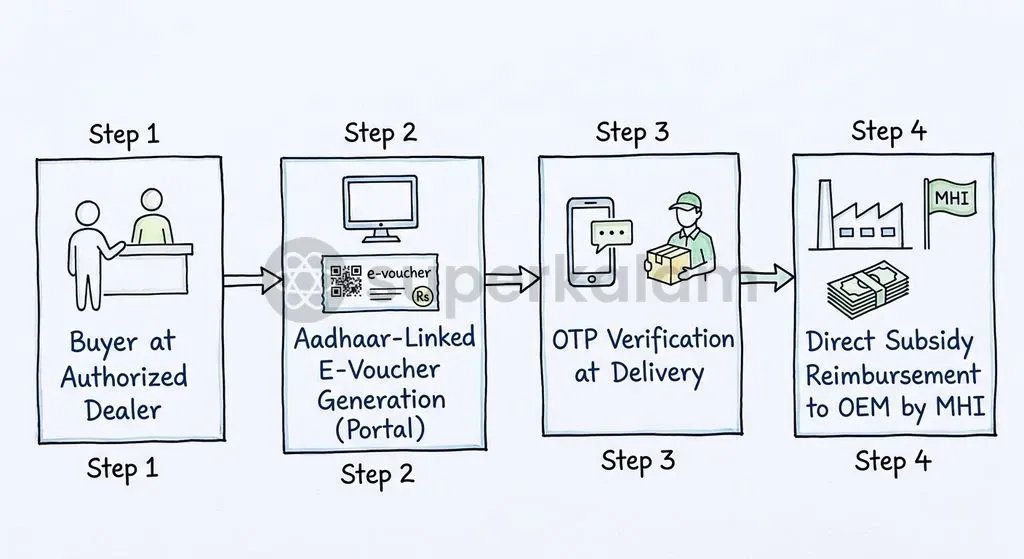
- Aadhaar-Linked Digital E-Vouchers: The scheme mandates an Aadhaar-authenticated digital e-voucher generated directly on the central PM E-DRIVE portal at the point of sale.
- OTP Verification at Dealerships: Buyers must validate the transaction via a mobile One-Time Password (OTP) before an OEM can submit subsidy claims, eliminating fictitious buyer entries.
- Integration with PLI Frameworks: PM E-DRIVE operates in institutional alignment with the ₹25,938 crore Production Linked Incentive (PLI) Scheme for Automobile and Auto Components, which mandates a minimum of 50% Domestic Value Addition (DVA) for qualifying manufacturers.
- Upstream Cell Integration: The initiative connects directly with the ₹18,100 crore National Programme on Advanced Chemistry Cell (ACC) Battery Storage, designed to build 50 GWh of cumulative domestic battery manufacturing capacity.
Fiscal Sustainability vs Adoption Pace: The Dilemma of Tapering Retail Subsidies
Tapering retail subsidies balances fiscal sustainability against the risk of slowing adoption across price-sensitive consumer segments. Direct purchase incentives bridge initial cost gaps effectively. However, indefinite fiscal support strains public finances and can discourage manufacturers from reducing their production costs.
The risks of sudden subsidy reductions emerged clearly during FAME-II. On June 1, 2023, the government reduced the e-2W subsidy from ₹15,000 per kWh (capped at 40% of the ex-factory price) to ₹10,000 per kWh (capped at 15%).
According to registration data from the [Federation of Automobile Dealers Associations (FADA) / MoRTH Vahan Portal Registration Data], national e-2W retail registrations experienced an immediate 56.3% month-on-month decline, falling from 105,338 units in May 2023 to 45,734 units in June 2023.
| Period | Policy Status | Monthly Sales | Market Penetration |
|---|---|---|---|
| May 2023 | ₹15,000/kWh (40% ex-factory cap) | 105,338 units | 7.0% |
| June 2023 | ₹10,000/kWh (15% ex-factory cap) | 45,734 units | 3.5% (56.3% drop) |
Market penetration in the two-wheeler sector halved from 7.0% in May 2023 to 3.5% in June 2023 as manufacturers passed price increases of ₹15,000 to ₹35,000 directly to retail consumers, as noted in the [FADA Retail Sales Report / Business Standard Analysis].
To prevent sharp market shocks, PM E-DRIVE adopts a predictable, phased taper schedule for registered electric two-wheelers. Incentives were set at ₹5,000 per kWh for FY 2024–25 and will reduce to ₹2,500 per kWh (with an overall ceiling of ₹5,000 per vehicle) for FY 2025–26, restricted to models with an ex-factory price up to ₹1.5 lakh. This predictable trajectory encourages manufacturers to improve operational efficiency and achieve cost parity through local supply chains rather than relying on sustained state subsidies.
Discuss with Superkalam
If you were advising a State Transport Undertaking, how would you leverage the ₹4,391 crore PM E-DRIVE allocation to optimise urban bus electrification?
Ask NowPrioritizing Public Transit: E-Buses, Fleet Electrification, and Charging Grids
Public transit and charging infrastructure form the central focus of the PM E-DRIVE scheme's resource allocation strategy. High-mileage public vehicles generate significantly greater carbon emissions and air pollution per day than private passenger cars. This makes public transit electrification far more impactful per rupee of public expenditure.
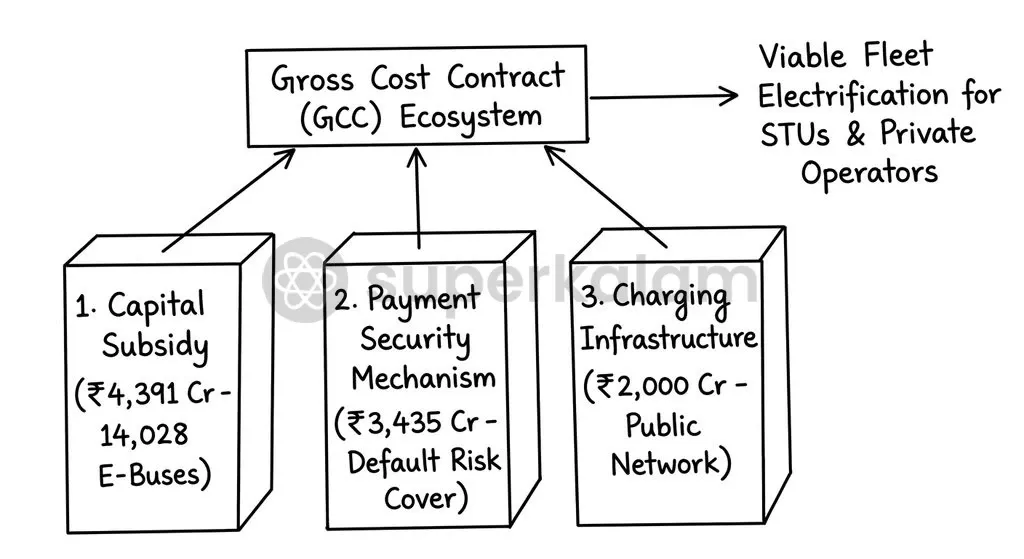
State Transport Undertakings (STUs) often face balance-sheet distress that complicates long-term electric bus adoption. To address this financial risk, the Union Cabinet approved the PM-eBus Sewa Payment Security Mechanism (PSM) with a dedicated outlay of ₹3,435 crore.
The mechanism guarantees timely payment streams to private bus operators on behalf of financially stressed municipal transport corporations. This attracts private capital through gross cost contract (GCC) concession models.
Infrastructure expansion and public service electrification under PM E-DRIVE include:
- Public Charging Infrastructure: The scheme commits ₹2,000 crore to install fast chargers across high-density urban centres and designated highway freight corridors.
- De-licensed Charging Regulations: The Ministry of Power revised the Guidelines for Installation and Operation of Electric Vehicle Charging Infrastructure on September 17, 2024, confirming charging station installation as a de-licensed activity and capping public supply equipment tariffs.
- Electric Ambulances: Under dedicated operational guidelines, demand incentives for AIS-125 compliant Type-B, Type-C, and Type-D electric ambulances are capped at the lower of ₹30,000 per kWh of battery capacity or 35% of the ex-factory cost.
Way Forward: Creating a Self-Reliant and Subsidies-Independent EV Market
Achieving an independent electric vehicle ecosystem requires synchronised supply-chain localisation, battery innovation, and grid readiness. Government policy must guide the automotive sector toward structural self-sufficiency as direct consumer incentives conclude in 2028.
Key strategic priorities include:
- Accelerating Domestic Upstream Localization: Timely execution of the 50 GWh Advanced Chemistry Cell (ACC) PLI scheme is critical to reducing battery pack costs, which account for 35% to 45% of total electric vehicle manufacturing expenses.
- Securing Strategic Critical Minerals: Establishing secure bilateral supply corridors through Khanij Bidesh India Limited (KABIL) for lithium, cobalt, and nickel will reduce external supply-chain vulnerabilities.
- Expanding Open-Access Charging Networks: State electricity distribution companies (DISCOMs) must modernise distribution substations and offer dedicated green energy open-access tariffs to support private fast-charging networks.
- Developing Battery Recycling Ecosystems: Enforcing the Battery Waste Management Rules will support secondary material recovery, lowering reliance on imported raw minerals.
- Scaling Innovative Fleet Financing: Expanding blended finance instruments and partial credit risk guarantees will improve commercial bank lending to commercial electric three-wheeler and small freight operators.
Discuss with Superkalam
Analyse the trade-off between the government's need for fiscal sustainability through subsidy tapering and the risk of slowing consumer adoption in price-sensitive EV segments.
Ask NowKey Takeaways
- The Ministry of Heavy Industries notified the PM E-DRIVE Scheme with an expanded outlay of ₹11,900 crore running through March 31, 2028, replacing FAME-II and subsuming EMPS 2024.
- The scheme completely excludes private electric passenger cars from direct purchase subsidies, reallocating public funds toward public transport, commercial fleets, and charging infrastructure.
- The largest single budgetary allocation of ₹4,391 crore is dedicated to deploying 14,028 electric buses, supported by a ₹3,435 crore Payment Security Mechanism for State Transport Undertakings.
- To eliminate PMP violations that led to ₹469 crore in subsidy clawbacks under FAME-II, PM E-DRIVE mandates an Aadhaar-authenticated digital e-voucher with buyer OTP validation.
- Retail incentives for electric two-wheelers follow a phased taper from ₹5,000/kWh in FY 2024–25 to ₹2,500/kWh (capped at ₹5,000 per vehicle) in FY 2025–26 to encourage cost parity.
- Upstream domestic value addition is driven by alignment with the ₹25,938 crore PLI-Auto (requiring 50% DVA) and the ₹18,100 crore ACC Battery Storage PLI schemes.
Mains Question
"The PM E-DRIVE Scheme marks a deliberate policy pivot from individual consumer subsidisation towards public transit and systemic charging infrastructure." Elucidate. (10 Marks)
Evaluate NowMains Question
Highlighting the compliance deficiencies exposed during the implementation of FAME-II, critically analyse how the PM E-DRIVE Scheme integrates digital safeguards and domestic manufacturing mandates to ensure sustainable EV adoption. (15 Marks)
Evaluate NowPractice MCQs
QUESTION 1
With reference to the PM Electric Drive Revolution in Innovative Vehicle Enhancement (PM E-DRIVE) Scheme, consider the following statements:
- It completely excludes private electric passenger cars from retail purchase subsidies.
- It allocates the single largest share of its financial outlay to the deployment of electric public buses.
- It replaces the post-sale OEM documentation audit with an Aadhaar-authenticated digital e-voucher system validated by buyer OTP.
Which of the statements given above are correct?
QUESTION 2
Consider the following statements regarding the evolution of electric vehicle incentive frameworks in India:
- The interim Electric Mobility Promotion Scheme (EMPS) 2024 was subsumed into the PM E-DRIVE Scheme.
- Under PM E-DRIVE, the subsidy for electric two-wheelers is designed to taper from ₹5,000 per kWh in FY25 to ₹2,500 per kWh in FY26.
- The Phased Manufacturing Programme audits under FAME-II led to subsidy clawback notices amounting to ₹469 crore from non-compliant manufacturers.
Which of the statements given above is/are correct?
QUESTION 3
With reference to the budgetary allocations under the PM E-DRIVE Scheme, consider the following pairs:
- Electric Public Buses: ₹4,391 crore
- Public Charging Infrastructure: ₹2,000 crore
- Modernisation of Testing Infrastructure: ₹780 crore
Which of the pairs given above is/are correctly matched?
QUESTION 4
Consider the following statements regarding the industrial linkages of the PM E-DRIVE Scheme:
- It operates in alignment with the Production Linked Incentive (PLI) Scheme for Automobile and Auto Components, which mandates a minimum of 50% Domestic Value Addition.
- It connects upstream with the National Programme on Advanced Chemistry Cell (ACC) Battery Storage targeting 50 GWh of domestic capacity.
Which of the statements given above is/are correct?
QUESTION 5
Which of the following vehicle segments receives dedicated funding of ₹500 crore each for the first time under the PM E-DRIVE Scheme demand incentive outlay?