Bankers' Books Evidence Act 2026: Key Changes, BSA Link & Impact
The Bankers’ Books Evidence Act 2026 updates banking-record evidence rules. See digital records, certified copies and links to India’s evidence framework.
Oct, 2026
•10 min read

Overview
The Bankers' Books Evidence Act, 2026 establishes a modernised evidentiary framework for India's financial sector, replacing the colonial-era 1891 statute to grant full legal admissibility to electronic, digital, and cloud-stored banking records without routine court appearances by bank officials. This legislative overhaul aligns financial recordkeeping with the Bharatiya Sakshya Adhiniyam, 2023 and the Bharatiya Nagarik Suraksha Sanhita, 2023. By legally validating automated system extracts, cryptographic logs, and offsite disaster recovery backups, the reform equips investigative agencies to expedite financial crime prosecutions.
Crucially, the statutory transition shifts India's banking evidence regime from physical ledger verification to automated system-integrity presumptions, placing the primary procedural burden on accused litigants to rebut system reliability when challenging bank records.
Why in the News: Modernising India's Financial Evidence Law
The Bankers' Books Evidence Act, 2026 came into force on 1 October 2026, officially repealing the 135-year-old colonial statute. As of October 2026, the new legislation—formally enacted as Act No. 15 of 2026 after receiving Presidential assent on 13 August 2026—modernises how financial records enter judicial proceedings across Indian courts, as announced by the Ministry of Finance.
Parliament enacted this replacement to resolve systemic evidentiary bottlenecks arising from rapid financial digitisation. While commercial banking transitioned to core banking solutions, cloud databases, and automated payment interfaces, evidentiary procedures remained constrained by century-old statutory language drafted for physical paper ledgers.
The modernised enactment establishes legal certainty for paperless financial documentation. It harmonises banking evidence rules with India's newly overhauled criminal jurisprudence, creating uniform standards for regulatory scrutiny, forensic investigation, and judicial trials.
Understanding the Bankers' Books Evidence Framework: From 1891 to 2026
The Bankers' Books Evidence Act, 1891 was originally enacted by the colonial administration to facilitate commercial litigation without disrupting daily banking operations. Under the 1891 framework, commercial banks were permitted to submit certified paper copies of ledger entries as prima facie evidence in legal proceedings, exempting bank clerks from routine physical attendance in courtrooms.
The 1891 framework functioned smoothly during the era of manual recordkeeping, where financial transactions were hand-written into physical registers. However, the subsequent emergence of electronic banking created significant procedural friction. Although piecemeal amendments following the Information Technology Act, 2000 extended limited recognition to computer printouts, the underlying statute lacked comprehensive definitions for modern data architectures.
Financial institutions increasingly relied on distributed networks, cloud infrastructure, and virtual servers that did not fit the restrictive definitions of the nineteenth-century enactment. Courts frequently faced procedural disputes regarding the admissibility of digital audit trails, transaction hashes, and electronic logs. A complete statutory replacement became essential to bridge the growing divide between modern banking technology and courtroom evidence rules.
Discuss with Superkalam
When did the Bankers' Books Evidence Act, 2026 come into force, and which colonial statute did it repeal?
Ask Now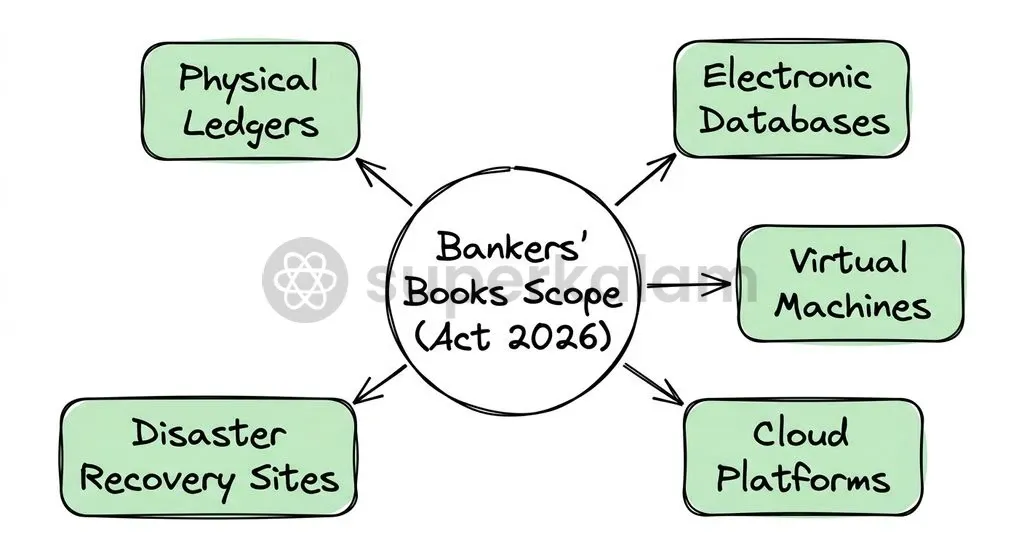
Key Provisions of the 2026 Law: What Changed?
The Bankers' Books Evidence Act, 2026 fundamentally expands the scope and definition of financial recordkeeping. According to the legislative text of the enactment, the statutory definition of bankers' books now explicitly encompasses all records maintained in the ordinary course of business across physical, electronic, digital, virtual, or cloud-based formats. This definition covers data hosted at offsite backups and disaster recovery facilities.
The Central Government holds the statutory authority to expand the scope of the legislation. Under the 2026 Act, the Central Government may extend these evidentiary provisions by official notification to any entity or class of entities operating within the wider financial sector, moving beyond traditional commercial banks and post office savings banks.
Authentication procedures under the new law adopt a technology-neutral framework. Financial institutions can validate certified records through manual signatures, digital signatures, or electronic signatures, eliminating rigid administrative requirements.
The statute also updates safeguards protecting bank officials from routine court summons. Bank officers cannot be compelled to produce original record books or appear as courtroom witnesses in cases where the financial institution is not a party, unless a judge issues a written order establishing a specific special cause.
The 2026 Act strictly codifies the legal grounds constituting a special cause for summoning bank personnel:
- When the accuracy or genuineness of an entry is disputed or appears doubtful before the court.
- When ordinary recordkeeping or automated data processing at the bank has experienced operational interruptions.
- When a financial institution fails to comply with a formal court order directing an inspection of records.
Discuss with Superkalam
Explain how the definition of 'bankers' books' under the 2026 Act accommodates modern core banking and cloud architectures.
Ask NowComparison: Bankers' Books Evidence Act 1891 vs 2026 Act
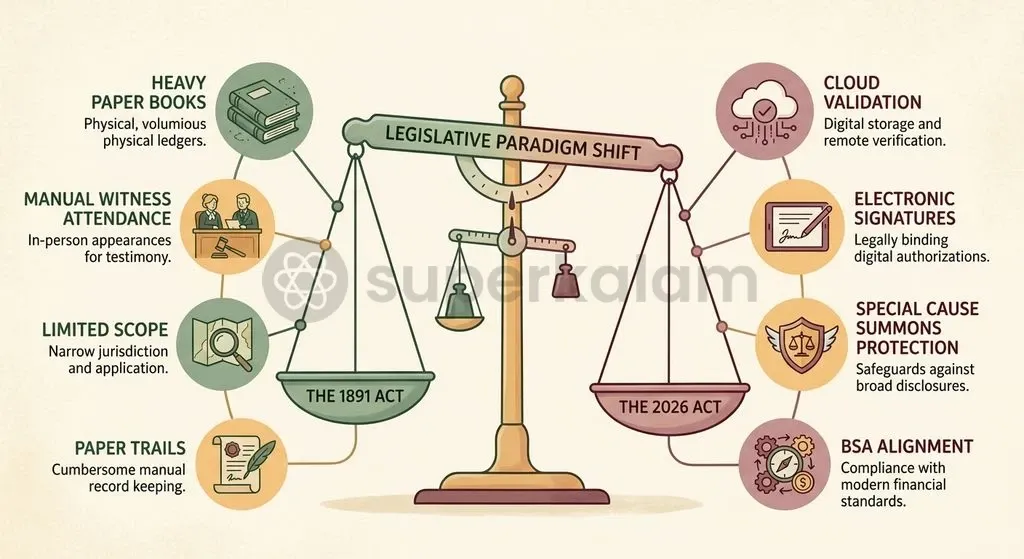
The Bankers' Books Evidence Act, 2026 modernises the structural architecture of banking evidence across several key operational dimensions.
| Dimension | Bankers' Books Evidence Act, 1891 | Bankers' Books Evidence Act, 2026 |
|---|---|---|
| Statutory Scope | Traditional commercial banks and post office savings banks | Banks, post office savings banks, and any financial entity notified by the Central Government |
| Recognised Media | Physical books and paper registers; limited computer printouts added later | Physical, optical, magnetic, semi-conductor, virtual, and cloud storage systems |
| Certification Method | Manual physical signatures and paper endorsements | Technology-neutral: manual, digital, or electronic signatures |
| Offsite & Cloud Data | Unregulated; required manual re-authentication of printouts | Explicit statutory recognition for cloud databases, offsite backups, and disaster recovery sites |
| Summoning Bank Staff | Broad judicial discretion leading to frequent clerk appearances | Strict statutory codification of special cause before summoning bank officers |
| Legislative Linkage | Indian Evidence Act, 1872 and Code of Criminal Procedure, 1973 | Bharatiya Sakshya Adhiniyam, 2023 and Bharatiya Nagarik Suraksha Sanhita, 2023 |
Digital Banking Records and Electronic Evidence: How the Rules Work
The Bankers' Books Evidence Act, 2026 establishes strict technical conditions governing the admissibility of electronic extracts. Under the statutory provisions, electronic copies and digital extracts are admissible as legally enforceable evidence provided they are true copies correctly derived from source records, show no unauthorised alterations, and originate from untampered systems.
Unlike the 1891 framework, the modernised enactment validates storage architectures across optical, magnetic, semi-conductor, virtual, and cloud platforms without requiring separate procedural re-authentication for each medium. This validation ensures that modern server architecture directly interfaces with judicial standards.
To maintain the legal enforceability of digital records, financial institutions must sustain continuous system integrity. The law mandates operational verification that data retrieval mechanisms accurately reflect stored information without systemic manipulation.
Discuss with Superkalam
If an investigating officer seeks digital logs from a bank's disaster recovery site during a fraud inquiry, how does the 2026 Act apply?
Ask NowConnecting the Dots: How the Act Links with BSA, BNS, and BNSS
The Bankers' Books Evidence Act, 2026 operates as an integrated component of India's overhauled legal architecture. The statute aligns its definitions and procedural mechanisms with the Bharatiya Sakshya Adhiniyam, 2023 (BSA), the Bharatiya Nagarik Suraksha Sanhita, 2023 (BNSS), the Information Technology Act, 2000, and the Arbitration and Conciliation Act, 1996.
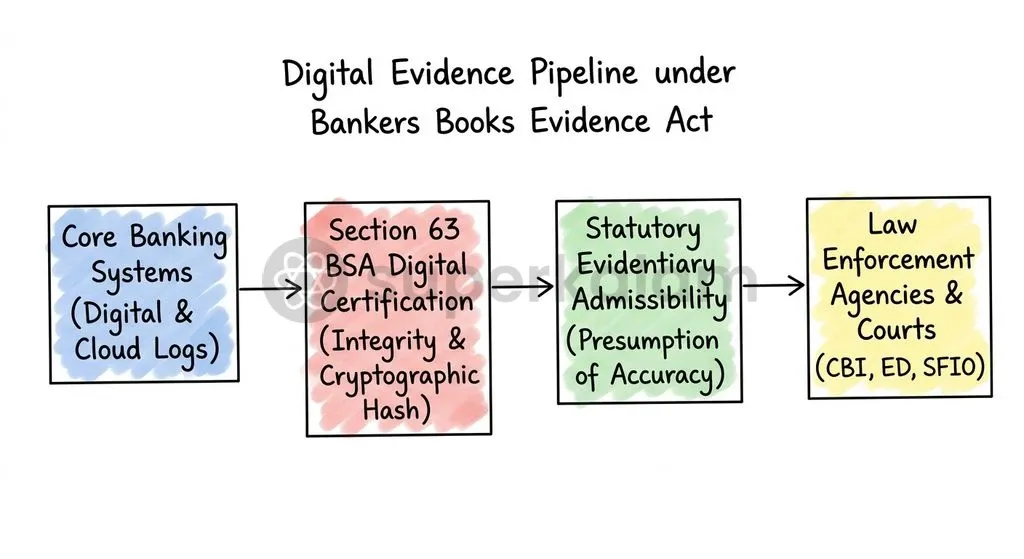
A critical procedural link exists between the 2026 Act and the electronic evidence rules of the BSA. The certification framework under the 2026 Act directly mirrors the digital certificate architecture established under Section 63 of the Bharatiya Sakshya Adhiniyam, 2023, establishing standardised parameters for electronic data authentication.
The 2026 Act interfaces with the procedural and substantive criminal codes across multiple dimensions:
- BNSS Summons and Investigation Powers: Investigating officers exercising powers under the BNSS can requisition electronic financial records directly through standardised digital certificates, eliminating delays caused by physical ledger verifications.
- BSA Electronic Presumptions: Certified electronic records submitted under the 2026 Act carry statutory evidentiary weight under the BSA, expediting the admission of financial exhibits during trials.
- BNS Financial Offence Prosecutions: The streamlined admissibility of digital transactions strengthens prosecutions under the Bharatiya Nyaya Sanhita, 2023 (BNS) for offences involving corporate fraud, criminal breach of trust, and cyber-enabled financial deception.
Discuss with Superkalam
Compare how the 1891 Act and the 2026 Act handle the summoning of bank officials and the authentication of electronic records.
Ask NowImpact on Financial Fraud Investigations and Banking Operations
The modernised evidentiary framework significantly accelerates multi-agency financial investigations across India. According to industry analyses, the 2026 Act streamlines evidence collection for specialised investigative bodies, including the Central Bureau of Investigation (CBI), the Enforcement Directorate (ED), and the Serious Fraud Investigation Office (SFIO).
In major money laundering and corporate fraud probes, investigative agencies frequently encounter complex transaction layers dispersed across multiple digital platforms. Under the earlier regime, obtaining court-admissible physical certifications for thousands of micro-transactions caused severe procedural backlogs. The 2026 framework allows financial institutions to supply digitally signed, cloud-derived transaction batches that satisfy statutory scrutiny immediately upon submission.
For commercial banks, the new law substantially reduces operational litigation overhead. Protecting bank officials from routine courtroom appearances saves administrative hours, allowing banking personnel to focus on core financial operations rather than testifying on non-contentious record production.
Key Challenges: Privacy Concerns, Data Security, and Compliance Burden
The Bankers' Books Evidence Act, 2026 introduces demanding technological compliance obligations for financial institutions. Banks must establish tamper-proof audit trails, maintain cryptographic hash logs, and preserve robust proofs of system integrity to defend the legal validity of their digital extracts.
Technical challenges arise from managing legacy software alongside modern cloud deployments. If a banking system experiences an unlogged disruption or security vulnerability, the statutory presumption of data accuracy may be compromised, exposing records to procedural challenges under the special cause exception.
Privacy advocates and legal experts have noted that standardised digital record disclosures must be reconciled with statutory protections under the Digital Personal Data Protection Act, 2023 (DPDPA) per reporting by LiveLaw (as reported on 15 August 2026). Indiscriminate production of complete digital audit logs containing non-relevant customer transaction metadata could create data privacy concerns if protective filters are not rigorously enforced.
Furthermore, the reform establishes an analytical shift in the judicial burden of proof. By treating system-derived electronic extracts as prima facie admissible upon digital certification, the law effectively presumes the reliability of automated bank infrastructure. Consequently, the practical burden falls upon accused litigants to demonstrate technical tampering or hardware malfunction—a technically complex and cost-intensive challenge for individual defendants facing institutional financial systems.
Way Forward: Building Capacity and Harmonising Digital Financial Rules
The Ministry of Finance and regulatory authorities must coordinate to ensure uniform execution of the new evidence framework. Official guidance recommends formulating harmonised Standard Operating Procedures (SOPs) across all commercial banks to standardise electronic certificate generation and record extraction.
Key institutional priorities for strengthening the 2026 framework include:
- Upgrading Cryptographic Infrastructure: Financial institutions must invest in resilient IT architecture capable of generating verifiable digital signatures, automated hash validations, and immutable audit logs.
- Inter-Agency Judicial Training: Comprehensive training programmes should be instituted for lower judiciary judges, prosecutors, and police investigators to standardise digital evidence evaluation under the BSA and BNSS.
- Capacity Building in Smaller Institutions: Smaller cooperative banks, regional rural lenders, and newly notified non-bank financial entities require institutional assistance to upgrade their core IT systems to meet statutory integrity benchmarks.
- Auditing and Security Benchmarks: Regular third-party cybersecurity audits should be conducted to certify that cloud storage, offsite servers, and disaster recovery centers remain free from unauthorised intrusions.
Discuss with Superkalam
Evaluate whether shifting to an automated system-integrity presumption adequately balances prosecutorial efficiency against the rights of the accused.
Ask NowKey Takeaways
- The Bankers' Books Evidence Act, 2026 (Act No. 15 of 2026) received Presidential assent on 13 August 2026 and entered into force on 1 October 2026, formally repealing the colonial Bankers' Books Evidence Act, 1891.
- The statutory definition of bankers' books has expanded to explicitly include physical, electronic, digital, virtual, and cloud-stored records, alongside disaster recovery backups.
- Certification is now technology-neutral, allowing verification via manual, digital, or electronic signatures.
- Bank officers are protected from routine witness summons unless a court issues a written order recording a special cause, such as doubtful entry genuineness or interrupted system logging.
- The 2026 Act aligns statutory banking rules directly with the Bharatiya Sakshya Adhiniyam, 2023 (Section 63) and the investigation framework of the Bharatiya Nagarik Suraksha Sanhita, 2023.
- The reform structurally shifts the procedural burden of proof onto accused litigants by legally presuming the reliability of certified digital extracts, requiring financial institutions to maintain cryptographic logs and robust cybersecurity safeguards.
Mains Question
'The Bankers\' Books Evidence Act, 2026 shifts India\'s financial evidentiary regime from physical ledger verification to automated system-integrity presumptions.' In this context, elucidate how the new law modernises banking evidence and interfaces with the Bharatiya Sakshya Adhiniyam, 2023. (10 Marks)
Evaluate NowMains Question
'While statutory recognition of digital and cloud-based financial records expedites criminal investigations, it introduces critical procedural and operational challenges.' Critically analyse the Bankers' Books Evidence Act, 2026 in terms of operational efficiency, systemic integrity, and safeguards for financial institutions. (15 Marks)
Evaluate NowPractice MCQs
QUESTION 1
With reference to the Bankers' Books Evidence Act, 2026, consider the following statements:
- It repeals and replaces the Bankers' Books Evidence Act, 1891.
- Under the Act, the Central Government has the authority to extend its provisions to any entity in the wider financial sector beyond traditional banks.
- The statutory definition of bankers' books explicitly includes records maintained on cloud databases and disaster recovery facilities. Which of the statements given above are correct?
QUESTION 2
Regarding the summoning of bank officials as witnesses under the Bankers' Books Evidence Act, 2026, consider the following statements:
- Bank officers cannot be compelled to attend court as witnesses where the bank is not a party, unless a judge issues a written order establishing a 'special cause'.
- Operational interruption in automated data processing at the bank is a legally codified ground constituting 'special cause'. Which of the statements given above is/are correct?
QUESTION 3
With reference to the alignment of the Bankers' Books Evidence Act, 2026 with India's overhauled criminal jurisprudence, consider the following statements:
- The certification framework of the 2026 Act mirrors the electronic certificate architecture under Section 63 of the Bharatiya Sakshya Adhiniyam, 2023.
- Certified electronic extracts under the Act carry statutory evidentiary weight that aids prosecutions under the Bharatiya Nyaya Sanhita, 2023.
- Investigating officers exercising powers under the Bharatiya Nagarik Suraksha Sanhita, 2023 can requisition electronic financial records using standardised digital certificates. Which of the statements given above are correct?
QUESTION 4
Consider the following statements comparing the Bankers' Books Evidence Act of 1891 and 2026:
- The 1891 Act relied exclusively on manual signatures and paper endorsements, whereas the 2026 Act provides a technology-neutral framework allowing manual, digital, or electronic signatures.
- The 2026 Act shifts the banking evidence regime from physical ledger verification to automated system-integrity presumptions. Which of the statements given above is/are correct?
QUESTION 5
Under the Bankers' Books Evidence Act, 2026, which of the following storage media are explicitly recognized for the maintenance of admissible banking records?