Supreme Court on Green Crackers: Formulations, Bans, and Judgments
Green crackers use tested formulations to reduce emissions. See CSIR-NEERI standards, PESO’s role and the Supreme Court’s firecracker regulation framework.
Oct, 2026
•8 min read
Overview
The Supreme Court of India prohibits conventional, toxic firecrackers nationwide. It conditionally permits scientifically validated green crackers developed by CSIR-NEERI, balancing festive traditions with the fundamental right to clean air.
Under this regulatory regime, all fireworks containing toxic heavy metals and barium salts remain banned across the country. Manufacturing units may only produce approved formulations that lower particulate emissions by at least 30 percent.
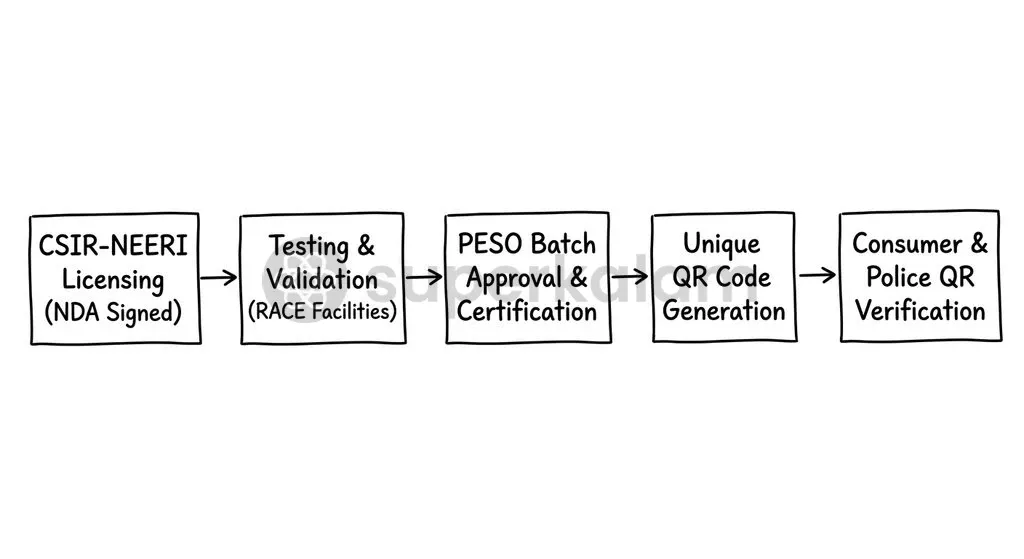
Genuine green crackers must carry a scannable QR code and pass mandatory verification by the Petroleum and Explosives Safety Organisation. By prioritising public health under Article 21, the judiciary anchors environmental governance firmly in the Precautionary Principle.
Why in the News?
The Supreme Court reiterated that its prohibition on hazardous chemical fireworks applies across all states, not merely the National Capital Region. As of October 2025, judicial scrutiny has intensified around compliance mechanisms, counterfeit certifications, and seasonal air degradation.
The Court ruled out a blanket nationwide prohibition on all fireworks, permitting only approved green crackers with strict noise limits. The bench also evaluated outdoor ambient air quality testing across Delhi, Bhopal, Kolkata, and Chennai before settling policy parameters for advanced formulations.
The Judicial Trajectory: From Arjun Gopal (2018) to Current Directives
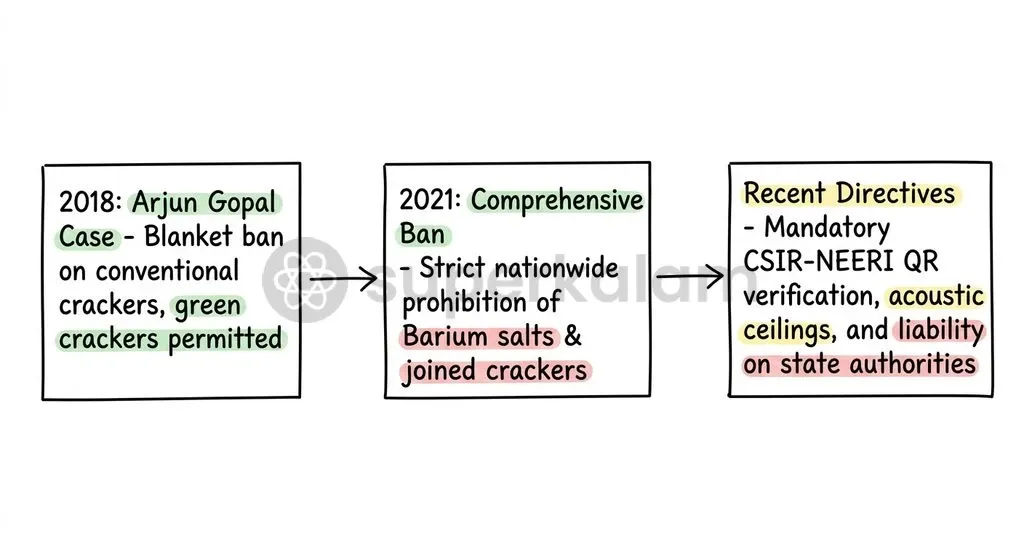
The Supreme Court established the modern legal foundation for firecracker regulation in Arjun Gopal v. Union of India (2018). In that verdict, the bench banned conventional fireworks with hazardous chemicals and allowed only improved and green crackers with reduced chemical footprints.
Subsequent judicial orders reinforced this stance against regulatory dilution:
- Nationwide Application (2021): The Court clarified that the ban on barium salts and non-green firecrackers applies across the entire territory of India, rejecting arguments that restrictions should operate only in Delhi-NCR.
- Rejection of Blanket Bans: The judiciary declined to impose an absolute prohibition on every category of firework, approving conditional relaxations for verified, next-generation joined green crackers.
- Noise Ceilings: The bench mandated strict adherence to statutory acoustic limits under the Environment (Protection) Rules, 1986, capping noise levels at 125 dB(AI) or 145 dB(C) peak at 4 metres from detonation.
Environmental jurisprudence in these rulings remains firmly anchored in the Precautionary Principle and the Polluter Pays Principle, placing legal responsibility on state enforcement authorities.
Discuss with Superkalam
Which three patented formulations were developed by CSIR-NEERI to replace conventional firecrackers?
Ask NowWhat Are Green Crackers? CSIR-NEERI Formulations and Banned Chemicals
Green crackers are pyrotechnic devices engineered by the Council of Scientific and Industrial Research - National Environmental Engineering Research Institute (CSIR-NEERI) to suppress air and noise pollution. According to the Ministry of Science and Technology, these formulations reduce particulate matter emissions (PM2.5 and PM10) by at least 30 percent compared to conventional equivalents.
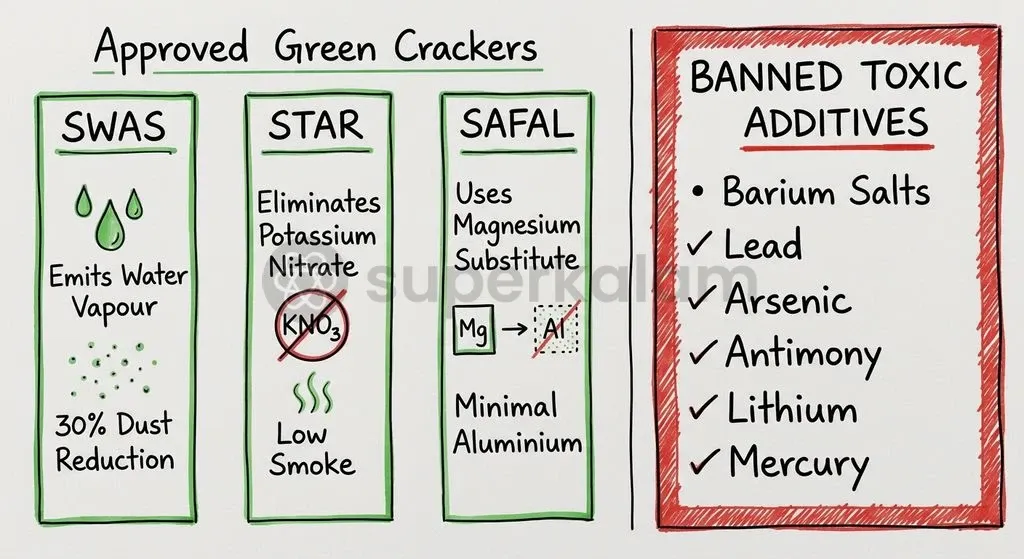
CSIR-NEERI designed three patented formulations:
- SWAS (Safe Water Releaser): This formulation eliminates potassium nitrate and sulphur entirely. Upon ignition, it releases water vapour that acts as an in-situ dust suppressant, reducing particulate output by 30 to 35 percent.
- STAR (Safe Thermite Cracker): This design eliminates potassium nitrate and sulphur while significantly reducing aluminium concentrations, resulting in lower particulate emissions and reduced sound intensity.
- SAFAL (Safe Minimal Aluminium): This formulation replaces conventional aluminium content with magnesium and safe oxidisers, achieving an emission reduction of 35 to 40 percent.
The Supreme Court strictly prohibited six hazardous elements across all firework types due to extreme bioaccumulation and respiratory risks: barium salts, lead, mercury, arsenic, antimony, and lithium.
Discuss with Superkalam
Explain the operational mechanism of the SWAS formulation in reducing ambient particulate matter during combustion.
Ask NowConventional vs Green Crackers: A Comparison of Ingredients and Emissions
The Petroleum and Explosives Safety Organisation evaluates chemical compositions to ensure green crackers diverge fundamentally from traditional pyrotechnic mixtures. The primary distinctions centre on chemical oxidisers, heavy metal binders, and atmospheric by-products.
| Dimension | Conventional Firecrackers | Green Firecrackers (CSIR-NEERI) |
|---|---|---|
| Primary Oxidiser | Potassium nitrate and hazardous barium nitrate | Modified oxidisers and de-nitrated chemical matrices |
| Particulate Emissions | Heavy discharge of PM2.5 and PM10 | Minimum 30% reduction in particulate emissions |
| Barium Content | Extensively used for vivid green colouration | Completely prohibited by judicial directives |
| Heavy Metals | Contains lead, arsenic, mercury, lithium, antimony | Strictly excluded from all approved formulations |
| Acoustic Levels | Frequently exceeds 140–160 dB | Capped at 125 dB(AI) or 145 dB(C) peak at 4 metres |
| Tracking Mechanism | Unregulated packaging and unverified labels | Mandatory CSIR-NEERI green logo and QR code |
Constitutional Balancing Act: Article 21 vs Article 19(1)(g) and Article 25
The Supreme Court harmonised conflicting fundamental rights by establishing a definitive legal hierarchy between commercial livelihoods, religious freedoms, and public health. In Arjun Gopal (2018), the Court addressed whether restrictions on firecrackers infringed upon economic liberty and religious expression.
| Constitutional Right | Scope and Judicial Standing | Legal Precedence |
|---|---|---|
| Article 21 (Life & Clean Health) | Clean air is intrinsic to human dignity and collective health | Superordinate right prevailing over commercial and customary claims |
| Article 19(1)(g) (Trade & Profession) | Subject to reasonable restrictions under Article 19(6) | Subordinate to environmental safety and public interest |
| Article 25 (Religious Practice) | Customary bursting of crackers is not an essential practice | Subject to state regulation for public welfare and health |
The Court delivered unambiguous legal holdings across these constitutional provisions:
- Article 21 (Right to Life and Clean Health): The judiciary held that clean air is an intrinsic element of the right to live with human dignity. The collective health of millions, especially children and elderly citizens, forms a non-negotiable state obligation.
- Article 19(1)(g) (Right to Practice Trade or Business): The bench ruled that commercial rights are subject to reasonable restrictions under Article 19(6) on grounds of public interest and environmental safety. No commercial enterprise possesses a fundamental right to manufacture products that poison the ambient atmosphere.
- Article 25 (Freedom of Religion): The Supreme Court held that bursting firecrackers does not constitute an essential religious practice under Article 25, allowing the state to regulate harmful customary conduct to protect public welfare.
Discuss with Superkalam
Analyse why market surveillance through QR codes often fails during peak festive seasons despite strict PESO guidelines.
Ask NowImplementation Bottlenecks: Fake QR Codes and Jurisdictional Gaps
Regulatory enforcement of green cracker directives faces acute practical bottlenecks across industrial supply chains. Over 1,400 firecracker manufacturers have signed non-disclosure agreements with CSIR-NEERI to produce green formulations, yet monitoring unauthorised production remains difficult.
Judicial proceedings in M.C. Mehta v. Union of India highlighted several systemic implementation failures:
- Counterfeit QR Codes: Unscrupulous entities affix forged CSIR-NEERI logos and non-functional QR codes to boxes containing conventional, barium-laced fireworks.
- Interstate Smuggling: Banned fireworks manufactured in decentralised hubs easily cross state borders during festival seasons due to porous transit checkpoints.
- Testing Constraints: CSIR-NEERI operates dedicated Raw Materials, Compositions, and Emissions (RACE) testing facilities at Nagpur and Sivakasi, but field testing kits for local police forces remain scarce.
- Multi-Agency Fragmentation: Regulatory coordination among local police, state pollution control boards, the Central Pollution Control Board, and the Commission for Air Quality Management often lacks unified operational protocols.
Ethical Dimensions: Public Health, Livelihoods, and Intergenerational Equity
The firecracker debate presents a fundamental ethical tension between intergenerational equity and economic survival. Reconciling these competing moral imperatives involves three primary dimensions:
- Livelihood Pressures vs Collective Safety: In regions like Sivakasi, hundreds of thousands of informal workers depend on pyrotechnic manufacturing for daily subsistence. Sudden prohibitions risk economic distress, pitting immediate socioeconomic needs directly against environmental mandates.
- Protection of Vulnerable Demographics: Ethical governance cannot treat severe respiratory damage as an acceptable externality. Post-festive surges in toxic air impose disproportionate burdens on vulnerable demographics, including neonates, pregnant women, asthmatic patients, and stray animals.
- Intergenerational Justice: Current generations hold no moral authority to degrade the ecological commons for temporary celebration. The ethical path forward lies in supporting a structured green industrial transition rather than tolerating toxic manufacturing.
Discuss with Superkalam
Weigh the conflict between protecting the livelihood of Sivakasi firecracker workers and ensuring the right to clean air under Article 21.
Ask NowWay Forward: Strengthening Oversight and Civic Responsibility
Sustainable regulation of firecrackers requires combining technological authentication with institutional accountability and widespread civic engagement. The Petroleum and Explosives Safety Organisation must accelerate sample testing cycles while expanding the capacity of RACE testing facilities across major industrial clusters.
Key policy interventions should focus on:
- Digital Enforcement: Empowering local law enforcement with the official CSIR-NEERI Green QR Code mobile verification tool to instantly detect counterfeit packages in retail markets.
- Industrial Transition Support: Providing technical and financial incentives for small-scale Sivakasi units to transition fully to certified SWAS, STAR, and SAFAL chemical matrices.
- Community-Level Celebrations: Encouraging designated community laser shows and centralised, time-bound green pyrotechnics to minimise decentralised air toxicity.
- Interstate Checkpoints: Strengthening border surveillance under the Commission for Air Quality Management to intercept illicit firecracker consignments during critical autumn air inversions.
Key Takeaways
- The Supreme Court prohibited conventional fireworks nationwide, permitting only verified CSIR-NEERI green crackers with reduced emissions.
- Chemical formulations under SWAS, STAR, and SAFAL achieve at least a 30 percent reduction in particulate matter emissions compared to traditional fireworks.
- The Supreme Court completely banned six toxic substances: barium salts, lead, mercury, arsenic, antimony, and lithium.
- Judicial jurisprudence establishes that the Right to Clean Air under Article 21 supersedes commercial rights under Article 19(1)(g) and religious claims under Article 25.
- Enforcement challenges include counterfeit QR codes, unapproved barium mixtures, and multi-agency regulatory gaps across interstate borders.
Mains Question
"The right to clean air under Article 21 operates as a superordinate right over economic freedoms under Article 19(1)(g) and customary practices under Article 25." In light of the Arjun Gopal (2018) judgment, elucidate the constitutional hierarchy established by the Supreme Court regarding firecracker regulations. (10 Marks)
Evaluate NowMains Question
Despite judicial mandates and scientific advancements in CSIR-NEERI green formulations, the implementation of firecracker regulations faces severe institutional bottlenecks. Critically analyse the structural challenges in enforcing green cracker norms. (15 Marks)
Evaluate NowPractice MCQs
QUESTION 1
With reference to 'Green Crackers' developed by CSIR-NEERI, consider the following statements:
- The SWAS formulation completely eliminates potassium nitrate and sulphur, releasing water vapour as an in-situ dust suppressant.
- The SAFAL formulation replaces aluminium content with magnesium and safe oxidisers to achieve particulate emission reductions.
- The Supreme Court has permitted the use of barium salts exclusively in approved green crackers to maintain acoustic thresholds. Which of the statements given above is/are correct?
QUESTION 2
Consider the following heavy metals/elements:
- Barium
- Lead
- Mercury
- Arsenic
- Antimony
- Lithium How many of the above elements are included in the list of hazardous substances strictly prohibited by the Supreme Court across all firework formulations?
QUESTION 3
Regarding the regulatory and acoustic standards governing firecrackers in India, consider the following statements:
- The Supreme Court restricted the ban on conventional fireworks solely to the National Capital Region (NCR).
- Green crackers must achieve a minimum particulate matter emission reduction of 30 percent compared to conventional equivalents.
- Statutory acoustic standards cap firecracker noise at 125 dB(AI) or 145 dB(C) peak at 4 metres from detonation. Which of the statements given above are correct?
QUESTION 4
Which of the following bodies is responsible for evaluating chemical compositions and verifying mandatory tracking mechanisms like QR codes for genuine green crackers in India?
QUESTION 5
With reference to the constitutional balancing of fundamental rights in Arjun Gopal v. Union of India, consider the following statements:
- The right to clean air under Article 21 was held to be a superordinate right prevailing over commercial and customary claims.
- The freedom to practice trade or business under Article 19(1)(g) cannot be subjected to restrictions based on environmental safety.
- The customary bursting of firecrackers is recognized as an essential religious practice protected under Article 25. Which of the statements given above is/are correct?