US Treasury Yield Surge: Impact on Rupee, Inflation & RBI
Bond yields move inversely to bond prices. See how US Treasury yields affect capital flows, the rupee, borrowing costs and monetary policy in India.
Oct, 2026
•9 min read

Overview
Surging US Treasury yields push up global risk-free borrowing costs. This narrowing interest-rate spread triggers foreign portfolio capital outflows, putting sustained downward pressure on the Indian Rupee.
Higher import bills for energy and industrial inputs elevate imported inflation risks. Consequently, the Reserve Bank of India must balance currency stability against domestic growth priorities.
As of September 2026, India manages these external spillovers from a solid macroeconomic base. Deep foreign exchange reserves exceeding $700 billion, a moderate external debt-to-GDP ratio of 19-20%, and structural inflows from global bond index inclusion shield the domestic financial system from the acute vulnerabilities seen in earlier tightening cycles.
Why in the News: The Surge in US Bond Yields
Global debt markets faced fresh volatility as benchmark US government yields climbed. As of January 2026, shifting US fiscal borrowing and Federal Reserve interest-rate expectations lifted returns on US sovereign paper across maturities, according to data from the US Department of the Treasury.
This upward yield trajectory directly affects emerging economies like India. The movement alters the risk-adjusted returns sought by global asset managers, spurring capital shifts from emerging market debt into dollar-denominated assets. For the Reserve Bank of India (RBI) and the Monetary Policy Committee (MPC), managing these external spillovers remains central to domestic liquidity management and interest-rate decisions.
Understanding the Basics: What Are US Treasury Yields and Why Do They Matter?
A US Treasury yield is the effective annual interest rate paid by the United States federal government on its sovereign debt. International capital markets treat these securities as the global risk-free benchmark for pricing sovereign debt, corporate paper, and foreign exchange risk worldwide.
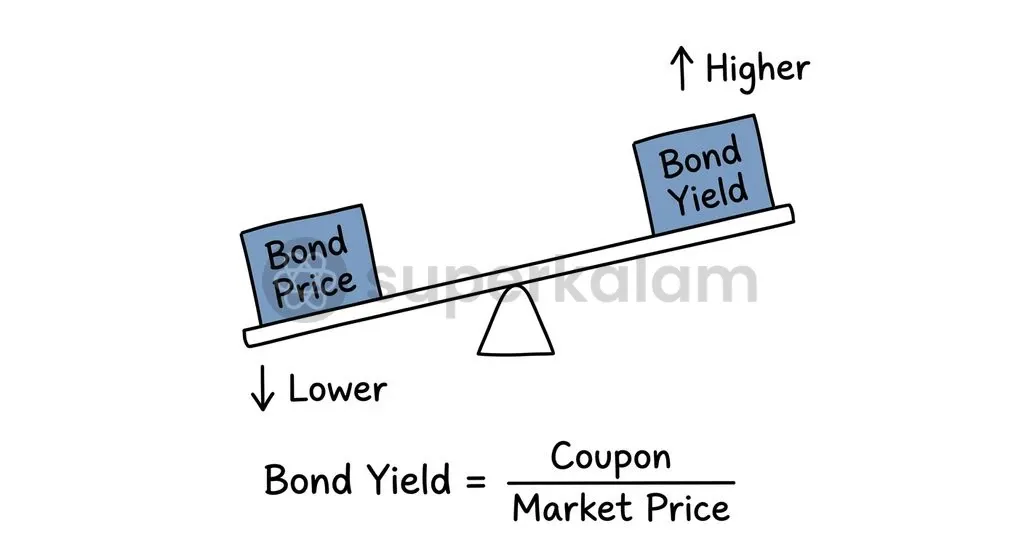
Bond yields and bond prices move in an exact inverse relationship. When market participants sell sovereign bonds heavily, bond prices drop and the effective annual yield rises.
| Metric / Concept | High Bond Price Regime | High Bond Yield Regime |
|---|---|---|
| Bond Market Dynamics | Heavy buying demand pushes secondary market bond prices above face value. | Heavy selling pressure pushes secondary market bond prices below face value. |
| Effective Yield / Return | Yield drops; borrowing cost for the sovereign falls. | Yield rises; borrowing cost for the sovereign increases. |
| Investor Risk Appetite | Signals risk-on sentiment or aggressive monetary easing. | Signals flight-to-safety, fiscal expansion, or policy tightening. |
| Global Capital Movement | Capital seeks higher returns across emerging market assets. | Capital reallocates back to US dollar sovereign securities. |
When US bond yields rise, sovereign debt issued by other nations must compete against a higher baseline return. Foreign Portfolio Investors (FPIs) demand an adequate risk premium to offset currency volatility and sovereign risk before keeping capital in emerging markets.
Discuss with Superkalam
What is the mathematical relationship between sovereign bond prices and bond yields during periods of heavy secondary market selling?
Ask NowThe Transmission Mechanism: How Global Yield Spikes Reach Emerging Markets
The transmission of US Treasury yield spikes into the Indian economy operates primarily through three interrelated macroeconomic channels:
- The Interest-Rate Differential Channel: A rise in US sovereign yields narrows the spread between Indian Government Securities (G-Secs) and US Treasury bills. As the return spread shrinks, foreign funds find less incentive to hold emerging market sovereign risk.
- The Portfolio Reallocation Channel: Higher risk-free US yields trigger a swift flight-to-safety dynamic. FPIs rebalance global portfolios by selling Indian equities and domestic debt securities to secure elevated US dollar yields, as highlighted in the Economic Survey 2025-26.
- The External Corporate Borrowing Channel: Higher benchmark yields raise the cost of servicing and rolling over foreign currency debt. Indian corporations with External Commercial Borrowings (ECBs) face higher overseas refinancing rates, pushing them to hedge foreign exposures or refinance through domestic banks.
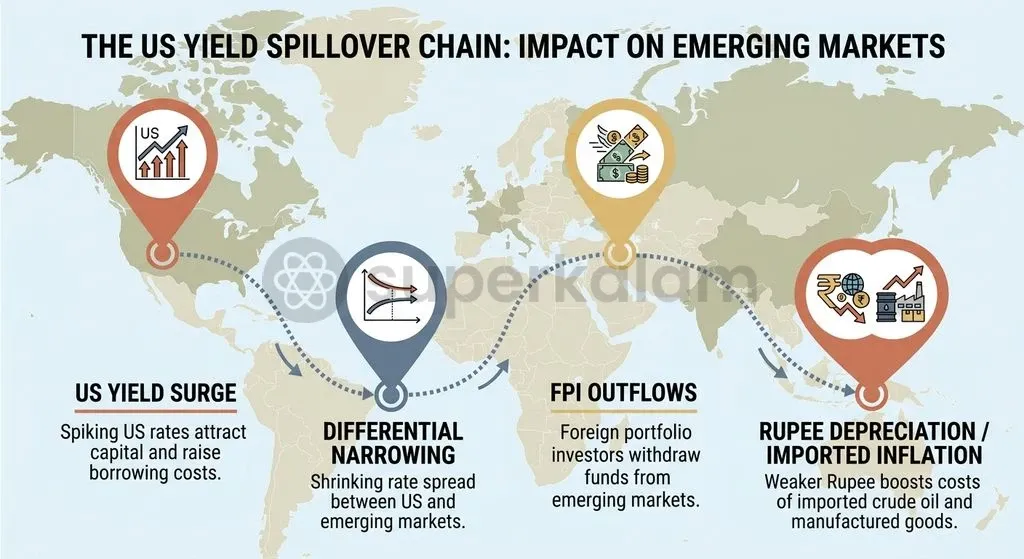
This structural transmission process alters cross-border capital flows and foreign exchange dynamics, exposing domestic markets to direct external stress.
Discuss with Superkalam
How does a narrowing interest-rate differential between Indian G-Secs and US Treasuries shift the risk premium demanded by foreign investors?
Ask NowDirect Impacts on India: Currency Depreciation, Capital Outflows, and Imported Inflation
Persistent capital outflows driven by rising US yields put severe selling pressure on domestic financial assets and the local currency. When FPIs sell domestic equities and bonds, they convert rupee proceeds into US dollars, creating direct downward depreciation pressure on the Indian Rupee.
The transmission cascade follows a direct path:
- Rising US Treasury Yields narrow the interest-rate differential between markets.
- FPI Capital Outflows accelerate via flight-to-safety portfolio shifts.
- Increased Dollar Demand triggers sustained rupee depreciation.
- Higher Landed Import Costs hit key supplies like crude oil and raw inputs.
- Widening Current Account Deficit intensifies domestic imported inflation.
This exchange rate depreciation strains India's external balances and domestic price stability across three key areas:
- Widening Trade and Current Account Deficit: India imports over 80% of its crude oil requirements. Because petroleum imports are priced in US dollars, an inelastic import basket and a weakening rupee inflate the national import bill, threatening to widen the Current Account Deficit (CAD).
- Imported Inflation Dynamics: A weaker rupee raises the landed cost of critical industrial inputs, active pharmaceutical ingredients, and electronic machinery. These elevated input costs pass into the domestic Wholesale Price Index (WPI) and Consumer Price Index (CPI), generating imported inflation across domestic supply chains.
- Domestic Yield Contagion: Rising US yields spill over into domestic fixed-income markets. Indian 10-year benchmark G-Sec yields face upward pressure as domestic investors demand higher returns, raising overall domestic borrowing costs.
Discuss with Superkalam
How would an increase in landed crude oil costs due to currency depreciation impact the cost structures of domestic manufacturing firms?
Ask Now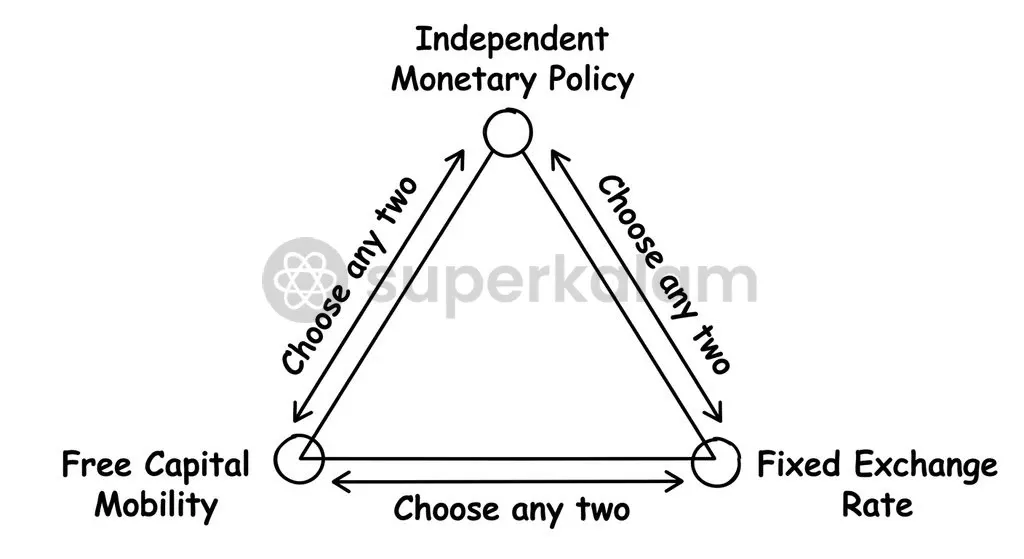
These interventions smooth sharp exchange rate fluctuations without pegging the currency to a fixed target, preserving orderly financial conditions.
Discuss with Superkalam
In light of the Mundell-Fleming Trilemma, break down why selling foreign exchange reserves requires compensatory Open Market Operations by the central bank.
Ask NowIndia vs Other Emerging Markets: Why Domestic Macro Fundamentals Offer Resilience
India demonstrates far greater external resilience today than during the volatile Taper Tantrum episode of 2013. In mid-2013, the US Federal Reserve's signal that it would taper asset purchases sparked rapid capital flight from emerging economies running twin deficits.
India's macroeconomic fundamentals show significant structural improvement across all major vulnerability metrics:
| Vulnerability Metric | 2013 'Taper Tantrum' Period | Current Position (2025–2026) | Significance for External Stability | | :--- | :--- | :--- | | Foreign Exchange Reserves | ~$304 billion | >$700 billion | Provides deep buffer to absorb global shocks and curb rupee volatility. | | Import Cover Duration | ~7.8 months of imports | >11–12 months of imports | Ensures stable financing for critical energy and industrial supply imports. | | Current Account Deficit (CAD) | 4.8% of GDP (FY2012-13) | Moderate and sustainable levels | Reduces reliance on short-term volatile capital inflows to fund external deficits. | | External Debt-to-GDP Ratio | Elevated with high short-term debt | ~19–20% of GDP | Lowers sovereign and corporate exposure to foreign currency refinancing risks. | | Global Bond Index Inclusion | Absent (closed debt market framework) | Included in JPMorgan GBI-EM index (10% cap) | Attracts steady, long-term passive institutional portfolio flows. |
These structural buffers decouple domestic debt markets from sudden external shocks, affording the central bank greater policy autonomy.
Discuss with Superkalam
Weigh whether structural buffers such as $700 billion in forex reserves and bond index inclusion can entirely shield emerging economies from global monetary tightening.
Ask NowWay Forward: Managing External Spillover Risks and Deepening Local Bond Markets
Sustaining economic resilience against persistent global yield shocks requires deepening domestic capital markets and reducing dollar dependence.
- Expanding the Fully Accessible Route (FAR): The RBI introduced the Fully Accessible Route in April 2020, removing foreign investment ceilings on designated Government of India dated securities. Deepening this market integration attracts stable foreign capital into domestic sovereign debt, expanding the investor base beyond domestic banks and insurers.
- Capitalising on Global Benchmark Inclusions: Following the phased inclusion of Indian G-Secs into the JPMorgan Government Bond Index-Emerging Markets (GBI-EM) with a 10% maximum weight by March 2025, India gains steady passive investment inflows. Streamlined tax and settlement processes will encourage further listings across global fixed-income indices.
- Promoting Internationalisation of the Rupee: Expanding rupee-denominated trade invoicing through Special Rupee Vostro Accounts (SRVA) and Special Non-Resident Rupee (SNRR) accounts shields bilateral trade settlements from dollar exchange rate fluctuations.
- Adhering to Fiscal Consolidation: Maintaining central government adherence to the Fiscal Responsibility and Budget Management framework—targeting a fiscal deficit below 4.5% of GDP by FY2025-26—anchors sovereign credit ratings and stabilises domestic bond yields against external volatility.
Key Takeaways
- US Treasury Yield Role: US Treasury yields represent the global risk-free rate; when they rise, the interest-rate differential between emerging markets and US debt narrows, triggering capital outflows.
- Exchange Rate Transmission: Foreign portfolio outflows elevate dollar demand, driving rupee depreciation, raising landed costs for inelastic crude oil imports, and generating imported inflation.
- RBI Intervention Mechanism: The RBI counters currency volatility through spot dollar sales, balancing systemic liquidity via Open Market Operations and managing the Mundell-Fleming Trilemma trade-offs.
- Enhanced Macro Buffers: India's external resilience has strengthened markedly since the 2013 Taper Tantrum, backed by foreign exchange reserves exceeding $700 billion and an external debt-to-GDP ratio of 19-20%.
- Structural Stabilisers: The Fully Accessible Route (FAR), a 10% weighting in the JPMorgan GBI-EM index, and local currency trade invoicing via Special Rupee Vostro Accounts provide durable long-term stability.
Mains Question
Under the 'Impossible Trinity' framework, managing external financial spillovers presents complex trade-offs for central banks. In this context, examine the policy instruments deployed by the Reserve Bank of India to stabilise the domestic currency while preserving liquidity balance. (10 Marks)
Evaluate NowMains Question
'Structural improvements in macroeconomic buffers have significantly enhanced India's external resilience against global yield spikes compared to the 2013 Taper Tantrum episode.' Discuss. (15 Marks)
Evaluate NowPractice MCQs
QUESTION 1
With reference to the transmission of surging US Treasury yields to emerging market economies, consider the following statements:
- A rise in US sovereign yields narrows the interest-rate differential between Indian Government Securities (G-Secs) and US Treasury bills.
- Higher benchmark US yields decrease the overseas refinancing and debt servicing costs for domestic firms holding External Commercial Borrowings (ECBs).
- Rising US yields trigger a flight-to-safety portfolio rebalancing, prompting foreign investors to shift capital into dollar-denominated assets.
Which of the statements given above are correct?
QUESTION 2
Consider the following statements regarding the comparison between India's macroeconomic position during the 2013 'Taper Tantrum' and the 2025–2026 period:
- India's foreign exchange reserves have expanded from approximately $304 billion in 2013 to exceeding $700 billion.
- The import cover duration has increased from roughly 7.8 months of imports to over 11–12 months.
- India's external debt-to-GDP ratio has moderated to around 19–20% of GDP.
Which of the statements given above is/are correct?
QUESTION 3
In the context of central banking and the 'Impossible Trinity' (Mundell-Fleming Trilemma), consider the following statements regarding the Reserve Bank of India's policy response to external yield spikes:
- Intervening in foreign exchange markets by selling US dollars absorbs domestic currency liquidity from the banking system.
- The Reserve Bank conducts Open Market Operations (OMOs) involving bond purchases to neutralise unintended domestic liquidity deficits.
- The RBI maintains an unyielding exchange rate peg to eliminate foreign exchange volatility entirely.
Which of the statements given above is/are correct?
QUESTION 4
Consider the following statements regarding the domestic impacts of a depreciating Indian Rupee driven by global capital outflows:
- A weaker rupee directly inflates the national import bill because India imports over 80% of its crude oil requirements.
- Currency depreciation exerts upward pressure on domestic headline inflation indices (CPI and WPI) via imported inputs and raw materials.
- Surging US Treasury yields generally cause domestic Indian 10-year G-Sec yields to decline due to heightened domestic liquidity.
Which of the statements given above are correct?
QUESTION 5
Which of the following institutional and structural mechanisms has contributed to attracting steady, long-term passive institutional portfolio inflows into Indian sovereign debt?
(a) Complete dollarisation of sovereign debt instruments (b) Inclusion in the JPMorgan GBI-EM index with a 10% weight cap (c) Mandatory conversion of External Commercial Borrowings into equity (d) Pegging the 10-year Indian G-Sec yield directly to US Treasury bills