National Coastal Mission 2.0: Outlay, Coastal Erosion and Policy Gaps
National Coastal Mission 2.0 has a Rs767 crore outlay to support coastal resilience, ecosystem restoration and the blue economy through 2030-31.
Oct, 2026
•8 min read
Overview
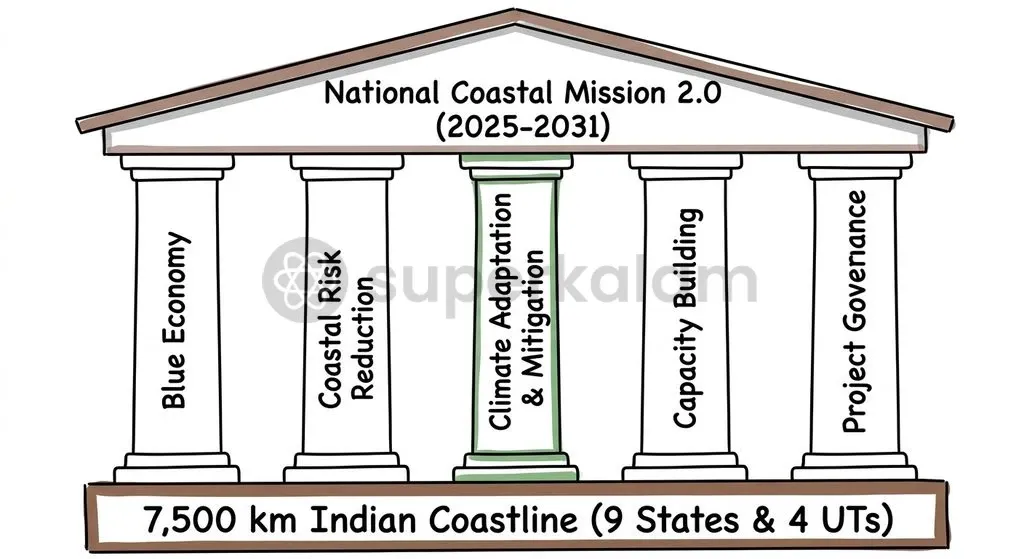
National Coastal Mission 2.0 establishes a dedicated central framework to coordinate shoreline defence, ecological restoration, and coastal governance across India's vulnerable littoral zones. Approved with a budgetary outlay of ₹767 crore across six fiscal years from 2025–26 to 2030–31, the 100% Central Sector Scheme seeks to build resilience across nine coastal States and four Union Territories.
Over a third of the mainland coast faces active erosion. As a result, the scheme's modest annual fiscal allocations require substantial convergence with external climate finance, state resources, and multi-sector infrastructure planning to achieve durable ecological protection.
Why in the News: The Rollout of National Coastal Mission 2.0
Union Minister for Environment, Forest and Climate Change Shri Bhupender Yadav launched the official implementation guidelines for National Coastal Mission 2.0 (NCM 2.0) on 30 September 2026 in New Delhi, as noted in a [PIB Delhi release: Union Environment Minister Shri Bhupender Yadav launches Guidelines for National Coastal Mission 2.0]. The mission establishes an updated administrative roadmap to safeguard littoral ecosystems against accelerating climate disruptions.
The operational guidelines structure the mission around five core thematic pillars:
- Promotion of a sustainable Blue Economy
- Coastal risk reduction and hazard management
- Climate change adaptation and mitigation
- Institutional capacity building
- Effective project management and monitoring
Targeted interventions under the guidelines include formulating Integrated Coastal Zone Management Plans (ICZMPs) and Marine Spatial Planning across 1,000 kilometres of priority coastline, alongside the active ecological restoration of vulnerable coral reefs and mangrove habitats.
Discuss with Superkalam
Can you recall the five core thematic pillars around which the operational guidelines of National Coastal Mission 2.0 are structured?
Ask NowWhat is National Coastal Mission 2.0: Objectives, Focus Areas, and Funding
National Coastal Mission 2.0 is designed as a 100% Central Sector Scheme funded directly by the Ministry of Environment, Forest and Climate Change. The mission operates over a six-year implementation horizon extending from 2025–26 to 2030–31, providing fully central funding to nine coastal States and four Union Territories.
The structural design of coastal governance in India has evolved substantially from early project-based interventions to mission-mode programmes.
| Feature | Integrated Coastal Zone Management Project (ICZMP) | National Coastal Mission 2.0 (NCM 2.0) |
|---|---|---|
| Operational Period | Pilot phase initiated in 2010 | Six fiscal years (2025–26 to 2030–31) |
| Funding Mechanism | Centrally assisted model with World Bank loan assistance | 100% Central Sector Scheme with an approved outlay of ₹767 crore |
| Geographic Focus | Specific pilot stretches in Gujarat, Odisha, and West Bengal | Nationwide coverage across 9 coastal States and 4 Union Territories |
| Strategic Emphasis | Basic capacity building and localized hazard line mapping | Marine Spatial Planning (1,000 km), blended finance, and multi-hazard mapping |
| Institutional Anchor | National Centre for Sustainable Coastal Management (NCSCM) pilot cells | Coordinated framework linking MoEFCC, NCZMA, SCZMAs, and local bodies |
To operationalise its objectives, NCM 2.0 moves beyond piecemeal seawall construction by mandating standardised multi-hazard vulnerability mapping.
The scheme also promotes blended climate financing models. It directs state agencies to tap municipal green bonds and Corporate Social Responsibility (CSR) funds to bridge coastal resilience deficits.
Discuss with Superkalam
How does reducing the No Development Zone from 200 metres to 50 metres under the CRZ Notification 2019 impact coastal climate resilience?
Ask NowThe Scale Problem: Can ₹767 Crore Protect a 7,500-Kilometre Coastline?
A critical financial mismatch exists between the mission's ambitious mandate and its approved budgetary outlay. According to high-resolution GIS High-Water Line surveys conducted by the National Hydrographic Office and the Survey of India, India's official coastline length has been revised from the traditional 7,516.6 km to 11,098.81 kilometres.
The funding arithmetic highlights the scale challenge:
- Annual budgetary release: Spreading the total approved budget of ₹767 crore across six operational years yields roughly ₹128 crore annually.
- State-level allocation: Distributed across 13 coastal jurisdictions, funding averages under ₹10 crore per coastal jurisdiction per year.
- Projected investment deficit: Independent assessments by UNEP and the Reserve Bank of India indicate India needs tens of billions of dollars through 2030 for coastal disaster management and climate adaptation infrastructure.
A micro-budget of under ₹10 crore per state per year is inadequate for capital-intensive coastal engineering works. This leaves a financing gap that state governments must fill through external borrowing or inter-departmental scheme convergence.
Discuss with Superkalam
How can coastal state administrations utilize municipal green bonds and CSR funds to supplement the central budgetary allocations of NCM 2.0?
Ask NowPolicy Conflict: Coastal Adaptation vs. Rapid Port and Infrastructure Growth
India's coastal policy reflects a persistent friction between conservation mandates and accelerated industrialisation. The clash plays out across two opposing statutory and development tracks:
- Industrial expansion: The Sagarmala Programme, overseen by the Ministry of Ports, Shipping and Waterways, envisions over 800 coastal projects requiring an estimated capital investment of ₹5.4 lakh crore for port modernisation, industrial corridors, and coastal connectivity.
- Regulatory dilution: Under the Coastal Regulation Zone (CRZ) Notification 2019, the Ministry of Environment, Forest and Climate Change reduced the No Development Zone (NDZ) along densely populated rural mainland coastlines (classified as CRZ-III A) from 200 metres down to 50 metres from the High Tide Line.
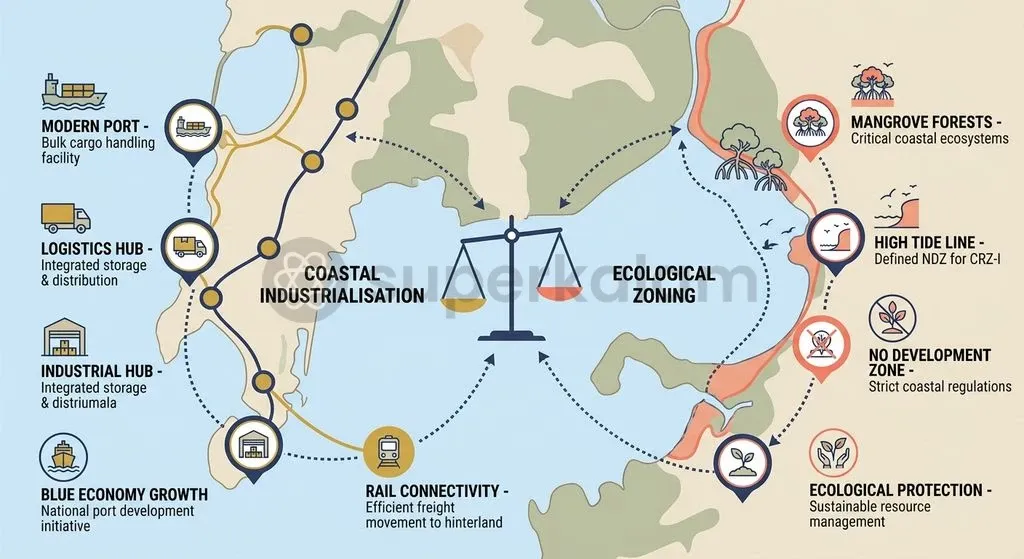
This regulatory relaxation encourages tourism, civic infrastructure, and real estate growth closer to the shoreline. However, narrowing the buffer zone directly increases asset exposure to storm surges, running counter to the climate risk reduction principles outlined under NCM 2.0.
Ground Realities: Rising Sea Levels, Cyclones, and Vanishing Shorelines
Shoreline retreat and severe weather events present an escalating threat to India's maritime fringe. Long-term shoreline assessment data published by the National Centre for Coastal Research (NCCR) reveals that 33.6% of mainland India's coastline experienced active erosion between 1990 and 2018, while 26.9% recorded accretion and 39.6% remained stable.
Coastal erosion exhibits acute regional variations across different states:
- West Bengal: Faces the highest proportion of eroding shoreline at 60.5%
- Kerala: Records severe erosion along 46.4% of its coast
- Tamil Nadu: Experiences erosion across 42.7% of its coastal reach
Changing cyclonic patterns amplify this physical vulnerability. Studies by the India Meteorological Department and the Ministry of Earth Sciences document a 52% increase in cyclonic frequency over the Arabian Sea in recent decades.
This shift exposes the heavily populated western seaboard to unprecedented storm surges. Consequently, it complicates disaster response strategies that were historically focused on the Bay of Bengal.
Discuss with Superkalam
Analyse the operational and financial challenges of protecting an 11,098.81-kilometre coastline with an annual outlay of approximately ₹128 crore.
Ask Now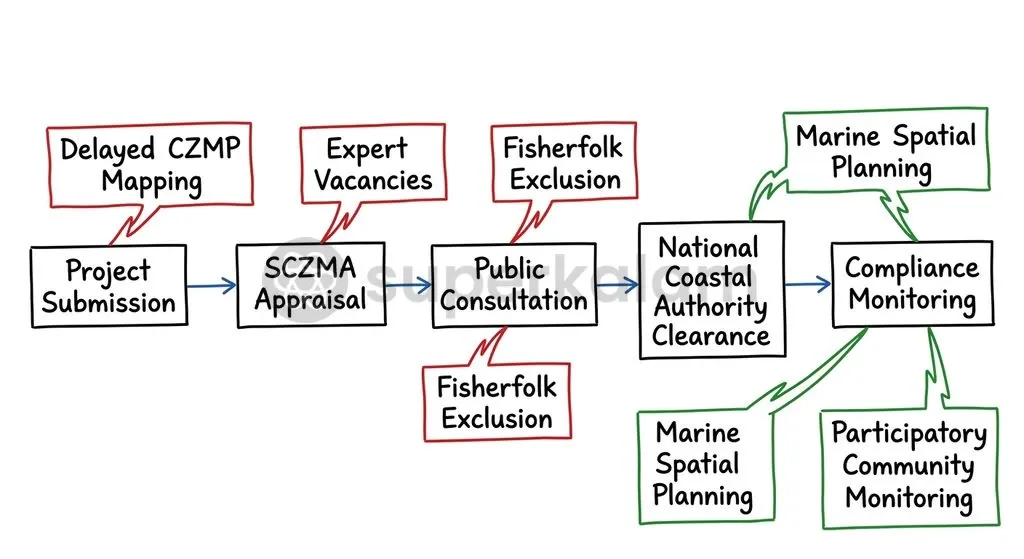
The audit identified critical governance deficits across three primary dimensions:
- Administrative Delays: Protracted delays in finalising baseline Coastal Zone Management Plans (CZMPs) have allowed unsanctioned commercial activities to proceed without approved zoning maps.
- Staffing and Oversight: Chronic vacancies in mandatory expert and scientific positions, coupled with infrequent statutory monitoring meetings, have diluted statutory regulatory scrutiny.
- Community Exclusion: Traditional fisherfolk communities and local coastal bodies are consistently excluded from project clearance deliberations and monitoring committees.
These governance deficits undermine statutory enforcement under the Environment (Protection) Act, 1986. They create a regulatory void where unauthorised construction and coastal reclamation frequently bypass institutional oversight.
Way Forward: A Smarter Path for India's Blue Economy and Shoreline Defence
Safeguarding India's maritime periphery requires moving beyond fragmented administrative efforts toward integrated, science-based interventions. The ocean economy is central to national prosperity. Policy documents from the Economic Advisory Council to the Prime Minister (EAC-PM) project that the Blue Economy contributes roughly 4% to India's GDP and supports more than 40 million livelihoods.
To balance economic development with ecological survival, policy implementation should focus on four practical pathways:
- Expanding Marine Spatial Planning (MSP): Building on the pilot MSP frameworks deployed in Lakshadweep and Puducherry in partnership with the Government of Norway, authorities must scale spatial mapping across all 13 coastal jurisdictions to resolve spatial conflicts between port logistics, tourism, and marine conservation.
- Scaling Hybrid and Nature-Based Defences: Hard engineering structures like concrete seawalls often transfer erosion to adjacent shores. Soft engineering alternatives have proven successful; for example, the National Institute of Ocean Technology (NIOT) used a submerged reef and beach nourishment to restore a 1.5 km vanished urban beach in Puducherry.
- Institutionalising Convergence Schemes: Coastal programmes must systematically pool financial outlays. MoEFCC can scale up the MISHTI (Mangrove Initiative for Shoreline Habitats & Tangible Incomes) initiative, which targets 540 sq km of mangrove restoration by converging CAMPA allocations with MGNREGS labour resources.
- Leveraging Multilateral Climate Finance: Given domestic budgetary ceilings, agencies must secure external capital. India's successful acquisition of a $43 million grant from the GCF for coastal resilience across Odisha, Andhra Pradesh, and Maharashtra provides a working blueprint for financing community-led adaptation.
Key Takeaways
- Union Environment Minister Bhupender Yadav launched the operational guidelines for National Coastal Mission 2.0 on 30 September 2026 as a 100% Central Sector Scheme spanning 2025–26 to 2030–31.
- NCM 2.0 operates with a total approved outlay of ₹767 crore, providing under ₹10 crore annually per coastal State and Union Territory across India's 11,098.81 km coastline.
- Long-term studies by the National Centre for Coastal Research show that 33.6% of mainland India's shoreline is eroding, with West Bengal facing the highest erosion rate at 60.5%.
- A structural policy tension persists between coastal ecological conservation under NCM 2.0 and the ₹5.4 lakh crore port-industrialisation target pursued under the Sagarmala Programme.
- Performance audits by the CAG reveal that State Coastal Zone Management Authorities struggle with delayed CZMP formulation, expert vacancies, and inadequate inclusion of local fishing communities.
- Sustainable shoreline protection requires scaling nature-based bio-shields like the MISHTI mangrove scheme, expanding Marine Spatial Planning, and accessing international climate finance like the Green Climate Fund.
Mains Question
"The dilution of buffer zones under the Coastal Regulation Zone Notification 2019 alongside massive infrastructure outlays under the Sagarmala Programme presents an inherent policy contradiction with coastal climate adaptation." Critically examine in the context of the newly launched National Coastal Mission 2.0. (15 Marks)
Evaluate NowMains Question
Highlighting structural weaknesses in State Coastal Zone Management Authorities (SCZMAs), the CAG Performance Audit Report No. 4 of 2022 pointed to severe governance deficits in coastal protection. Elucidate the key institutional bottlenecks and suggest corrective measures. (10 Marks)
Evaluate NowPractice MCQs
QUESTION 1
With reference to the National Coastal Mission 2.0 (NCM 2.0), consider the following statements:
- It is designed as a 100% Central Sector Scheme funded by the Ministry of Environment, Forest and Climate Change.
- It operates across a six-year implementation horizon from 2025–26 to 2030–31 covering nine coastal States and four Union Territories.
- It mandates Marine Spatial Planning across 10,000 kilometres of priority coastline during its operational tenure.
Which of the statements given above are correct?
QUESTION 2
Consider the following statements regarding coastal erosion and shoreline dynamics in India based on National Centre for Coastal Research (NCCR) data:
- Over 50% of mainland India's coastline experienced active erosion between 1990 and 2018.
- Among coastal states, West Bengal recorded the highest proportion of eroding shoreline.
- The Arabian Sea has witnessed a decrease in cyclonic frequency over recent decades compared to historical averages.
Which of the statements given above is/are correct?
QUESTION 3
Regarding the regulatory framework governing coastal zones in India, consider the following statements:
- The Coastal Regulation Zone (CRZ) Notification 2019 reduced the No Development Zone (NDZ) in CRZ-III A areas from 200 metres to 50 metres from the High Tide Line.
- The pilot phase of the Integrated Coastal Zone Management Project (ICZMP) initiated in 2010 was fully funded through municipal green bonds.
Which of the statements given above is/are correct?
QUESTION 4
According to the Comptroller and Auditor General of India (CAG) Performance Audit Report No. 4 of 2022 on the Conservation of Coastal Ecosystems, which of the following were identified as major structural failures in State Coastal Zone Management Authorities (SCZMAs)?
- Protracted delays in finalising baseline Coastal Zone Management Plans (CZMPs).
- Chronic vacancies in mandatory expert and scientific positions.
- Consistent exclusion of traditional fisherfolk communities from project clearance deliberations.
Select the correct answer using the code given below:
QUESTION 5
Following high-resolution GIS High-Water Line surveys conducted by the National Hydrographic Office and the Survey of India, what is the revised official coastline length of India?