RDI Fund: Rs 1 Lakh Crore Deep-Tech Funding and Application Pause
The Rs 1 lakh crore RDI Fund backs private deep-tech research. See ANRF and DST roles, financing, eligibility and the pause in fresh applications.
Sep, 2026
•8 min read
Overview
The Union Cabinet approved the Research, Development and Innovation (RDI) Scheme with a corpus of ₹1 lakh crore over six years. Its goal is to scale up private-sector-led innovation in strategic domains. The scheme moves away from traditional non-repayable academic grants. Instead, this statutory mechanism provides long-term patient capital through concessional loans and equity infusion.
This financing bridges the funding gap between laboratory discovery and industrial commercialisation. As of September 2026, the fund represents a decisive transition in India's science policy towards sovereign-backed risk financing for deep technology, clean energy security, and semiconductors.
Why is the RDI Fund in the News?
The Union Government operationalised the Research, Development and Innovation (RDI) Scheme following Cabinet approval on July 1, 2025, committing a total corpus of ₹1 lakh crore over a six-year implementation window.
According to a Lok Sabha unstarred question answered on July 29, 2026, the initiative disburses long-term patient capital rather than non-repayable grants to stimulate private-sector research. As of September 2026, the programme marks a major shift in India's gross expenditure trajectory by backing commercial ventures in deep tech and sunrise manufacturing.
Timeline and Evolution: From Budget Announcement to Operational Framework
The Department of Science and Technology (DST) is the nodal administrative custodian for the RDI Scheme. It anchors implementation inside a statutory institutional architecture. Early sovereign science funding focused strictly on state-run laboratories. Bridging the commercialisation gap, however, required an autonomous funding vehicle capable of managing financial risk.
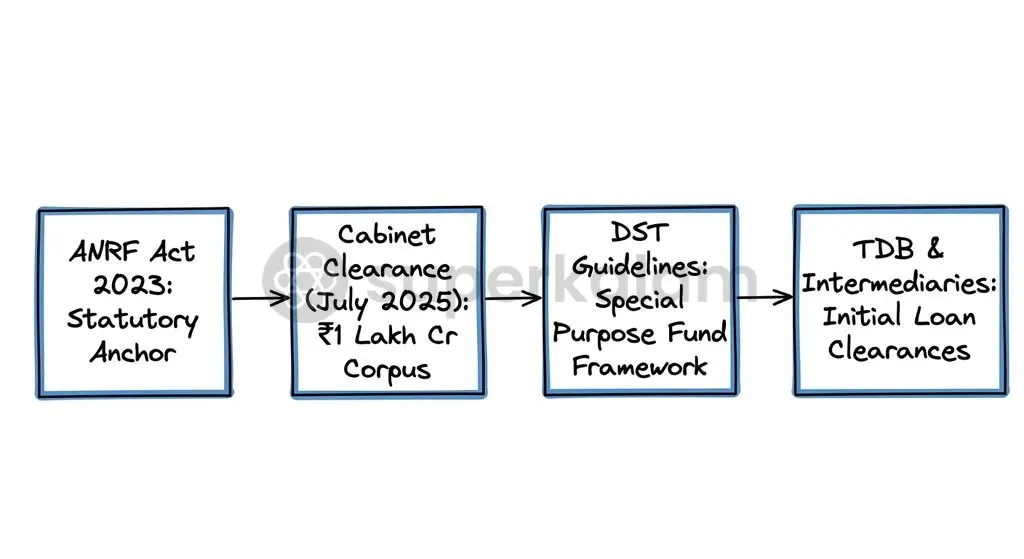
The legislative and policy evolution unfolded through distinct operational stages:
- Statutory Foundation (2023): Parliament enacted the Anusandhan National Research Foundation Act, 2023, establishing the ANRF as the apex body to steer strategic research direction across Indian universities and industrial hubs.
- Cabinet Approval (July 1, 2025): The Union Cabinet formally cleared the ₹1 lakh crore RDI Scheme over six years to anchor private-sector industrial innovation.
- Institutional Operationalisation (November 2025): The DST notified operational guidelines creating a dedicated Special Purpose Fund (SPF) within the ANRF structure to channel capital.
- First Cohort Clearances (July 2026): The Technology Development Board (TDB) sanctioned an initial ₹2,192 crore in concessional loans across 22 private projects with an aggregate research outlay of ₹4,744 crore.
Discuss with Superkalam
What minimum Technology Readiness Level (TRL) is required for a commercial project to be eligible under the RDI Fund?
Ask NowWhat is the Research, Development, and Innovation (RDI) Fund?
The Research, Development and Innovation (RDI) Fund is a specialised financial mechanism created to de-risk high-capital, long-gestation commercial technologies. According to the DST Guidelines, the scheme explicitly excludes traditional non-repayable academic grants and short-term debt.
Eligibility under the fund is strictly restricted to commercialisation-oriented proposals positioned at Technology Readiness Level 4 (TRL-4) and above, which designates technologies validated in laboratory or simulated operational environments.
| Parameter | Traditional Government Research Grants | RDI Fund Mechanism |
|---|---|---|
| Financial Instrument | Non-repayable fiscal grants | Long-term concessional loans, equity, Fund of Funds |
| Primary Target | Academic institutions and state laboratories | Private commercial enterprises and deep-tech startups |
| Project Maturity | Basic research (TRL-1 to TRL-3) | Applied testing and commercialisation (TRL-4 and above) |
| Return Expectation | Academic papers, publications, and patents | Commercial products, market scaling, and loan repayment |
| Risk Metrics | Administrative compliance and peer review | Market viability evaluated by domain and venture experts |
Discuss with Superkalam
How does providing low-interest, long-tenure loans without physical collateral alter the risk calculation for deep-tech entrepreneurs compared to standard commercial bank debt?
Ask NowKey Institutional Pillars: ANRF, DST, and Financing Intermediaries
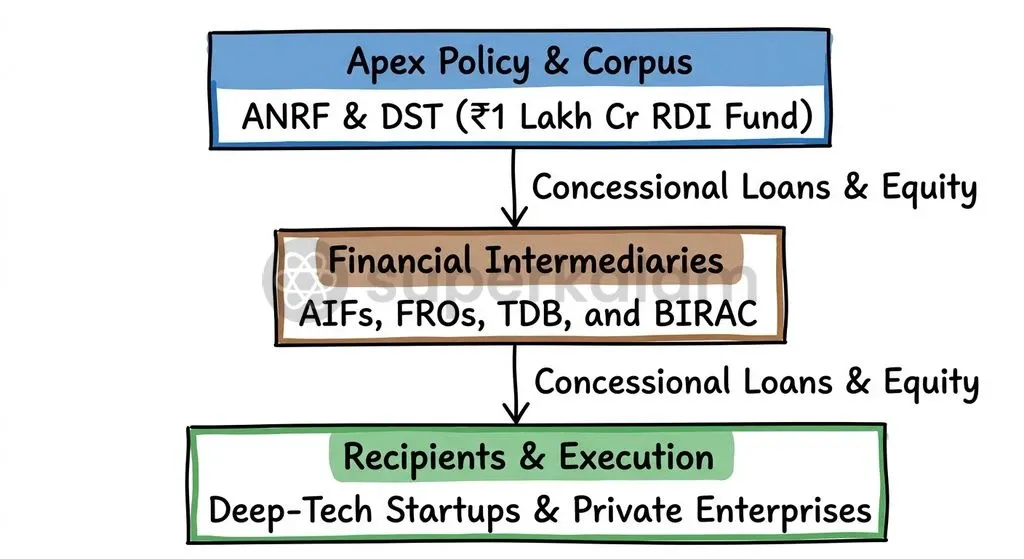
The Anusandhan National Research Foundation (ANRF) provides the overarching statutory home for the Special Purpose Fund that executes the RDI Scheme. Administrative stewardship is handled by the Department of Science and Technology (DST), which coordinates governance between ministries and executing bodies.
The implementation architecture relies on a multi-tier governance design:
- Apex Governance (ANRF & DST): The ANRF defines high-level strategic research priorities and coordinates with the DST to ensure budgetary allocations align with national missions.
- Second-Level Fund Managers (SLFMs): Capital deployment is delegated to specialised intermediaries, including Focused Research Organisations (FROs) and SEBI-registered Alternative Investment Funds (AIFs), ensuring professional asset allocation.
- Direct Execution Arms: The Union Government sanctioned an initial ₹1,000 crore each to the Technology Development Board (TDB) and the Biotechnology Industry Research Assistance Council (BIRAC) to run immediate financing calls.
- Empowered Investment Committee: Project proposals undergo screening by a committee of domain technologists, scientists, and venture professionals who assess strategic impact rather than standard banking collateral.
Core Numbers and Financing Architecture: How Long-Term Capital Works
The Technology Development Board delivers RDI Fund financing through patient debt instruments designed for deep-tech cycles. According to investment committee disclosures reported by the Financial Express on September 29, 2026, loan financing carries concessional interest rates of 3% to 4% per annum for tenures extending up to 15 years without demanding physical collateral or personal promoter guarantees.
The capital injection model operates across three primary financial pathways:
- Concessional Debt: Low-interest loans at 3% to 4% interest with tenures reaching up to 15 years.
- Direct Equity Infusion: Sovereign co-investment in high-growth commercial deep-tech enterprises.
- Fund of Funds Contributions: Channelling capital through SEBI-registered Alternative Investment Funds to leverage private venture funding.
Priority sectors earmarked under the scheme focus on strategic technologies where private venture capital is historically scarce:
- Deep Technologies: Quantum computing, robotics, autonomous systems, and advanced space applications.
- Artificial Intelligence: Foundational models, computing hardware, and industrial automation.
- Clean Energy Security: Next-generation energy storage, green hydrogen technologies, and grid resilience.
- Biotechnology: Synthetic biology, biomanufacturing platforms, and bio-therapeutics.
- Semiconductors: Advanced packaging, fabrication infrastructure, and microelectronic design.
All beneficiary enterprises must sign mandatory covenants stipulating that all generated Intellectual Property (IP) must reside in India and corporate ownership control must remain with Indian citizens throughout the funding cycle.
Discuss with Superkalam
Suppose an Indian startup develops an advanced quantum computing processor using RDI Fund concessional loans. What legal conditions must it comply with regarding IP and corporate ownership?
Ask NowWhy the Application Window Faces a Pause or Bottleneck in 2026
The Technology Development Board temporarily paused accepting fresh proposals under the RDI Fund in late September 2026. As reported by The Indian Express on September 30, 2026, the administrative pause was instituted amid procedural delays in downstream fund releases from the DST's allocated budget.
Key aspects of this operational bottleneck include:
- Administrative Disbursal Delays: Procedural lags between central ministry budget allocations and downstream operational releases created temporary capital constraints.
- Accounting Friction: Integrating high-speed private venture timelines with public-sector financial and audit norms remains an ongoing governance challenge.
Comparing India's R&D Spending with Global Benchmarks
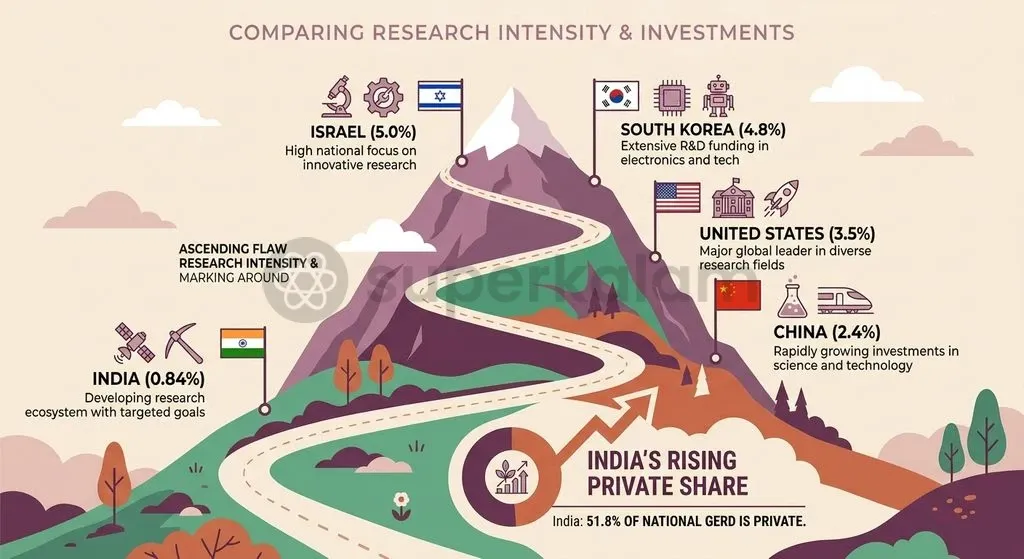
The Department of Science and Technology's 'Research and Development Statistics 2025-26' notes that India's Gross Expenditure on Research and Development (GERD) rose from 0.64% of GDP in 2020-21 to 0.84% in 2023-24.
Significantly, private industry's contribution to national R&D expenditure surpassed public funding for the first time in 2023-24, reaching 51.8% of GERD compared to 36.4% in 2020-21.
| Country | GERD as a % of GDP | Primary Financing Driver |
|---|---|---|
| Israel | ~5.0% | Private enterprise / Technology startups |
| South Korea | ~4.8% | Private conglomerates (Chaebols) |
| United States | ~3.5% | Private enterprise & Defense R&D agencies |
| China | ~2.4% | State-backed enterprises & Private tech firms |
| India | ~0.84% (2023-24) | Transitioning; Private share reached 51.8% in 2023-24 |
Key Challenges: Private Sector Absorption and Commercialisation
Private enterprises in India continue to encounter structural friction when scaling up capital-intensive research. Converting laboratory-validated prototypes (TRL-4) into mass-manufactured, market-ready hardware requires specialised testing infrastructure, patient venture backing, and industrial risk tolerance.
Key operational impediments include:
- Downstream Commercialisation Risk: Commercial lenders avoid uncollateralised deep-tech ventures due to uncertain development cycles, leaving advanced prototypes vulnerable to the funding valley of death.
- IP Protection and Enforcement: Maintaining strict domestic IP ownership covenants while attempting to integrate into global technology supply chains presents operational friction for cross-border joint ventures.
- Administrative Release Cycles: Bureaucratic disbursal delays between fiscal tranches can destabilise startup cash reserves during critical developmental testing.
Discuss with Superkalam
Compare India's GERD profile—where private industry reached 51.8% of spending in 2023-24—with economies like South Korea and Israel in terms of total GDP percentage and primary funding drivers.
Ask NowWay Forward: Building an End-to-End Innovation Ecosystem
The Anusandhan National Research Foundation must establish streamlined fund disbursement mechanisms that insulate deep-tech financing from standard administrative delays. Synchronising capital releases across Second-Level Fund Managers will ensure uninterrupted development timelines for recipient enterprises.
Strategic structural measures should include:
- Expanding Alternative Investment Vehicles: Scaling allocations through SEBI-registered Alternative Investment Funds (AIFs) and Focused Research Organisations (FROs) will accelerate commercial decision-making.
- Public Procurement Linkages: Establishing assured state procurement channels for indigenously developed deep-tech products will de-risk commercial scale-up for domestic innovators.
- Strengthening Industry-Academia Pipelines: Leveraging the ANRF's statutory mandate will allow seamless translation of TRL-1 academic breakthroughs into TRL-4 commercial cohorts under the RDI Fund.
Key Takeaways
- The Union Cabinet approved the ₹1 lakh crore RDI Scheme on July 1, 2025, deploying long-term patient capital across six years for strategic private-sector innovation.
- The fund provides concessional loans at 3% to 4% interest with tenures up to 15 years without requiring collateral, alongside equity infusions for projects at TRL-4 and above.
- Governance is anchored by the ANRF and the Department of Science and Technology, disbursing through intermediaries like the Technology Development Board and BIRAC.
- India's Gross Expenditure on R&D reached 0.84% of GDP in 2023-24, with private sector contributions expanding to 51.8% of national spending.
- All beneficiaries must adhere to mandatory covenants ensuring generated IP resides in India and corporate control remains with Indian citizens.
Mains Question
"The shift from traditional non-repayable academic grants to sovereign-backed patient capital marks a structural transition in India's science and innovation architecture." In light of the Research, Development and Innovation (RDI) Scheme under the ANRF framework, evaluate the potential of this financing model in overcoming the commercialisation bottleneck in deep-tech sectors. (15 Marks)
Evaluate NowMains Question
"While private sector contribution to India's Gross Expenditure on Research and Development (GERD) has crossed the halfway mark, bridging the commercialisation gap requires resolving administrative and structural bottlenecks." Critically analyse. (10 Marks)
Evaluate NowPractice MCQs
QUESTION 1
With reference to the Research, Development and Innovation (RDI) Scheme, consider the following statements:
- It replaces non-repayable academic grants with long-term patient capital including concessional debt and equity infusion.
- Proposals are eligible for funding only if they are positioned at Technology Readiness Level 4 (TRL-4) and above.
- Beneficiary enterprises are mandatorily required to ensure that generated Intellectual Property (IP) resides in India. Which of the statements given above are correct?
QUESTION 2
Consider the following statements regarding the institutional and financing architecture of the RDI Fund:
- The Anusandhan National Research Foundation (ANRF) hosts the Special Purpose Fund for executing the scheme.
- Concessional loans under the scheme carry interest rates of 3% to 4% per annum with tenures extending up to 15 years without physical collateral.
- An initial corpus of ₹1,000 crore each was sanctioned to the Technology Development Board (TDB) and BIRAC as direct execution arms. Which of the statements given above is/are correct?
QUESTION 3
With reference to India's Gross Expenditure on Research and Development (GERD) outlined in official statistics, consider the following statements:
- India's GERD increased from 0.64% of GDP in 2020-21 to 0.84% of GDP in 2023-24.
- In 2023-24, private industry's contribution to national R&D expenditure surpassed public funding for the first time. Which of the statements given above is/are correct?
QUESTION 4
Consider the following statements regarding the capital deployment pathways under the RDI Fund:
- It deploys capital through Second-Level Fund Managers including Focused Research Organisations and SEBI-registered Alternative Investment Funds.
- Basic laboratory research falling under TRL-1 to TRL-3 is the primary target for equity co-investment.
- Sovereign co-investment is directed towards high-growth commercial deep-tech enterprises. Which of the statements given above is/are correct?
QUESTION 5
Which of the following departments acts as the nodal administrative custodian for the operationalisation of the Research, Development and Innovation (RDI) Scheme?