PRAGATI-50 Initiative: 50 Model Clean Cities under SBM-Urban 2.0
PRAGATI-50 targets 50 cities across 24 states under SBM-Urban 2.0. See its objectives, sanitation priorities and difference from the PM's PRAGATI platform.
Sep, 2026
•8 min read
Overview
The PRAGATI-50 initiative under Swachh Bharat Mission-Urban 2.0 is a targeted urban governance framework. Designed by the Ministry of Housing and Urban Affairs, it accelerates municipal sanitation outcomes across 50 high-impact cities. It relies on milestone-based oversight, direct bureaucratic handholding, and targeted infrastructure delivery. Launched on 29 September 2026, the programme establishes high-performing sanitation benchmarks across 76 municipal jurisdictions.
Capital subsidies alone cannot fix urban sanitation. Success demands intensive bottleneck resolution and real-time municipal accountability. By prioritising legacy waste remediation, used water management, and decentralised civic technology, the initiative operationalises global sustainability mandates while closing persistent capacity gaps in local self-governments.
Why in the News?
On 29 September 2026, Union Minister for Housing and Urban Affairs Manohar Lal launched the PRAGATI-50 initiative under the Swachh Bharat Mission-Urban 2.0 (SBM-U 2.0) framework. According to the Ministry of Housing and Urban Affairs, the initiative was conceptualised following specific directives issued by the Prime Minister during the 51st national PRAGATI review meeting.
The central objective is to transform 50 identified urban centres into national sanitation benchmarks. This transformation relies on intensive project tracking and structured institutional handholding.
What Is the PRAGATI-50 Initiative under SBM-U 2.0?
The PRAGATI-50 initiative is an urban governance acceleration mechanism designed to eliminate structural bottlenecks in municipal sanitation projects. The programme covers 50 selected cities across 24 states, spanning 76 municipal jurisdictions. These locations represent state capitals, economic engines, cultural centres, and high-footfall pilgrimage hubs such as Delhi, Mumbai, Bengaluru, Chennai, Surat, Varanasi, Puri, and Ayodhya.
Rather than spreading central administrative resources thinly across thousands of statutory towns, PRAGATI-50 concentrates oversight on dense urban nodes. Establishing these lighthouse models aims to trigger peer emulation across contiguous urban agglomerations.
Alongside the core tracking mechanism, the Ministry of Housing and Urban Affairs introduced specialised technology and circular economy platforms:
- Swachh Bharat Test Bed: Launched in collaboration with CSIR-CMERI to validate and scale indigenous waste processing technology.
- Swachhata Startups 3rd Cohort: Onboarded with IIT Kanpur to deploy field-ready engineering solutions for solid waste management.
- Workplace Circularity Models: Inauguration of a dedicated Reduce, Reuse and Recycle (RRR) Centre at Sankalp Bhawan in New Delhi to model circular resource efficiency in government offices.
- Behavioural Knowledge Bank: Deployment of the Swachhata Behaviour Change Digital Kosh to share practical nudge strategies with urban local bodies.
Discuss with Superkalam
Which Union Ministry launched the PRAGATI-50 initiative, and how many municipal jurisdictions does it cover?
Ask NowCore Objectives and Key Focus Areas of PRAGATI-50
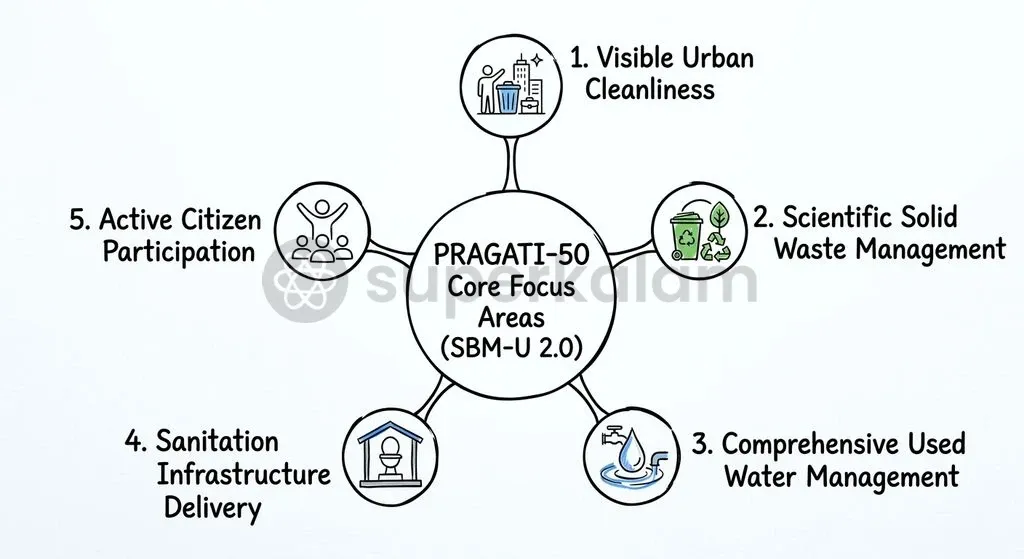
The PRAGATI-50 framework operates across five primary intervention pillars designed to transform municipal public health infrastructure. According to official programme guidelines from the Ministry of Housing and Urban Affairs, these pillars align local project execution with the comprehensive mandate of SBM-U 2.0.
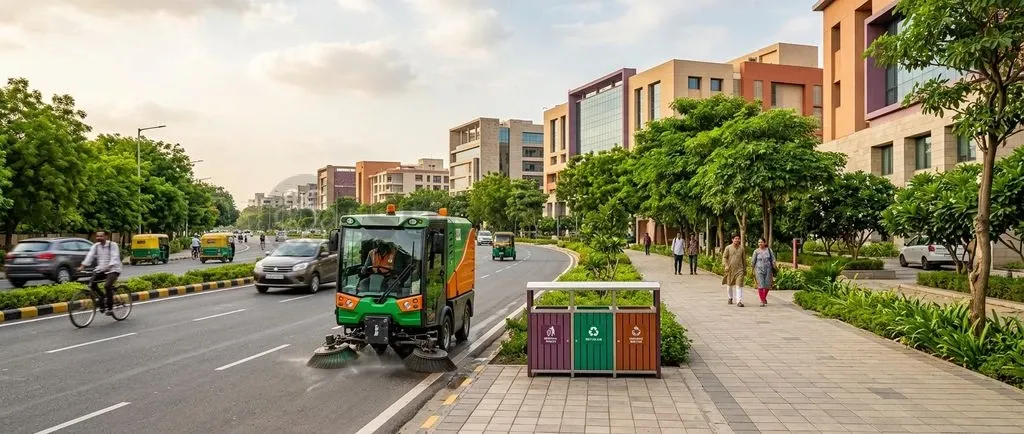
- Visible Urban Cleanliness: Elimination of open garbage vulnerable points (GVPs), continuous mechanical road sweeping, and beautification of public commercial corridors.
- Scientific Solid Waste Management: Achieving 100 percent door-to-door segregated collection, source-level organic composting, and material recovery facilities (MRFs) for non-recyclable fractions.
- Comprehensive Used Water Management: Ensuring safe interception, conveyance, and biological treatment of domestic sewage, alongside the functional scaling of non-potable wastewater reuse.
- Sanitation Infrastructure Resilience: Construction and continuous maintenance of dynamic community and public toilet complexes adhering to open defecation free (ODF) plus and water-plus parameters.
- Active Citizen Participation (Jan Andolan): Embedding community-led accountability through digital grievance redressal systems and targeted behavioural campaigns.
The initiative directly targets historical dumpsite reclamation. Under the wider legacy waste remediation mandate of SBM-U 2.0, urban local bodies have bio-remediated approximately 65 percent of the 26 crore metric tonnes of legacy waste across 2,482 dumpsites, reclaiming around 9,000 acres of prime urban land as of late 2026. PRAGATI-50 seeks to clear the remaining backlog in critical metropolitan jurisdictions.
| Key Focus Area | Primary Operational Target | Implementation Instrument |
|---|---|---|
| Legacy Dumpsites | Complete bio-mining and bio-remediation of accumulated waste | Automated trommel screening and RDF off-take agreements |
| Used Water | Interception of untreated drains and scaling secondary effluent reuse | Decentralised and centralised Sewage Treatment Plants (STPs) |
| Municipal Solid Waste | 100% source segregation into dry, wet, and hazardous streams | Door-to-door tracked vehicles and automated Material Recovery Facilities |
| Civic Innovation | Commercial deployment of indigenous engineering solutions | Swachh Bharat Test Bed (CSIR-CMERI) and IIT Kanpur incubation |
Discuss with Superkalam
How does the 'Swachh City Partnership' mentorship model leverage peer emulation to improve urban sanitation performance?
Ask NowHow the PRAGATI-50 Monitoring Framework Works
The PRAGATI-50 architecture tackles execution delays by linking national administrators directly to municipal commissioners. Project tracking relies on dynamic Key Performance Indicators (KPIs) that capture real-time operational milestones rather than static input disbursements.
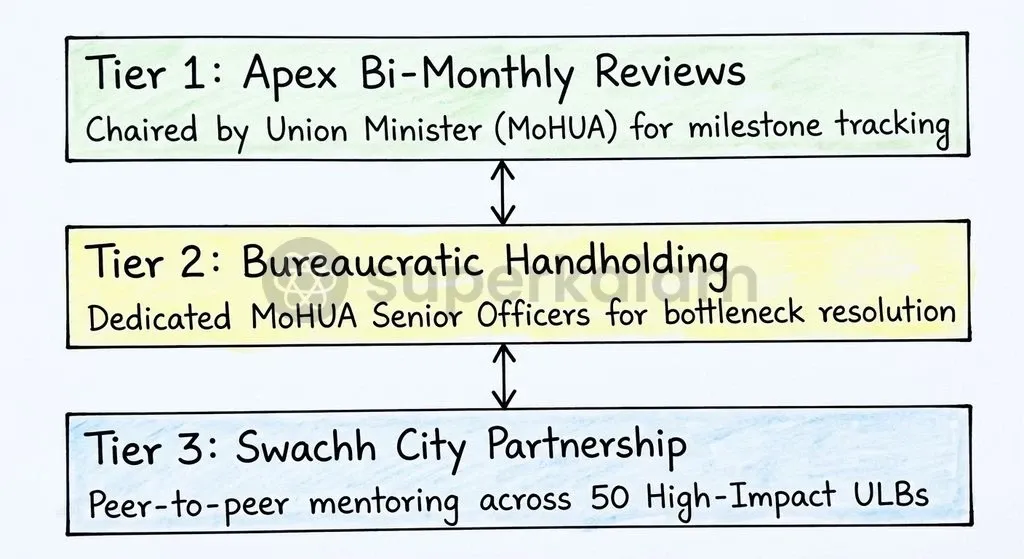
The operational review chain functions through three institutional layers:
- Bi-Monthly Apex Reviews: The Union Minister for Housing and Urban Affairs personally chairs bi-monthly performance reviews to assess physical milestones, clear inter-state coordination hurdles, and evaluate municipal compliance.
- Dedicated Officer Handholding: The ministry assigns designated senior officers (Joint Secretaries and Directors) to individual cities. These officers conduct on-site inspections, facilitate inter-ministerial clearances, and provide direct administrative problem-solving to city managers.
- Peer-to-Peer City Mentorship: Under the complementary Swachh City Partnership model, 78 top-performing municipalities mentor lower-ranked urban local bodies across states under the guiding ethos of 'Each One Clean One'.
PRAGATI-50 vs PM PRAGATI: Understanding the Key Differences
Candidates often confuse PRAGATI-50 with the apex PM PRAGATI platform due to identical acronym usage. While both platforms institutionalise proactive project monitoring, they differ substantially in administrative hierarchy, jurisdictional scope, and institutional focus.
The table below delineates the structural differences between these two governance instruments:
| Dimension | PM PRAGATI (Pro-Active Governance And Timely Implementation) | PRAGATI-50 Initiative |
|---|---|---|
| Nodal Authority | Prime Minister's Office (PMO) with National Informatics Centre (NIC) | Ministry of Housing and Urban Affairs (MoHUA) |
| Chairperson | Prime Minister of India | Union Minister for Housing and Urban Affairs |
| Year of Launch | 2015 | 2026 |
| Functional Mandate | Multi-sectoral tracking of mega infrastructure projects (exceeding ₹1,000 crore) and major national social schemes across multiple Union ministries | Sector-specific urban sanitation, solid waste processing, used water management, and dumpsite remediation under SBM-U 2.0 |
| Administrative Scope | Pan-India cross-ministerial coordination involving Union Cabinet Secretaries and State Chief Secretaries | Targeted municipal monitoring spanning 50 cities across 76 Urban Local Bodies in 24 States |
| Technological Stack | Integration of digital data applications, video-conferencing, and geospatial (GIS) tracking | Key Performance Indicator (KPI) dashboards, field handholding, and the Swachhata Digital Kosh repository |
Discuss with Superkalam
If you were appointed as a municipal commissioner of an underperforming city under PRAGATI-50, how would you utilize the Swachhata Behaviour Change Digital Kosh to address Garbage Vulnerable Points?
Ask NowChallenges Facing Urban Local Bodies in Waste and Sanitation Projects
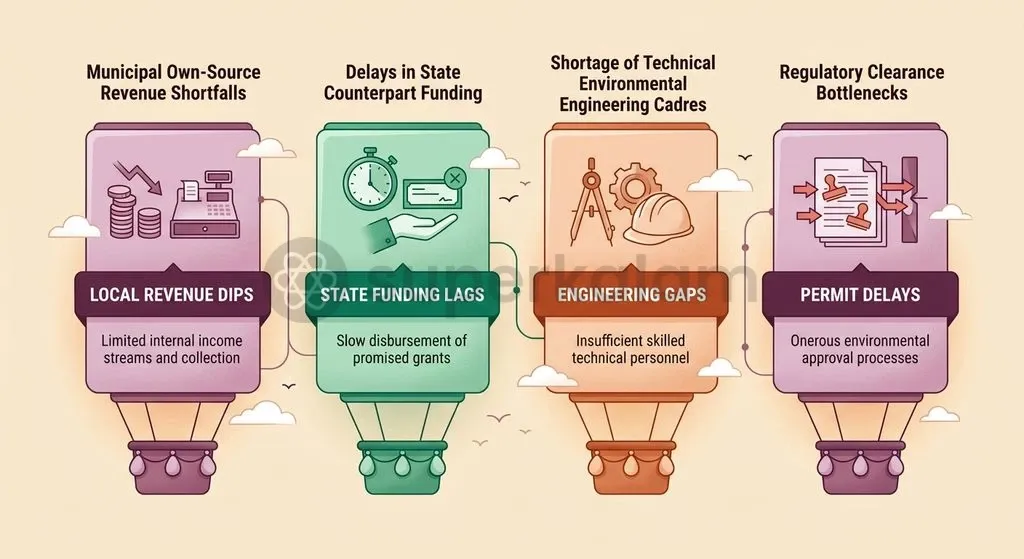
Urban local bodies face deep structural bottlenecks that impede modern sanitation delivery. Assessments by NITI Aayog and the 15th Finance Commission reveal that municipal execution is constrained by fiscal and technical deficits.
- Own-Source Revenue Deficits: Most municipalities remain heavily dependent on tied fiscal transfers. Weak property tax collection mechanisms and unrealistically low user charges for waste collection undermine financial sustainability.
- Delays in Counterpart State Funding: SBM-U 2.0 operates as a Centrally Sponsored Scheme requiring matching financial contributions from state governments. Delays in releasing state-share funds frequently stall capital works.
- Deficit of Technical Expertise: City administrations face acute shortages of qualified environmental engineers, bio-remediation experts, and contract negotiation managers, leading to poorly drafted public-private partnership tenders.
- Regulatory Clearance Deadlocks: Setting up waste-to-energy facilities and regional sanitary landfills often stalls due to delayed State Pollution Control Board consents and protracted land acquisition disputes.
Way Forward: Strengthening Municipal Capacity and Urban Governance
Sustainable urban sanitation requires transitioning from top-down monitoring to autonomous municipal resilience. PRAGATI-50 is a catalyst, but systemic governance reforms are necessary to achieve long-term public health goals.
- Fiscal Empowerment of Municipal Bodies: States must devolve property taxation powers and operationalise municipal bond frameworks to help local bodies finance sanitation capital expenditure independently.
- Aligning with Global Sustainability Targets: Municipal planning must institutionalise Sustainable Development Goal 6 (Target 6.2 on equitable sanitation and Target 6.3 on halving untreated wastewater) and Sustainable Development Goal 11 (Target 11.6 on reducing urban environmental impacts through solid waste management).
- Institutionalising Cadre Professionalisation: State municipal administrations should create dedicated municipal engineering and public health cadres to manage modern sewage treatment plants and mechanised waste facilities.
- Strengthening Circular Economic Linkages: Cities must build reliable industrial off-take linkages for Refuse-Derived Fuel (RDF) in cement plants and expand municipal composting networks with regional agricultural cooperatives.
Discuss with Superkalam
Analyze the structural differences between PM PRAGATI and PRAGATI-50 in terms of institutional hierarchy, mandate, and technological tracking.
Ask NowKey Takeaways
- Strategic Launch: Union Minister Manohar Lal launched the PRAGATI-50 initiative on 29 September 2026 under SBM-U 2.0 to transform 50 major urban centres across 24 states into model clean cities.
- Distinct Institutional Identity: PRAGATI-50 is a MoHUA-anchored, sector-specific urban sanitation tracking platform, whereas PM PRAGATI is the apex 2015 PMO platform for multi-sectoral mega infrastructure projects.
- Five Core Pillars: The initiative concentrates on visible cleanliness, scientific solid waste management, used water management, public sanitation infrastructure, and citizen engagement.
- Intensive Governance Architecture: Oversight includes bi-monthly ministerial reviews, KPI-based digital tracking, dedicated senior central officer handholding, and city-to-city peer mentorship through the Swachh City Partnership.
- Global Alignment: PRAGATI-50 operationalises international obligations under SDG 6 (Clean Water and Sanitation) and SDG 11 (Sustainable Cities and Communities).
Mains Question
"Capital subsidies alone cannot fix urban sanitation; sustainable transformation demands real-time monitoring and addressing structural municipal capacity deficits." In light of the newly launched PRAGATI-50 initiative under SBM-U 2.0, examine the institutional bottlenecks faced by Urban Local Bodies in municipal waste management. (10 Marks)
Evaluate NowMains Question
Compare the governance architecture and operational scope of the PRAGATI-50 initiative under SBM-U 2.0 with the apex PM PRAGATI mechanism. Evaluate how milestone-based monitoring and institutional handholding can bridge the implementation deficit in urban local governance. (15 Marks)
Evaluate NowPractice MCQs
QUESTION 1
With reference to the PRAGATI-50 initiative launched under Swachh Bharat Mission-Urban 2.0 (SBM-U 2.0), consider the following statements:
- It covers 50 selected cities spanning across 76 municipal jurisdictions in 24 states.
- It is an apex multi-sectoral mechanism chaired by the Prime Minister to monitor mega infrastructure projects exceeding ₹1,000 crore.
- It includes technological collaborations such as the Swachh Bharat Test Bed with CSIR-CMERI to validate indigenous waste processing technology.
Which of the statements given above are correct?
QUESTION 2
Consider the following statements regarding the institutional differences between PM PRAGATI and the PRAGATI-50 initiative:
- While PM PRAGATI is anchored by the Prime Minister's Office with NIC, PRAGATI-50 is anchored by the Ministry of Housing and Urban Affairs.
- PM PRAGATI monitors cross-ministerial infrastructure projects and national social schemes, whereas PRAGATI-50 focuses specifically on urban sanitation and waste management under SBM-U 2.0.
- Both platforms were launched concurrently in 2015 to enhance cooperative federalism.
Which of the statements given above is/are correct?
QUESTION 3
Consider the following pairs regarding initiatives associated with the PRAGATI-50 framework:
- Swachh Bharat Test Bed : CSIR-CMERI
- Swachhata Startups 3rd Cohort : IIT Kanpur
- Reduce, Reuse and Recycle (RRR) Centre : Sankalp Bhawan, New Delhi
How many of the above pairs are correctly matched?
QUESTION 4
Under the Swachh City Partnership model operationalised alongside PRAGATI-50, which of the following mechanisms is utilised to improve municipal outcomes?
QUESTION 5
With reference to the legacy waste remediation achievements under Swachh Bharat Mission-Urban 2.0 (SBM-U 2.0) highlighted in the context of PRAGATI-50, consider the following statements:
- Urban local bodies have bio-remediated approximately 65 percent of the 26 crore metric tonnes of legacy waste.
- Legacy dumpsite remediation has successfully reclaimed around 9,000 acres of prime urban land.
Which of the statements given above is/are correct?