Grassland Restoration in India: Why Grassland Conservation Matters
Grassland restoration cannot fully replace ancient ecosystems. See the importance of grasslands, biodiversity, carbon storage and conservation in India.
Sep, 2026
•7 min read
Overview
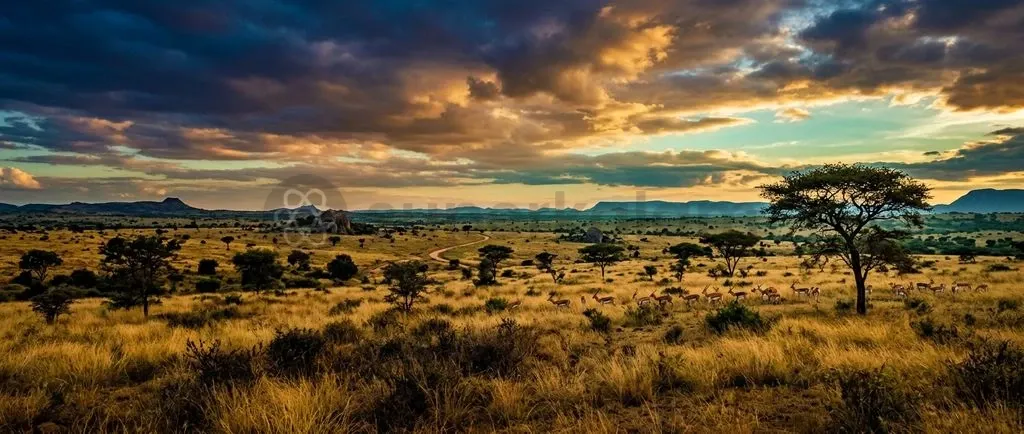
Ancient old-growth grasslands are irreplaceable ecological biomes shaped across millennia. Newly restored secondary grasslands cannot replicate their complex belowground root architectures, resilient microbial assemblages, or specialised endemic biodiversity.
According to the International Union for Conservation of Nature, these primary open ecosystems co-evolved with natural fire regimes and megaherbivore grazing patterns to establish resilient subterranean carbon sinks. Restored sites help stabilise degraded lands, but they consistently display structural species poverty and cannot substitute for pristine grassland conservation.
India's semi-arid open natural biomes require dedicated statutory safeguards. These protections must prevent tree-centric compensatory afforestation and reverse historical revenue misclassifications.
Why Are Grasslands in the News?
On August 17, 2026, the Ministry of Environment, Forest and Climate Change launched India's first dedicated open ecosystems guide at the UNCCD COP17 summit in Ulaanbaatar.
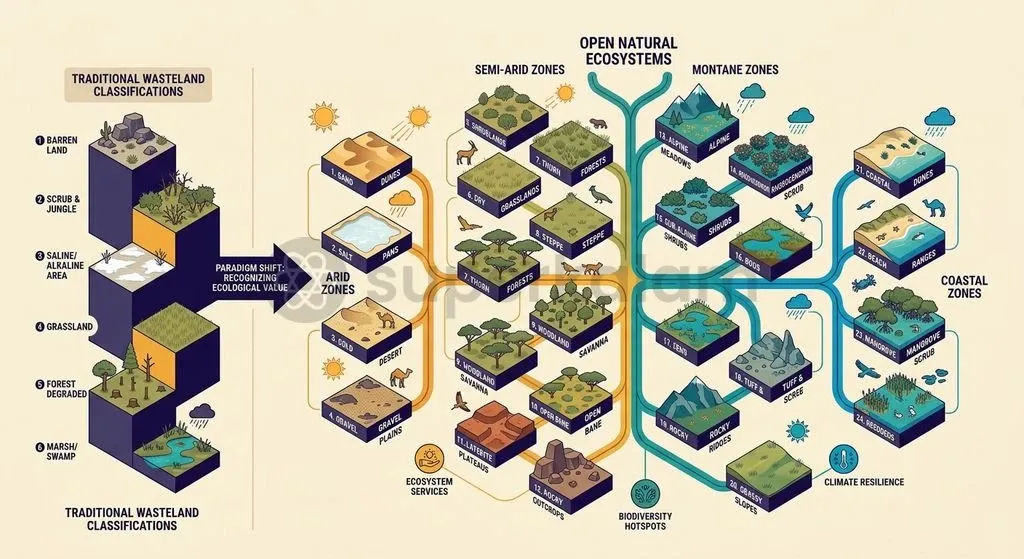
The publication, titled 'Guide to Grasslands and Other Open Natural Ecosystems of India', officially categorises 24 distinct open ecosystem types across the country. This policy framework marks an institutional departure from colonial-era classifications that treated non-forested landscapes as degraded terrain.
As of August 2026, official recognition highlights the ecological vulnerability of India's Open Natural Ecosystems (ONEs). These biomes face persistent degradation from poorly targeted greening campaigns and infrastructure expansion, requiring a shift toward function-based habitat conservation.
What Are Old-Growth Grasslands?
Old-growth grasslands are ancient, primary ecological biomes that have maintained structural continuity over thousands of years. They evolved through continuous interaction with periodic fire regimes and native herbivore grazing.
These ancient biomes feature extraordinary floristic richness, specialised botanical traits, and deep evolutionary heritage. Unlike secondary grasslands that emerge after agricultural clearing, primary grasslands feature flora with extensive Underground Storage Organs (USOs), deep bud banks, and lignotubers.
Botanists classify many of these ancient herbaceous species as geoxylic life-forms, often described as underground forests. Massive subterranean woody root networks allow native plants to resprout rapidly following seasonal fires and prolonged droughts.
Discuss with Superkalam
How do the Underground Storage Organs (USOs) of geoxylic plants enable ancient grasslands to survive seasonal fires and droughts?
Ask NowOld-Growth vs Restored Grasslands: Key Differences Compared
The Proceedings of the National Academy of Sciences reveals that secondary restored grasslands suffer from severe taxonomic depauperation compared to ancient ecosystems.
Restored grasslands take centuries to assemble the intricate soil horizons, mycorrhizal networks, and niche specialisations found in undisturbed native biomes. The table below outlines the core functional differences between both systems:
| Ecological Dimension | Ancient Old-Growth Grasslands | Secondary / Restored Grasslands |
|---|---|---|
| Origin and Age | Millennia-old continuous biomes shaped by natural evolutionary dynamics. | Decadal assemblages established after agricultural abandon or active replanting. |
| Floristic Diversity | High taxonomic richness featuring rare endemic herbs and geophytes. | Low species richness, dominated by opportunistic pioneer grasses. |
| Belowground Architecture | Dense bud banks, lignotubers, and deep root networks forming 'underground forests'. | Shallow root stratification with minimal subterranean storage organs. |
| Disturbance Response | Rapid vegetative resprouting following natural fire regimes and grazing. | High vulnerability to fire mortality and invasive species colonisation. |
| Carbon Permanence | Stable, resilient soil organic carbon pools insulated from surface disturbances. | Transient soil carbon storage subject to rapid post-disturbance depletion. |
Discuss with Superkalam
Compare the carbon permanence of subterranean grassland roots with aboveground forest biomass under increasing wildfire frequencies.
Ask NowWhy Replacing Ancient Grasslands Fails: Belowground Carbon, Soil Microbes, and Endemic Species
Subterranean biomass dynamics explain why artificial restoration cannot substitute for ancient grassland carbon permanence or specialised habitat functions.
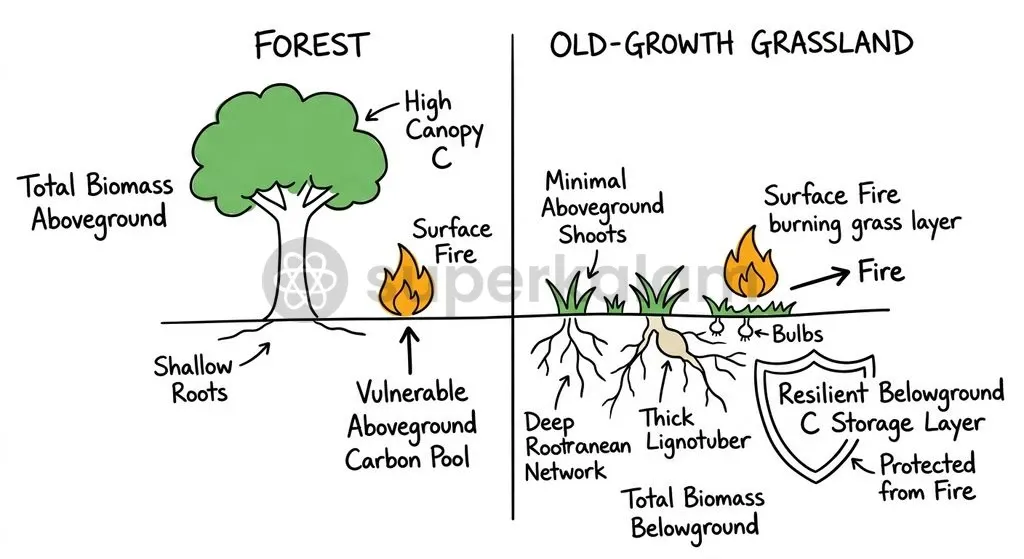
World Resources Institute assessments establish that grasslands sequester up to 90% of their organic carbon pool belowground within roots, rhizomes, and microbial necromass. While forest biomass stores carbon largely above ground in woody stems, grassland soil carbon remains insulated from surface wildfires. Post-fire regimes allow grassland carbon to re-enter vegetative cycles rapidly without net atmospheric release.
Specialised endemic fauna depend exclusively on the micro-topography and open architecture of ancient grasslands:
- Great Indian Bustard (Ardeotis nigriceps): The Wildlife Institute of India reports fewer than 140 wild individuals surviving in Thar desert grasslands, serving as an obligate indicator of open savanna health.
- Lesser Florican (Sypheotides indicus): Endemic bustard species requiring undisturbed mosaic grasslands for seasonal breeding and lekking displays.
- Carnivore Guilds: The Indian Wolf (Canis lupus pallipes), Blackbuck (Antilope cervicapra), and Caracal depend on contiguous open terrain for hunting and pack dynamics.
The Flawed Policy View: Why Grasslands Were Misclassified as Wastelands
Colonial revenue systems in British India systematically categorised non-forested, untilled landscapes as unproductive wastelands because they yielded no timber or agricultural land tax.
This fiscal bias persisted in post-independence land administration:
- The Wasteland Atlas Mapping: The Wasteland Atlas of India, compiled by the Department of Land Resources alongside the ISRO Space Applications Centre, maps nearly 70% of Open Natural Ecosystems as wastelands.
- Extensive Geographic Extent: Semi-arid Open Natural Ecosystems cover approximately 300,000 to 320,000 square kilometres, representing 10% of India's geographical expanse.
- Protection Deficit: Despite supporting unique biodiversity and pastoral livelihoods, less than 5% of these biomes fall within India's formal Protected Area network.
Discuss with Superkalam
What proportion of India's semi-arid Open Natural Ecosystems currently falls within the formal Protected Area network?
Ask NowThe Danger of Tree-Planting Schemes in Native Grassland Habitats
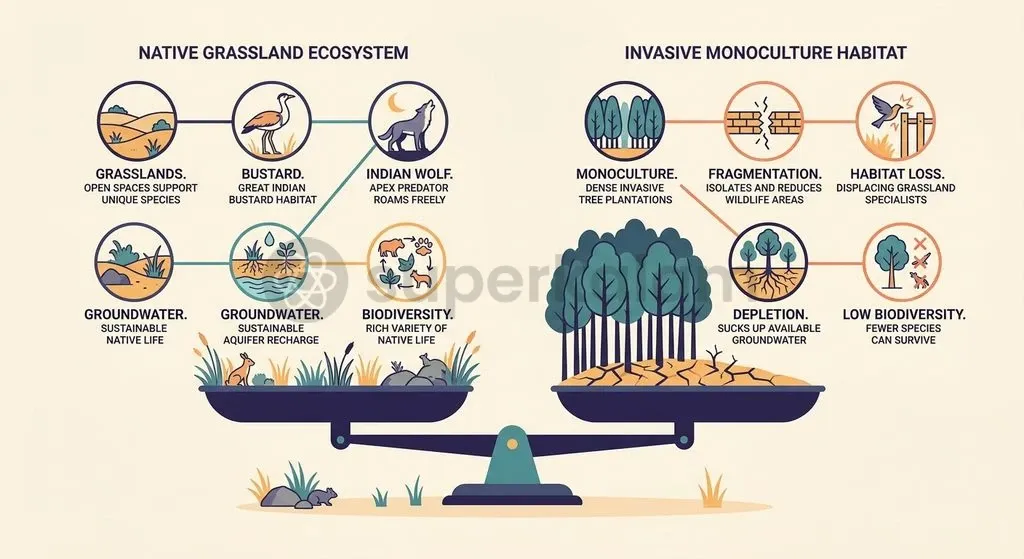
Compensatory Afforestation Fund Management and Planning Authority (CAMPA) funding has inadvertently incentivised ecological destruction by financing monoculture tree plantations across native grassland biomes.
Target-driven afforestation initiatives treat open biomes as blank spaces for tree planting. Plantations of exotic and invasive species such as Prosopis juliflora and Eucalyptus alter soil hydrology, disrupt open flight paths for heavy birds like bustards, and suppress indigenous grasses.
In the high-altitude Shola-grassland mosaics of the Western Ghats, historical plantations of Acacia mearnsii (black wattle) and Eucalyptus have severely depleted montane grassland cover. These invasive woody canopies desiccate mountain catchments and impair downstream hydrological flows.
Conversely, in the Banni grasslands of Gujarat, research indicates that soil organic carbon densities reached 142.72 tonnes of carbon per hectare in native grassland plots where Prosopis juliflora was systematically eradicated. This empirical evidence directly contradicts the administrative premise that establishing tree cover uniformly maximises carbon sequestration.
Ethical and Ecological Imperatives under GS Paper 3
Ecological governance requires aligning domestic conservation practices with constitutional mandates and international commitments:
- Constitutional Directive: Treating ancient biomes as disposable landbanks violates the mandate under Article 48A of the Constitution to protect and improve the natural environment.
- Intergenerational Equity: Diverting intact grasslands on the assumption that damage can be offset elsewhere through secondary replanting undermines intergenerational environmental equity.
- Limits of Offsetting: Secondary restoration provides valuable land stabilisation and erosion control, but it cannot replace the complex evolutionary legacy of primary biomes or serve as an offset licence for industrial diversion.
The Way Forward: Protecting Ancient Biomes Alongside Responsible Restoration
The Ministry of Environment, Forest and Climate Change must reform ecological restoration metrics by replacing crude tree-canopy targets with native biodiversity indicators and hydrological assessments.
A sustainable conservation roadmap requires four structural policy reforms:
- Statutory Classification Reform: The Department of Land Resources must de-link Open Natural Ecosystems from the Wasteland Atlas, notifying them as ecologically sensitive biomes.
- Re-orienting CAMPA Guidelines: Compensatory afforestation guidelines must prohibit planting trees within designated savanna, scrubland, and steppe habitats.
- Landscape-Level Protection: Expand community-conserved reserves across the 300,000 square kilometres of semi-arid Open Natural Ecosystems, integrating pastoral grazing rights.
- Targeted Ecological Metrics: Adopt the IUCN Red List Index and soil organic carbon health to evaluate habitat quality instead of measuring gross canopy cover.
Discuss with Superkalam
Evaluate whether carbon offset policies should treat tree cover and grassland restoration as equivalent climate mitigation strategies.
Ask NowKey Takeaways
- Ancient Evolutionary Heritage: Old-growth grasslands are millennia-old biomes shaped by natural fire and herbivore dynamics, possessing specialized underground root structures that secondary restorations cannot replicate.
- Belowground Carbon Stability: Grasslands sequester up to 90% of their organic carbon pool belowground, creating resilient carbon sinks that survive surface wildfires far more effectively than tree biomass.
- Administrative Wasteland Bias: Nearly 70% of India's 300,000 to 320,000 square kilometres of Open Natural Ecosystems are misclassified as wastelands, leaving 95% of these landscapes outside the formal Protected Area network.
- Afforestation Risks: CAMPA-funded monoculture tree planting and invasive species introduction severely degrade endemic grassland fauna habitats, including the critically endangered Great Indian Bustard.
- Metric Shift Required: Ecological policy must transition from gross tree canopy measurements to native biodiversity indices, indicator species health, and hydrological functionality assessments.
Mains Question
'Compensatory afforestation schemes that treat open natural biomes as blank spaces for tree planting undermine ecological integrity rather than enhancing it.' In light of this statement, critically analyse the impact of target-driven tree plantations on India's native grasslands and hydrological regimes. (10 Marks)
Evaluate NowMains Question
Colonial-era revenue categorisations have historically labelled non-forested landscapes as 'unproductive wastelands', leaving primary grasslands ecologically vulnerable. Discuss the structural and functional significance of ancient old-growth grasslands and elucidate the policy measures required for their conservation. (15 Marks)
Evaluate NowPractice MCQs
QUESTION 1
With reference to old-growth grasslands and their ecological dynamics, consider the following statements:
- Unlike secondary grasslands, primary old-growth grasslands feature extensive Underground Storage Organs (USOs) and geoxylic life-forms described as 'underground forests'.
- In grasslands, up to 90% of the organic carbon pool is sequestered belowground in roots, rhizomes, and microbial necromass, insulating it from surface wildfires.
- Secondary restored grasslands rapidly replicate the taxonomic diversity and mycorrhizal stratification of ancient grasslands within a few decades. Which of the statements given above is/are correct?
QUESTION 2
Consider the following statements regarding Open Natural Ecosystems (ONEs) in India:
- Semi-arid Open Natural Ecosystems cover approximately 10% of India's geographical expanse.
- The Wasteland Atlas of India categorises nearly 70% of Open Natural Ecosystems as wastelands.
- More than 25% of India's Open Natural Ecosystems are currently protected under the formal Protected Area network. Which of the statements given above is/are correct?
QUESTION 3
Consider the following statements regarding the 'Guide to Grasslands and Other Open Natural Ecosystems of India' launched by the Ministry of Environment, Forest and Climate Change:
- It was officially launched at the UNCCD COP17 summit in Ulaanbaatar.
- It officially categorises 24 distinct open ecosystem types across India.
- It advocates for replacing native grassland vegetation with exotic fast-growing timber species. Which of the statements given above is/are correct?
QUESTION 4
Which of the following endemic or obligate wildlife species depend directly on the contiguous open terrain and micro-topography of India's native grasslands?
- Great Indian Bustard (Ardeotis nigriceps)
- Lesser Florican (Sypheotides indicus)
- Indian Wolf (Canis lupus pallipes) Select the correct answer using the code given below:
QUESTION 5
In the context of grassland ecology, what is the primary consequence of establishing monoculture plantations of species like Acacia mearnsii, Prosopis juliflora, and Eucalyptus in native open ecosystems?