CHIME 21-cm Neutral Hydrogen Discovery: Mapping Dark Energy
CHIME uses neutral hydrogen’s 21-cm radio emission to map large-scale cosmic structure. See how hydrogen intensity mapping helps study dark energy.
Oct, 2026
•11 min read

Overview
The Canadian Hydrogen Intensity Mapping Experiment (CHIME) collaboration, featuring key contributions from India's Raman Research Institute, has achieved the world's first standalone cosmological detection of ancient neutral hydrogen's 21-centimetre emission without relying on optical galaxy surveys. This observational breakthrough isolates the faint radio glow of the early cosmos across 94 nights of observation, establishing that roughly 2% of the universe's total hydrogen existed in neutral atomic form at redshift z ≈ 1. By confirming that Hydrogen Intensity Mapping works independently, this milestone validates a fundamental observational technique required to map dark energy and cosmic expansion, directly reinforcing India's strategic scientific investments in next-generation megascience facilities like the Square Kilometre Array.
Why is the CHIME Telescope Discovery in the News?
The Canadian Hydrogen Intensity Mapping Experiment (CHIME) collaboration announced the first standalone detection of neutral atomic hydrogen (H I) in autocorrelation across cosmological distances, as reported in September 2026. This measurement successfully captured the statistical clustering of ancient hydrogen across the 608.2–707.8 MHz radio band, corresponding to redshifts between z = 1.01 and 1.34.
Researchers recorded this signal at an extraordinary statistical significance of 12.4 sigma, far exceeding the standard five-sigma threshold for confirmed scientific discoveries. The achievement represents a crucial milestone for observational cosmology because it eliminates the long-standing requirement to cross-reference radio data with optical galaxy surveys.
Scientists from the Raman Research Institute (RRI), an autonomous institute under India's Department of Science and Technology (DST), played a direct institutional role in the discovery by developing specialized signal processing and foreground-removal pipelines. As of September 2026, these results provide cosmological researchers with an unvetted baseline to measure how the large-scale architecture of the universe evolved under the influence of dark energy.
Discuss with Superkalam
What specific quantum mechanical process produces the 21-cm radio emission in neutral hydrogen atoms?
Ask NowWhat is the CHIME Telescope and How Does It Work?
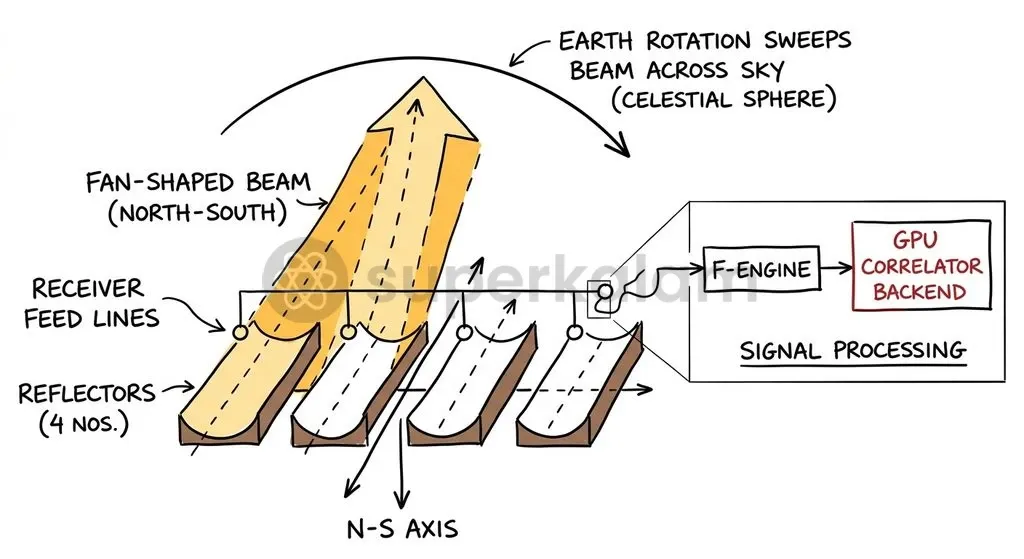
The CHIME telescope is a stationary, drift-scan radio interferometer located at the Dominion Radio Astrophysical Observatory near Penticton in British Columbia, Canada. Unlike conventional steerable parabolic dishes that track individual celestial targets, CHIME possesses no moving mechanical parts.
The physical apparatus consists of four cylindrical parabolic reflectors, each measuring 100 metres in length and 20 metres in width. Suspended directly above these steel mesh cylinders are 1,024 dual-polarization radio receivers that gather incoming radiation across a total collecting surface of 8,000 square metres.
CHIME relies on Earth's daily rotation to sweep its overhead field of view across the northern sky. The telescope operates across a wide frequency window of 400 MHz to 800 MHz, designed specifically to capture radio waves emitted by neutral hydrogen between redshifts z = 0.8 and z = 2.5.
Incoming analog signals are digitized instantly using a custom FPGA-based ICE electronics backend before streaming into a massive computing cluster powered by over 1,000 graphics processing units. This processing engine correlates massive data streams in real time, transforming raw sky noise into high-fidelity three-dimensional radio maps of the cosmos.
Understanding the 21-cm Signal: How Scientists Trace Ancient Neutral Hydrogen
Neutral atomic hydrogen (H I) emits a distinct spectral line at a rest-frame wavelength of 21 centimetres, governed by quantum mechanics. This emission occurs during a hyperfine spin-flip transition within ground-state neutral hydrogen atoms, happening when the electron's spin relative to the proton spontaneously flips from a parallel alignment to an antiparallel configuration.
The rest-frame frequency of this spin-flip transition is exactly 1420.405 MHz. While this quantum transition occurs rarely for any individual hydrogen atom, the staggering abundance of neutral hydrogen throughout the early universe produces an aggregate background glow detectable by sensitive radio arrays.
Cosmological expansion stretches these primordial radio photons as they travel across billions of light-years, lengthening their wavelength and shifting their observed frequency downward into the metre-scale radio band. Astronomers leverage this cosmological redshift as a cosmic clock:
- Emission: Hydrogen atoms emit radio waves at 1420.405 MHz during distant cosmic epochs.
- Cosmic Stretching: The ongoing expansion of spacetime stretches these waves proportionally to their travel time.
- Observation: Terrestrial radio telescopes record the shifted signals between 400 MHz and 800 MHz, directly calculating lookback time and distance.
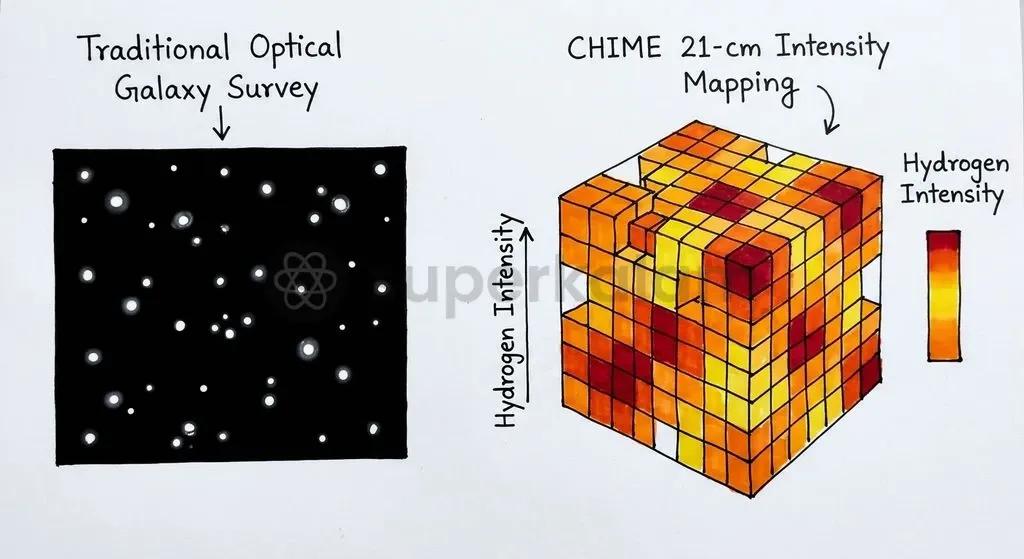
Instead of attempting to resolve faint, individual galaxies, CHIME employs Hydrogen Intensity Mapping (HIM). This observational technique measures collective brightness fluctuations across coarse three-dimensional spatial voxels, allowing researchers to rapidly trace the Large Scale Structure of the universe across vast cosmological volumes.
Discuss with Superkalam
How does the cosmological redshift of 21-cm radio waves function as a cosmic clock to determine lookback time and distance?
Ask NowWhy Standalone Detection of Neutral Hydrogen is a Major Breakthrough
Earlier cosmological detections of neutral hydrogen required cross-correlation techniques, matching weak radio observations with pre-existing optical galaxy surveys to verify that signals originated from real cosmic structures. The recent CHIME discovery marks the first successful standalone autocorrelation measurement of neutral hydrogen intensity mapping, proving that radio interferometers can extract pristine cosmological signals entirely on their own.
| Dimension | Cross-Correlation Method | Standalone Autocorrelation (CHIME Breakthrough) |
|---|---|---|
| Data Dependency | Requires external optical redshift surveys | Completely self-contained radio measurement |
| Selection Bias | Inherits optical biases toward bright, massive galaxies | Measures total diffuse neutral hydrogen unbiasedly |
| Foreground Robustness | Relies on optical positions to verify faint radio peaks | Removes bright foregrounds via mathematical filtering |
| Cosmological Reach | Limited to sky patches mapped by optical surveys | Efficiently scans vast cosmic volumes across deep time |
Optical galaxy surveys naturally suffer from observational biases because they predominantly catalog luminous, star-forming galaxies, frequently missing diffuse gas reservoirs. Standalone 21-cm intensity mapping avoids these systematic errors, enabling unbiased volumetric reconstructions of cosmic structure across uncharted epochs.
CHIME's standalone analysis confirmed that approximately 2% of universal hydrogen remained in neutral atomic form during the cosmic epoch at redshift z ≈ 1. This measurement delivers an empirical anchor for theoretical models describing how cosmic gas cooled, condensed, and fueled star formation across cosmic history.
Decoding Dark Energy and the Accelerating Expansion of the Universe
Dark energy constitutes approximately 68% of the universe's total energy budget, functioning as a repulsive gravitational force driving the accelerated expansion of spacetime. Understanding whether dark energy behaves as a static Cosmological Constant (represented as Lambda in Einstein's field equations) or as a dynamical, evolving scalar field remains one of modern physics' greatest unresolved challenges.
Neutral hydrogen intensity mapping provides an independent method to measure this expansion through Baryon Acoustic Oscillations (BAO). These primordial acoustic sound waves froze into the distribution of matter shortly after the Big Bang, leaving a predictable periodic clustering signature that acts as a standard cosmological ruler.
By mapping how this acoustic scale shifts across redshifts between z = 0.8 and z = 2.5, astronomers can precisely track cosmic expansion history. This technique directly constrains the dark energy equation-of-state parameter, denoted mathematically as w(z), testing whether dark energy's density remains constant or changes over cosmic time.
Standalone 21-cm observations provide a clean test of cosmological models without relying on complex assumptions about galaxy formation physics. These measurements offer an essential cross-check against traditional dark energy probes, such as Type Ia supernovae and optical galaxy surveys.
Comparison: CHIME vs Other Global Radio Astronomy Facilities
Modern radio astronomy relies on specialized observatories optimized for distinct frequency coverages, baseline geometries, and scientific targets. Comparing CHIME with premier facilities like India's GMRT and the upcoming Square Kilometre Array highlights how complementary observational designs tackle fundamental cosmological questions.
| Facility / Parameter | CHIME (Canada) | GMRT (Khodad, Pune, India) | SKA-Low & SKA-Mid (Australia / South Africa) |
|---|---|---|---|
| Telescope Architecture | 4 stationary parabolic cylinders; drift-scan array | 30 steerable 45-metre parabolic dishes; interferometric array | Thousands of dipole antennas (Low) and hundreds of steerable dishes (Mid) |
| Primary Frequency Band | 400 MHz – 800 MHz | 50 MHz – 1450 MHz (Broadband upgraded GMRT) | 50 MHz – 350 MHz (SKA-Low); 350 MHz – 15 GHz (SKA-Mid) |
| Core Scientific Mandate | 21-cm Hydrogen Intensity Mapping; Fast Radio Bursts | Pulsar timing, galaxy evolution, diffuse galactic emissions, Epoch of Reionization | Transformational cosmology, dark energy mapping, cosmic magnetism, first star formation |
| Observing Strategy | Wide-field continuous northern sky survey via drift-scan | Targeted high-resolution deep pointing and interferometry | Hybrid: ultra-deep targeted pointing combined with wide-area cosmological surveys |
While CHIME focuses entirely on wide-area intensity mapping across the northern hemisphere, the Giant Metrewave Radio Telescope provides targeted spatial resolution across multiple flexible observing bands. The Square Kilometre Array combines these capabilities on an unprecedented scale, synthesizing massive collecting areas across continents.
Discuss with Superkalam
How can standalone Hydrogen Intensity Mapping be applied to test whether dark energy is a static cosmological constant or a dynamic field?
Ask NowIndia's Radio Astronomy Footprint: GMRT, SKA-India, and Key Contributions
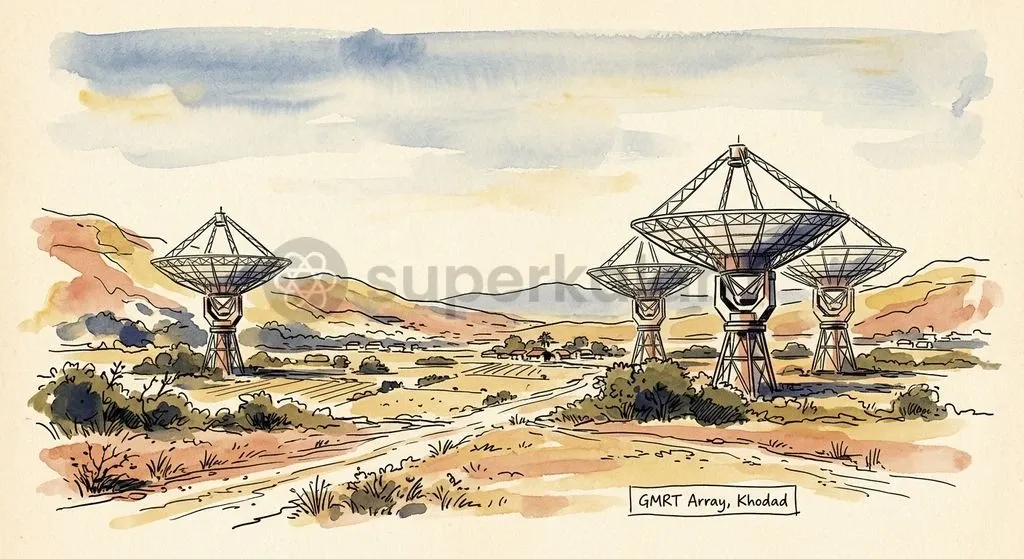
The National Centre for Radio Astrophysics operates the Giant Metrewave Radio Telescope (GMRT) at Khodad near Pune, representing a premier low-frequency radio observatory. The GMRT array consists of 30 steerable parabolic antennas, each 45 metres in diameter, distributed across a 25-kilometre baseline to achieve high angular resolution.
India's institutional presence in cosmological radio astronomy spans specialized domestic experiments and major international partnerships:
- SARAS Experiment: Designed by the Raman Research Institute, the Shaped Antenna measurement of the background RAdio Spectrum is a precision radiometer engineered to detect global 21-cm absorption profiles from the Cosmic Dawn and Epoch of Reionization across 40–200 MHz.
- Full SKA Membership: In January 2024, the Union Cabinet approved India's full-member participation in the Square Kilometre Array Observatory (SKAO) with a dedicated financial outlay of ₹1,250 crore.
- Telescope Manager Software: Indian software engineers and computational astrophysicists led the international design of the core Telescope Manager suite, the specialized system that coordinates global operations across the entire SKA network.
- Foreground Removal Algorithms: Researchers at RRI and NCRA contribute advanced statistical algorithms to filter out overwhelming Galactic foreground noise from faint cosmological signals.
These strategic initiatives highlight how Indian scientific institutions have transitioned from operating regional facilities to leading the software, algorithmic, and instrumentation architecture of global megascience projects.
Challenges in Radio Astronomy: Radio Frequency Interference and Data Volume
Astrophysical foreground contamination presents the most severe technical hurdle for 21-cm cosmological experiments. Diffuse Galactic synchrotron radiation and bright extragalactic point sources are 10,000 to 100,000 times brighter than the faint 21-cm neutral hydrogen signal across the 400–800 MHz band.
Extracting this microscopic cosmological signature requires extreme instrumental calibration and highly sophisticated mathematical filtering. Any minor calibration drift or spectral leakage easily obscures the cosmological fluctuations beneath false statistical artifacts.
Terrestrial Radio Frequency Interference (RFI) compounds these observational difficulties. Terrestrial communications, FM radio, digital television broadcasts, mobile networks, aircraft transponders, and satellite constellations generate strong electromagnetic emissions that overwhelm sensitive astronomical receivers.
Telescopes like CHIME address terrestrial interference through automated real-time excision algorithms embedded directly within their computing architecture. Processing these raw data streams demands massive computational bandwidth, requiring dedicated GPU clusters running real-time signal correlators to process gigabytes of data per second.
Discuss with Superkalam
Analyse the structural and observational differences between traditional steerable radio dishes and CHIME's stationary drift-scan architecture.
Ask NowWay Forward: Next-Generation Telescopes and Deep Cosmological Mapping
The successful validation of standalone 21-cm intensity mapping establishes a clear roadmap for next-generation cosmological surveys. Expanding drift-scan interferometer networks and deploying ultra-wideband digital receivers will enable scientists to reconstruct cosmic history seamlessly from the modern era back to the Epoch of Reionization.
To overcome Earth's increasingly congested radio spectrum and ionospheric distortions, space agencies are designing space-based observatories. India's Space Commission and the Department of Science and Technology have initiated preliminary concept studies for lunar-orbiting cosmological payloads, including the CosmoCube mission concept, designed to operate in the radio-quiet zone of the Moon's far side.
India's ₹1,250 crore commitment to the Square Kilometre Array Observatory positions the nation to capitalize directly on these observational advances. By leveraging its computational expertise in telescope management software and radio signal processing, India is building self-reliance in megascience data analytics. This technical expertise ensures that Indian astrophysicists will lead future standalone neutral hydrogen surveys, translating fundamental scientific investments into indigenous technological capabilities across high-performance computing, digital signal processing, and precision electronics.
Key Takeaways
- The CHIME telescope achieved the first standalone cosmological detection of neutral hydrogen's 21-cm emission in autocorrelation at a 12.4 sigma significance.
- Standalone 21-cm intensity mapping eliminates observational selection biases inherited from optical surveys, confirming that neutral atomic hydrogen comprised roughly 2% of cosmic hydrogen at redshift z ≈ 1.
- The 21-centimetre emission arises from a quantum hyperfine spin-flip transition in neutral hydrogen, providing a standard cosmological ruler via Baryon Acoustic Oscillations to probe the nature of dark energy.
- India maintains a prominent footprint in radio astronomy through NCRA-TIFR's Giant Metrewave Radio Telescope (GMRT), RRI's SARAS experiment, and full membership in the Square Kilometre Array backed by a ₹1,250 crore Union Cabinet outlay.
- Indian computational scientists developed the central Telescope Manager software for the SKA, demonstrating leadership in processing petabyte-scale astrophysical data while mitigating severe terrestrial radio interference.
Mains Question
"The standalone detection of cosmological 21-cm neutral hydrogen emissions represents a fundamental milestone in overcoming the observational constraints of optical galaxy surveys." Elucidate the scientific principles underlying Hydrogen Intensity Mapping (HIM) and its significance in studying cosmic evolution. (10 Marks)
Evaluate NowMains Question
"Mapping the expansion history of the universe through Baryon Acoustic Oscillations is vital to understanding the nature of Dark Energy." Examine how radio interferometers like CHIME probe cosmic acceleration, and evaluate the role of institutional and computational innovations in extracting such cosmological signals. (15 Marks)
Evaluate NowPractice MCQs
QUESTION 1
With reference to the Canadian Hydrogen Intensity Mapping Experiment (CHIME) telescope, consider the following statements:
- It is a stationary, drift-scan radio interferometer with no moving mechanical parts.
- It operates across an observational frequency window of 400 MHz to 800 MHz.
- It uses Earth's rotation to sweep its field of view across the sky. Which of the statements given above are correct?
QUESTION 2
Regarding the 21-centimetre signal of neutral atomic hydrogen (H I), consider the following statements:
- The 21-cm spectral line is produced by a hyperfine spin-flip transition when the electron's spin flips from parallel to antiparallel alignment.
- The rest-frame frequency of this spin-flip transition is exactly 1420.405 MHz.
- Cosmological expansion shifts the observed frequency of primordial 21-cm photons upward into the gigahertz band. Which of the statements given above is/are correct?
QUESTION 3
Consider the following statements regarding the standalone autocorrelation detection achieved by the CHIME collaboration:
- It captured the statistical clustering of ancient hydrogen across redshifts between z = 1.01 and 1.34 at a significance of 12.4 sigma.
- It proved that roughly 2% of the universe's total hydrogen was in neutral atomic form at redshift z ≈ 1.
- Unlike cross-correlation methods, standalone Hydrogen Intensity Mapping does not inherit selection biases toward luminous, star-forming optical galaxies. Which of the statements given above is/are correct?
QUESTION 4
In the context of modern cosmology, how does neutral hydrogen intensity mapping aid in decoding Dark Energy?
QUESTION 5
Consider the following statements regarding Indian contributions to the CHIME discovery:
- The Raman Research Institute (RRI) is an autonomous institute under India's Department of Science and Technology.
- Indian researchers contributed directly by developing specialized signal processing and foreground-removal pipelines. Which of the statements given above is/are correct?