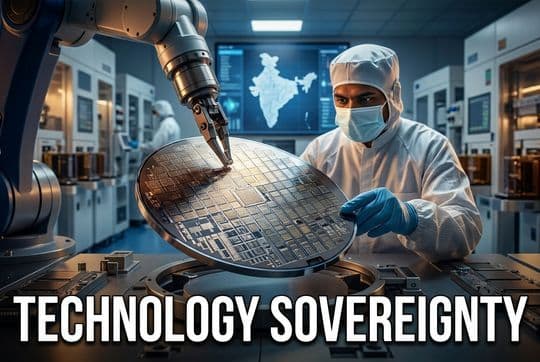
India-EFTA Trade Deal: Is the $100 Billion Investment Pledge Legally Enforceable?
India-EFTA TEPA entered into force on 1 October 2025. See the four EFTA members, investment aims, jobs target, trade benefits and review mechanism.
Oct, 2026
•8 min read
Context
The India-EFTA Trade and Economic Partnership Agreement legally conditions long-term market access on capital formation. It links tariff reductions for four non-European Union nations directly to a target of USD 100 billion in direct foreign investment into India over a fifteen-year period.
Formally entering into force on 1 October 2025, this landmark pact creates an investment-linked trade architecture rather than relying solely on traditional tariff liberalisation. Sovereign states cannot legally compel private corporations to deploy capital. To address this, the treaty establishes a conditional enforcement mechanism allowing India to proportionally roll back tariff concessions if capital inflow thresholds are missed. Consequently, the agreement is a practical blueprint for modern international trade diplomacy.
Why in the News: The Signing of the India-EFTA Trade Agreement
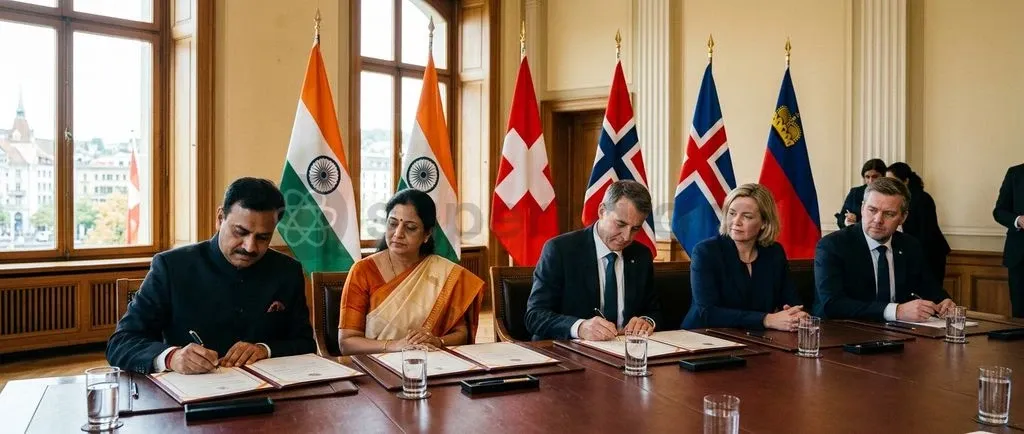
India signed the Trade and Economic Partnership Agreement (TEPA) with the European Free Trade Association on 10 March 2024, setting a new precedent for economic integration. As of October 2025, the historic trade agreement formally entered into force, following domestic ratification procedures across all participating member states.
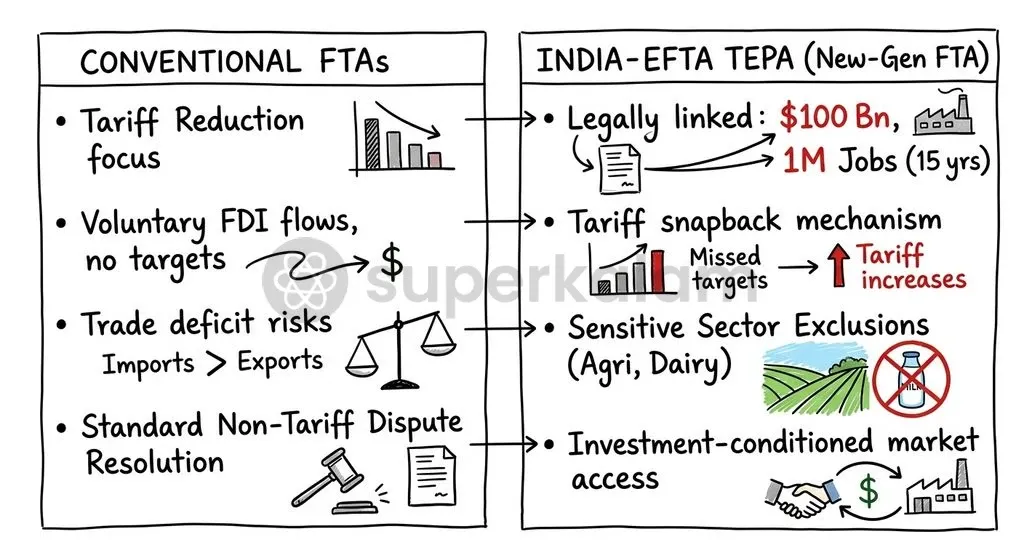
The pact establishes an unprecedented economic framework that directly addresses India's historical reservations regarding standard Free Trade Agreements (FTAs). Rather than focusing exclusively on duty elimination that risks widening trade deficits, TEPA explicitly ties trade liberalisation to tangible domestic capital formation and high-skilled employment creation.
Discuss with Superkalam
Which four countries constitute the European Free Trade Association (EFTA), and when did TEPA formally enter into force?
Ask NowWhat is EFTA and How Does the TEPA Differ from Traditional FTAs?
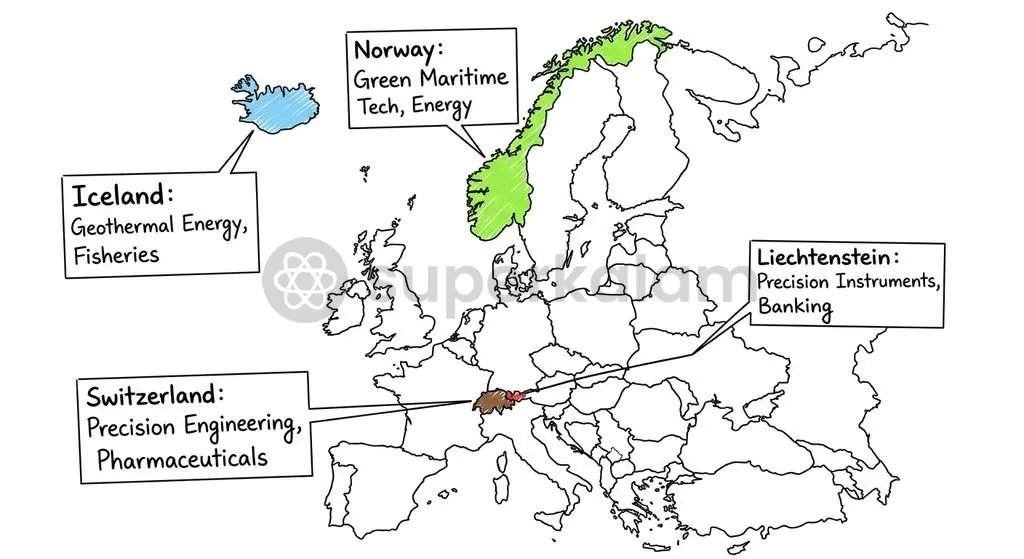
The European Free Trade Association is a four-nation intergovernmental trade organisation founded in 1960 through the historic Stockholm Convention. The grouping comprises Switzerland, Norway, Iceland, and Liechtenstein, operating entirely outside the European Union single market framework while maintaining high technological and financial capabilities.
Unlike conventional free trade agreements that focus strictly on reciprocal tariff cuts and border clearances, TEPA integrates a legally structured investment promotion framework. Conventional trade deals signed by India historically suffered from structural imbalances:
- Asymmetric benefits: Foreign partners secured deep tariff cuts while Indian exports routinely faced non-tariff barriers.
- Capital integration: Traditional agreements lacked enforceable links to long-term manufacturing growth.
To overcome these limitations, the Ministry of Commerce and Industry negotiated TEPA as an investment-linked industrial partnership. Under this architecture, tariff access granted to advanced European industrial exports is explicitly balanced against measurable direct foreign capital inflows into India's domestic manufacturing and infrastructure ecosystems.
Breaking Down the $100 Billion Investment Commitment and Job Creation Targets
Chapter 7 of the TEPA obligates EFTA member nations to pursue direct foreign investments reaching USD 100 billion in India over fifteen years. This capital commitment explicitly requires direct foreign investment into tangible manufacturing and service facilities, strictly excluding volatile foreign portfolio investments.
According to the Ministry of Commerce and Industry, the investment roadmap follows a two-tiered sequential timeline:
- Tranche 1 (Years 1 to 10): EFTA states facilitate the deployment of the first USD 50 billion in direct investments across priority Indian industrial sectors.
- Tranche 2 (Years 11 to 15): The grouping facilitates an additional USD 50 billion, completing the aggregate target within fifteen years.
Alongside capital deployment, the pact mandates the generation of 1 million direct jobs within India over the fifteen-year operational window. These employment targets focus heavily on high-value technology domains, precision engineering, research and development centres, and advanced renewable infrastructure.
Discuss with Superkalam
Explain why the investment target in the India-EFTA TEPA is structured as an 'obligation of conduct' rather than an enforceable sovereign guarantee.
Ask NowIs the Investment Pledge Legally Binding? Understanding the Enforcement Mechanism
The investment chapter operates as an obligation of conduct rather than a sovereign debt guarantee from EFTA member governments. Under international legal jurisprudence, democratic governments cannot directly order private corporations, venture funds, or sovereign wealth entities to purchase foreign commercial assets.
Because private capital allocation remains market-driven, the treaty does not expose EFTA member states to monetary damages or legal suits. Key institutional parameters shape this approach:
- No financial liability: Chapter 7 is explicitly excluded from the standard state-to-state Dispute Settlement Mechanism in Chapter 12.
- No investor arbitration: The chapter contains no Investor-State Dispute Settlement (ISDS) provisions.
Instead of financial penalties, the treaty establishes a novel commercial consequence known as a conditional tariff snap-back. If EFTA states fail to generate the targeted capital flows, India retains the sovereign treaty right to suspend the preferential market access granted under Chapter 2 (Trade in Goods).
The 15-Year Review Process and Consequences if Investment Targets Fall Short
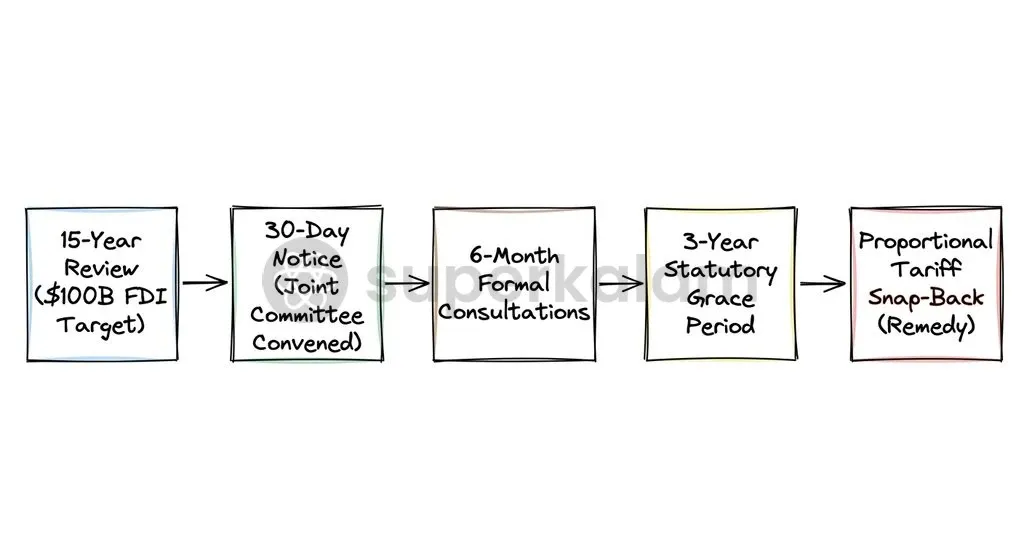
The TEPA establishes a structured institutional process to review investment benchmarks and enforce corrective remedies if capital targets fall short. This mechanism prevents arbitrary tariff adjustments while preserving a credible enforcement timeline for both trading partners.
The formal review and remediation sequence follows three distinct procedural stages under Chapter 7:
- Mandatory Joint Consultations: If capital targets remain unmet at the milestone review, India can summon the bilateral Joint Committee within 30 days to conduct formal consultations, which must conclude within 6 months.
- Statutory Grace Period: If inter-governmental consultations fail to resolve the shortfall, the treaty provides a 3-year grace period for EFTA states to stimulate remedial private capital deployment.
- Proportional Tariff Snap-Back: If the investment deficit persists after the three-year window, India may proportionally suspend tariff concessions on imported EFTA goods until investment levels realign with agreed targets.
Discuss with Superkalam
How might India apply the conditional tariff snap-back model in future trade negotiations with other advanced economies?
Ask NowComparison: India-EFTA TEPA vs Conventional Free Trade Agreements
The structural mechanics of TEPA establish a significant departure from India's previous free trade pacts with regional partners.
| Parameter | Traditional Free Trade Agreements (e.g. Early ASEAN / CEPA) | India–EFTA TEPA Framework |
|---|---|---|
| Primary Objective | Broad-based mutual tariff elimination on goods and services | Tariff concessions tied directly to foreign capital and job quotas |
| Investment Commitments | Voluntary investor protection without volume targets | USD 100 billion target over 15 years in direct investments |
| Enforcement of Investment | Absent or limited to standard ISDS arbitration claims | Proportional tariff snap-back without monetary damages |
| Dispute Settlement on Capital | Subject to contentious international arbitration | Excluded from state-to-state dispute arbitration mechanisms |
| Strategic Focus | Merchandise trade volume expansion | Domestic manufacturing capacity building and technology transfer |
Strategic and Economic Implications for India
The agreement offers extensive tariff concessions, with EFTA members eliminating duties across 92.2% of tariff lines, covering 99.6% of Indian merchandise exports. Indian exporters in textiles, apparel, leather, gems and jewellery, and specialised engineering gain duty-free entry into European markets.
In return, India provides phased tariff relief across 82.7% of its tariff lines, covering 95.3% of EFTA exports. Indian industries gain access to advanced capital equipment, including:
- Swiss precision engineering tools, specialised industrial machinery, and diagnostic medical devices.
- Norwegian maritime innovations, green hydrogen solutions, and offshore wind technologies.
- Icelandic geothermal applications and clean energy systems.
India reinforced its domestic economic sovereignty by entirely shielding vulnerable sectors from trade exposure. Gold imports, which represent over 80% of India's merchandise imports from Switzerland, face zero cuts in effective customs duties. Furthermore, dairy, soya, coal, wheat, rice, maize, poultry, and honey are placed on an outright exclusion list to protect domestic farming communities.
In trade in services, TEPA facilitates cross-border digital operations and temporary movement of Indian technical specialists. The agreement incorporates frameworks for Mutual Recognition Agreements (MRAs) in regulated professions such as nursing, architecture, and chartered accountancy, significantly easing mobility for Indian skilled labour.
Key Challenges: Rules of Origin, IPR, and Swiss Domestic Opposition
The negotiation of the TEPA required resolving contentious friction points surrounding intellectual property rights and sovereign regulatory autonomy. EFTA delegations historically sought strict TRIPS-plus provisions, such as patent term extensions and clinical data exclusivity, which could have delayed the market entry of affordable Indian generic pharmaceuticals.
India successfully defended its domestic pharmaceutical industry by aligning Chapter 8 strictly with standard WTO TRIPS guidelines. The final treaty text rejects data exclusivity mandates, safeguarding India's ability to produce low-cost life-saving generic medicines and export them globally.
Operationalising the deal still presents distinct administrative hurdles:
- Strict Rules of Origin (RoO): Preventing third-party trade diversion requires rigorous value-addition certification to ensure goods originating outside the four EFTA nations do not bypass Indian customs duties.
- Investment Climate Predictability: Meeting the USD 100 billion target requires India to provide stable corporate taxation, streamlined land acquisition, and rapid environmental clearances.
- Swiss Domestic Lobbying: Agricultural and chemical lobbies in European partner nations continue to monitor market concessions closely, requiring active bilateral coordination through the Joint Committee.
Discuss with Superkalam
Analyse the trade-off between shielding domestic sectors like agriculture and gold while providing duty-free access to advanced European precision machinery.
Ask NowWay Forward: Maximising Gains from New-Generation Trade Deals
The Department of Commerce must institutionalise continuous investment monitoring to ensure the TEPA achieves its intended economic outcomes. Establishing a dedicated EFTA Fast-Track Investment Cell under Invest India can help channel Swiss and Norwegian capital into high-growth manufacturing sectors.
India should leverage TEPA's investment-linked structure as a negotiating template for ongoing trade talks with the United Kingdom and the European Union. By conditioning market access on domestic capital formation, India can protect its current account balance while integrating deeper into resilient global value chains.
Key Takeaways
- The European Free Trade Association consists of four non-EU nations: Switzerland, Norway, Iceland, and Liechtenstein.
- TEPA commits EFTA states to facilitate USD 100 billion in direct foreign investments and create 1 million direct jobs in India over fifteen years.
- The investment commitment is an obligation of conduct rather than a sovereign debt guarantee, protecting partner states from direct financial liability claims.
- India retains the unique legal right to execute a proportional tariff snap-back on EFTA imports if investment targets remain unfulfilled after formal review and a three-year grace period.
- India protected key sensitive sectors by maintaining customs duties on gold imports and placing dairy, grains, and poultry on an outright tariff exclusion list.
- The treaty upholds standard TRIPS compliance without TRIPS-plus data exclusivity, preserving India's generic pharmaceutical manufacturing ecosystem.
Mains Question
'The India-EFTA Trade and Economic Partnership Agreement (TEPA) departs from traditional Free Trade Agreements by pioneering an investment-linked trade architecture.' Elucidate. (10 Marks)
Evaluate NowMains Question
While the India-EFTA TEPA introduces a novel 'conditional tariff snap-back' mechanism, sovereign democratic states cannot legally command private capital deployment. In this context, critically analyse the enforceability and operational challenges of the USD 100 billion investment commitment. (15 Marks)
Evaluate NowPractice MCQs
QUESTION 1
With reference to the European Free Trade Association (EFTA) and the Trade and Economic Partnership Agreement (TEPA) signed with India, consider the following statements:
- EFTA was founded in 1960 through the Stockholm Convention and comprises Switzerland, Norway, Iceland, and Liechtenstein.
- EFTA member nations operate within the European Union single market framework.
- TEPA's USD 100 billion investment commitment strictly excludes volatile foreign portfolio investments.
Which of the statements given above are correct?
QUESTION 2
Regarding the investment and dispute settlement architecture under Chapter 7 of the India-EFTA TEPA, consider the following statements:
- The investment commitment follows a two-tiered roadmap of USD 50 billion in the first 10 years and an additional USD 50 billion between years 11 and 15.
- The pact targets the creation of 1 million direct jobs in India over the fifteen-year operational window.
- Failure by EFTA states to meet capital targets exposes them to financial penalties under the Chapter 12 state-to-state Dispute Settlement Mechanism.
Which of the statements given above is/are correct?
QUESTION 3
Consider the following statements regarding the 15-year review and remediation process in the India-EFTA TEPA:
- India can summon the bilateral Joint Committee within 30 days of an unmet investment milestone to hold consultations that must conclude within 6 months.
- A statutory 3-year grace period is provided if inter-governmental consultations fail to resolve an investment shortfall.
- India retains the sovereign treaty right to proportionally suspend tariff concessions granted under Chapter 2 if the deficit persists after the grace period.
Which of the statements given above are correct?
QUESTION 4
Consider the following statements regarding market access and sectoral provisions under the India-EFTA TEPA:
- EFTA members eliminate duties across 92.2% of tariff lines, covering 99.6% of Indian merchandise exports.
- Gold imports from Switzerland receive an immediate elimination of effective customs duties.
- Sensitive agricultural commodities like dairy, wheat, rice, and poultry are placed on an outright exclusion list by India.
Which of the statements given above is/are correct?
QUESTION 5
Under the India-EFTA Trade and Economic Partnership Agreement (TEPA), the USD 100 billion investment pledge is legally characterized as which of the following?
Discuss with Superkalam
Evaluate the credibility and practical effectiveness of a 3-year grace period in stimulating private capital flows during an investment deficit.
Ask Now