Green Energy Corridor Phase-III: India's ₹1.86 Lakh Cr Grid & 50 GWh Storage Plan
Green Energy Corridor Phase III pairs transmission expansion with battery storage. See renewable power evacuation, grid stability and implementation challenges.
Oct, 2026
•9 min read
Overview
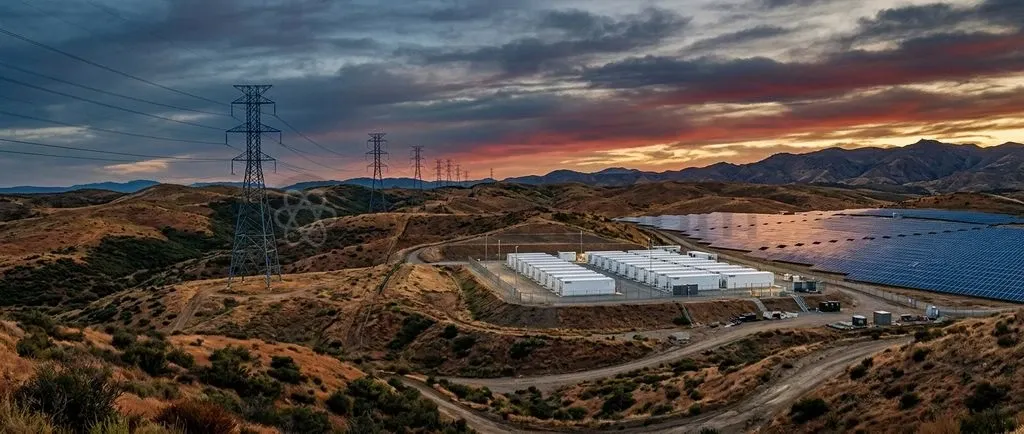
The Union Cabinet approved the ₹1,86,405-crore Green Energy Corridor Phase-III scheme to overhaul India's power grid. The initiative pairs large-scale intra-state transmission lines with 50 GWh of battery storage to evacuate 135 GW of clean electricity by FY 2032-33.
Supported by ₹54,082 crore in Central Financial Support, the plan tackles solar intermittency and curtails midday generation losses. It lays the physical foundations required to reach India's updated climate targets: 500 GW non-fossil capacity by 2030 and 900 GW by 2035.
Why in the News: India's Shift Toward Storage-Backed Transmission
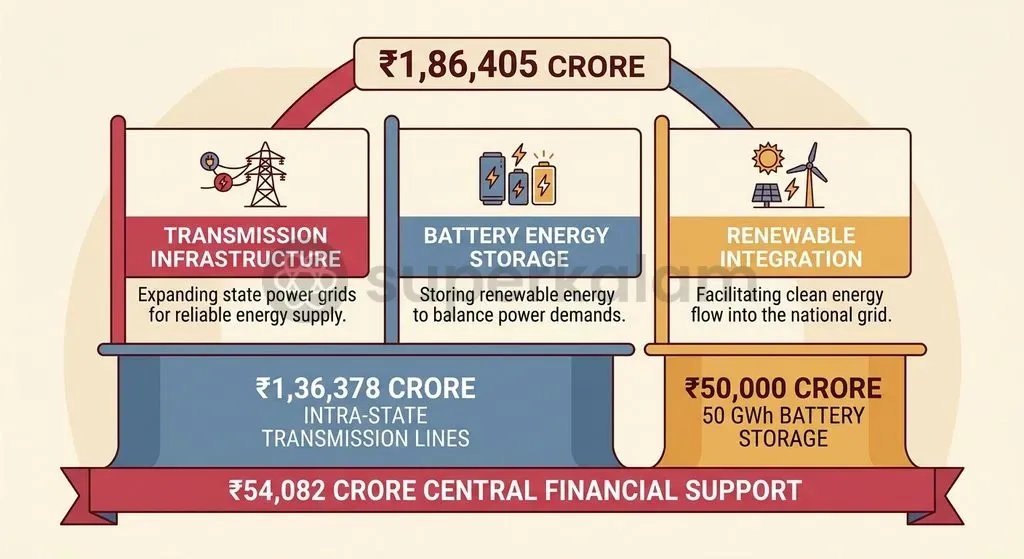
On September 30, 2026, the Union Cabinet approved the Green Energy Corridor Phase-III (GEC-III) scheme with a total project outlay of ₹1,86,405 crore. As of September 2026, this decision represents the largest coordinated expansion of state-level electricity infrastructure and storage assets in India's renewable energy history.
The financial layout targets two distinct asset classes:
- Intra-State Transmission Systems (InSTS): ₹1,36,378 crore allocated to construct high-voltage state grid lines.
- Battery Energy Storage Systems (BESS): ₹50,000 crore dedicated to deploying 50 GWh of utility-scale storage.
To prevent tariff spikes for retail consumers, the Union Government sanctioned ₹54,082 crore in Central Financial Support (CFS). This grant offsets intra-state wheeling fees and facilitates the evacuation of 135 GW of renewable capacity by FY 2032-33, aligning state networks with India's target of 900 GW non-fossil capacity by 2035.
Discuss with Superkalam
How does the 'duck curve' phenomenon create operational stress for conventional power grids during peak solar generation hours?
Ask NowWhat Is the Green Energy Corridor Project?
The Green Energy Corridor project is India's dedicated transmission initiative led jointly by the Ministry of New and Renewable Energy and the Ministry of Power. The programme builds synchronised power highways to evacuate variable electricity from solar and wind generation hubs to major consumption centres.
The framework operates across two jurisdictional tiers:
- Inter-State Transmission System (ISTS): High-voltage lines that move bulk power across state borders, managed primarily by the Central Transmission Utility and Power Grid Corporation of India Limited (POWERGRID).
- Intra-State Transmission System (InSTS): State-level grids run by State Transmission Utilities (STUs) that connect renewable generation plants directly to State Distribution Companies (DISCOMs).
Project execution under Phase-III uses a split commercial model:
| Project Classification | Procurement Route | Operating Framework | Primary Objective |
|---|---|---|---|
| Greenfield Transmission Lines | Tariff-Based Competitive Bidding (TBCB) | Build-Own-Operate-Maintain (BOOM) | Minimises capital costs through private sector competition |
| Brownfield Grid Upgradations | Cost-Plus Basis (CPB) | Regulated State Utility Returns | Enables rapid expansion of existing substations and lines |
| Grid-Connected BESS (50 GWh) | Tariff-Based Competitive Bidding (TBCB) | Long-Term Storage Contracts | Delivers frequency response and peak-load shifting |
Central Financial Support functions as an economic buffer. By funding capital works directly, the central grant stops State Electricity Regulatory Commissions from passing network development costs onto consumer electricity bills.
Discuss with Superkalam
Compare the execution and commercial risk profiles of Greenfield Transmission Lines under TBCB with Brownfield Upgradations under the Cost-Plus Basis.
Ask NowPhase-I to Phase-III: How the Transmission Blueprint Evolved
India's Green Energy Corridor framework began as regional evacuation lines under Phase-I and matured into a storage-backed intra-state network under Phase-III. Each successive phase expanded geographical reach, operational capacity, and central funding mechanisms.
According to the Ministry of Power Annual Report 2025-26, Phase-I targeted ~9,767 circuit kilometres (ckm) of intra-state lines and 22,689 mega-volt-amperes (MVA) of substation capacity across eight states to evacuate ~24 GW of power. Financing combined a 40% central grant with a 40% concessional KfW loan.
The Cabinet Committee on Economic Affairs approved GEC Phase-II in January 2022 to construct ~10,750 ckm of lines and 27,500 MVA capacity across seven states, supported by 33% Central Financial Assistance of ₹3,970 crore to evacuate ~20 GW. Phase-II also added an ISTS project in Ladakh featuring a 13 GW renewable complex paired with 12 GWh of storage, backed by ₹20,773.70 crore and 40% central funding.
| Feature / Metric | Phase-I (Approved 2015) | Phase-II (Approved 2022) | Phase-III (Approved 2026) |
|---|---|---|---|
| Target RE Evacuation | ~24 GW | ~20 GW (plus 13 GW Ladakh ISTS) | 135 GW |
| Physical Assets | ~9,767 ckm; 22,689 MVA | ~10,750 ckm; 27,500 MVA | Intra-state grid expansion across all States/UTs |
| Storage Integration | Nil | 12 GWh BESS (Ladakh ISTS only) | 50 GWh BESS across state grid nodes |
| Total Outlay | Bilateral model (~₹10,141 crore) | ₹12,031 crore (InSTS) + ₹20,773.70 crore (ISTS) | ₹1,86,405 crore |
| Central Fiscal Support | 40% grant + 40% KfW loan | 33% CFA (InSTS) / 40% CFA (ISTS) | ₹54,082 crore CFS |
| Delivery Model | State Utility EPC contracts | State Utility EPC + ISTS TBCB | Mandatory TBCB (BOOM) for greenfield |
Why 50 GWh Battery Storage Is Vital for Renewable Integration
The Central Electricity Authority estimates that India needs 73.93 GW / 411.4 GWh of total storage by 2031-32 to preserve grid balance. Per the National Electricity Plan (Generation Planning), this requires 47.24 GW / 236.22 GWh from BESS alongside 26.69 GW / 175.18 GWh from Pumped Storage Projects.
The 50 GWh battery allocation under GEC Phase-III resolves four operational bottlenecks:
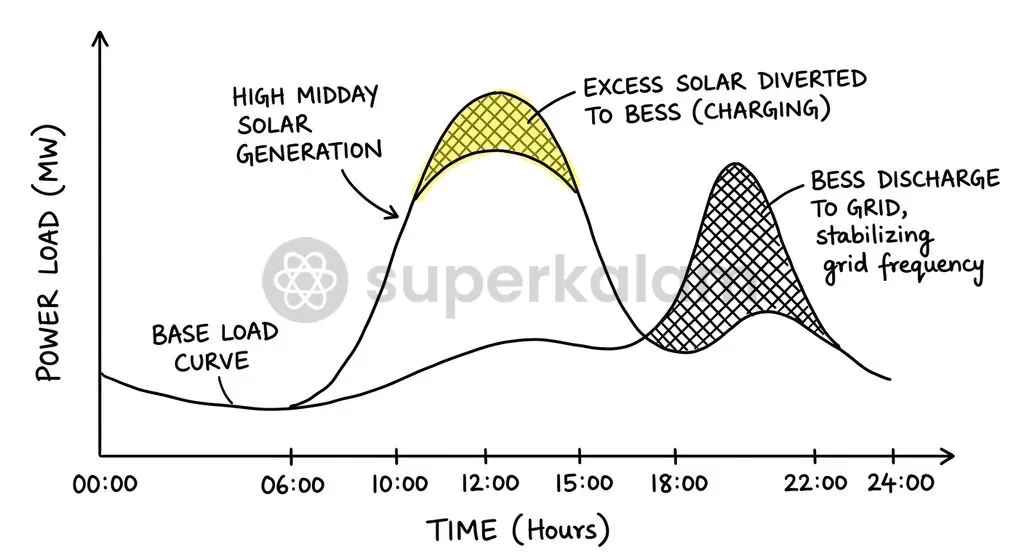
- Tackling the Solar Duck Curve: Solar generation peaks during afternoon hours when system load is moderate, dropping sharply as evening consumption climbs. Co-located batteries store midday energy and discharge power during the evening peak window.
- Preventing Renewable Curtailment: Transmission lines experience congestion during peak generation hours. Grid-scale batteries absorb surplus electricity at generator substations, preventing backing-down instructions from the National Load Despatch Centre.
- Frequency Regulation and Inertia: Solar panels and wind turbines supply zero mechanical inertia. Battery systems deliver millisecond-level rapid frequency support to maintain statutory grid limits when generating units trip.
- Deferring Transmission Capex: Strategic battery deployment at substations shaves peak loads, reducing the required capacity and capital expenditure of new transmission lines.
To mandate operational flexibility, the Central Electricity Authority published draft regulations requiring ground-mounted solar and onshore wind projects commissioned after July 1, 2027, to co-locate a 2-hour BESS of at least 10% capacity. Battery power conversion units and at least 15% of renewable inverters must deploy Grid-Forming (GFM) control by July 2027 to provide synthetic inertia.
Financial incentives complement these rules. The Union Cabinet's ₹3,760-crore Viability Gap Funding scheme covers up to 40% of BESS capital expenditure, targeting a Levelised Cost of Storage of ₹5.50–6.60 per kWh. Distribution licensees must also meet a mandatory Energy Storage Obligation trajectory rising to 4.0% by FY 2029-30.
Discuss with Superkalam
Evaluate whether Central Financial Support of ₹54,082 crore is sufficient to insulate retail power tariffs given the ongoing financial distress of state DISCOMs.
Ask NowKey Operational Challenges: Land Acquisition, Supply Chains, and Grid Balancing
Transmission expansion requires acquiring land corridors, securing critical minerals, and managing utility balance sheets. Resolving these constraints is necessary to prevent severe commissioning bottlenecks.
The Central Electricity Authority notes that grid expansion requires adding over 1,91,000 ckm of lines and 1,270 GVA transformation capacity by 2032 at an estimated cost of ₹9.15 lakh crore.
| Bottleneck Category | Core Structural Constraint | Operational Impact on Grid Expansion |
|---|---|---|
| Right-of-Way (RoW) & Land | • Dense crop compensation disputes • Forest clearance delays |
Prolongs project timelines and inflates civil execution costs |
| Critical Mineral Supply Chains | • ~100% import dependency for processed Li, Ni, and Co | Exposes storage targets to global raw material price shocks |
| DISCOM Financial Health | • High AT&C losses • Delayed tariff true-up filings |
Elevates counterparty payment risk for long-term BESS tenders |
Land acquisition and Right-of-Way (RoW) rules present continuous friction:
- Right-of-Way (RoW) Disputes: Running high-voltage lines across agricultural lands triggers local compensation disputes, frequently ending in protracted litigation.
- Clearance Backlogs: Lines routed through eco-sensitive zones and forest patches face multi-agency statutory delays.
Supply chains present serious external exposure. India imports nearly 100% of its processed lithium, nickel, and cobalt, mostly from China and East Asian refiners. Upstream price spikes directly increase battery pack costs.
Counterparty risk remains a hurdle at the state level. Persistent Aggregate Technical and Commercial (AT&C) losses and delayed tariff adjustments continue to weaken State Distribution Companies (DISCOMs). These financial weaknesses dampen private developer participation in long-term storage auctions.
Discuss with Superkalam
Design a strategic roadmap to reduce India's 100% import dependency on processed critical minerals required for the 50 GWh BESS mandate.
Ask NowWay Forward: Building a Resilient, Flexible National Grid by 2030
Reaching India's 500 GW clean capacity milestone requires pairing battery storage with pumped hydro assets and domestic manufacturing.
Key policy priorities include:
- Strengthening Domestic Battery Manufacturing: The Ministry of Heavy Industries must accelerate the ₹18,100-crore Production Linked Incentive (PLI) Scheme for Advanced Chemistry Cells (ACC). Awardees must secure 25% domestic value addition within two years and 60% within five years, committing ₹225 crore per GWh to reduce import reliance.
- Harnessing Pumped Storage Hydropower (PSP): Batteries manage short daily shifts, while Pumped Storage Hydro handles seasonal balancing. Developers should utilise the 100% waiver of ISTS charges for PSPs awarded on or before June 30, 2028.
- Rigorous Enforcement of Storage Obligations: State regulators must enforce the Energy Storage Obligation (ESO) trajectory up to 4.0% by FY 2029-30, penalising non-compliant distribution licensees.
- Mandating Advanced Grid Standards: Regulators must ensure compliance with CEA Grid-Forming inverter standards and storage co-location mandates by July 2027 to supply synthetic inertia.
- Streamlining Right-of-Way Approvals: State authorities must standardise Right-of-Way compensation norms and introduce single-window digital clearances to speed up private transmission builds.
Key Takeaways
- The Union Cabinet approved Green Energy Corridor Phase-III on September 30, 2026, with a total outlay of ₹1,86,405 crore to evacuate 135 GW of renewable capacity by FY 2032-33.
- GEC Phase-III allocates ₹1,36,378 crore for Intra-State Transmission Systems and ₹50,000 crore for 50 GWh of Battery Energy Storage Systems (BESS), supported by ₹54,082 crore in Central Financial Support.
- Greenfield transmission works under Phase-III will follow Tariff-Based Competitive Bidding (TBCB) on a BOOM model, while brownfield upgradations will use a Cost-Plus Basis.
- According to the Central Electricity Authority, India requires 73.93 GW / 411.4 GWh of storage by 2031-32 (47.24 GW BESS and 26.69 GW PSP) to prevent renewable curtailment and stabilise grid frequency.
- The CEA has mandated co-located 2-hour BESS (minimum 10% capacity) for solar and wind projects commissioned after July 1, 2027, alongside Grid-Forming control capabilities for battery PCS and at least 15% of renewable inverters.
- Addressing supply chain vulnerability requires scaling the ₹18,100-crore Advanced Chemistry Cell PLI scheme to achieve 60% domestic value addition within five years.
Mains Question
The Union Cabinet's approval of the ₹1.86-lakh-crore Green Energy Corridor Phase-III represents a shift from simple power evacuation to storage-backed transmission planning. Examine how this framework addresses the technical vulnerabilities of integrating large-scale variable renewable energy into the national grid. (10 Marks)
Evaluate NowMains Question
"Achieving India's long-term renewable energy targets requires addressing structural frictions across land acquisition, critical mineral supply chains, and power distribution finances." In light of the Green Energy Corridor initiatives, critically analyse the operational bottlenecks confronting grid modernisation and suggest policy measures to mitigate them. (15 Marks)
Evaluate NowPractice MCQs
QUESTION 1
With reference to the Green Energy Corridor Phase-III (GEC-III) scheme, consider the following statements:
- It focuses on developing Intra-State Transmission Systems (InSTS) paired with utility-scale Battery Energy Storage Systems (BESS).
- Greenfield transmission lines under the scheme are executed through Tariff-Based Competitive Bidding on a Build-Own-Operate-Maintain model.
- The entire financial outlay is borne by State Transmission Utilities without any central budgetary assistance.
Which of the statements given above are correct?
QUESTION 2
Consider the following statements regarding the technical and regulatory frameworks for renewable grid integration in India:
- Draft Central Electricity Authority regulations mandate a 2-hour BESS of at least 10% capacity for solar and wind projects commissioned after July 1, 2027.
- Renewable generation units inherently provide mechanical inertia equivalent to conventional thermal turbines.
- At least 15% of renewable inverters must adopt Grid-Forming (GFM) control to supply synthetic inertia by July 2027.
Which of the statements given above is/are correct?
QUESTION 3
Consider the following statements regarding the evolution of India's Green Energy Corridor (GEC) programme:
- Phase-I was structured with nil battery energy storage integration and relied on bilateral financing including a KfW loan.
- Phase-II incorporated an Inter-State Transmission System project in Ladakh featuring 13 GW renewable capacity and 12 GWh storage.
- Phase-III scales up evacuation capacity to 135 GW backed by 50 GWh of storage across state grid nodes.
Which of the statements given above are correct?
QUESTION 4
According to the Central Electricity Authority's generation and transmission projections, consider the following statements:
- India's projected energy storage requirement by 2031-32 relies entirely on Pumped Storage Projects without utility-scale batteries.
- The Viability Gap Funding scheme covers up to 40% of the capital expenditure for Battery Energy Storage Systems.
- Distribution licensees are subject to an Energy Storage Obligation trajectory rising to 4.0% by FY 2029-30.
Which of the statements given above is/are correct?
QUESTION 5
Which of the following creates the primary external supply chain vulnerability for India's utility-scale Battery Energy Storage Systems (BESS) deployment under GEC Phase-III?