PRIP Scheme: Inside India's ₹5,000-Crore Pharma R&D Push
The Rs5,000 crore PRIP Scheme supports pharma and MedTech research. See its objectives, NIPER centres of excellence, industry support and Discovery Track.
Oct, 2026
•8 min read

Overview
The Promotion of Research and Innovation in Pharma-MedTech Sector (PRIP) Scheme is a The total financial outlay for the scheme is ₹5,000 crore. Central Sector initiative designed to transform India's pharmaceutical industry from a high-volume generic producer into a high-value global innovation hub. Spanning a five-year implementation period from FY 2023–24 to FY 2027–28, the programme addresses India's persistent value gap by funding advanced infrastructure, complex generics, and novel chemical entities.
Its newly operationalised Discovery Track offers financial assistance of up to ₹50 crore for early-stage drug discovery. By requiring co-funding to crowd in private venture capital, the scheme moves domestic biopharma up the global intellectual property value chain.
Why in the News: The Latest Push for Pharma-MedTech Innovation
The Department of Pharmaceuticals approved ₹1,600 crore in financial assistance for 41 pioneering projects under the first call of the PRIP Scheme. As of September 2026, this milestone operationalises the government's flagship effort to de-risk high-stakes pharmaceutical research.
The approved funding breaks down across three distinct therapeutic and technology streams:
- New Medicines (27 projects): Targets New Chemical Entities (NCEs) and biological platforms.
- Novel Medical Devices (9 projects): Accelerates high-end diagnostic equipment and therapeutic hardware.
- Complex Generics & Biosimilars (5 projects): Expands affordable access to difficult-to-formulate therapies.
Pioneering research backed under this round includes an exosome-based regenerative therapy for corneal disease and an in-vivo Chimeric Antigen Receptor T-cell (CAR-T) platform. It also funds novel antibacterials designed to overcome multidrug-resistant Gram-negative bacterial infections.
Discuss with Superkalam
What is the statutory timeline under the New Drugs and Clinical Trials Rules, 2019 for the CDSCO to decide on clinical trial applications for investigational drugs?
Ask NowWhat Is the PRIP Scheme and How Is Its ₹5,000-Crore Outlay Structured?
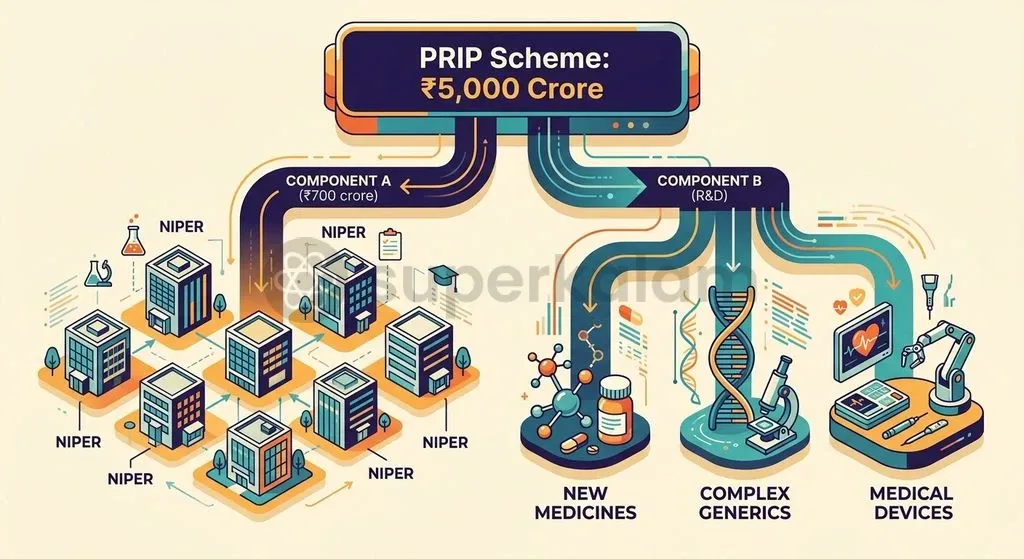
The Ministry of Chemicals and Fertilizers structured the PRIP Scheme as a ₹5,000-crore five-year intervention running from FY 2023–24 to FY 2027–28. The initiative runs through two distinct, mutually reinforcing components targeting institutional capacity and commercial pipelines.
The scheme divides funding between institutional development and industry-led research:
- Component A (₹700 crore): Upgrades infrastructure and builds dedicated Centres of Excellence (CoEs) across seven National Institutes of Pharmaceutical Education and Research (NIPERs).
- Component B (₹4,300 crore): Delivers direct financial assistance for R&D projects across industry, MSMEs, and startups.
Under Component A, parliamentary disclosures show that ₹183.46 crore had been disbursed to the seven NIPERs by January 31, 2026. These funds procure advanced analytical equipment and establish specialised research laboratories.
Component B targets three specific industry priorities:
- New Medicines: Backs New Chemical Entities (NCEs), New Biological Entities (NBEs), and standardised phytopharmaceuticals (plant-derived medicinal compounds).
- Complex Generics and Biosimilars: Supports clinical development for complex synthetic peptides, recombinant proteins, and monoclonal antibodies.
- Novel Medical Devices: Funds indigenous design and manufacturing of high-end diagnostic, imaging, and implantable medical technologies.
This funding framework connects directly with wider national manufacturing initiatives. PRIP complements the ₹15,000-crore PLI Scheme for Pharmaceuticals and the ₹6,940-crore PLI Scheme for Bulk Drugs, establishing a linked policy pipeline from discovery to manufacturing scale.
Understanding the Discovery Track: Moving Beyond Generic Manufacturing
The Discovery Track provides targeted financial assistance of up to ₹50 crore per company to de-risk early-stage New Chemical Entity and biological research. This specialised track focuses exclusively on pre-clinical and translational stages, where private capital is historically most hesitant to invest.
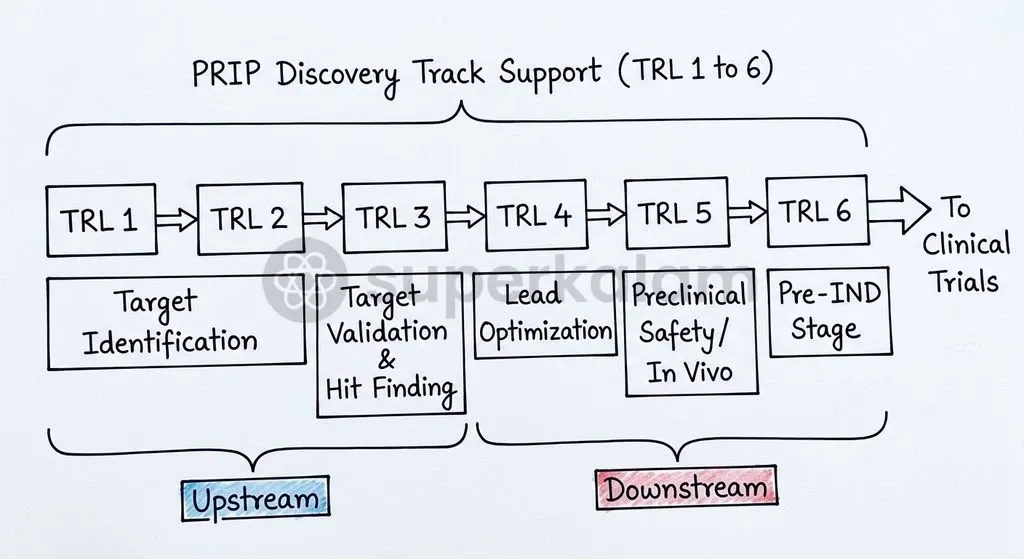
Eligible proposals must begin at Technology Readiness Levels (TRL) 1, 2, or 3, funding their progression up to TRL 6:
- TRL 1–3 (Concept & Target Validation): Focuses on target identification, hit-to-lead validation, and fundamental biological synthesis.
- TRL 4–5 (Laboratory & Animal Validation): Covers in-vitro optimisation, lead candidate profiling, and comprehensive animal efficacy testing.
- TRL 6 (Pre-IND Demonstration): Delivers non-human safety validation, formal toxicology profiling, and preparation for Investigational New Drug (IND) filings.
To crowd in private venture investment, applicants must secure a minimum 25% co-funding commitment from bona fide institutional investors. This mandatory co-investment ensures that public funds support commercially viable scientific hypotheses vetted by market participants.
Discuss with Superkalam
Why does the Discovery Track require a mandatory 25% co-funding commitment from private institutional investors rather than providing 100% public grants?
Ask NowHow PRIP Connects Industry, Academia, and Startups
National Institutes of Pharmaceutical Education and Research are institutional anchors connecting academic research with commercial pharmaceutical development. By upgrading NIPER infrastructure into shared research hubs, the scheme allows startups and MSMEs to access high-end laboratory equipment without prohibitive initial capital expenditures.
Collaborative platforms also work to resolve regulatory friction. The MedTech Mitra platform brings this coordination together, managed jointly by the Indian Council of Medical Research (ICMR), the Central Drugs Standard Control Organisation (CDSCO), and the Department of Pharmaceuticals.
MedTech Mitra guides innovators through several critical commercialisation steps:
- Preclinical animal studies: Protocols and safety reviews.
- Clinical evaluation pathways: Structured trial design and statutory compliance.
- Conformity assessments: Device testing and standardisation clearances.
Comparing India's Generic Dominance with Global R&D Leaders
Global pharmaceutical rankings reveal a stark divergence between India's immense manufacturing volume and its modest share of intellectual property value. India is recognised globally as the "pharmacy of the world," supplying essential, cost-effective medications across developed and developing nations alike.
| Dimension | India (Generic-Led Model) | Global Biopharma Leaders (US, Europe, China) |
|---|---|---|
| Global Production Rank | 3rd globally by volume (~20% global generic supply, ~60% vaccines) | Lower volumetric share, dominant market value concentration |
| Global Value Rank | 14th globally by value | Top-tier market value dominance |
| Industry R&D Spend | Less than 5% to 8% of annual revenue | 15% to 25% of annual revenue |
| Primary Focus Areas | Simple generics, process chemistry, formulation engineering | First-in-class NCEs, gene therapies, advanced biologics |
| Capital Architecture | Debt-heavy corporate balance sheets, low VC appetite | Deep public venture capital, private equity, capital markets |
Bridging this gap requires transitioning from incremental formulation improvements to discovery-driven biotherapeutics. While process engineering delivers reliable margins, patented breakthrough molecules generate disproportionate long-term returns and strategic health sovereignty.
Discuss with Superkalam
If an Indian biotech startup has developed a novel lead compound at TRL 2, how can it utilize the PRIP Scheme and NIPER infrastructure to advance towards an Investigational New Drug (IND) filing?
Ask NowMajor Challenges Facing India's Pharmaceutical Innovation Pipeline
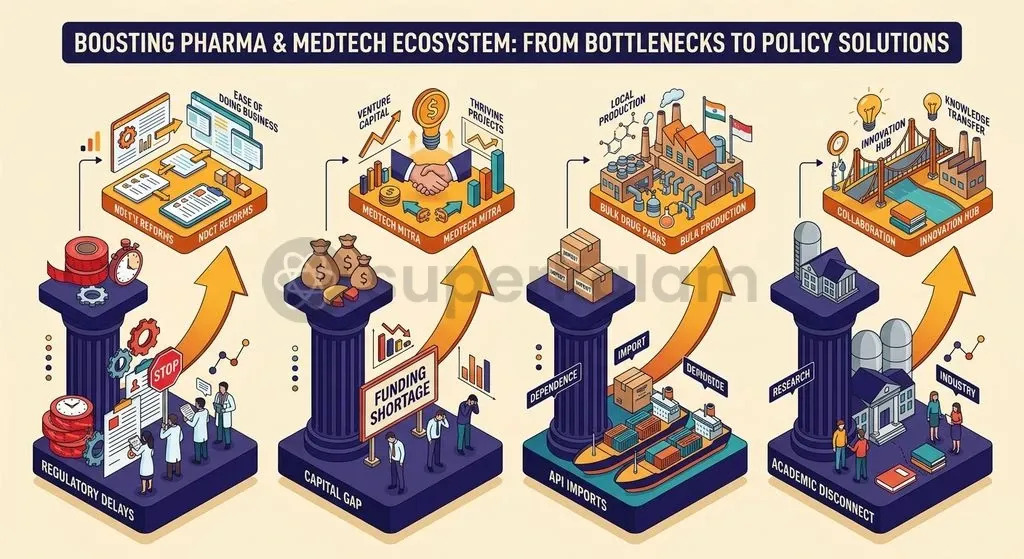
Indian drug discovery faces substantial structural bottlenecks spanning regulatory timelines, limited early-stage venture funding, and high attritional risks in clinical trials. Developing a single New Chemical Entity requires significant risk capital, with failure rates exceeding 90% in early translational stages.
Key structural challenges confronting the domestic sector include:
- Protracted Regulatory Timelines: Under the New Drugs and Clinical Trials (NDCT) Rules, 2019, the statutory period for CDSCO to decide on clinical trial applications for investigational drugs is 90 working days. While the New Drugs and Clinical Trials (Amendment) Rules, 2026 reduced the timeline for manufacturing test licences from 90 to 45 working days, comprehensive trial clearances still require multi-committee reviews.
- Constrained Risk Capital: Domestic venture funds traditionally favour late-stage service companies over high-risk, early-stage drug development ventures that demand long gestation horizons.
- Upstream Supply Chain Vulnerabilities: Domestic drug synthesis remains reliant on imported raw materials. To mitigate this dependency, the Department of Pharmaceuticals is developing three Bulk Drug Parks with a ₹3,000-crore outlay in Gujarat, Himachal Pradesh, and Andhra Pradesh to ensure active pharmaceutical ingredient (API) security.
- Academic-Industrial Disconnect: University research has historically prioritised academic publication over filing enforceable patent portfolios and licensing technology to commercial drugmakers.
Discuss with Superkalam
Analyze the structural differences in capital architecture and R&D spending between India's generic-led pharma industry and global biopharma leaders.
Ask NowWay Forward: Building a High-Value Biopharma Ecosystem
Sustaining India's biopharmaceutical transition requires synchronising public R&D grants, streamlined regulatory approvals through CDSCO, and deep domestic venture capital markets. The PRIP scheme establishes a foundational framework, but enduring global competitiveness requires structural reforms across the research ecosystem.
Priority policy interventions focus on four strategic pillars:
- Expanding Blended Finance Mechanisms: Public discovery grants must integrate with institutional venture capital to fund Phase II and Phase III clinical trials.
- Accelerating Regulatory Approvals: Expanding digital single-window clearances and enhancing technical capacity within CDSCO will ensure statutory review timelines under the NDCT Rules are consistently met without compromising safety.
- Institutionalising IP Commercialisation: Academic institutes must create professional Technology Transfer Offices (TTOs) to license university discoveries to commercial pharma enterprises.
- Consolidating Industrial Infrastructure: Accelerating the operationalisation of the three Bulk Drug Parks across Gujarat, Himachal Pradesh, and Andhra Pradesh will insulate indigenous drug discovery from international raw material price volatility.
Key Takeaways
- Policy Architecture: The PRIP Scheme is a ₹5,000-crore Central Sector Scheme (FY 2023–24 to FY 2027–28) managed by the Department of Pharmaceuticals to pivot Indian pharma from volume to innovation.
- Component Breakdown: Component A allocates ₹700 crore to seven NIPERs (with ₹183.46 crore disbursed by January 31, 2026), while Component B funds industry, MSME, and startup innovation.
- Discovery Track Mechanics: Offers up to ₹50 crore per project to progress NCE/NBE candidates from TRL 1–3 up to TRL 6, backed by a mandatory 25% institutional co-funding rule.
- First-Round Deployments: The central government approved ₹1,600 crore for 41 projects (27 New Medicines, 9 Medical Devices, 5 Biosimilars), including novel antibacterials and exosome therapies.
- Structural Value Gap: India ranks 3rd globally in volume but only 14th in value, spending under 5–8% of revenue on R&D compared to 15–25% among global industry leaders.
- Regulatory Modernisation: The NDCT (Amendment) Rules, 2026 shortened manufacturing test licence timelines from 90 to 45 working days, complementing inter-agency platforms like MedTech Mitra.
Mains Question
"While India is globally recognised as the 'pharmacy of the world' in terms of generic volume, it faces a significant value gap in biopharmaceutical innovation." In light of the Promotion of Research and Innovation in Pharma-MedTech Sector (PRIP) Scheme, evaluate the strategy to transition domestic biopharma up the global value chain. (15 Marks)
Evaluate NowMains Question
"High translational attrition rates, lengthy regulatory clearances, and raw material dependencies impede India's pharmaceutical innovation pipeline." Critically examine the structural challenges confronting drug discovery in India. (10 Marks)
Evaluate NowPractice MCQs
QUESTION 1
With reference to the Promotion of Research and Innovation in Pharma-MedTech Sector (PRIP) Scheme, consider the following statements:
- It is a Central Sector initiative structured with a total financial outlay of ₹5,000 crore spanning from FY 2023–24 to FY 2027–28.
- Component A is dedicated to upgrading infrastructure and establishing Centres of Excellence across seven NIPERs.
- Component B exclusively finances the manufacturing scale-up of conventional generic formulations. Which of the statements given above is/are correct?
QUESTION 2
Consider the following statements regarding the Discovery Track under the PRIP Scheme:
- It provides financial assistance of up to ₹50 crore per company to de-risk early-stage drug discovery.
- It supports scientific proposals starting at Technology Readiness Levels (TRL) 1, 2, or 3 and funds progression up to TRL 6.
- Applicants are required to secure a minimum 25% co-funding commitment from bona fide institutional investors. Which of the statements given above are correct?
QUESTION 3
Regarding the structural profile and regulatory framework of India's pharmaceutical sector, consider the following statements:
- India ranks 3rd globally in pharmaceutical production volume but 14th by value.
- The Indian pharmaceutical industry spends approximately 15% to 25% of annual revenue on R&D, on par with global leaders.
- Under the New Drugs and Clinical Trials (Amendment) Rules, 2026, the statutory timeline for manufacturing test licences was reduced to 45 working days. Which of the statements given above is/are correct?
QUESTION 4
Consider the following statements regarding the 'MedTech Mitra' platform:
- It is jointly managed by the Indian Council of Medical Research (ICMR), Central Drugs Standard Control Organisation (CDSCO), and Department of Pharmaceuticals.
- It provides handholding for innovators across preclinical animal study protocols, clinical evaluation pathways, and conformity assessments. Which of the statements given above is/are correct?
QUESTION 5
To mitigate active pharmaceutical ingredient (API) import dependency, the Department of Pharmaceuticals is establishing three Bulk Drug Parks with an outlay of ₹3,000 crore across which group of states?