ECI Voter Re-Enrolment: Due Process, Tech Purges & RPA 1950
As automated roll purges risk arbitrary disenfranchisement, the ECI's re-enrolment drive reinforces statutory due process under electoral law.
Oct, 2026
•8 min read

Overview
The Election Commission of India has directed Chief Electoral Officers to initiate targeted voter re-enrolment drives under continuous updation. This step aims to rectify arbitrary disenfranchisement after algorithmic voter roll purges bypassed mandatory statutory inquiries.
The drive highlights an enduring administrative friction. It pits centralised digital database sanitisation against statutory due-process protections under electoral law. Automated deduplication seeks to eliminate duplicate entries across over 95 crore voters. However, unverified software purges turn a decision-support platform into an instrument of wrongful exclusion.
Reconciling digital efficiency with democratic inclusion requires statutory notice compliance, independent code audits, and grassroots operational support.
Why in the News: The Push to Re-Enroll Unjustly Excluded Citizens
The Election Commission of India directed state election authorities to launch special re-enrolment drives under continuous updation to restore eligible electors excluded during intensive revision exercises. This administrative push follows reports of genuine voters finding their names missing from rolls without prior statutory notice or physical field verification. As of October 2026, election authorities have mobilised field machinery to process fresh enrolment claims through continuous updation mechanisms.
Electoral roll revision balances database hygiene with universal franchise under the constitutional supervision of the Election Commission of India. When automated software purges run without ground checks, bureaucratic speed trumps procedural fairness. Restoring wrongfully deleted citizens is not just an administrative correction; it remains a statutory obligation under electoral law.
The special drive focuses on three core administrative priorities:
- Restoring Omitted Electors: Re-enrolling legitimate citizens deleted without formal notice during mass cleanup exercises.
- Continuous Updation Activation: Directing state machinery to process claims continuously right up to nomination deadlines.
- Field Machinery Mobilisation: Requiring grassroots officers to verify physical residence before executing deletions.
Statutory Safeguards: How Section 22 of the RPA Mandates Natural Justice
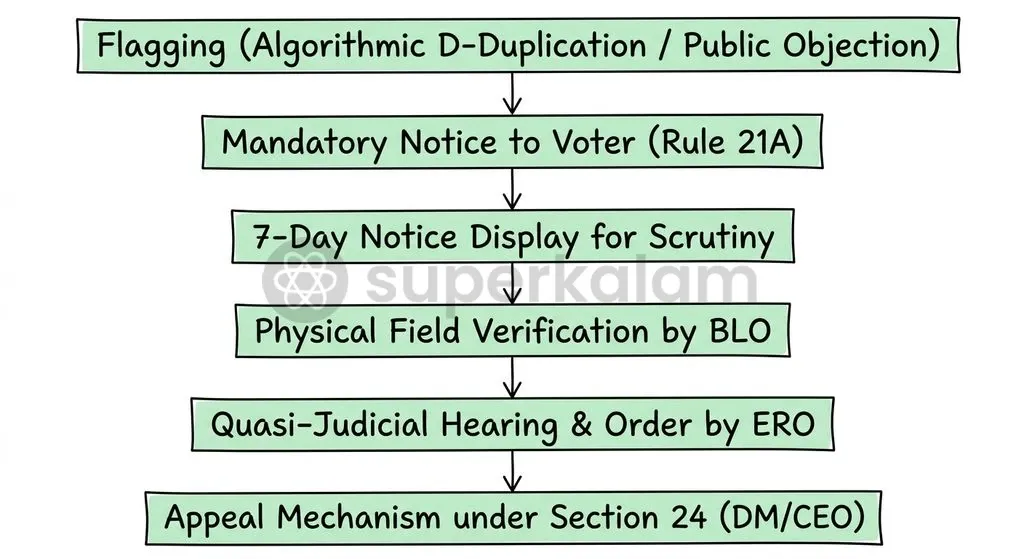
Section 22 of the Representation of the People Act, 1950 prohibits the summary deletion of an elector's name without providing a reasonable opportunity of being heard. The Electoral Registration Officer must follow statutory natural justice before altering or deleting any entry on grounds of shifted residence or disqualification. Administrative convenience cannot bypass this mandatory inquiry.
Procedural mechanisms under secondary legislation reinforce these statutory protections:
- Mandatory Show-Cause Notice: Rule 21A of the Registration of Electors Rules, 1960 requires the Electoral Registration Officer to issue a formal show-cause notice and hold an inquiry before deleting inadvertently registered names.
- Public Scrutiny Window: Under statutory operational guidelines, lists of proposed deletions during continuous updation must be displayed on the Electoral Registration Officer's notice board for at least 7 days for public objections.
- Continuous Updation Window: Section 23 of the Representation of the People Act, 1950, read with Rule 26 of the 1960 Rules, allows omitted citizens to submit Form 6 for inclusion up to the last date of nominations.
- Statutory Appeals Architecture: Section 24 of the Representation of the People Act, 1950 grants an aggrieved citizen a first appeal to the District Collector and a second appeal to the Chief Electoral Officer.
The statutory framework prescribes specific forms under the Registration of Electors Rules, 1960:
- Form 6: Designated exclusively for the inclusion of names for new or omitted electors.
- Form 7: Prescribed for lodging objections against an existing inclusion or seeking the deletion of a name.
- Form 8: Utilised for correcting demographic particulars, updating photographs, or executing transposition within a constituency.
To broaden registration access, the Election Laws (Amendment) Act, 2021 amended Section 14(b) of the Representation of the People Act, 1950 to introduce four qualifying dates each year: January 1, April 1, July 1, and October 1.
Discuss with Superkalam
What are the four statutory qualifying dates introduced by the Election Laws (Amendment) Act, 2021?
Ask NowAlgorithms vs Ground Reality: ERONET De-Duplication and BLO Workload
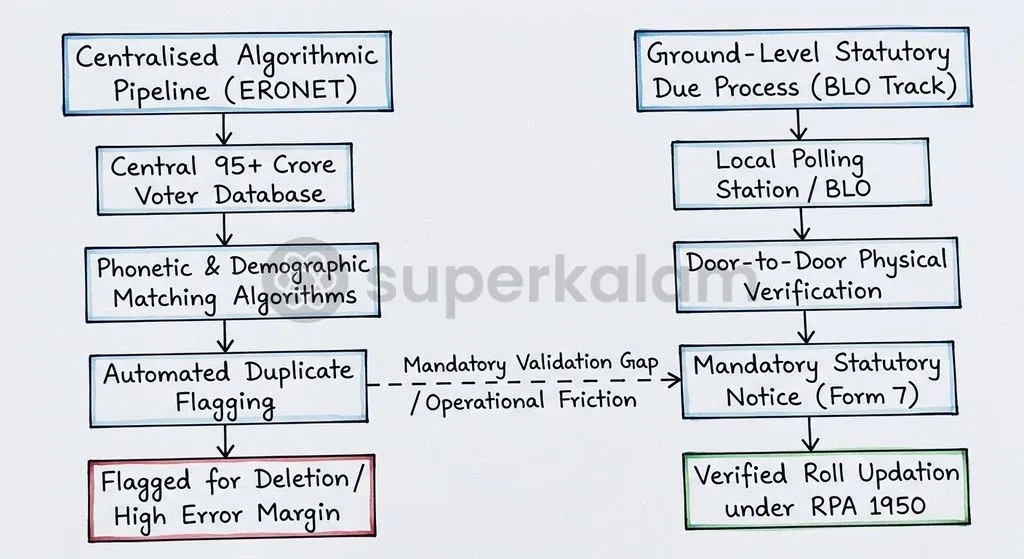
The Election Commission of India deploys the ERONET platform across the Unified National Photo Electoral Roll database, which houses over 95 crore voter records to automate processing and identify duplicate entries. ERONET uses algorithmic parameters to cross-match entries across constituencies, flagging potential demographic and phonetic similarities.
Algorithmic de-duplication in India generates false positives due to shared naming conventions, common patronymics, and approximate birth dates. The statutory architecture designates ERONET strictly as a decision-support tool, explicitly barring automated machine deletions without formal Electoral Registration Officer adjudication.
The gap between software algorithms and ground verification emerges from several operational constraints:
- High False-Positive Rates: Common phonetic spellings and shared family names trigger inaccurate duplicate flags across national rolls.
- Statutory Decision Boundaries: Software is legally restricted to generating advisory flags rather than executing automated voter deletions.
- Frontline Workload Pressures: Booth Level Officers—primarily teachers, Anganwadi workers, and revenue staff—face compressed timelines during revision drives.
- Superficial Field Scrutiny: Heavy administrative burdens lead some staff to accept automated deletion flags without conducting comprehensive physical visits.
The Aadhaar-Voter ID Controversy: Lessons from Mass Deletion Precedents
Past administrative purification drives demonstrated that automated cross-database linkages carry significant risks of wrongful voter disenfranchisement. During the 2015 National Electoral Roll Purification and Authentication Programme and the 2018 Telangana Assembly elections, algorithmic cross-matching with Aadhaar and state resident databases led to the reported unverified deletion of approximately 30 lakh voter entries.
Mass exclusions exposed the hazards of relying on external demographic databases for voter roll management. The judicial framework governing roll fidelity rests on key constitutional rulings:
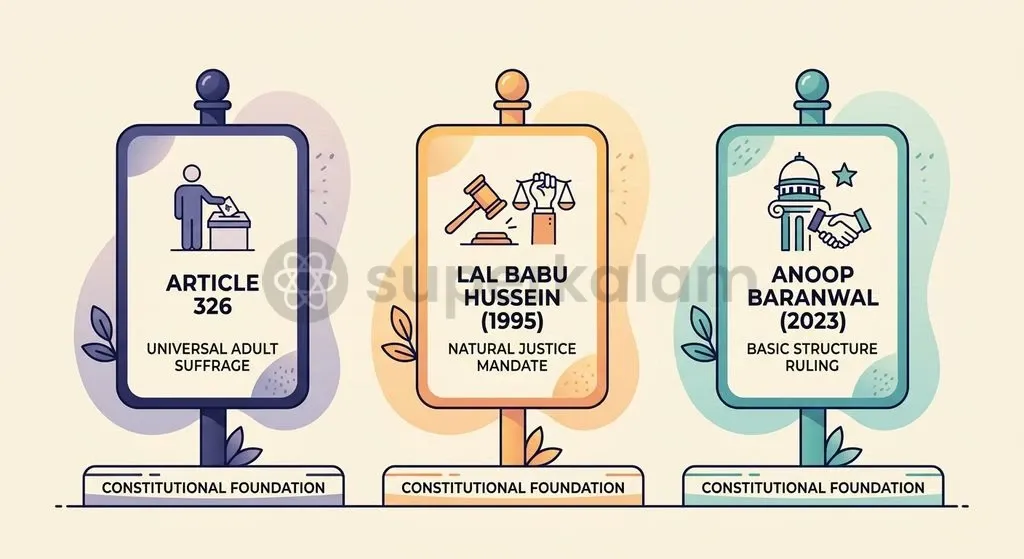
- Burden of Proof on Administration: In Lal Babu Hussein v. Electoral Registration Officer (1995), the Supreme Court established that an enrolled voter cannot be summarily deleted without substantive material and adherence to natural justice, placing the primary burden of proof squarely on the election administration.
- Electoral Integrity as Basic Structure: In Anoop Baranwal v. Union of India (2023), the Supreme Court reinforced that free, fair, and credible elections form an integral part of the basic structure of the Constitution.
- Institutional Due Process: Administrative systems must establish procedural safeguards to prevent automated exclusions that erode democratic legitimacy.
Discuss with Superkalam
Why does algorithmic de-duplication generate high false-positive rates when applied to Indian voter databases?
Ask NowCleanup Models: Automated Digital Purging vs Door-to-Door Physical Verification
Electoral roll maintenance involves choosing between centralised algorithmic purging and decentralised, physical field verification. Algorithmic matching processes millions of records rapidly, yet it struggles with contextual demographic realities. In contrast, door-to-door verification ensures human contact but requires significant administrative resources and time.
The table below contrasts the two operational approaches across statutory and administrative dimensions:
| Dimension | Automated Digital Purging (Algorithm-First) | Physical Field Verification (BLO-Led) |
|---|---|---|
| Primary Mechanism | Centralised phonetic and demographic matching on databases | Door-to-door physical visits and local verification by Booth Level Officers |
| Speed and Scale | High; analyses millions of entries across constituencies instantaneously | Moderate to slow; limited by field staff capacity and revision windows |
| Error Typology | High false-positive rate on shared names and approximate age clusters | Low false-positive rate, but vulnerable to field non-contact and human oversight |
| Statutory Due Process | High risk of violating the Section 22 hearing mandate if automated | Fully compliant with show-cause notice and inquiry requirements |
| Vulnerable Cohort Impact | Disproportionately flags internal migrant workers, women, and linguistic minorities | Offers immediate on-site verification and collection of supporting documents |
| Statutory Role | Permitted solely as an advisory decision-support system | Core statutory evidentiary foundation for Electoral Registration Officer orders |
The Election Commission of India also undertakes Special Intensive Revisions under Section 21(3) of the Representation of the People Act, 1950 to reconstruct rolls from the ground up in areas undergoing rapid demographic churn or extensive out-migration.
Discuss with Superkalam
If a genuine voter discovers their name missing during election season, what statutory remedies and forms can they utilise up to the last date of nominations?
Ask NowConstitutional Stakes: Article 326, the Franchise, and Democratic Legitimacy
Article 326 of the Constitution of India guarantees universal adult suffrage, establishing that every citizen aged 18 years or above is entitled to be registered unless disqualified by law. This constitutional entitlement is executed through the statutory machinery of the Representation of the People Act, 1950.
Electoral management bodies confront a structural trade-off between maximising roll purity and protecting substantive democratic inclusion. An administrative fixation on statistical perfection can penalise migrant workers and vulnerable households who are difficult to trace during standard office hours. Administrative metrics must never take precedence over substantive democratic rights.
Way Forward: Independent Algorithm Audits, Notice Mandates, and BLO Support
The Election Commission of India must ensure algorithmic tools remain subordinate to statutory due-process mandates through institutional and technical reforms. Technology should assist administrative adjudication rather than replace field-based inquiry.
The key reform priorities include:
- Mandatory Multi-Channel Notice Trail: The Parliamentary Standing Committee on Personnel, Public Grievances, Law and Justice recommended establishing a verifiable paper trail by pairing physical registered show-cause notices with SMS and digital alerts before approving any deletion.
- Third-Party Algorithmic Bias Audits: In line with recommendations from the Justice B.N. Srikrishna Committee report, independent technical bodies should conduct periodic bias audits of ERONET de-duplication code to prevent the systematic exclusion of demographically vulnerable cohorts.
- Capacity Building for Booth Level Officers: Providing formal training, modern digital devices, and dedicated honorariums will alleviate operational strain and ensure reliable ground verification.
- Proactive Public Disclosure: Displaying proposed deletion lists at gram panchayat offices, urban ward centres, and public digital portals ensures local community scrutiny before final orders are passed.
Discuss with Superkalam
How does automated digital purging compare with Booth Level Officer-led field verification in terms of statutory due process and error typologies?
Ask NowKey Takeaways
- Statutory Hearing Mandate: Section 22 of the Representation of the People Act, 1950 prohibits the deletion of an elector's name without a reasonable opportunity of being heard.
- Decision Support Only: ERONET is statutorily designed as a decision-support tool across 95 crore voter records and cannot execute automated deletions without Electoral Registration Officer inquiry.
- Judicial Precedent on Proof: The Supreme Court in Lal Babu Hussein (1995) affirmed that the burden of proof rests on the election administration before deleting an enrolled voter.
- Basic Structure Anchor: The Supreme Court in Anoop Baranwal (2023) held that free, fair, and credible elections form part of the basic structure of the Constitution.
- Continuous Updation Window: Section 23 of the Representation of the People Act, 1950 allows omitted citizens to submit Form 6 for inclusion up to the last date of nominations.
Mains Question
"The Representation of the People Act, 1950 establishes statutory natural justice safeguards to prevent arbitrary disenfranchisement during voter roll revisions." In this context, examine the procedural protections available to electors under the Act and secondary rules. (10 Marks)
Evaluate NowMains Question
"While algorithmic de-duplication through platforms like ERONET aims to enhance database hygiene, unverified automated purges risk undermining electoral integrity." Critically analyse this statement in light of administrative challenges and judicial precedents. (15 Marks)
Evaluate NowPractice MCQs
QUESTION 1
With reference to the statutory safeguards governing electoral roll revision under the Representation of the People Act, 1950, consider the following statements:
- Section 22 of the Act explicitly prohibits the summary deletion of an elector's name without providing a reasonable opportunity of being heard.
- Rule 21A of the Registration of Electors Rules, 1960 mandates the issuance of a formal show-cause notice prior to deleting inadvertently registered names.
- Under Section 24 of the Act, an appeal against an Electoral Registration Officer's decision lies first to the Chief Electoral Officer and subsequently to the Supreme Court. Which of the statements given above are correct?
QUESTION 2
Consider the following statements regarding the statutory forms and procedures under the Registration of Electors Rules, 1960:
- Form 6 is prescribed exclusively for the inclusion of names of new or omitted electors.
- Form 7 is designated for updating demographic particulars and intra-constituency transposition.
- The Election Laws (Amendment) Act, 2021 amended Section 14(b) of the RPA, 1950 to provide four qualifying dates in a calendar year. Which of the statements given above is/are correct?
QUESTION 3
Consider the following statements regarding judicial pronouncements on electoral roll management in India:
- In Lal Babu Hussein v. Electoral Registration Officer (1995), the Supreme Court ruled that the primary burden of proof for deletion of an enrolled voter rests squarely on the election administration.
- In Anoop Baranwal v. Union of India (2023), the Supreme Court held that conducting free, fair, and credible elections forms an integral part of the basic structure of the Constitution. Which of the statements given above is/are correct?
QUESTION 4
In the context of the Election Commission of India's roll purification mechanisms, the ERONET platform is statutorily designated as:
QUESTION 5
Under the statutory operational guidelines and provisions of the Representation of the People Act, 1950, what is the mandatory duration for which a list of proposed voter deletions must be displayed for public scrutiny on the Electoral Registration Officer's notice board?
Discuss with Superkalam
Weighing administrative efficiency against democratic legitimacy, should automated algorithmic purges ever be permitted to execute voter deletions without prior physical verification?
Ask Now