UNEP Emissions Gap Report 2026: 1.5°C Goal Slipping, What the Report Says
As emissions close the 1.5°C window, relying on speculative mid-century carbon removal risks irreversible tipping points and deepens global equity divides.
Oct, 2026
•9 min read
Overview
The window to limit global temperature rise to 1.5°C without exceeding that threshold has officially closed, according to the UNEP Emissions Gap Report 2026. Existing domestic policies leave the planet on track for 2.8°C of warming by 2100.
Bridging this divide requires global emissions to fall 45% by 2035 relative to 2025 levels, yet current Nationally Determined Contributions project only an 11% to 15% reduction. Counting on a speculative mid-century overshoot to 1.8°C introduces severe biophysical vulnerabilities, shifting catastrophic ecological and economic risks directly onto developing nations.
Why the Latest UNEP Emissions Gap Report Matters Right Now
The United Nations Environment Programme confirms that the carbon budget required to keep global temperature rise strictly below 1.5°C without exceeding that boundary has now been exhausted. Decades of insufficient mitigation have driven global greenhouse gas emissions to approximately 58.4 GtCO₂e in 2025, foreclosing a smooth, linear decarbonisation trajectory.
The arithmetic of delayed decarbonisation exposes two critical realities:
- Accelerating thermal momentum: Every five years that worldwide carbon dioxide emissions persist at current volumes permanently elevates peak warming by approximately 0.1°C.
- The overshoot compromise: The international dialogue has drifted toward managing an "overshoot"—a scenario where temperatures breach 1.5°C, crest near 1.8°C around mid-century, and theoretically drop back through technological atmospheric extraction.
This statistical framing creates an illusion of policy flexibility. Climate overshoot is not a benign detour, but an unforgiving biophysical trap that compounds systemic risk. Decarbonisation delayed today cannot be compensated tomorrow without inflicting irreversible damage on the Earth's climate system.
What a 1.8°C Climate Overshoot Actually Means in Practice
The United Nations Framework Convention on Climate Change defines climate overshoot as a transient period where warming exceeds targeted thresholds before carbon removal technologies theoretically reverse the rise. To achieve the lowest feasible overshoot pathway, global emissions must decline 18% by 2030, 45% by 2035, and 69% by 2040 relative to 2025 levels, as documented by the UNEP Emissions Gap Report 2026: The Point of Return.
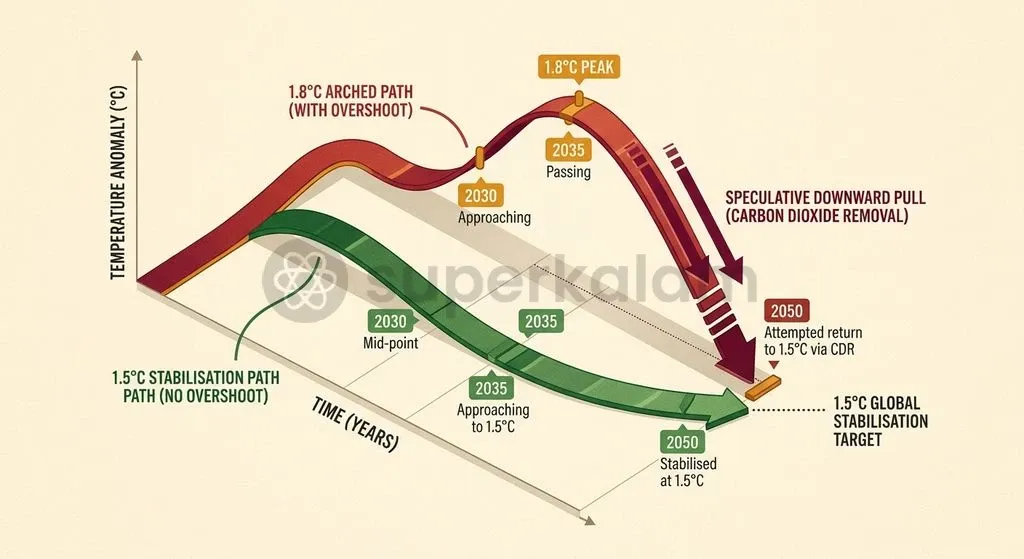
Full implementation of current Nationally Determined Contributions leaves an emissions gap of approximately 16 GtCO₂e in 2035. Current national pledges deliver only an 11% to 15% cut, creating an enormous shortfall against the required 45% benchmark. Meanwhile, the G20 economies account for 76% of global greenhouse gas emissions, with their emissions excluding the land-use sector expanding by 0.7% in 2025.
| Dimension | 1.5°C Non-Overshoot Trajectory | 1.8°C Overshoot Scenario |
|---|---|---|
| Peak Warming Threshold | Caps global mean temperature anomaly at 1.5°C | Peaks between 1.7°C and 1.8°C around mid-century |
| 2035 Emissions Reduction Benchmark | Requires deep, immediate cuts across sectors | Mandates a 45% cut by 2035 against 2025 baselines |
| Emissions Gap (at 2035) | Negligible gap through immediate fossil fuel phaseout | Leaves an emissions gap of roughly 16 GtCO₂e under current NDCs |
| Reliance on Negative Emissions | Limited to residual hard-to-abate industrial sectors | Demands removing ~320 GtCO₂ over the 21st century |
| Ecological Reversibility | Preserves baseline cryosphere and marine habitats | Risks irreversible breaches across critical tipping points |
The Flaw in 'Temporary' Warming: Irreversible Tipping Points
The Intergovernmental Panel on Climate Change demonstrates that warming beyond 1.5°C crosses biophysical thresholds that cannot be restored simply by lowering atmospheric temperatures decades later. Critical planetary components operate with distinct thermal inertia. A transient thermal spike triggers irreversible physical breakdowns across multiple planetary systems:
- Polar ice sheets and ocean circulation: A thermal spike toward 1.8°C threatens the structural integrity of both the Greenland and West Antarctic ice sheets. Destabilisation in these polar systems initiates centuries of unstoppable sea-level rise and disrupts the Atlantic Meridional Overturning Circulation, altering planetary monsoonal patterns.
- Marine biodiversity collapse: Warm-water coral reefs decline by 70% to 90% at 1.5°C, but face over 99% extinction at 2°C. A transient breach past 1.5°C wipes out these living structures, nullifying any subsequent benefit from mechanical cooling in 2100.
- Runaway carbon cycle feedbacks: Permafrost thaw and boreal forest dieback present further nonlinear risks. These tipping elements activate self-reinforcing carbon cycle feedbacks that release vast volumes of methane and carbon dioxide, overwhelming engineered drawdown mechanisms.
Discuss with Superkalam
Recall the global greenhouse gas emissions reduction benchmark required by 2035 relative to 2025 levels to maintain the lowest feasible overshoot pathway.
Ask NowThe Risky Bet on Large-Scale Carbon Dioxide Removal (CDR)
The United Nations Environment Programme projects that mid-century cooling requires sequestering roughly 320 gigatonnes of atmospheric carbon dioxide through unproven, highly speculative removal technologies. This 320-gigatonne requirement corresponds to roughly eight years of global emissions at 2024 rates.
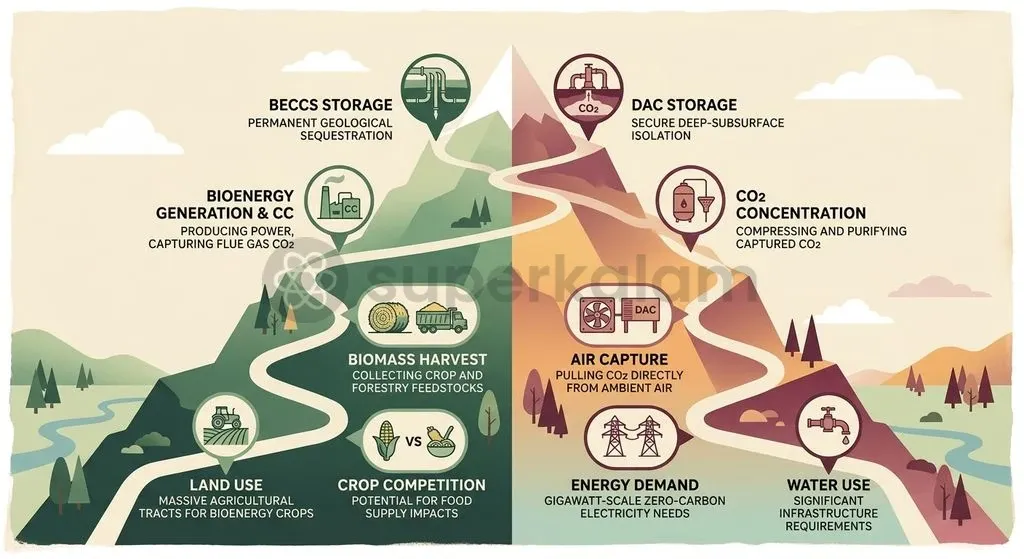
Integrated assessment models lean heavily on two speculative technological pillars:
- Bioenergy with Carbon Capture and Storage (BECCS): Deploying this approach at scale would require hundreds of millions of hectares of arable land, creating severe conflicts with global food security and natural forest preservation.
- Direct Air Carbon Capture and Storage (DACCS): Operating today at a negligible fraction of gigaton scale, engineered extraction faces steep economic, energetic, and resource bottlenecks, demanding immense quantities of zero-carbon power and water per ton of captured carbon dioxide.
Relying on hypothetical future sequestration to justify sustained fossil fuel combustion constitutes an extreme policy gamble. If technical, land, or energy constraints prevent gigatonne-scale carbon drawdown, the world will remain trapped at elevated temperatures permanently.
Discuss with Superkalam
Explain why biophysical tipping points, such as coral reef mortality and polar ice sheet destabilisation, cannot simply be reversed by cooling the atmosphere later in the century.
Ask NowThe Climate Finance Stalemate: Breaking Down the NCQG Deadlock
The UNFCCC COP29 agreement established the New Collective Quantified Goal to mobilise at least $300 billion annually by 2035 from developed nations to developing countries. This financial architecture includes a broader, aspirational target to mobilise $1.3 trillion per year from all public and private sources.
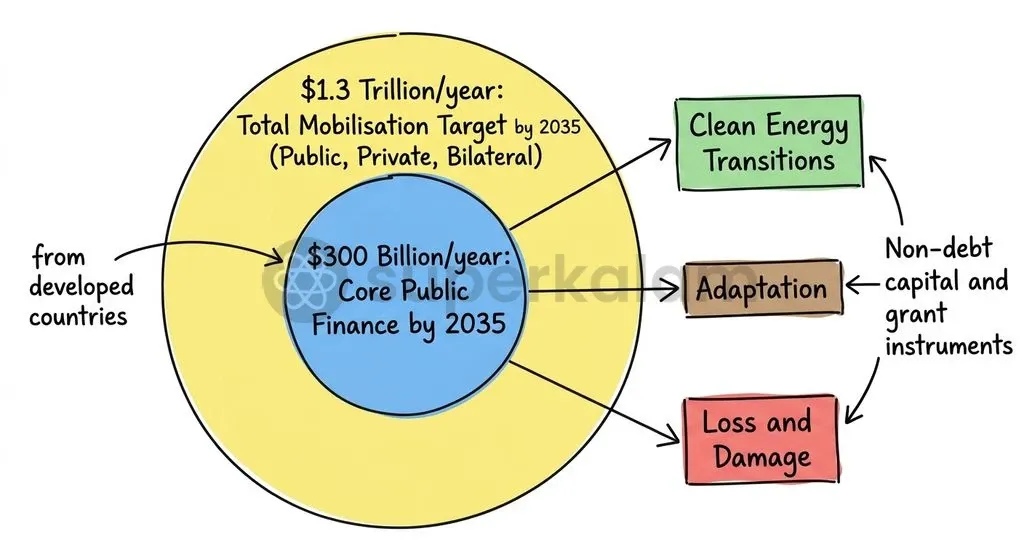
Developing economies face an acute contradiction between rapid decarbonisation and basic economic development:
- Concessional capital requirements: Stepping up renewable installations, upgrading transmission grids, and retiring young fossil infrastructure requires substantial concessional finance that avoids compounding debt, rather than expensive commercial loans.
- Fiscal diversion away from welfare: The persistent shortfall in public climate finance forces developing countries to divert scarce domestic revenues away from public health and education toward climate mitigation and disaster recovery.
Without reliable fiscal transfers, low-income nations cannot close their domestic implementation gaps or finance the transition away from carbon-intensive fuels.
What the Widening Emissions Gap Means for India's Energy Transition
The Ministry of Environment, Forest and Climate Change maintains that India must safeguard its domestic manufacturing and grid reliability while updating its Nationally Determined Contributions for 2035. India continues to anchor its diplomatic posture in the principle of Common But Differentiated Responsibilities, pointing out that its historical contribution to cumulative emissions stands below 4%.
India's climate policy must balance several conflicting domestic pressures:
- Low per-capita baseline: Indian per-capita emissions remain less than half the global average, reflecting deep domestic frugality alongside widespread energy poverty.
- Urban and industrial expansion: Formulating India's updated 2035 targets (NDC 3.0) involves reconciling decarbonisation with rapid urbanisation and industrialisation.
- Need for external investment: NITI Aayog policy reviews emphasise that expanding industrial production requires affordable international green capital alongside technology transfers to prevent domestic assets from stranding.
Despite these baseline constraints, national climate strategies must incorporate rapid clean-energy additions without compromising grid resilience.
Discuss with Superkalam
If you were advising a finance ministry in a developing country, how would you address the fiscal dilemma of funding capital-intensive renewable transitions without diverting funds from health and education?
Ask NowThe Moral Hazard: Passing Systemic Risk to the Next Generation
The United Nations Environment Programme warns that institutionalising an overshoot model creates moral hazard by allowing industrialised economies to delay near-term fossil fuel phaseouts. Policymakers use distant negative emissions as an accounting device to defer costly political decisions, generating a fiction of ongoing carbon space.
This deferred action compromises two fundamental ethical baselines:
- Intergenerational inequity: The current generation consumes the remainder of the carbon budget, while burdening future societies with managing destabilised ecological systems and maintaining planetary-scale carbon removal industries.
- Disproportionate loss for developing states: As noted in statements on the 2026 report, the physical consequences of transient warming fall most heavily on low-emitting developing countries that possess minimal adaptive infrastructure.
The populations that contributed least to atmospheric carbon accumulation endure destructive heatwaves, disrupted agrarian seasons, and coastal inundation, while high-emitting nations postpone domestic structural reform.
Discuss with Superkalam
Analyse the trade-offs between dedicating hundreds of millions of hectares of arable land to Bioenergy with Carbon Capture and Storage (BECCS) versus maintaining global food security.
Ask NowThe Way Forward: Closing the Real-World Implementation Gap
The United Nations Framework Convention on Climate Change must steer global policy toward front-loaded decarbonisation rather than relying on distant, unproven carbon sequestration pledges. Closing the 16 GtCO₂e emissions gap demands verifiable sectoral milestones rather than theoretical mid-century net-zero commitments.
A workable implementation roadmap requires:
- Front-Loaded G20 Mitigation: Industrialised economies accounting for the bulk of global emissions must achieve immediate absolute reductions, eliminating fossil subsidies and accelerating coal and gas phaseouts.
- Concessional Capital Delivery: Wealthy nations must operationalise the New Collective Quantified Goal through grants and low-cost equity, meeting the $300 billion annual baseline without inflating debt burdens.
- Strict Limits on CDR Accounting: Multilateral accounting frameworks must decouple direct mitigation from biological and mechanical carbon removal, restricting removal credits to strictly residual emissions.
- Technology and Grid Collaboration: Multilateral initiatives must transfer clean technology and support regional grid integration, allowing emerging markets like India to scale renewable energy without jeopardising industrial development.
Relying on climate overshoot is a structural trap that substitutes technological speculation for political resolve. The sole viable path to planetary stability rests on immediate emission reductions executed within this decade.
Key Takeaways
- The UNEP Emissions Gap Report 2026 confirms that the pathway to limit global warming to 1.5°C without overshoot has officially closed, with current domestic policies directing the Earth toward 2.8°C of warming by 2100.
- Reaching the lowest overshoot pathway (peaking at 1.7°C to 1.8°C) mandates global emission cuts of 18% by 2030, 45% by 2035, and 69% by 2040 against 2025 levels.
- Current Nationally Determined Contributions leave an emissions gap of roughly 16 GtCO₂e in 2035, yielding only an 11% to 15% reduction against the required 45% reduction benchmark.
- Overshooting 1.5°C risks irreversibly crossing critical tipping points, including ice sheet collapse, ocean circulation disruption, and over 99% extinction of warm-water coral reefs at 2°C.
- Modelled overshoot pathways rely on sequestering roughly 320 GtCO₂ over the 21st century—equivalent to eight years of global emissions at 2024 levels—via land-intensive BECCS and unproven DACCS.
- Under the UNFCCC COP29 agreement, the New Collective Quantified Goal targets at least $300 billion annually by 2035, which must be delivered as non-debt-creating finance to safeguard developing nations' industrial transitions.
Mains Question
The UNEP Emissions Gap Report 2026 characterizes a mid-century climate overshoot not as a benign detour, but as an 'unforgiving biophysical trap'. Critically examine the ecological tipping points and technological constraints that undermine the viability of an overshoot scenario. (15 Marks)
Evaluate NowMains Question
'Bridging the widening emissions gap requires reconciling ambitious decarbonisation targets with developmental imperatives and adequate climate finance.' In light of the COP29 New Collective Quantified Goal (NCQG), discuss the structural challenges faced by developing countries such as India in executing their energy transition. (10 Marks)
Evaluate NowPractice MCQs
QUESTION 1
According to the UNEP Emissions Gap Report 2026, consider the following statements regarding global emissions trajectories:
- To achieve the lowest feasible overshoot pathway, global emissions must decline by 45% by 2035 relative to 2025 levels.
- Full implementation of current Nationally Determined Contributions (NDCs) leaves an emissions gap of approximately 16 GtCO₂e in 2035.
- Every five years that worldwide carbon dioxide emissions persist at current volumes permanently elevates peak warming by approximately 0.5°C. Which of the statements given above are correct?
QUESTION 2
With reference to the biophysical consequences of climate overshoot highlighted in the UNEP report, consider the following statements:
- A thermal spike toward 1.8°C threatens the structural integrity of both the Greenland and West Antarctic ice sheets.
- Warm-water coral reefs face over 99% extinction at 2°C of warming.
- Permafrost thaw and boreal forest dieback can activate self-reinforcing carbon cycle feedbacks that release methane and carbon dioxide. Which of the statements given above are correct?
QUESTION 3
Regarding Carbon Dioxide Removal (CDR) technologies discussed in the context of mid-century cooling, consider the following statements:
- The 1.8°C overshoot scenario requires sequestering approximately 320 gigatonnes of atmospheric CO₂ over the 21st century.
- Deploying Bioenergy with Carbon Capture and Storage (BECCS) at scale requires hundreds of millions of hectares of arable land.
- Direct Air Carbon Capture and Storage (DACCS) currently operates globally at a multi-gigatonne scale. Which of the statements given above is/are correct?
QUESTION 4
With reference to the New Collective Quantified Goal (NCQG) established at UNFCCC COP29, consider the following statements:
- It agreed to mobilise at least $300 billion annually by 2035 from developed nations to developing countries.
- It includes an aspirational target to mobilise $1.3 trillion per year from all public and private sources. Which of the statements given above is/are correct?
QUESTION 5
Consider the following statements regarding global and Indian greenhouse gas (GHG) emission profiles:
- The G20 economies account for approximately 76% of global greenhouse gas emissions.
- India's historical contribution to cumulative global emissions stands below 4%.
- Indian per-capita emissions remain less than half the global average. Which of the statements given above are correct?