UN Declaration on Sea-Level Rise: Sovereignty and Sea Borders
The UN's 2026 sea-level-rise declaration addresses the rights of island states facing rising seas. See its implications for statehood and maritime zones.
Sep, 2026
•11 min read
Overview
The United Nations General Assembly adopted the landmark UN Declaration on Sea Level Rise by consensus on 24 September 2026. This historic text affirms the continuity of statehood, sovereignty, and maritime entitlements for vulnerable island nations facing physical territorial loss. According to the United Nations, this multilateral instrument directly addresses the legal voids created by climate-induced land submersion. It establishes an explicit presumption in favour of maintaining recognized maritime zones and UN membership even if a state loses its landmass. By seeking to insulate sovereign rights from shifting shorelines, the declaration recalibrates international ocean governance to ensure that affected populations retain their economic entitlements, legal identity, and human dignity amidst accelerating environmental disruption.
Why in the News: The UNGA High-Level Declaration on Sea Level Rise
The United Nations General Assembly adopted the historic UN Declaration on Sea Level Rise by consensus on 24 September 2026 during its eighty-first session. As of September 2026, accelerating climate change poses an immediate threat to the physical existence of low-lying island archipelagos and coastal territories.
Data presented by the World Meteorological Organization revealed that global sea levels rose by nearly 6 millimetres in 2024, marking the largest annual increase on satellite record. Observed rates of global sea level rise more than doubled from 2.1 mm/year between 1993 and 2002 to 4.7 mm/year over the 2015–2024 decade.
This physical acceleration forced the international community to confront an unaddressed question in international law: whether disappearing land erodes sovereign statehood and maritime jurisdiction. The UNGA High-Level Meeting brought global leaders together to build international consensus, affirming that legal rights must endure despite physical submersion.
Discuss with Superkalam
Recall the rate at which global sea levels rose during the 2015–2024 decade as reported by the World Meteorological Organization.
Ask NowThe Legal Problem: Why Rising Seas Threaten Maritime Boundaries and Statehood
The United Nations Convention on the Law of the Sea faces an existential challenge as ocean rise threatens established baselines across vulnerable island geographies. Under traditional interpretations of public international law, maritime jurisdiction rests on the doctrine that "the land dominates the sea."
When ocean waters submerge an island state's land territory, that physical erosion disrupts three interconnected pillars of sovereign authority:
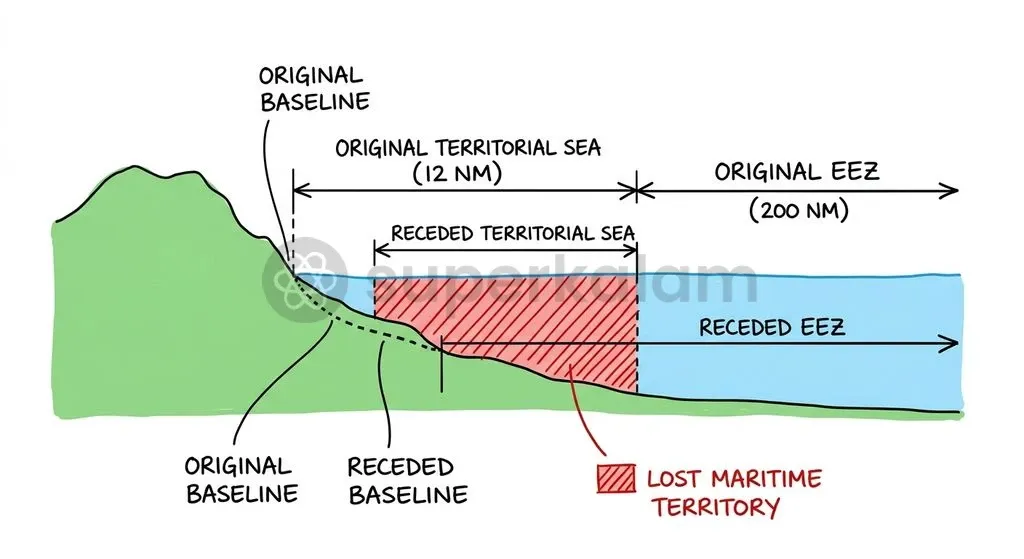
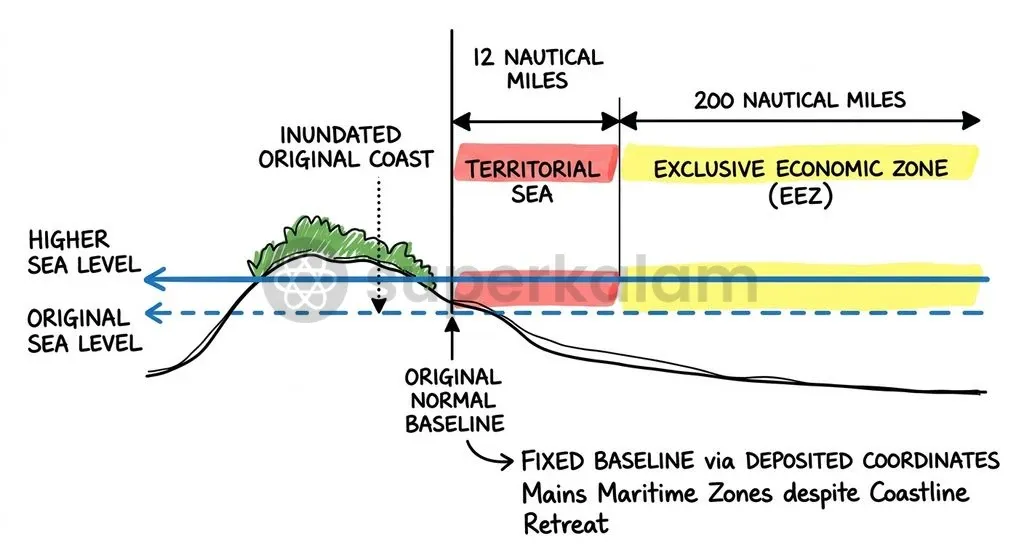
- Baseline instability: Normal baselines run along the low-water line of the coast, meaning coastal retreat moves the baseline landward.
- Shrinking maritime entitlements: As baselines regress, sovereign maritime zones—including the 12-nautical-mile Territorial Sea and the 200-nautical-mile Exclusive Economic Zone (EEZ)—shrink proportionally under orthodox legal interpretations.
- Loss of island legal status: Under UNCLOS Article 121(3), rocks which cannot sustain human habitation or economic life of their own cannot generate an EEZ or continental shelf.
This legal exposure creates acute economic vulnerability for Small Island Developing States (SIDS), whose public revenues depend heavily on sovereign fisheries licensing and subsea mineral rights.
What the UN Declaration Actually Adopted: Key Commitments and Legal Principles
The UN Declaration on Sea Level Rise establishes an unprecedented multilateral framework upholding sovereign continuity, fixed maritime entitlements, and human dignity for climate-threatened nations. Adopted by consensus, the declaration synthesises emerging state practice into a unified political document.
The text codifies several core commitments:
- Presumption of statehood continuity: The declaration establishes an international consensus that statehood, sovereignty, and international legal personality persist regardless of territorial reduction.
- Preservation of United Nations membership: Member states affirm that climate-induced inundation shall not terminate a nation's status or voting rights within the United Nations system.
- Stability of notified maritime zones: Maritime boundaries and entitlements formally established and notified in accordance with UNCLOS 1982 remain legally valid without reduction despite coastal erosion.
- Protection of fundamental human rights: Signatories commit to safeguarding the nationality, cultural heritage, and human dignity of communities displaced by environmental changes.
Building upon regional foundations, the document draws directly from the 2021 Pacific Islands Forum (PIF) Declaration and the 2024 AOSIS Leaders Declaration on Sea Level Rise and Statehood.
Discuss with Superkalam
Explain why orthodox interpretations of UNCLOS Article 121(3) threaten the Exclusive Economic Zones of low-lying island nations.
Ask NowSovereignty Under Threat: How the Declaration Protects Maritime Zones and Baselines
Coastal states and Small Island Developing States rely on maritime entitlements defined under the 1982 UNCLOS framework to secure fisheries, seabed resources, and sovereign jurisdiction. The declaration establishes a protective legal shield over these zones, freezing maritime limits against physical coastal changes.
According to the International Law Commission, traditional ocean jurisprudence viewed baselines as inherently ambulatory, meaning they moved automatically with the tides and changing coastlines. If an atoll submerged, its territorial sea and EEZ would legally evaporate.
The UN Declaration alters this trajectory by affirming that once a coastal state deposits its maritime charts and geographic coordinates with the UN Secretary-General, those outer limits remain permanently fixed. This preservation of maritime entitlements ensures that island nations do not lose access to marine living resources, offshore renewable energy zones, and seabed mineral exploration areas that constitute their sovereign wealth.
The Montevideo Dilemma: Can a Nation Without Land Remain a State?
Article 1 of the 1933 Montevideo Convention establishes defined physical territory and a permanent population as foundational legal criteria for sovereign statehood. For decades, international lawyers presumed that if an island nation lost its physical landmass to the sea, its legal status as a state would technically extinguish.
The UN Declaration challenges this orthodox doctrine by decoupling sovereign statehood from permanent physical dry land:
- Presumption against extinction: International law maintains a powerful legal presumption in favour of the continuity of existing states, meaning that recognized statehood is extraordinarily difficult to extinguish involuntarily.
- Evolution beyond Montevideo criteria: While the Montevideo Convention defined criteria for the creation of new states, the declaration clarifies that these standards should not be weaponised to revoke the sovereignty of existing nations struck by climate disaster.
- Deterritorialised sovereignty: The declaration provides political grounding for sovereign governments to operate digitally or extraterritorially while retaining UN membership, diplomatic recognition, and treaty rights.
This structural shift ensures that global carbon emissions do not legally disenfranchise entire sovereign populations through no fault of their own.
Discuss with Superkalam
If a submerged state operates extraterritorially, analyze the legal and administrative challenges it faces in exercising domestic criminal and civil jurisdiction.
Ask NowWhat the Declaration Does Not Change: Limits and Non-Binding Realities
The United Nations General Assembly adopted the declaration as a non-binding political instrument rather than a formal, enforceable amendment to the 1982 UNCLOS treaty. Aspirants must distinguish between political consensus and hard statutory international law.
Several significant legal and structural limitations remain:
- Absence of treaty amendment: The UNGA cannot unilaterally amend UNCLOS; changing treaty text requires a formal diplomatic conference or consensus amendments under UNCLOS Articles 312 and 313.
- Non-justiciable character: The declaration cannot be directly enforced before the International Court of Justice (ICJ) or the International Tribunal for the Law of the Sea (ITLOS) as a standalone binding treaty.
- Customary law in transition: While the declaration reflects widespread state practice (opinio juris), it represents soft law that must crystallise over time into binding customary international law.
- Unresolved practical logistics: The text does not resolve how a deterritorialised state will exercise civil jurisdiction, enforce domestic criminal laws, or manage physical public services in host territories.
Despite these formal constraints, the consensus adoption provides political momentum that international courts and tribunals can draw upon when interpreting international law.
Comparing Approaches: Fixed Baselines vs Ambulatory Baselines Under UNCLOS
International maritime law historically applied ambulatory baselines under UNCLOS, contrasting sharply with the emerging legal doctrine of permanently fixed baselines.
The table below contrasts the classical baseline interpretation with the fixed baseline regime endorsed by the UN Declaration on Sea Level Rise:
| Dimension | Ambulatory Baselines (Traditional UNCLOS) | Fixed Baselines (2026 UN Declaration) |
|---|---|---|
| Legal Basis | Traditional reading of UNCLOS Articles 5, 7, and 16 | Multilateral consensus rooted in PIF and AOSIS declarations |
| Baseline Behaviour | Shifts landward automatically as the physical low-water line recedes | Remains permanently stable at deposited geographic coordinates |
| Maritime Entitlements | EEZ and territorial sea boundaries contract alongside physical coastal retreat | Preserves the full 200-nautical-mile EEZ and maritime zones indefinitely |
| Sovereignty Impact | High risk of losing EEZ if an island degrades into an Article 121(3) rock | Guarantees sovereign rights over resources regardless of physical submersion |
| Legal Certainty | Creates recurring boundary disputes and maritime delimitation instability | Ensures permanent legal predictability for maritime borders and trade |
| Statutory Status | Orthodox treaty interpretation | Political consensus driving the evolution of customary international law |
Discuss with Superkalam
Evaluate whether a non-binding UNGA declaration is sufficient to protect SIDS maritime rights without a formal diplomatic conference to amend UNCLOS.
Ask NowEthical and Human Rights Dimensions: Climate-Induced Displacement and Statelessness
The United Nations estimates that hundreds of millions of coastal inhabitants confront severe displacement risks, creating profound ethical challenges regarding nationality and human dignity. Approximately 770 to 900 million people live in low-lying coastal zones situated less than five metres above the high-tide line.
Projections indicate that over 1 billion people will face coastal inundation and extreme hazards by 2050. The human dimensions of this crisis span several critical areas:
- Preventing de facto statelessness: When an island state is submerged, its citizens risk losing effective domestic legal protection; the declaration commits states to safeguarding nationality and legal identity.
- Cultural heritage preservation: Displacement severs indigenous communities from ancestral lands and sacred fishing grounds, necessitating global recognition of intangible cultural heritage.
- Climate justice and equity: Small island states contribute less than 1% of global greenhouse gas emissions yet bear the immediate existential costs of rising sea levels.
- Limits of the 1951 Refugee Convention: Current international refugee law does not recognise environmental or climate displacement as grounds for refugee status, making regional human rights frameworks and political declarations vital safety nets.
Protecting displaced populations is fundamentally an issue of global equity and distributive justice, requiring high-emitting nations to uphold their extraterritorial human rights obligations.

India's Stakes and Strategic Position: Island Territories and Indo-Pacific Leadership
The Ministry of Earth Sciences and INCOIS project significant coastal vulnerability across Indian shorelines and archipelagos, shaping New Delhi's maritime security calculus. India possesses over 7,500 kilometres of coastline and hundreds of low-lying islands across the Bay of Bengal and the Arabian Sea.
According to a coastal vulnerability assessment by the Indian National Centre for Ocean Information Services (INCOIS), sea levels along Indian coastlines are projected to rise between 0.5 and 1 metre by 2100.
India's strategic stakes and policy responses encompass two distinct dimensions:
Domestic Coastal Governance
India enforces the Island Protection Zone (IPZ) notifications under its coastal regulation framework. This regime mandates strict buffer zones, adaptive infrastructure, and ecosystem conservation across the ecologically fragile Lakshadweep and Andaman & Nicobar archipelagos to mitigate storm surges and erosion.
Indo-Pacific Leadership and South-South Cooperation
India champions maritime resilience across the Global South through several diplomatic and developmental mechanisms:
- FIPIC (Forum for India-Pacific Islands Cooperation): New Delhi provides technical assistance, sustainable development grants, and desalination infrastructure to Pacific island nations.
- IORA (Indian Ocean Rim Association): India leads coastal risk management and marine spatial planning initiatives across the Indian Ocean littoral.
- CDRI and the IRIS Initiative: Under the Coalition for Disaster Resilient Infrastructure, India spearheads the Infrastructure for Resilient Island States (IRIS) programme, financing climate-proof coastal transport and communications systems for SIDS.
By aligning with the UN Declaration, India reinforces its standing as a responsible maritime power committed to a rules-based ocean order and climate justice.
Discuss with Superkalam
Propose an institutional mechanism through which international judicial bodies like the ICJ or ITLOS could integrate the principle of fixed baselines into binding customary law.
Ask NowWay Forward: From Political Declarations to Binding International Law
The International Law Commission and global maritime institutions must translate the political consensus of the UN Declaration into durable customary international law. While the declaration provides strong political backing for SIDS, securing long-term legal stability requires concrete institutional reforms.
To establish permanent protection under international law, states must pursue several priority actions:
- Deposit permanent maritime coordinates: Coastal nations should immediately prepare and deposit definitive geographic coordinates with the UN Division for Ocean Affairs and the Law of the Sea to lock in their baselines.
- Codification of state practice: The International Law Commission (ILC) should continue drafting authoritative articles on sea level rise to formalise state practice and opinio juris on statehood continuity.
- Advisory opinions from international tribunals: States must actively engage with forthcoming advisory proceedings before the International Court of Justice (ICJ) and ITLOS to embed fixed baseline principles into international jurisprudence.
- Multilateral climate mobility treaties: Regional blocs must formulate binding legal agreements that ensure cross-border mobility, mutual recognition of nationality, and full civil rights for displaced populations.
Securing these reforms ensures that international law adapts to planetary realities, protecting vulnerable nations from losing their sovereign place in the global community.
Key Takeaways
- The UN General Assembly adopted the first UN Declaration on Sea Level Rise by consensus on 24 September 2026, establishing a historic presumption in favour of the continuity of statehood and sovereignty.
- The declaration directly preserves established maritime zones and EEZ entitlements, affirming that boundaries notified under UNCLOS 1982 do not contract despite physical shoreline retreat.
- It moves global jurisprudence beyond the strict physical criteria of the 1933 Montevideo Convention, enabling deterritorialised states to retain UN membership and sovereign rights.
- While the instrument represents a powerful non-binding political declaration, it does not constitute a formal treaty amendment to UNCLOS 1982.
- Data from the WMO recorded global sea levels rising by nearly 6 mm in 2024, with average rates more than doubling over the last three decades to 4.7 mm/year (2015–2024).
- India faces domestic risks with 0.5 to 1 metre sea level rise projected by 2100 by INCOIS, while actively leading SIDS capacity-building through the Island Protection Zone framework, FIPIC, and CDRI's IRIS initiative.
Mains Question
"The orthodox doctrine of international maritime law that 'the land dominates the sea' poses existential legal challenges for Small Island Developing States facing physical submergence." In light of the UN Declaration on Sea Level Rise, examine how international law is evolving from ambulatory baselines toward the preservation of statehood and maritime entitlements. (15 Marks)
Evaluate NowMains Question
"While the 2026 UN Declaration on Sea Level Rise creates a political shield for climate-threatened nations, it remains a soft-law instrument with unresolved legal and practical limitations." Critically analyse. (10 Marks)
Evaluate NowPractice MCQs
QUESTION 1
With reference to the United Nations Convention on the Law of the Sea (UNCLOS) and the legal implications of sea level rise, consider the following statements:
- Under traditional interpretations of UNCLOS, normal baselines follow the low-water line and are ambulatory, moving landward as coastlines recede.
- Under Article 121(3) of UNCLOS, rocks that cannot sustain human habitation or economic life of their own cannot generate an Exclusive Economic Zone or continental shelf.
- The UN Declaration on Sea Level Rise legally amends UNCLOS Articles 312 and 313 to enforce permanently fixed baselines across all signatory states.
Which of the statements given above are correct?
QUESTION 2
Consider the following statements regarding the 1933 Montevideo Convention criteria in the context of the UN Declaration on Sea Level Rise:
- The Montevideo Convention established defined physical territory and a permanent population as foundational criteria for sovereign statehood.
- The 2026 UN Declaration strictly enforces the Montevideo criteria to automatically revoke the sovereignty and UN membership of completely submerged island nations.
- International law recognises a presumption in favour of the continuity of existing recognized states despite environmental disruptions.
Which of the statements given above is/are correct?
QUESTION 3
Consider the following statements regarding global sea level rise observations presented by the World Meteorological Organization (WMO):
- Observed rates of global sea level rise increased from 2.1 mm/year between 1993 and 2002 to 4.7 mm/year during the 2015–2024 decade.
- In 2024, global sea levels rose by nearly 6 millimetres, marking the largest annual increase on satellite record.
Which of the statements given above is/are correct?
QUESTION 4
The UN Declaration on Sea Level Rise adopted by the UN General Assembly in September 2026 built directly upon which of the following regional declarations?
QUESTION 5
Regarding the legal nature and institutional limitations of the UN Declaration on Sea Level Rise, consider the following statements:
- It was adopted by consensus in the UN General Assembly as a non-binding political declaration.
- It can be directly enforced as a justiciable standalone treaty before the International Court of Justice (ICJ).
- It affirms that once a state deposits its maritime charts and geographic coordinates with the UN Secretary-General, its maritime limits remain stable.
Which of the statements given above are correct?