RTI Act Section 24(4): Can States Exempt Police Departments?
Section 24(4) lets states exempt specified intelligence and security bodies from the RTI Act, with exceptions for corruption and human rights complaints.
Sep, 2026
•8 min read

Overview
Section 24(4) of the Right to Information Act, 2005 permits State Governments to exempt specialised intelligence and security bodies from transparency obligations. However, this statutory carve-out does not authorise blanket secrecy for regular police wings or routine law-and-order administration.
While executive notifications frequently attempt to shield sensitive investigative branches from scrutiny, statutory safeguards and constitutional jurisprudence strictly limit these exemptions. Disclosures concerning human rights violations and corruption allegations remain mandatory across all notified organisations, ensuring that executive discretion does not erode democratic oversight.
Discuss with Superkalam
Which specific constitutional article forms the bedrock of the Right to Information as recognized in State of U.P. v. Raj Narain (1975)?
Ask NowWhy in the News: The Tamil Nadu Government Order and Its Rollback
The Government of Tamil Nadu issued G.O. Ms. No. 57 on 21 September 2026, categorising its Public (Law and Order) Department as an exempt intelligence body under the Right to Information Act, 2005. The notification invoked Section 24(4) to remove the department from routine public disclosure obligations.
This administrative move prompted swift concern across civil society and legal circles. As reported by The Hindu and The Indian Express, the Public (Law and Order) Department exercises sovereign oversight over sensitive police records:
- Custodial inquiries and misconduct: Involves custodial death inquiries and custodial torture complaints.
- Public order documentation: Encompasses police firing reports and communal clash dossiers.
- Preventive detention records: Covers detention orders under the National Security Act (NSA) and the Conservation of Foreign Exchange and Prevention of Smuggling Activities Act (COFEPOSA).
Faced with substantial political opposition and public debate regarding police accountability, the State Government withdrew the notification. As reported on 27 September 2026, the Human Resources Management Department issued a formal revocation of G.O. Ms. No. 57. The controversy underscored the recurring legal debate over how far state governments can extend statutory secrecy shields over administrative police functions.
What is Section 24(4) of the RTI Act?
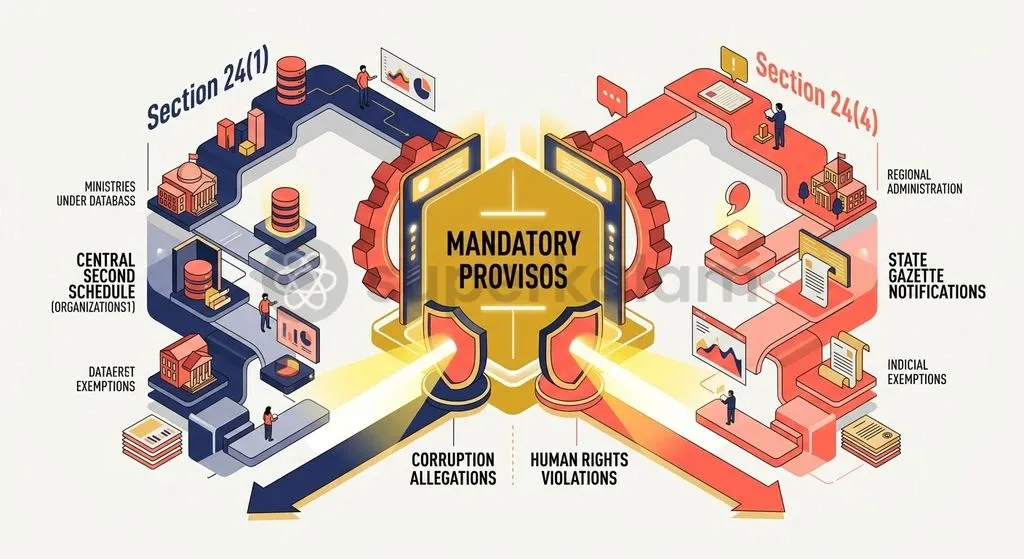
Section 24(4) of the Right to Information Act, 2005 empowers State Governments to exempt specified intelligence and security organisations from statutory transparency mandates through an Official Gazette notification.
The Right to Information Act, 2005 balances administrative confidentiality with democratic accountability through a tiered statutory architecture. While Section 24(1) exempts specified central intelligence and security agencies listed in the Second Schedule, Section 24(4) delegates equivalent notification powers to State Governments.
| Statutory Dimension | Section 24(1) (Central Sphere) | Section 24(4) (State Sphere) |
|---|---|---|
| Competent Authority | Central Government | State Government |
| Mechanism of Exemption | Listed in the Second Schedule of the RTI Act | Notification published in the Official Gazette |
| Nature of Bodies | Central intelligence and security agencies | State intelligence and security organisations |
| Corruption Proviso | Mandatory disclosure applies | Mandatory disclosure applies |
| Human Rights Proviso | Mandatory disclosure with CIC approval (45 days) | Mandatory disclosure with SIC approval within 45 days |
According to the statutory design of the Act, an exemption under Section 24(4) is neither unconstrained nor absolute. Any notification issued by an executive authority must satisfy strict statutory conditions and adhere to the fundamental rights guaranteed under the Constitution.
Discuss with Superkalam
How does the functional test established in Special Police Establishment v. Kamta Prasad Mishra (2026) distinguish intelligence bodies from routine investigative agencies?
Ask NowIntelligence and Security vs Routine Law and Order: Understanding the Distinction
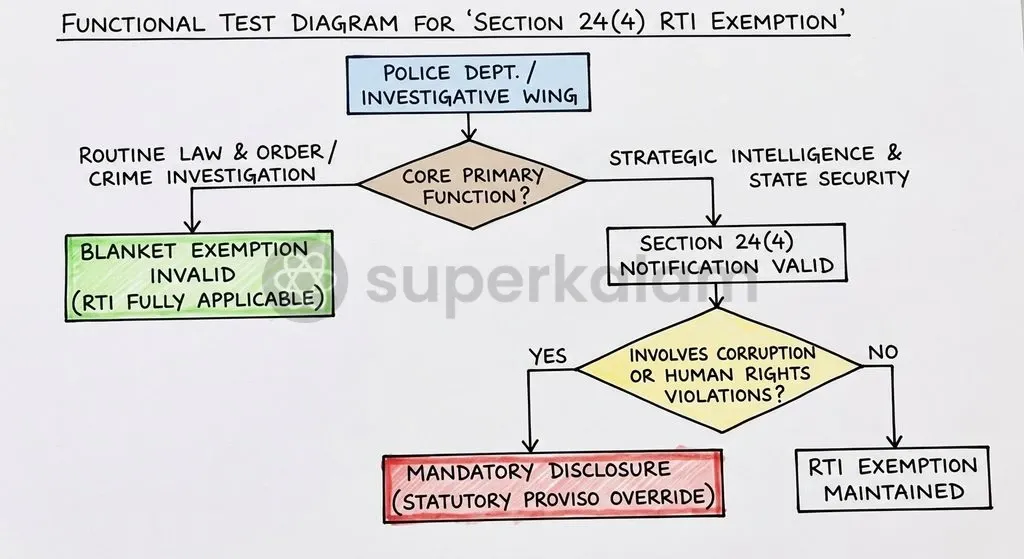
The Supreme Court of India established the functional test in Special Police Establishment v. Kamta Prasad Mishra & Ors. (2026) to determine whether an agency qualifies for exemption under Section 24(4).
In that ruling, the Supreme Court held that an investigative body focused on corruption under the Prevention of Corruption Act cannot be classified as an intelligence and security organisation under Section 24(4). The Court emphasised that primary statutory duties determine an agency's eligibility for exemption, rather than broad executive categorisations.
| Operational Sphere | Core Functions | RTI Status |
|---|---|---|
| Routine Law and Order | Crime investigation, FIR registration, general diary entries, and trial evidence | Subject to RTI Disclosures |
| Specialised Intelligence & Security | Counter-espionage, external threat intelligence, and strategic state security | Eligible for Exemption under Section 24(4) |
The distinction rests on three functional boundaries:
- Core Operational Mandate: Intelligence organisations focus on external threats, counter-espionage, and strategic state security. Routine police departments handle general penal enforcement and domestic crime investigation.
- Evidentiary Openness: Ordinary police procedures operate within the public domain of criminal trials, where charge sheets and general diary entries interface with open courtrooms. Strategic intelligence bodies rely on operational covertness to protect sovereign integrity.
- Administrative Scope: Executive departments managing public order records carry regulatory and custodial oversight functions that fall outside the intended scope of Section 24(4).
The Non-Negotiable Provisos: Human Rights Violations and Corruption
The first proviso to Section 24(4) of the RTI Act, 2005 explicitly bars notified intelligence and security bodies from withholding information regarding allegations of corruption and human rights violations.
Parliament introduced these statutory safeguards to prevent Section 24 from turning into a complete opacity mechanism. Even when an agency is validly notified under the Official Gazette, citizens retain the legal right to seek records on specific misconduct:
- Allegations of Corruption: The exemption is entirely lifted when an applicant seeks records regarding corrupt practices, financial irregularities, or illegal gratification involving personnel of the notified organisation.
- Human Rights Violations: The second proviso to Section 24(4) mandates that information relating to human rights abuses can be disclosed after obtaining the approval of the State Information Commission within 45 days of receiving the application.
Discuss with Superkalam
If a state government issues a notification exempting its anti-corruption bureau under Section 24(4), how would you evaluate its legal validity based on recent Supreme Court jurisprudence?
Ask NowThese statutory provisos ensure that claims of custodial violence, extrajudicial actions, or arbitrary detentions cannot be shielded under the banner of national or state security.
What the Courts Have Ruled on Blanket RTI Exemptions
The Supreme Court of India recognised the Right to Information as an intrinsic facet of the Freedom of Speech and Expression under Article 19(1)(a) of the Constitution in State of Uttar Pradesh v. Raj Narain (1975).
Building on this jurisprudence, the Supreme Court ruled in S.P. Gupta v. Union of India (1981) that an open government is an essential clean-governance requirement in a democracy. The ruling established that disclosure must remain the general rule while secrecy remains an exception strictly justified by public interest.
Constitutional boundaries govern statutory secrecy in a clear hierarchy:
- Article 19(1)(a) Freedom of Expression: Encompasses the fundamental right to access government-held information.
- Article 19(2) Reasonable Restrictions: Defines the narrow constitutional grounds for permissible statutory exemptions.
- Section 24(4) Statutory Scope: Confines secrecy exclusively to genuine intelligence and security establishments.
Statutory exemptions under Section 24 remain constitutionally bounded by the permissible reasonable restrictions enumerated under Article 19(2) of the Constitution. High Courts and the Central Information Commission have consistently held that Section 24 does not provide a blanket immunity for administrative records within exempted bodies.
In Praveen Kumar Abhinapu v. State Information Commissioner, the Madras High Court held that police authorities cannot routinely withhold inquiry reports regarding allegations affecting personal dignity and human rights under the guise of statutory exemptions. The Court reiterated that the mere existence of an investigation does not justify withholding information under Section 8(1)(h) unless the public authority establishes precisely how disclosure would hamper prosecution or investigation.
Discuss with Superkalam
Why do the statutory provisos on corruption and human rights violations act as an essential check against executive opacity in notified security agencies?
Ask Now
Administrative and Ethical Concerns: Why Police Transparency Matters
The Second Administrative Reforms Commission (2nd ARC) highlighted in its First Report that external transparency is the master key to clean governance and ethical administration.
From the perspective of administrative ethics, sovereign police power operates on a delegated public trust. When executive notifications block public access to police oversight records, significant governance risks emerge:
- Deterrence of Custodial Excesses: Public scrutiny over inquiry reports, post-mortem findings, and internal disciplinary proceedings acts as an institutional check against torture and unconstitutional force.
- Preventing Arbitrary Executive Power: Cloaking detention records and public order decisions under Section 24(4) weakens the constitutional protections citizens enjoy against arbitrary arrest and detention.
- Sustaining Public Institutional Trust: Democratic policing requires community cooperation, which depends directly on open, accountable, and rule-based law enforcement.
Discuss with Superkalam
How can statutory boundaries be redesigned to prevent the executive from misusing Section 24(4) to shield administrative and custodial misconduct?
Ask NowWay Forward: Defining Clear Boundaries for Statutory Secrecy
State Governments must adopt structured administrative guidelines to align executive notifications under Section 24(4) with constitutional requirements and judicial precedents.
- Application of the Functional Test: Executive notifications should be restricted strictly to specialised intelligence collection and counter-subversion units. Routine police departments, anti-corruption wings, and general law-and-order oversight bodies must remain within the active purview of the RTI Act.
- Proactive Disclosure under Section 4(1)(b): Police headquarters and home departments should voluntarily publish non-sensitive operational guidelines, standard operating procedures for handling protests, and annual statistics on custodial complaints.
- Strengthening State Information Commissions: State Information Commissions must develop dedicated fast-track benches to process human rights and corruption complaints involving notified organisations within the mandated 45-day window.
- Distinguishing Operations from Administration: In line with judicial directives, state rules must clarify that administrative matters, civilian recruitments, public procurements, and expenditure records of security units remain subject to public disclosure.
Key Takeaways
- Section 24(4) of the RTI Act, 2005 empowers State Governments to exempt genuine intelligence and security organisations from disclosure mandates via the Official Gazette.
- In Special Police Establishment v. Kamta Prasad Mishra (2026), the Supreme Court ruled that anti-corruption and routine investigative bodies do not qualify as intelligence and security organisations under Section 24(4).
- The first and second provisos to Section 24(4) ensure that allegations of corruption and human rights violations cannot be excluded from disclosure, with human rights cases requiring State Information Commission approval within 45 days.
- The Right to Information is anchored in Article 19(1)(a) of the Constitution, meaning any statutory secrecy provision is strictly bounded by the reasonable restrictions under Article 19(2).
- The withdrawal of Tamil Nadu's G.O. Ms. No. 57 highlights that administrative departments handling records on custodial deaths and public order cannot be shielded behind statutory intelligence exemptions.
Mains Question
"Section 24(4) of the RTI Act, 2005 permits exemptions for intelligence and security organisations, but does not provide a blanket immunity for routine police and administrative oversight." In light of recent executive notifications and judicial rulings, critically examine the statutory scope and constitutional boundaries of Section 24(4). (15 Marks)
Evaluate NowMains Question
The Second Administrative Reforms Commission characterized transparency as the 'master key to good governance'. Elucidate the ethical and administrative necessity of subjecting police oversight records—such as custodial inquiry and detention reports—to public scrutiny. (10 Marks)
Evaluate NowPractice MCQs
QUESTION 1
With reference to Section 24(4) of the Right to Information (RTI) Act, 2005, consider the following statements:
- It empowers State Governments to exempt specified intelligence and security organisations through an Official Gazette notification.
- The statutory exemption under Section 24(4) completely bars disclosures regarding allegations of corruption.
- Information pertaining to allegations of human rights violations can be disclosed only after obtaining the approval of the State Information Commission within 45 days. Which of the statements given above are correct?
QUESTION 2
Consider the following statements regarding the distinction between intelligence organisations and routine law-and-order bodies under the RTI Act, 2005:
- In Special Police Establishment v. Kamta Prasad Mishra (2026), the Supreme Court ruled that primary statutory duties determine eligibility for exemption under Section 24(4).
- An investigative body dealing with offenses under the Prevention of Corruption Act can be automatically classified as an exempt intelligence organisation under Section 24(4).
- Routine police records such as FIRs, general diary entries, and trial evidence fall outside the scope of Section 24(4) exemptions. Which of the statements given above is/are correct?
QUESTION 3
Regarding the constitutional and judicial jurisprudence on the Right to Information in India, consider the following statements:
- In State of U.P. v. Raj Narain (1975), the Supreme Court recognized the Right to Information as an intrinsic facet of Article 19(1)(a).
- In S.P. Gupta v. Union of India (1981), the Supreme Court held that secrecy must be the general rule in public administration to protect state security.
- Section 24 statutory exemptions are constitutionally circumscribed by the reasonable restrictions under Article 19(2). Which of the statements given above is/are correct?
QUESTION 4
In Praveen Kumar Abhinapu v. State Information Commissioner, what standard did the Madras High Court reiterate regarding withholding information under Section 8(1)(h) of the RTI Act?
QUESTION 5
Which of the following bodies or reports emphasized that external transparency is the 'master key' to clean governance and ethical administration?