Transgender Persons Amendment Act 2026: Changes and SC Case
The 2026 amendment changes how transgender identity is certified. Compare it with the 2019 Act and the NALSA ruling, and see what is challenged in court.
Sep, 2026
•9 min read
Context
The Transgender Persons (Protection of Rights) Amendment Act, 2026 alters India's statutory framework for gender recognition. By replacing self-perceived identity declarations with mandatory Chief Medical Officer screenings, the statute has triggered constitutional challenges in the Supreme Court over bodily autonomy and privacy.
As passed by Parliament in March 2026, the statutory revisions remove explicit guarantees of self-identification previously established under the landmark NALSA ruling.
While the Union Government justifies these administrative safeguards to prevent fraudulent welfare claims, petitioners argue that medical gatekeeping violates basic rights guaranteed under Part III of the Constitution. This evolving dispute tests whether legal gender recognition remains an inalienable component of dignity or an administratively regulated status.
Why in the News: The 2026 Amendment and Supreme Court Scrutiny
The Supreme Court of India is examining constitutional challenges against the Transgender Persons Amendment Act, 2026, which received Presidential assent on 30 March 2026.
Key judicial developments in the ongoing challenge include:
- Constitutional Petitions: A batch of writ petitions led by activists Laxmi Narayan Tripathi, Akkai Padmashali, and Grace Banu challenged the enactment, arguing that the statute subverts judicial precedents and violates Articles 14, 15, 19(1)(a), and 21. The petitioners contend that the new law reimposes medical gatekeeping over personal identity.
- No Interim Stay: A three-judge Supreme Court Bench headed by Chief Justice Surya Kant declined to grant an interim stay on the operation of the Amendment Act, consolidating and staying all related High Court proceedings.
- Protection of Existing Cards: The Union Government recorded an undertaking through Solicitor General Tushar Mehta that identity cards issued under the earlier 2019 framework will remain valid pending final adjudication.
Background: From the Landmark NALSA Judgment to the 2019 Act
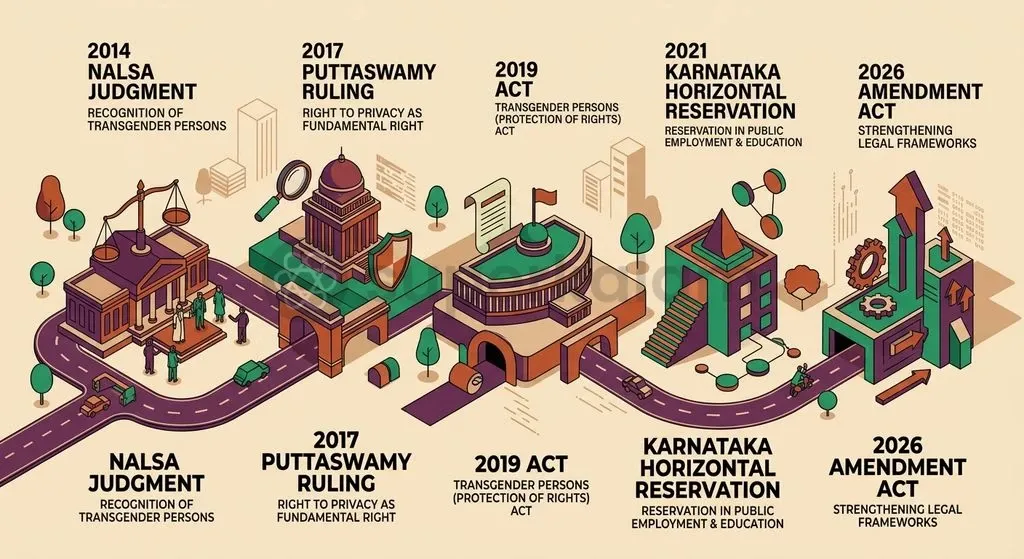
The Supreme Court established the constitutional benchmark for transgender rights in the landmark ruling National Legal Services Authority (NALSA) v. Union of India (2014).
In the NALSA judgment, the Court laid down two core principles:
- Autonomy and Dignity: The right to self-determined gender identity is integral to personal autonomy, dignity, and freedom under Articles 14, 19(1)(a), and 21 of the Constitution, explicitly barring mandatory medical or psychological interventions as prerequisites for legal recognition.
- Affirmative Action Directive: The Court directed the Union and State Governments to treat transgender persons as Socially and Educationally Backward Classes (SEBC) and extend reservations in public educational institutions and government appointments.
Parliament subsequently enacted the Transgender Persons (Protection of Rights) Act, 2019, creating a statutory mechanism for identity certification through the District Magistrate. However, civil society groups criticised the 2019 Act on multiple counts:
- Surgical Preconditions: The statute required medical proof of gender-affirming surgery to update legal gender markers from "transgender" to "male" or "female".
- Sentencing Disparity: Under Section 18(d), the law prescribed a maximum punishment of two years imprisonment for sexual abuse against transgender individuals. Critics noted this created an unjustified disparity compared to the Indian Penal Code provisions for cisgender women, where sexual assault carries a minimum sentence of seven to ten years.
Discuss with Superkalam
Recall the core constitutional principles laid down by the Supreme Court in NALSA v. Union of India (2014) regarding gender self-determination.
Ask NowWhat Changed: Comparing the 2019 Act with the 2026 Amendment
The Transgender Persons (Protection of Rights) Amendment Act, 2026 significantly modifies identity certification protocols, statutory definitions, institutional reporting mandates, and criminal penalties.
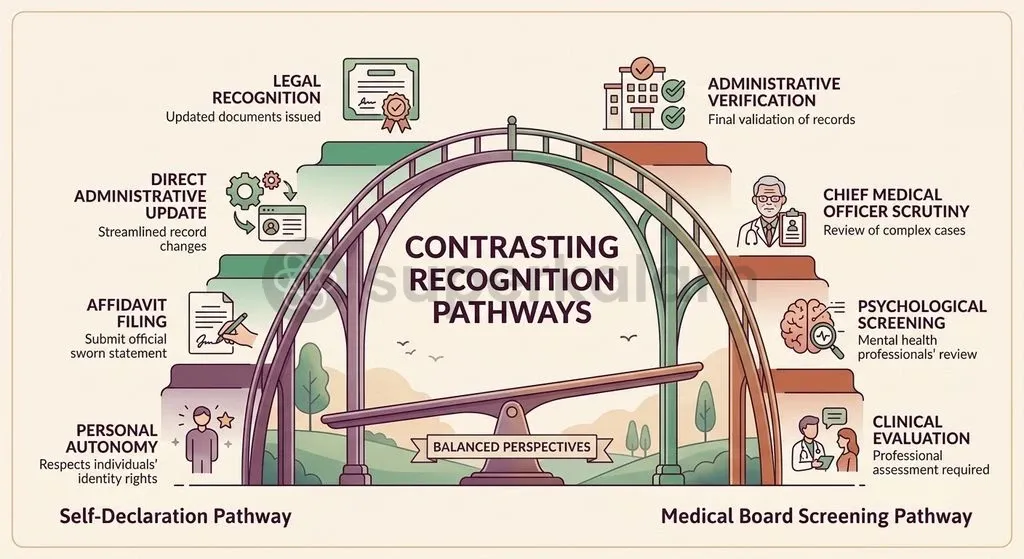
The 2026 Amendment omitted Section 4(2) of the 2019 Act, which had explicitly guaranteed every transgender person the statutory right to a self-perceived gender identity. Under the amended Section 6 and newly inserted Section 2(aa), the District Magistrate cannot issue an identity certificate without examining recommendations from a designated medical board headed by a Chief Medical Officer (CMO) or Deputy CMO.
Parliament also narrowed the definition in Section 2(k) by removing references to "trans-man", "trans-woman", and "genderqueer", restricting statutory recognition to biological variations, socio-cultural identities such as kinner, hijra, aravani, and jogta, and eunuchs. In addition, medical institutions conducting gender-affirming procedures must now furnish records directly to administrative and medical authorities.
| Dimension | Transgender Persons Act, 2019 | Transgender Persons Amendment Act, 2026 |
|---|---|---|
| Self-Identification | Recognised self-perceived identity under Section 4(2) | Omitted Section 4(2); made recognition conditional on institutional evaluation |
| Certification Process | Application submitted directly to the District Magistrate | Mandatory examination by a Chief Medical Officer board prior to District Magistrate approval |
| Statutory Definitions | Broad scope explicitly naming trans-men, trans-women, and genderqueer persons | Narrowed Section 2(k) to biological variations, socio-cultural identities, and eunuchs |
| Hospital Reporting | No compulsory administrative disclosure for medical facilities | Mandatory reporting of gender-affirming procedures to the District Magistrate |
| Penal Framework | Section 18 prescribed up to two years imprisonment for physical or sexual abuse | Heightened penalties up to life imprisonment for forced mutilation, coercion, or allurement |
Discuss with Superkalam
Explain how the introduction of a CMO-led medical board alters the administrative process of obtaining a transgender identity certificate.
Ask NowSelf-Identification vs Medical Screening: The Core Points of Friction
The Ministry of Social Justice and Empowerment defends mandatory medical evaluation to prevent fraudulent declarations, while civil society advocates argue that clinical screening violates personal autonomy.
The debate centres on distinct competing priorities:
- State Administrative Objectives: The Union Government asserts that objective screening is essential to protect welfare schemes and affirmative action from misuse. State authorities argue that unverified self-declaration could compromise gender-segregated public spaces and Targeted Public Distribution benefits.
- Bureaucratic Gatekeeping: Rights groups argue clinical screening creates bureaucratic gatekeeping that deters marginalised persons from seeking legal recognition. According to Census 2011 figures, India recorded approximately 4.88 lakh transgender individuals, yet only around 32,500 had obtained official identity certificates by 2026.
- State-Level Divergence: Inter-governmental differences have surfaced in court. The Andhra Pradesh State Government submitted an affidavit in the Supreme Court declining to defend the 2026 amendments, maintaining that the legislative changes were undertaken solely within the Union Government's remit.
Discuss with Superkalam
Analyse the key legal arguments connecting bodily autonomy under Article 21 (as established in Puttaswamy) with mandatory clinical screening.
Ask NowKey Legal Challenges Before the Supreme Court
Petitioners before the Supreme Court contend that the 2026 Amendment violates the doctrine of self-determination and contradicts established privacy jurisprudence.
The challenge rests on three primary constitutional grounds:
- Subversion of NALSA Precedent: The petition led by Laxmi Narayan Tripathi argues that conditioning legal status on a medical board's sanction directly subverts binding directions in NALSA v. Union of India. The petitioners submit that omitting self-perceived identity reinstates a discarded medicalised model.
- Infringement on Bodily Autonomy: In K.S. Puttaswamy v. Union of India (2017), a nine-judge Bench affirmed that informational privacy and bodily autonomy are fundamental rights under Article 21. Petitioners argue that compelling individuals to undergo physical examinations before administrative boards constitutes an impermissible intrusion into bodily integrity.
- Exclusionary Statutory Definitions: The petitions challenge the narrowing of Section 2(k). By excluding terms such as "genderqueer", "trans-man", and "trans-woman", the amended statute leaves non-binary and diverse gender expressions without explicit statutory protection, creating legal uncertainty in employment, healthcare, and education.
Discuss with Superkalam
Weigh the Union Government's rationale of preventing welfare fraud against the petitioners' concerns regarding bureaucratic exclusion and human dignity.
Ask NowConstitutional Dimensions: Fundamental Rights Under Articles 14, 19, and 21
The constitutional validity of the 2026 Amendment rests on the interpretation of Articles 14, 15, 19(1)(a), and 21 of the Indian Constitution.
Under Article 14, state action must satisfy the test of reasonable classification and avoid manifest arbitrariness. The petitioners argue that imposing medical screening exclusively on transgender citizens, while cisgender citizens face no biological scrutiny to establish legal identity, constitutes discriminatory classification under Article 15.
Gender expression constitutes a fundamental form of speech and self-representation protected under Article 19(1)(a). Subjecting chosen presentation, attire, and identity markers to the discretionary veto of a medical board places unreasonable administrative restrictions on protected constitutional expression.
Under Article 21, the right to life encompasses the right to live with dignity, which includes self-determining one's identity without state coercion. The constitutional discourse also intersects with demands for public employment and educational reservations:
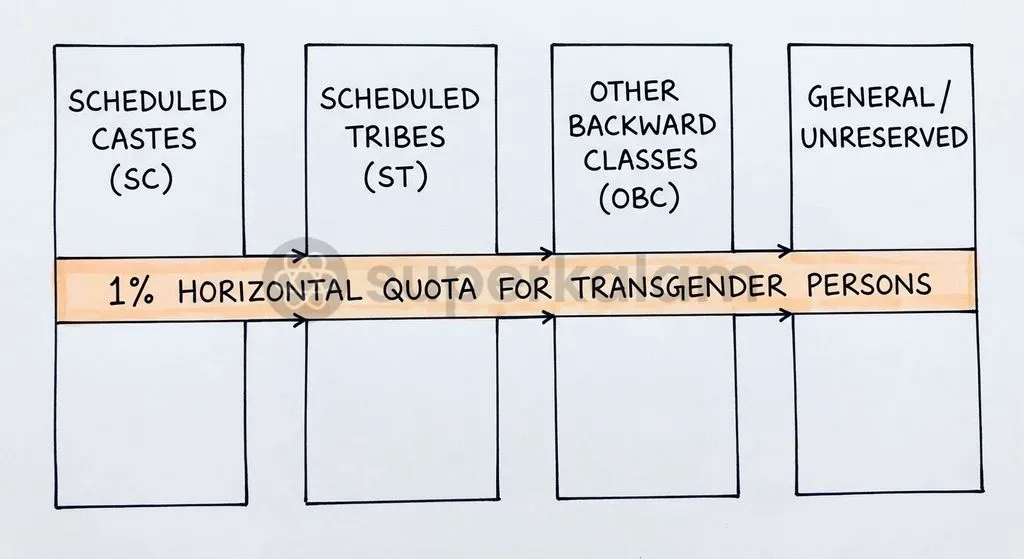
- Vertical Reservations: Grouping transgender individuals entirely under the existing Other Backward Classes (OBC) quota forces them to compete against large, established socio-economic groups, often resulting in negligible actual representation.
- Horizontal Reservations: Legal scholar Grace Banu and community advocates argue for intersectional horizontal reservations across Scheduled Caste (SC), Scheduled Tribe (ST), OBC, and General categories to address compounded caste and gender marginalisation.
- State Precedents: Karnataka established an operative policy model in 2021 by amending the Karnataka Civil Services Rules to provide 1% horizontal reservation for transgender candidates across all recruitment categories.
Discuss with Superkalam
Propose institutional measures that could balance administrative verification of welfare delivery with the preservation of personal dignity and bodily autonomy.
Ask NowWay Forward: Aligning Statutory Law with Human Rights Standards
Reforming India's transgender rights framework requires harmonising domestic legislation with the NALSA principles and international human rights standards.
A rights-respecting legal framework should separate administrative welfare verification from legal gender recognition. India can draw on international best practice models that decouple legal identity from medical procedures:
- International Self-Declaration Frameworks: Jurisdictions such as Argentina (Gender Identity Law, 2012), Malta (Act XI of 2015), and Spain (Law 4/2023) recognise legal gender purely through administrative self-declaration without clinical verification.
- Statutory Decoupling: Parliament should restore explicit recognition of self-perceived identity under Section 4, limiting medical boards to facilitating voluntary gender-affirming healthcare rather than acting as identity gatekeepers.
- Intersectional Affirmative Action: Union and State Governments should implement horizontal reservation policies across educational institutions and public employment, adapting the Karnataka model at the national level.
- Sensitisation of Administrative Machinery: District Magistrates, healthcare personnel, and law enforcement agencies require systemic training to administer social security benefits without subjecting applicants to harassment or arbitrary delays.
Key Takeaways
- Judicial Foundation: In NALSA v. Union of India (2014), the Supreme Court ruled that self-determined gender identity is protected under Articles 14, 19(1)(a), and 21 of the Constitution.
- Core Legislative Shift: The Transgender Persons Amendment Act, 2026 omitted Section 4(2) of the 2019 Act and mandated Chief Medical Officer board recommendations before a District Magistrate can issue an identity certificate.
- Narrowed Scope: The 2026 Amendment removed trans-men, trans-women, and genderqueer individuals from Section 2(k), confining coverage to biological variations, socio-cultural groups, and eunuchs.
- Supreme Court Status: The Supreme Court declined an interim stay on the 2026 Act but consolidated all High Court challenges, while recording the Union's undertaking that 2019 identity cards remain valid.
- Affirmative Action Models: Community advocates seek horizontal reservations across SC, ST, and OBC quotas, following Karnataka's 2021 implementation of a 1% horizontal reservation in civil services.
Mains Question
"Replacing self-determination with institutional medical screening alters the core foundation of legal gender recognition." In light of the Transgender Persons (Protection of Rights) Amendment Act, 2026 and the NALSA (2014) precedent, critically examine this statement. (15 Marks)
Evaluate NowMains Question
The Transgender Persons (Protection of Rights) Amendment Act, 2026 introduces significant changes to identity certification protocols and statutory definitions. Elucidate the key modifications brought by the 2026 Amendment over the 2019 Act. (10 Marks)
Evaluate NowPractice MCQs
QUESTION 1
With reference to the Transgender Persons (Protection of Rights) Amendment Act, 2026, consider the following statements:
- It omits the statutory recognition of self-perceived gender identity previously granted under the 2019 Act.
- It mandates examination and recommendation by a designated Chief Medical Officer-led medical board prior to the issuance of an identity certificate by the District Magistrate.
- It expands the statutory definition of a transgender person by explicitly including 'trans-man', 'trans-woman', and 'genderqueer'.
Which of the statements given above are correct?
QUESTION 2
Consider the following statements regarding the landmark Supreme Court ruling in NALSA v. Union of India (2014):
- It held that the right to self-determined gender identity is integral to personal autonomy and dignity under Articles 14, 19(1)(a), and 21.
- It made psychological evaluation and medical procedures mandatory prerequisites for legal gender recognition.
- It directed the Union and State Governments to treat transgender persons as Socially and Educationally Backward Classes (SEBC).
Which of the statements given above is/are correct?
QUESTION 3
With reference to legislative frameworks and judicial developments concerning transgender rights in India, consider the following statements:
- The Transgender Persons Act, 2019 prescribed a maximum punishment of two years imprisonment for sexual abuse against transgender individuals under Section 18(d).
- The 2026 Amendment introduced heightened penalties extending up to life imprisonment for forced mutilation, coercion, or allurement.
- Under the 2026 framework, identity cards issued under the 2019 Act were immediately invalidated upon Presidential assent.
Which of the statements given above is/are correct?
QUESTION 4
Consider the following statements regarding the institutional changes introduced under the Transgender Persons (Protection of Rights) Amendment Act, 2026:
- Medical facilities conducting gender-affirming procedures are mandated to furnish records directly to administrative and medical authorities.
- The Supreme Court granted an interim stay on the operation of the Amendment Act across India.
- State governments are unanimously defending the 2026 amendments before the Supreme Court.
Which of the statements given above is/are correct?
QUESTION 5
In the context of Indian constitutional law, the challenge against mandatory medical board screening under the Transgender Persons Amendment Act, 2026 primarily relies on the right to informational privacy and bodily autonomy recognized under Article 21 in which of the following landmark judgments?