150 Years of Vande Mataram: History, Constitutional Status, and Debates
As India marks 150 years of Vande Mataram, examine how constitutional democracy reconciles patriotic reverence with fundamental rights under Articles 19 and 25.
Sep, 2026
•7 min read
Overview
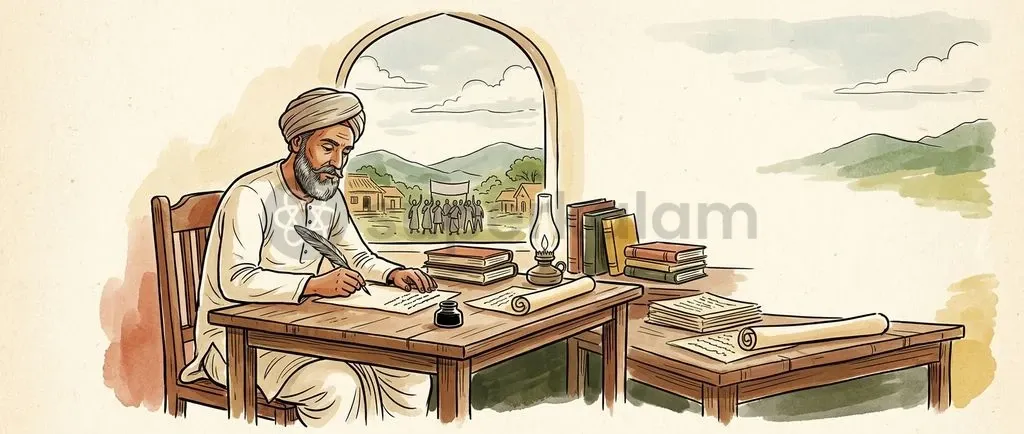
Composed in November 1875 by Bankim Chandra Chattopadhyay, Vande Mataram marks its 150th anniversary as India's National Song. It holds equal constitutional status with the National Anthem, balancing patriotic heritage, statutory protections, and fundamental liberties.
Dr. Rajendra Prasad formally accorded the hymn equal status with Jana Gana Mana on 24 January 1950, per the Constituent Assembly debates. During the national movement, the song galvanised mass mobilisation from the 1905 anti-partition agitation to provincial assemblies.
Modern jurisprudence under Articles 19(1)(a) and 25 distinguishes voluntary reverence from state-enforced compliance. The sesquicentennial milestone offers a lens on how constitutional democracy balances national symbols with civil liberties.
Why is Vande Mataram in the News?
The Ministry of Culture launched a nationwide commemoration spanning 7 November 2025 to 7 November 2026 to celebrate 150 years of Vande Mataram.
As of August 2026, this sesquicentennial observance has renewed attention on the song's historical legacy and statutory framework. The song was rendered from the ramparts of the Red Fort on 15 August 2026 during the 80th Independence Day celebrations, as announced by the Ministry of Defence.
Parliament introduced legislative steps to resolve long-standing statutory differences between national symbols. The Prevention of Insults to National Honour (Amendment) Act, 2026 extended Section 3's penal protection to the National Song. On 22 September 2026, while hearing a challenge to the amendment, the Supreme Court observed that the state may determine the song's scope and length but cannot punish a conscientious objector merely for declining to sing one or all stanzas. The Court invoked the principle in Bijoe Emmanuel and sought the Union government's response. These were observations at a hearing, not a final judgment striking down the law.
Origin and Composition: Bankim Chandra Chattopadhyay and Anandamath
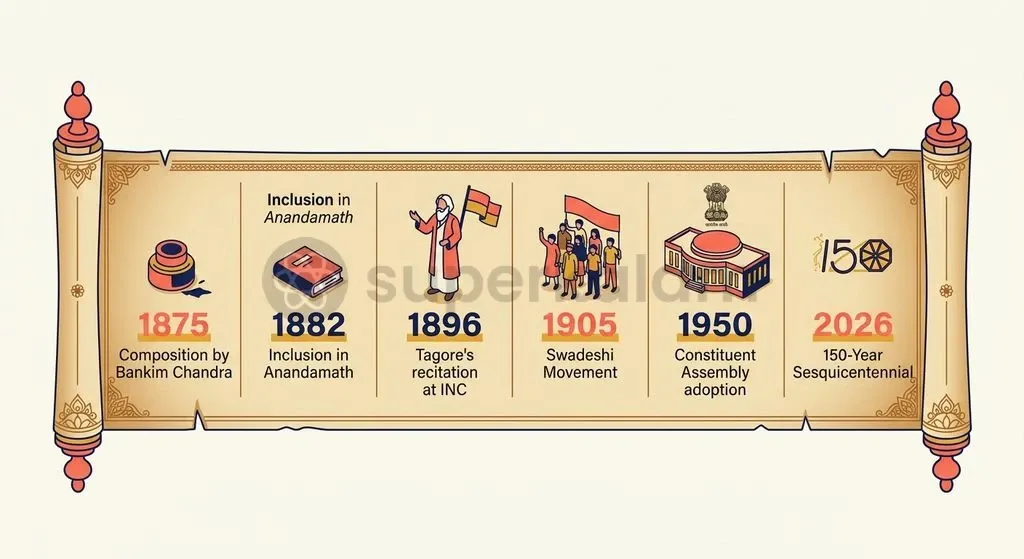
Bankim Chandra Chattopadhyay composed the hymn 'Vande Mataram' on 7 November 1875, coinciding with Akshaya Navami.
The author first published the poem in the Bengali literary journal Bangadarshan, according to a PIB Backgrounder. Chattopadhyay later incorporated the composition into his political novel Anandamath, published in 1882. That work was set against the Sanyasi Rebellion (1763–1800), an early armed uprising against British East India Company rule in Bengal.
The hymn blends Sanskrit and Bengali idioms, personifying the motherland as a maternal entity endowed with strength and abundance. Chattopadhyay conceptualised the motherland across three distinct manifestations:
- The mother as she was: A prosperous and bountiful land prior to colonial rule.
- The mother as she became: An impoverished, chained entity under British subjugation.
- The mother as she shall be: A re-empowered, sovereign force sustained by her children.
Discuss with Superkalam
When and where was 'Vande Mataram' publicly sung for the first time by Rabindranath Tagore at an Indian National Congress session?
Ask NowRole in the Indian Freedom Struggle: From Swadeshi to the INC Sessions
'Vande Mataram' evolved from a literary hymn into the primary rallying anthem of the anti-colonial movement across three pivotal milestones:
- 1896 Calcutta Congress: Rabindranath Tagore set the hymn to music and rendered it publicly for the first time at the 1896 Calcutta session of the Indian National Congress.
- 1905 Swadeshi Movement: Lord Curzon partitioned Bengal in 1905, triggering widespread resistance. Freedom fighters adopted 'Vande Mataram' as a greeting, a protest slogan, and an anthem sung during marches despite British bans.
- 1937 CWC Resolution: In October 1937, the Congress Working Committee adopted a resolution selecting only the first two stanzas of Vande Mataram for official public gatherings, as documented in Indian National Congress archival records. The CWC noted that these opening stanzas offered an unreservedly secular depiction of nature, ensuring broad inclusivity.
Discuss with Superkalam
How did the 1937 Congress Working Committee resolution balance the literary composition of Vande Mataram with the need for communal inclusivity?
Ask NowConstitutional Status: How the Constituent Assembly Adopted the National Song
The Constituent Assembly of India finalised the standing of national symbols during its final session on 24 January 1950.
Assembly President Dr. Rajendra Prasad chose not to put a formal legislative motion to a vote. Instead, he entered a direct presidential ruling into the assembly proceedings:
"The composition consisting of the words and music known as Jana Gana Mana is the National Anthem of India, subject to such alterations in the words as the Government may authorise as occasion arises; and the song Vande Mataram, which has played a historic part in the struggle for Indian freedom, shall be honoured equally with Jana Gana Mana and shall have equal status with it." — Dr. Rajendra Prasad, Constituent Assembly of India Debates (Proceedings), Vol. XII
This declaration established three foundational legal realities:
- Equal Constitutional Status: The ruling accorded Vande Mataram equal status with Jana Gana Mana, honouring its historic contribution to Indian freedom.
- Absence of Legislative Enactment: The status arose from an executive ruling by the Assembly President rather than an article in the text of the Constitution.
- Divergent Statutory Tracks: While granted equal constitutional prestige, subsequent statutes created distinct enforcement frameworks for the two compositions.
National Anthem vs National Song: Key Legal and Constitutional Differences
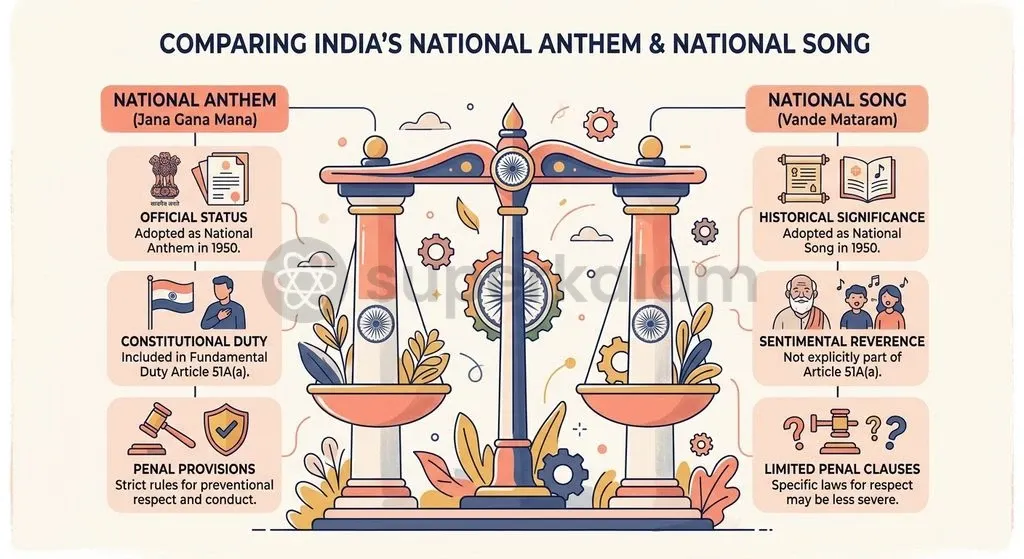
The Constitution of India and related parliamentary statutes maintain clear distinctions between Jana Gana Mana and Vande Mataram.
The 42nd Constitutional Amendment Act, 1976 introduced Part IVA into the Constitution. Under Article 51A(a), every citizen has a fundamental duty to abide by the Constitution and respect the National Flag and the National Anthem. The constitutional text contains no explicit reference to the National Song.
Statutory enforcement mechanisms mirrored this asymmetry for decades. The Prevention of Insults to National Honour Act, 1971 provided penal sanctions solely for insults directed at the National Flag, the Constitution, and the National Anthem.
| Dimension | National Anthem (Jana Gana Mana) | National Song (Vande Mataram) |
|---|---|---|
| Author & Origin | Rabindranath Tagore (1911) | Bankim Chandra Chattopadhyay (1875) |
| Constituent Assembly Mandate | Declared National Anthem on 24 January 1950 | Accorded equal status on 24 January 1950 |
| Fundamental Duties (Art 51A(a)) | Explicitly named as a fundamental duty to respect | Omitted from textual mention in Part IVA |
| Penal Protection (Original 1971 Act) | Section 3 penalised preventing or disturbing its singing | Not included under penal provisions of Section 3 |
| 2026 Legislative Amendment | Maintained penal safeguards against disruption | Section 3 substitution extends equal penal protection |
Judicial Stance and Debates Around Compulsory Singing
The Supreme Court of India consistently safeguards fundamental freedoms when deciding disputes over national symbols.
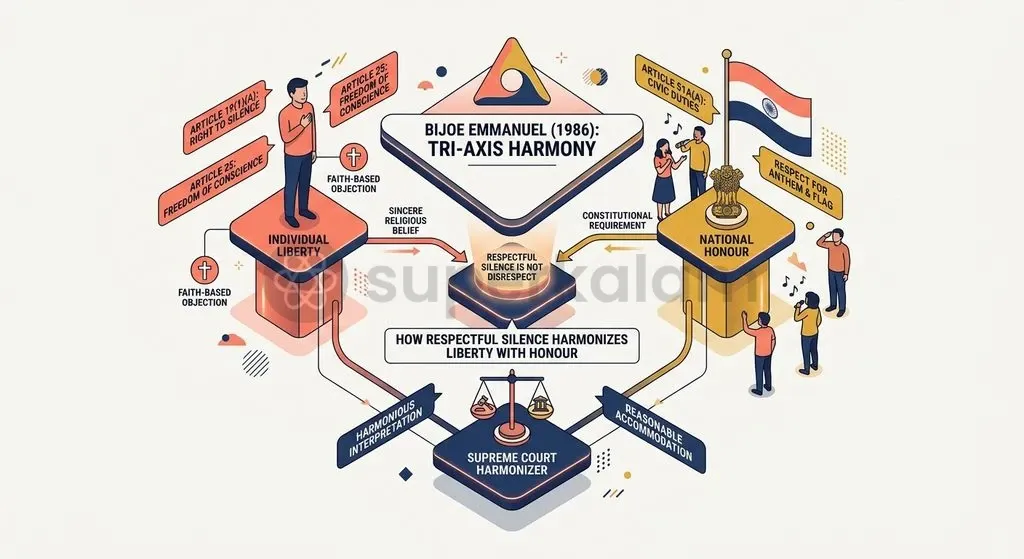
In Bijoe Emmanuel v. State of Kerala (1986), the Supreme Court ruled that expelling Jehovah's Witnesses students for remaining respectfully silent during the morning anthem violated their basic rights. The bench held that standing respectfully without singing does not constitute an offence under Section 3 of the Prevention of Insults to National Honour Act, 1971.
The judiciary anchors its jurisprudence across three constitutional principles:
- Freedom of Speech and Expression (Article 19(1)(a)): Free expression includes the right to remain silent, provided the citizen shows no disrespect.
- Freedom of Conscience and Religion (Article 25): Compelling citizens to sing verses that breach their religious beliefs infringes upon freedom of conscience.
- Nature of Fundamental Duties (Part IVA): Fundamental duties guide responsible citizenship but remain non-justiciable directives, lacking penal enforceability unless backed by parliamentary legislation.
Discuss with Superkalam
Analyse how the Supreme Court used Articles 19(1)(a) and 25 in the Bijoe Emmanuel (1986) case to demarcate the boundary between respectful conduct and forced speech.
Ask NowWay Forward: Balancing Patriotic Heritage with Constitutional Freedoms
Constitutional democracy rests on encouraging voluntary civic cohesion rather than imposing statutory uniformity.
Preserving the legacy of 'Vande Mataram' depends on spreading historical awareness about its role in the independence struggle. The 150th anniversary provides an opportunity to ground school curricula in that history, demonstrating how diverse communities rallied behind shared symbols.
Public policy must balance national pride with liberal constitutional guarantees. While statutes like the Prevention of Insults to National Honour Act deter overt desecration, true constitutional patriotism grows through voluntary civic reverence. Harmonising civic duties with fundamental rights ensures the National Song remains a uniting emblem of shared heritage.
Discuss with Superkalam
Evaluate whether legislative measures like the Prevention of Insults to National Honour (Amendment) Bill, 2026 are sufficient to foster constitutional patriotism, or if educational and cultural initiatives are more effective.
Ask NowKey Takeaways
- Bankim Chandra Chattopadhyay composed 'Vande Mataram' on 7 November 1875, later incorporating it into his 1882 novel Anandamath during the historical backdrop of Bengal's Sanyasi Rebellion.
- Rabindranath Tagore set the song to music at the 1896 Calcutta Congress session, and the hymn became the foremost rallying cry during the 1905 Swadeshi Movement.
- On 24 January 1950, Constituent Assembly President Dr. Rajendra Prasad declared Vande Mataram as having equal status with the National Anthem Jana Gana Mana.
- Article 51A(a) explicitly obligates citizens to respect the National Flag and National Anthem, leaving the National Song unmentioned in the text of Part IVA.
- In Bijoe Emmanuel v. State of Kerala (1986), the Supreme Court affirmed that standing respectfully without singing protects rights under Articles 19(1)(a) and 25.
- The Prevention of Insults to National Honour (Amendment) Bill, 2026 seeks to substitute Section 3 to extend statutory protection against disruption to the National Song.
Mains Question
"The Constituent Assembly accorded equal status to Vande Mataram with Jana Gana Mana, yet statutory and constitutional texts have maintained distinct enforcement tracks." Elucidate the legal and constitutional nuances governing the National Song versus the National Anthem in India. (10 Marks)
Evaluate NowMains Question
"Constitutional patriotism thrives on voluntary civic reverence rather than state-enforced compliance." In light of the Supreme Court's ruling in Bijoe Emmanuel v. State of Kerala (1986) and provisions under Articles 19(1)(a) and 25, critically analyse the debate surrounding the compulsory rendering of national symbols. (15 Marks)
Evaluate NowPractice MCQs
QUESTION 1
With reference to the constitutional status and history of 'Vande Mataram', consider the following statements:
- It was adopted as India's National Song through a formal constitutional amendment inserted into the text of the Constitution.
- Dr. Rajendra Prasad made a presidential ruling in the Constituent Assembly on 24 January 1950 according it equal status with Jana Gana Mana.
- The song was originally composed by Bankim Chandra Chattopadhyay in 1875 and later incorporated into his novel Anandamath.
Which of the statements given above are correct?
QUESTION 2
Consider the following statements regarding the legal and constitutional framework governing national symbols in India:
- Article 51A(a) of the Constitution explicitly mentions a fundamental duty to respect both the National Anthem and the National Song.
- In the original Prevention of Insults to National Honour Act, 1971, Section 3 penalised preventing the singing of the National Anthem, but did not include the National Song.
- Fundamental Duties under Part IVA are non-justiciable directives unless backed by specific parliamentary legislation.
Which of the statements given above is/are correct?
QUESTION 3
With reference to the Indian freedom struggle and the evolution of 'Vande Mataram', consider the following statements:
- Rabindranath Tagore set the hymn to music and rendered it publicly at the 1896 Calcutta session of the Indian National Congress.
- The novel Anandamath, which featured the hymn, was set against the historical backdrop of the Sanyasi Rebellion.
- In 1937, the Congress Working Committee adopted a resolution selecting all stanzas of the poem for official public gatherings.
Which of the statements given above is/are correct?
QUESTION 4
In the landmark case Bijoe Emmanuel v. State of Kerala (1986), the Supreme Court of India held that:
QUESTION 5
Consider the following statements regarding 'The Prevention of Insults to National Honour (Amendment) Bill, 2026':
- It was introduced to substitute Section 3 of the principal Act.
- It extends penal safeguards against intentional disruption to the National Song.
Which of the statements given above is/are correct?