Coal Ministry CSR Framework: Mining Welfare and DMF Governance
India's first sector-wide CSR framework for coal companies - what it is, why it is in news, its key provisions, the Section 135 statutory basis, CSR vs District Mineral Foundation overlap, and the Just Transition angle for UPSC.
Sep, 2026
•8 min read
Overview
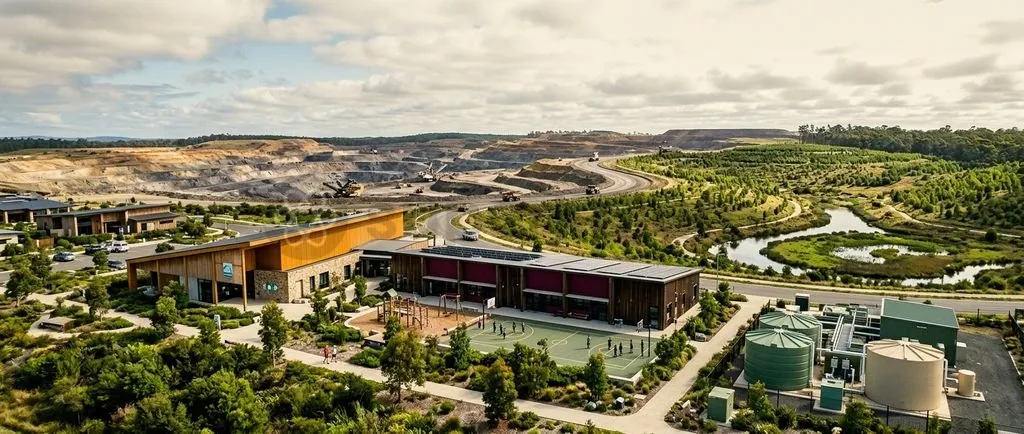
The Ministry of Coal launched a unified Corporate Social Responsibility framework on 8 September 2026 to transition coal public sector enterprises from fragmented local welfare spending into measurable, high-impact regional development across India's mining belts. Central Public Sector Enterprises such as Coal India Limited and NLC India Limited deploy an annual combined budget of approximately ₹800 crore across healthcare, education, and infrastructure.
This framework establishes an auditable metric to align corporate philanthropy with statutory District Mineral Foundation trusts. Meaningful socio-economic transformation in mining belts depends on addressing systemic implementation bottlenecks, preventing regional fund skew, and embedding community-led social audits ahead of a Just Energy Transition.
Why in the News? Coal Ministry Directives on CSR
The Ministry of Coal launched the first-ever sector-wide Comprehensive Corporate Social Responsibility Framework for Indian Coal Companies on 8 September 2026. As of September 2026, the updated directive standardises welfare administration across all operating subsidiaries of Coal India Limited and NLC India Limited.
The policy introduces an auditable 100-point Community Trust and Social Value Index to evaluate local public sentiment and project performance. Mining operations generate severe ecological disruption, land alienation, and public health strains in remote tribal belts. The Ministry of Coal designed this unified policy to ensure public sector spending targets long-term community resilience rather than ad-hoc, short-term civil construction.
Discuss with Superkalam
Which statutory provisions and administrative guidelines govern the mandatory CSR spending of public sector coal enterprises in India?
Ask NowUnderstanding the Legal Framework: Section 135 and DPE Guidelines
India's statutory architecture binds public sector coal enterprises through two complementary tiers of legal compliance:
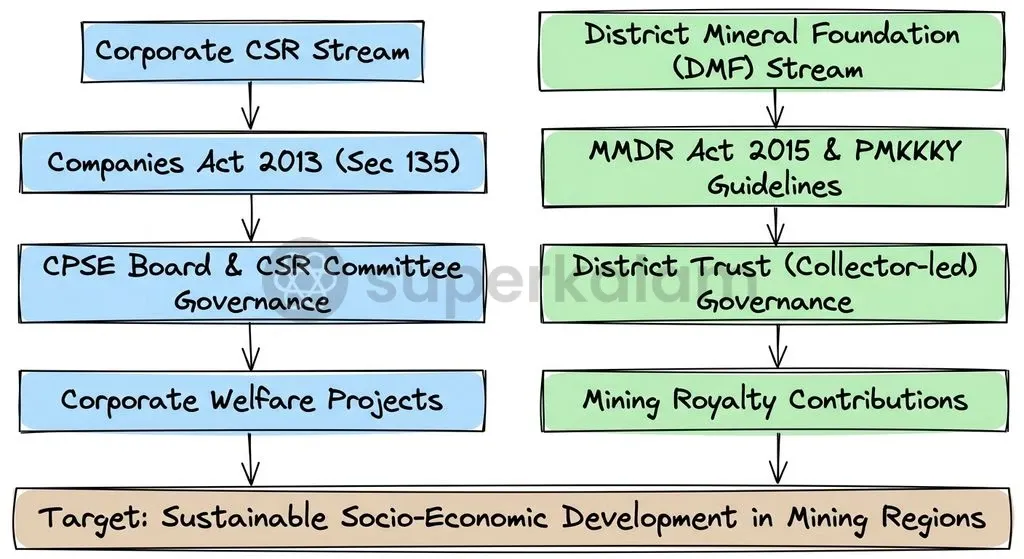
- The Companies Act, 2013 (Section 135 & Schedule VII): Qualifying commercial entities must allocate at least 2% of average net profits earned over the three preceding financial years to approved social welfare initiatives. The statute directs companies to give preference to local areas around operational sites.
- Department of Public Enterprises (DPE) Guidelines: Administrative directives require state-owned enterprises to link their corporate social responsibility targets directly to national development priorities, including the aspirational districts programme.
Public sector coal companies must balance commercial balance-sheet mandates with public accountability, ensuring transparent procurement and statutory reporting under parliamentary oversight.
Key Provisions of the Coal Sector CSR Policy
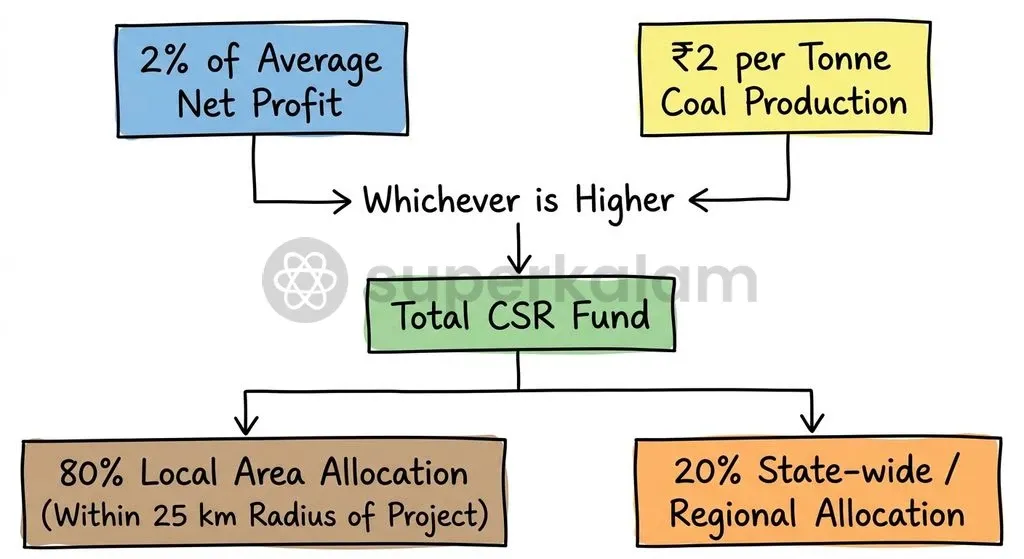
The Coal India Limited CSR policy establishes a dual-track budgetary mechanism that protects social spending from financial volatility. Coal India Limited calculates its annual budget using 2% of standalone average net profit of the three preceding financial years or ₹2.00 per tonne of coal production from the previous year, whichever is higher. This volume-linked formula guarantees substantial welfare capital even during cyclical market downturns.
Subsidiaries of Coal India Limited follow strict spatial allocation mandates to ensure local mine-adjacent populations benefit directly. Operating units must deploy 80% of budgeted funds within a 25 km radius of project sites, active mines, and operational headquarters. The remaining 20% allocation is earmarked for broader development priorities within the respective operational state. Coal India Limited, its subsidiaries, and NLC India Limited together maintain an annual combined allocation of approximately ₹800 crore across mining districts.
| Regulatory Dimension | Statutory Mandate under Companies Act, 2013 | Coal Sector Specific Policy Mechanism |
|---|---|---|
| Minimum Spending Formula | 2% of average net profits over three preceding financial years | 2% of average net profit or ₹2.00 per tonne of coal production, whichever is higher |
| Spatial Ring-Fencing | General preference to local operational areas without a fixed statutory radius | Mandatory 80% spend within a 25 km project radius; 20% within the operational state |
| Performance Assessment | Board-level CSR Committee review and annual statutory financial disclosures | Auditable 100-point Community Trust and Social Value Index tracking local sentiment |
| Annual Budget Scale | Varies across individual commercial entities based entirely on net profitability | Combined annual commitment of approximately ₹800 crore across coal enterprises |
Discuss with Superkalam
How does the volume-linked spending formula (₹2.00 per tonne of coal) insulate local social welfare programs from commodity price shocks?
Ask NowFocus on Healthcare: Key Health Schemes and Medical Outreach in Mining Zones
Coal public sector enterprises channel substantial welfare expenditure into specialised healthcare programmes across isolated mining belts:
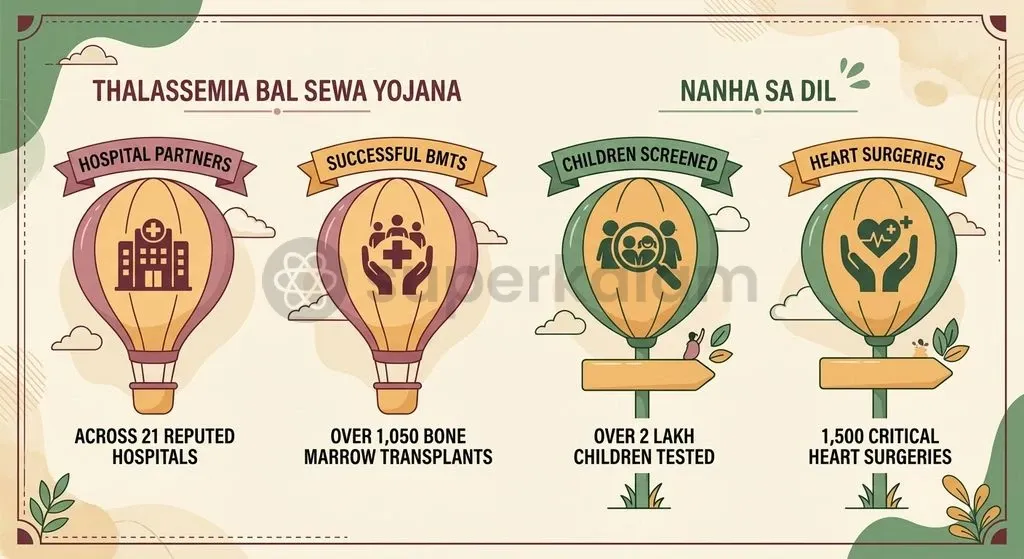
- Thalassemia Bal Sewa Yojana: This flagship scheme provides direct financial assistance of up to ₹10 lakh per patient to empanelled hospitals for curative Bone Marrow Transplants. It supports vulnerable paediatric patients suffering from severe blood disorders, specifically Thalassemia Major and Aplastic Anemia.
- Treatment Scale and Outreach: As of September 2026, the initiative has supported over 1,050 Bone Marrow Transplants across 21 empanelled medical centres nationwide, backed by a cumulative commitment of ₹130 crore across four phases. Mobile medical units treat occupational respiratory illnesses, silicosis, and water-borne conditions in remote hamlets.
- Nanha Sa Dil Initiative: Run in partnership with the Sri Sathya Sai Health & Education Trust, this project has screened over 2 lakh children in underserved regions. The partnership has completed over 1,500 free corrective surgeries for children with Congenital Heart Defects, reducing out-of-pocket medical expenses for mining families.
CSR Funds vs District Mineral Foundation: Understanding the Overlap and Differences
District Mineral Foundations operate as statutory non-profit trusts established under Section 9B of the Mines and Minerals (Development and Regulation) Act, 1957. State governments establish these trusts in mining-affected districts, financing them through mandatory mineral holder contributions amounting to 10% to 30% of royalty. While corporate social responsibility represents corporate-managed philanthropic expenditure, District Mineral Foundations function under district administration and local governing councils.
Pradhan Mantri Khanij Kshetra Kalyan Yojana guidelines regulate the expenditure pattern of District Mineral Foundation revenues. The central guidelines mandate that managing committees must allocate 60% to 70% of funds toward designated high-priority sectors, including drinking water supply, healthcare facilities, primary education, sanitation, and sustainable livelihood generation. The remaining balance supports other physical infrastructure, irrigation networks, and environmental remediation projects.
| Comparison Parameter | Corporate Social Responsibility (CSR) | District Mineral Foundation (DMF / PMKKKY) |
|---|---|---|
| Governing Statute | Section 135 and Schedule VII of the Companies Act, 2013 | Section 9B of the MMDR Act, 1957, read with Section 20A |
| Funding Mechanism | 2% of average net profits or ₹2.00 per tonne of coal output | Mandatory statutory levy of 10% to 30% on mineral royalty payments |
| Administrative Control | Board of Directors and Corporate CSR Committees of CPSEs | District-level Trust chaired by the District Collector or Magistrate |
| Sectoral Allocation | Broad developmental menu aligned with Schedule VII activities | Mandatory 60% to 70% ring-fenced for high-priority human development |
| Geographic Coverage | Targeted within a 25 km operational radius and host state | Strictly mining-affected districts and directly impacted local villages |
Discuss with Superkalam
Why do administrative bodies tend to skew DMF and CSR spending toward routine civil construction rather than health and nutrition, and what are the developmental consequences?
Ask NowCritical Challenges in Fund Utilization and Local Impact
Independent audits and parliamentary reviews highlight key structural gaps in mining welfare delivery:
- Exclusion of Directly Impacted Villages: A performance audit tabled in the Chhattisgarh Assembly in July 2026 revealed that 44% of directly affected villages (754 of 1,734 villages) across 11 sampled districts were excluded from welfare works. This occurred despite aggregate trust expenditures reaching ₹4,536.58 crore.
- Unspent Balances and Inordinate Delays: The Parliamentary Standing Committee on Coal, Mines and Steel highlighted substantial unspent balances and delayed fund utilisation in mineral-rich states including Jharkhand, Odisha, and Rajasthan.
- Skew Toward Routine Civil Infrastructure: Parliamentary reviews noted that administrative bodies routinely channel development funds into routine civil infrastructure projects, like concrete roads and office buildings. This tendency diverts capital away from pressing priorities like malnutrition, specialist healthcare, and clean drinking water.
Ethical Governance and Just Transition for Mining Communities
A Just Energy Transition requires coal enterprises to align extraction activities with restorative social justice for indigenous mining populations. Mining projects disproportionately impact tribal communities, causing involuntary displacement, environmental degradation, and loss of traditional agrarian livelihoods. The constitutional mandate of democratic decentralisation requires public sector enterprises to respect local self-governance under the Panchayats (Extension to Scheduled Areas) Act, 1996.
Corporate accountability requires moving beyond transactional welfare allocations toward participatory local democracy. Institutional frameworks must guarantee that project-affected families possess decision-making authority over local developmental spending. Establishing long-term ecological rehabilitation and sustainable secondary livelihoods ensures that vulnerable mining communities do not face economic abandonment when coal pits face planned decommissioning.
Discuss with Superkalam
Between corporate-managed CSR and district administration-led DMF trusts, which framework offers a more effective mechanism for local community empowerment?
Ask NowKey Takeaways
- Coal India Limited allocates CSR funds based on 2% of standalone average net profit or ₹2.00 per tonne of coal production, whichever is higher.
- Subsidiaries must spend 80% of budgeted CSR funds within a 25 km radius of project sites, with the remaining 20% utilized across the operational state.
- The Thalassemia Bal Sewa Yojana has completed over 1,050 Bone Marrow Transplants across 21 empanelled hospitals with a cumulative outlay of ₹130 crore.
- District Mineral Foundations are statutory trusts created under Section 9B of the MMDR Act, 1957, requiring 60% to 70% of funds for high-priority sectors.
- A CAG performance audit revealed that 44% of directly affected villages were excluded from mineral foundation works in Chhattisgarh despite ₹4,536.58 crore expenditure.
- Establishing institutionalized social audits and post-mining endowment funds is critical to securing a Just Energy Transition in mining belts.
Mains Question
"The institutional design of Coal India Limited's CSR policy combines a volume-linked funding formula with strict spatial ring-fencing to ensure sustained local welfare." Elucidate. (10 Marks)
Evaluate NowMains Question
"Despite significant financial mobilization under District Mineral Foundations (DMF) and CPSE Corporate Social Responsibility, welfare delivery in mining-affected regions continues to face critical implementation deficits." Critically examine. (15 Marks)
Evaluate NowPractice MCQs
QUESTION 1
With reference to the Corporate Social Responsibility (CSR) policy mechanism of Coal India Limited (CIL), consider the following statements:
- The annual CSR budget is calculated using 2% of standalone average net profit of the three preceding financial years or ₹2.00 per tonne of coal production from the previous year, whichever is higher.
- CIL operating subsidiaries are mandated to deploy 80% of budgeted CSR funds within a 25 km radius of project sites, active mines, and operational headquarters.
- The remaining 20% of the CSR fund allocation is earmarked for broader development priorities within the respective operational state. Which of the statements given above are correct?
QUESTION 2
Consider the following statements regarding District Mineral Foundations (DMFs) in India:
- They are statutory non-profit trusts established under Section 9B of the Mines and Minerals (Development and Regulation) Act, 1957.
- They are financed through a mandatory contribution from mineral concession holders ranging from 10% to 30% of royalty payments.
- Under Pradhan Mantri Khanij Kshetra Kalyan Yojana (PMKKKY) guidelines, at least 60% to 70% of DMF funds must be utilized for designated high-priority sectors. Which of the statements given above is/are correct?
QUESTION 3
With reference to healthcare initiatives supported by Central Public Sector Enterprises under the Ministry of Coal, consider the following statements:
- The Thalassemia Bal Sewa Yojana provides direct financial assistance of up to ₹10 lakh per patient for curative Bone Marrow Transplants.
- The Nanha Sa Dil Initiative, partnered with Sri Sathya Sai Health & Education Trust, provides free corrective surgeries for paediatric Congenital Heart Defects.
- Thalassemia Bal Sewa Yojana primarily targets adult mine workers suffering from occupational silicosis. Which of the statements given above is/are correct?
QUESTION 4
Consider the following statements regarding the CSR framework launched by the Ministry of Coal:
- It introduces an auditable 100-point Community Trust and Social Value Index to evaluate local public sentiment and project performance.
- Central Public Sector Enterprises including Coal India Limited and NLC India Limited deploy an annual combined CSR commitment of approximately ₹800 crore. Which of the statements given above is/are correct?
QUESTION 5
In the Indian legal and mineral governance framework, District Mineral Foundations (DMFs) are established under which of the following statutory provisions?