Mediation Act 2023: Family Disputes, Process and Safeguards
The Mediation Act, 2023 sets a framework for resolving civil and family disputes. See the process, settlement rules and safeguards where one party is vulnerable.
Sep, 2026
•10 min read

Overview
The Mediation Act, 2023 establishes India's first dedicated statutory regime to institutionalise, standardise, and enforce dispute resolution outside traditional litigation channels, offering a formal framework to resolve matrimonial and family conflicts while easing pressure on backlogged civil courts. While the statute grants mediated settlement agreements the legal status of civil court decrees, its ultimate efficacy in protecting vulnerable spouses depends on maintaining voluntary participation, preventing coerced compromise in instances of domestic abuse, and counteracting deep-seated socio-economic power imbalances.
Why in the News: The Shift Toward Formal Mediation in Matrimonial Disputes
The Mediation Act, 2023 officially received presidential assent on 14 September 2023, creating an umbrella statutory structure for Alternative Dispute Resolution (ADR) across civil, commercial, and matrimonial spheres. As of October 2023, the Ministry of Law and Justice operationalised core administrative provisions of the statute, including the framework for the Mediation Council of India, via Notification S.O. 4388(E).
Family and matrimonial litigation has historically overwhelmed Indian courts, consuming extensive judicial bandwidth and subjecting disputing spouses to protracted adversarial trials. While Section 9 of the Family Courts Act, 1984 already imposed a duty on judges to persuade parties toward settlement, earlier ADR interventions relied on fragmented statutory provisions, primarily Section 89 of the Code of Civil Procedure, 1908. The enactment of Act No. 32 of 2023 converts ad-hoc reconciliation into a regulated legal process, establishing time-bound procedures and uniform enforcement standards.
Discuss with Superkalam
What is the statutory timeline prescribed under Section 18 of the Mediation Act, 2023 for concluding mediation proceedings?
Ask NowUnderstanding the Mediation Act 2023: Key Provisions for Matrimonial and Civil Conflicts
The Mediation Act, 2023 establishes structured guidelines for pre-litigation and court-referred mediation, providing clear operational rules for civil and family disputes. The statute standardises process timelines, participant rights, and institutional linkages to ensure procedural predictability.
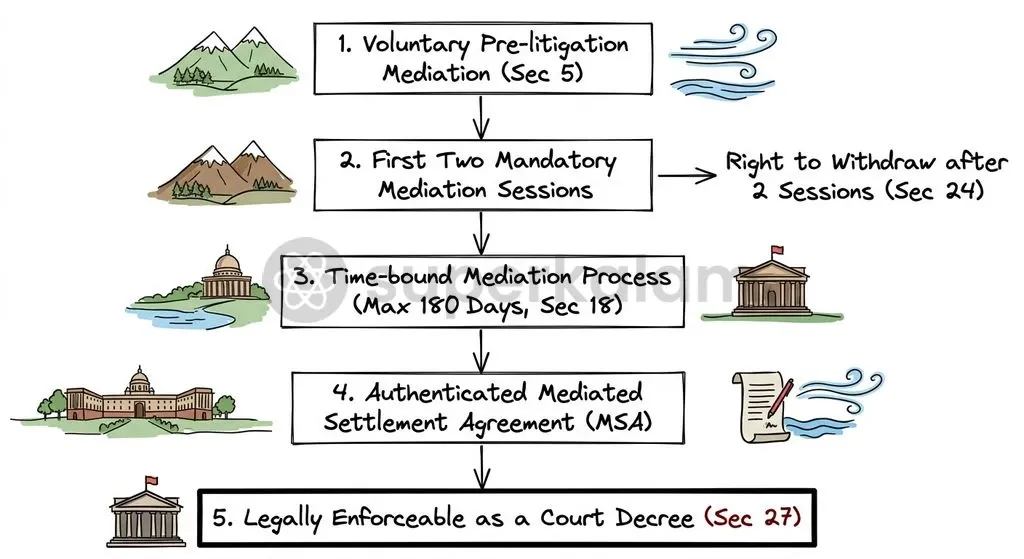
The initial draft of the law proposed mandatory pre-litigation mediation for all civil disputes. However, the Parliamentary Standing Committee on Personnel, Public Grievances, Law and Justice (117th Report) recommended removing compulsory participation to prevent procedural delays and systemic abuse. Consequently, Section 5(1) frames pre-litigation mediation as voluntary, allowing spouses to explore amicable settlements without mandatory legal hurdles.
The Structural Power Imbalance: Can Mediation Truly Shield Vulnerable Spouses?
Structural power imbalances between spouses represent the most significant operational challenge during matrimonial mediation. Mediation operates on the foundational presumption that disputing parties negotiate as autonomous equals, yet socio-economic realities in family conflicts frequently contradict this assumption.
Financial dependence, social stigma, and unequal access to legal representation often disadvantage vulnerable spouses during negotiations. When a financially dependent spouse negotiates maintenance, child custody, or property division, informal family pressure can compel acceptance of unfavourable compromise terms simply to secure immediate financial stability. Unlike open court proceedings where judicial officers evaluate statutory entitlements, private mediation risks concealing structural coercion behind a facade of mutual consent.
Section 24 provides a statutory safeguard against coercion by granting parties the right to withdraw after two sessions without legal penalty. Additionally, Section 5(3) integrates mediation with the Legal Services Authorities Act, 1987, granting indigent spouses access to state-funded legal aid and institutional panels. However, procedural exit options alone cannot neutralise unequal bargaining capacity unless mediators actively identify power disparities and ensure genuine informed consent.
Discuss with Superkalam
How does granting a Mediated Settlement Agreement the status of a civil court decree alter the enforcement burden on disputing parties?
Ask NowBoundary Lines: Distinguishing Mediated Civil Matters from Criminal Domestic Abuse
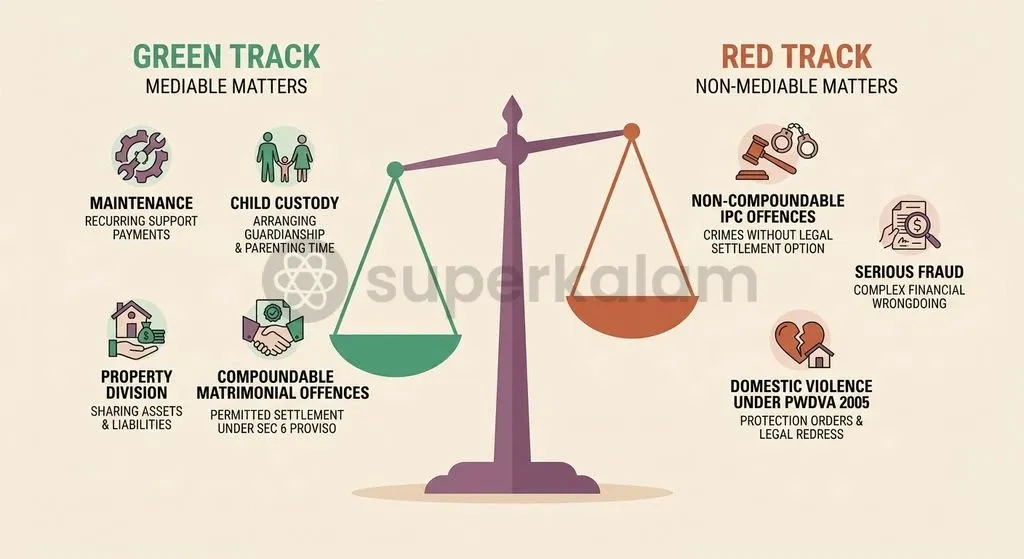
The Mediation Act, 2023 establishes explicit statutory boundaries between mediable civil disputes and non-mediable criminal offences. Section 6 read with the First Schedule excludes serious and non-compoundable criminal offences, serious fraud, and matters affecting rights in rem from the purview of mediation.
Matrimonial disputes frequently involve intersecting civil and criminal claims, creating complex legal questions regarding what can be lawfully settled:
- Non-Mediable Criminal Allegations: Allegations involving severe bodily harm, systemic cruelty, and non-compoundable offences cannot be settled privately or substituted with monetary arrangements under Section 6.
- Protection of Women from Domestic Violence Act, 2005 (PWDVA): The PWDVA does not mandate mediation for violent acts; Section 12 applications require swift magistrate hearings within three days to provide immediate emergency protection, residence, and monetary relief.
- Court Referral of Compoundable Offences: Under the proviso to Section 6, courts may refer compoundable matrimonial offences to mediation, but the resulting settlement does not operate as an automatic civil decree until formally accepted by the relevant criminal court.
- Interim Judicial Protection: Section 7 empowers courts to refer pending matrimonial disputes to mediation at any stage while retaining authority to pass binding interim protective orders to prevent spousal endangerment.
Judicial precedent has long guided the mediation of compoundable matrimonial conflicts. In Afcons Infrastructure Ltd. v. Cherian Varkey Construction Co. (P) Ltd. (2010), the Supreme Court identified matrimonial, maintenance, and child custody disputes as pre-eminently suitable for ADR under Section 89 of the Code of Civil Procedure, 1908. Furthermore, in K. Srinivas Rao v. D.A. Deepa (2013), the Supreme Court directed family courts to refer matrimonial disputes to mediation early, even where proceedings under Section 498A of the Indian Penal Code had commenced.
Where non-compoundable matrimonial prosecutions are resolved amicably, the Supreme Court affirmed in B.S. Joshi v. State of Haryana (2003) that High Courts may exercise inherent quashing powers under Section 482 of the Code of Criminal Procedure to quash criminal proceedings and prevent abuse of process.
Discuss with Superkalam
In a scenario where a spouse faces ongoing domestic cruelty, how do the protections of PWDVA, 2005 operate alongside the exclusions in the Mediation Act, 2023?
Ask NowFrom Agreement to Execution: How Mediated Settlements Gain Court Decree Status
Section 27 of the Mediation Act, 2023 grants authenticated settlement agreements the same legal status and enforceability as a civil court decree. This provision eliminates the prior requirement of filing a separate civil suit to enforce an ad-hoc settlement agreement.
Treating a Mediated Settlement Agreement as a final decree prevents recalcitrant spouses from reneging on agreed maintenance or child support arrangements. However, because Section 28 severely narrows the permissible grounds for challenging an executed agreement, a spouse who signs an agreement under subtle emotional coercion faces strict statutory bars when seeking subsequent judicial review.
Discuss with Superkalam
Why did the Parliamentary Standing Committee recommend making pre-litigation mediation voluntary rather than mandatory in civil disputes?
Ask NowInstitutional Oversight: The Mandate of the Mediation Council of India
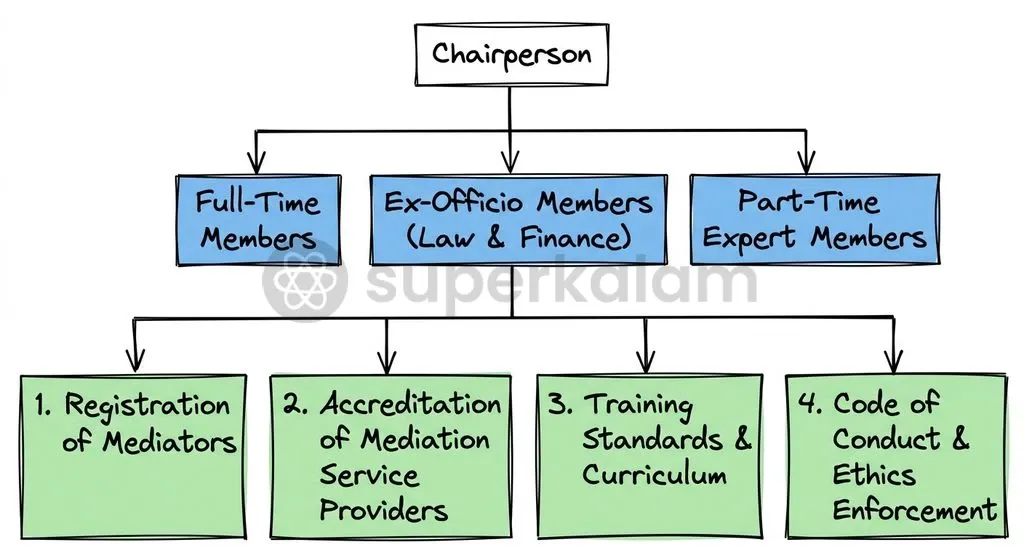
Sections 31 and 32 of the Mediation Act, 2023 establish the Mediation Council of India (MCI) as a centralised statutory regulatory authority. The Council oversees the institutionalisation of dispute resolution standards and enforces professional accountability across the country.
The composition of the Mediation Council of India balances judicial experience with technical ADR expertise:
- Chairperson: An individual who is a retired Supreme Court Judge, a retired Chief Justice of a High Court, or an eminent person with extensive expertise in ADR.
- Full-Time Members: Two full-time members, consisting of one experienced ADR practitioner and one academician specialising in alternate dispute resolution laws.
- Ex-Officio Members: Three ex-officio members representing key Union Government departments, including the Department of Legal Affairs and the Department of Expenditure.
- Part-Time Member: One part-time representative drawn from recognised industry or commerce bodies.
Under Section 38, the Council is empowered to register professional mediators, recognise mediation service providers, accredit training institutes, and frame binding codes of professional conduct. Centralised professional registration ensures that matrimonial mediators adhere to uniform operational standards and clear ethical boundaries.
Ethical Dimensions: Confidentiality, Informed Consent, and Neutrality
The ethical framework of the Mediation Act, 2023 rests on strict standards of confidentiality, transparency, and procedural neutrality. In matrimonial disputes, ethical mediation requires maintaining genuine impartiality while preventing hidden coercion or unequal settlements.
Sections 22 and 23 guarantee absolute confidentiality for all communications, proposals, and admissions made during mediation proceedings. This statutory bar prevents spouses from using admissions made during settlement talks as prejudicial courtroom evidence if negotiations break down. Confidentiality fosters honest dialogue, enabling spouses to discuss personal arrangements without fearing future litigation penalties.
Equally critical is mediator impartiality. Under Section 10, mediators must provide a written conflict disclosure before accepting an assignment, detailing any circumstance that could create justifiable doubts regarding their independence or impartiality. When handling family conflicts, mediators face the ethical duty of remaining strictly neutral while ensuring that vulnerable spouses retain genuine agency and make fully informed decisions.
Discuss with Superkalam
Assess whether the right to withdraw after two sessions under Section 24 provides an adequate safeguard against socio-economic coercion during private mediation.
Ask NowWay Forward: Capacity Building, Gender Sensitization, and Safeguarding Equity
Achieving equitable family dispute resolution under the Mediation Act, 2023 requires robust administrative capacity, specialized training, and structural safeguards for vulnerable participants.
- Mandatory Gender Sensitization: The Mediation Council of India must make comprehensive gender-sensitization modules compulsory under Section 38 accreditation standards to equip mediators to spot subtle economic coercion.
- Expanding Legal Aid Linkages: State Legal Services Authorities should embed independent legal advisors within mediation centres under Section 5(3) to review draft agreements for vulnerable spouses before final execution.
- Screening for Domestic Abuse: Institutional service providers must implement standardised pre-mediation screening protocols to prevent domestic violence matters from being improperly diverted away from magistrate courts.
- Regulating Online Dispute Resolution: The Central Government should establish secure technological infrastructure under Section 30 to prevent unauthorized digital recordings and ensure privacy during remote proceedings.
Key Takeaways
- The Mediation Act, 2023 creates India's first standalone statutory framework to regulate domestic and cross-border mediation, receiving presidential assent on 14 September 2023.
- Pre-litigation mediation is voluntary under Section 5(1), following recommendations in the 117th Report of the Parliamentary Standing Committee to avoid procedural delays.
- Section 27(2) provides that an authenticated Mediated Settlement Agreement is enforceable under the Code of Civil Procedure, 1908 in the same manner as a civil court decree.
- Section 28 restricts legal challenges to mediated settlements strictly to fraud, corruption, impersonation, or subject matter excluded by the First Schedule, within a 90-day limitation period.
- Section 6 and the First Schedule bar non-compoundable criminal offences from mediation, while Section 12 of the PWDVA ensures independent legal remedies for domestic abuse.
- The Mediation Council of India, established under Sections 31 and 32, serves as the primary statutory regulator responsible for registering mediators and setting professional codes of conduct.
Mains Question
"While the Mediation Act, 2023 institutionalises alternative dispute resolution by granting settlement agreements the status of a civil court decree, structural socio-economic inequalities between spouses can undermine genuine consent." Critically analyse. (15 Marks)
Evaluate NowMains Question
The Mediation Act, 2023 seeks to demarcate civil dispute resolution from criminal domestic abuse. Elucidate the statutory safeguards and judicial mechanisms governing the mediation of matrimonial conflicts. (10 Marks)
Evaluate NowPractice MCQs
QUESTION 1
With reference to the Mediation Act, 2023, consider the following statements:
- Pre-litigation mediation has been made mandatory for all civil and matrimonial disputes before filing a suit.
- A party to the mediation proceedings has the statutory right to withdraw without assigning reasons after attending two sessions.
- The Act mandates that mediation proceedings must be completed within 180 days, which can be extended by an additional 180 days with mutual party consent.
Which of the statements given above is/are correct?
QUESTION 2
Regarding the legal status and execution of settlement agreements under the Mediation Act, 2023, consider the following statements:
- An authenticated Mediated Settlement Agreement is enforceable under the Code of Civil Procedure, 1908, in the same manner as a civil court decree.
- Agreements arrived at through local community mediation enjoy the same status and enforceability as a civil court decree.
- A challenge against a Mediated Settlement Agreement can be made on grounds of fraud, corruption, or impersonation within a limitation period of 90 days.
Which of the statements given above is/are correct?
QUESTION 3
Consider the following statements regarding the treatment of criminal and domestic violence matters under the Mediation Act, 2023:
- Non-compoundable criminal offences and serious fraud are excluded from the scope of mediation under the First Schedule.
- In compoundable matrimonial offences referred by a court, the mediated settlement automatically operates as a civil court decree without criminal court acceptance.
- Courts referring pending matrimonial disputes to mediation retain the power to pass binding interim protective orders.
Which of the statements given above is/are correct?
QUESTION 4
Which of the following judicial pronouncements held that High Courts can exercise inherent powers under Section 482 of the CrPC to quash non-compoundable criminal matrimonial proceedings if the parties have reached an amicable settlement?
QUESTION 5
With reference to the institutional and procedural framework of the Mediation Act, 2023, consider the following statements:
- Section 30 accords formal statutory recognition to encrypted Online Dispute Resolution (ODR) with written party consent.
- Section 5(3) integrates mediation with the Legal Services Authorities Act, 1987 to facilitate legal aid for indigent parties.
- Admissions and proposals made during mediation proceedings remain admissible as evidence in subsequent civil court trials.
Which of the statements given above is/are correct?