Kandla e-Methanol Plant: Proposed Green Fuel Project Explained
The proposed port-based e-methanol project at Kandla aims to support cleaner shipping fuel. See its planned phases, capacity and why it matters.
Sep, 2026
•8 min read
Overview
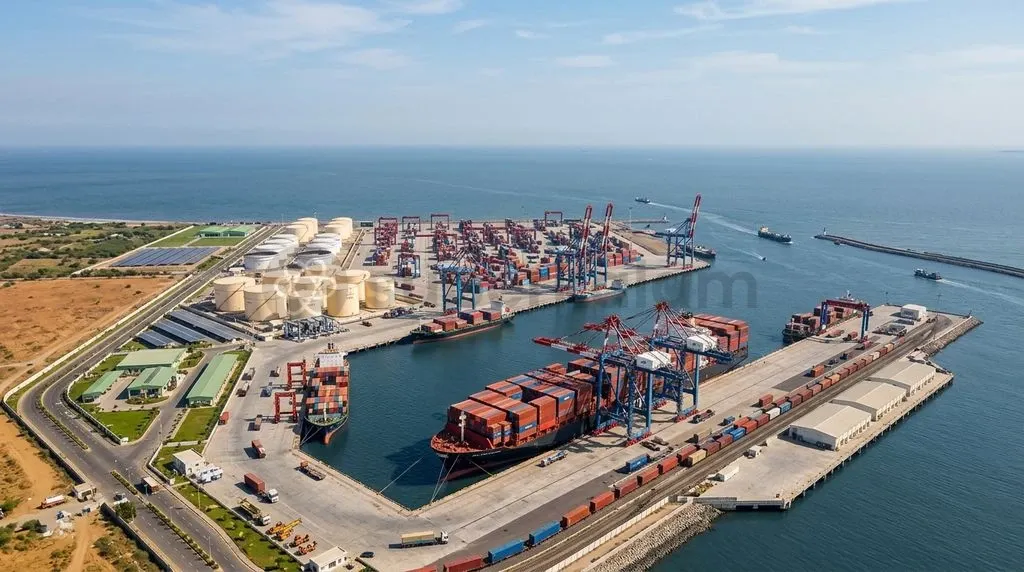
India laid the foundation stone for its first port-based e-methanol production and bunkering facility at Deendayal Port Authority in Kandla, Gujarat, marking a strategic leap toward establishing domestic green shipping corridors. The ₹2,300 crore joint venture delivers a nameplate capacity of 150 tonnes per day to supply low-carbon maritime fuel along high-density international shipping lanes.
By synthesizing green hydrogen with captured carbon dioxide, the facility creates a scalable alternative to fossil bunker fuels without requiring expensive cryogenic handling infrastructure. This initiative positions Kandla as an anchor hub in global maritime decarbonisation, leveraging regional renewable energy capacity to supply green fuel at competitive international benchmarks.
Why in the News?
As of September 2026, the foundation stone was laid for India's first port-based e-methanol plant at Deendayal Port Authority (DPA) in Kandla, Gujarat. The commercial rollout follows an initial Memorandum of Understanding signed between Assam Petro-Chemicals Ltd (APL) and DPA on 29 January 2026.
The project requires a total capital expenditure of ₹2,300 crore and is structured as a 76:24 joint venture between Deendayal Port Authority (76%) and Assam Petro-Chemicals Ltd (24%). Production will scale across two modular phases: Phase I deploys 50 tonnes per day (TPD) capacity by January 2027 with a ₹1,200 crore investment, while Phase II adds 100 TPD by March 2027 with an outlay of ₹1,100 crore.
What Is e-Methanol and How Is It Produced?
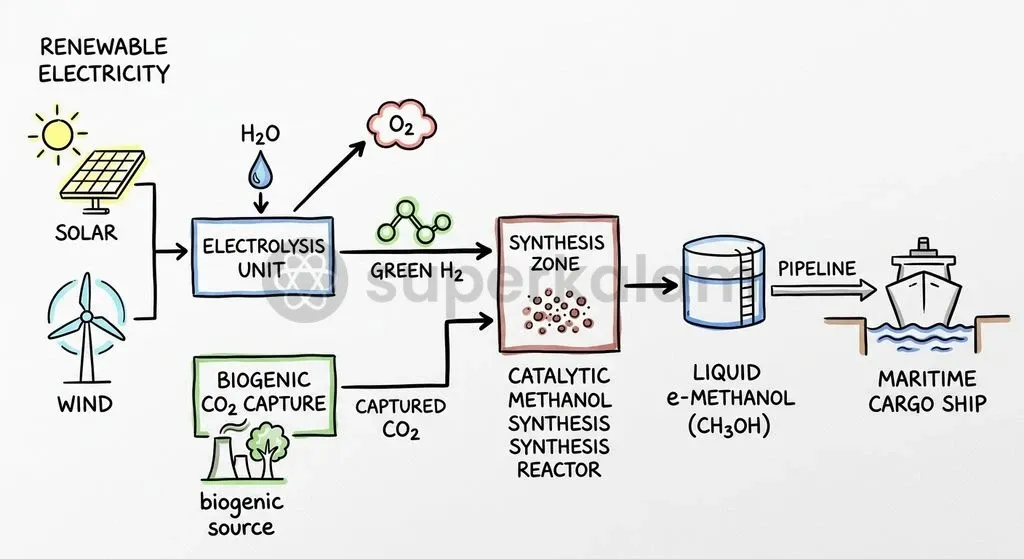
E-methanol is an ultra-low-carbon synthetic fuel produced by combining green hydrogen with captured biogenic or industrial carbon dioxide ($CO_2$). The chemical synthesis transforms intermittent renewable electricity into a stable, transportable liquid carrier.
The production cycle operates through three distinct stages:
- Green Hydrogen Generation: Water is split into hydrogen and oxygen inside electrolysers powered entirely by dedicated solar or wind electricity.
- Carbon Dioxide Capture: Biogenic $CO_2$ from industrial fermentation or biomass combustion, or point-source industrial emissions, is captured and purified.
- Catalytic Methanol Synthesis: Green hydrogen and carbon dioxide react catalytically under elevated temperature and pressure ($CO_2 + 3H_2 \rightarrow CH_3OH + H_2O$) to produce liquid e-methanol.
Unlike gaseous hydrogen or cryogenic methane, e-methanol remains liquid at ambient temperature and pressure, avoiding expensive boil-off mitigation and heavily insulated tanks. It integrates directly into existing maritime distribution networks with minor retrofitting.
Discuss with Superkalam
What are the three chemical steps involved in the production of e-methanol from renewable energy?
Ask NowWhy Kandla Port Was Chosen as the Anchor Hub
Deendayal Port Authority in Kandla holds a decisive geographical and infrastructural edge over other coastal ports designated under national clean energy programmes. While the Ministry of New and Renewable Energy also designated V.O. Chidambaranar Port (Tuticorin) and Paradip Port as green hydrogen hubs, Kandla's immediate proximity to western India's massive renewable energy generation gives it a clear cost advantage. Cheap renewable electricity directly reduces the levelised cost of water electrolysis, making local green hydrogen production commercially viable.
Furthermore, Kandla sits directly adjacent to high-density international shipping routes, notably the Asia-Europe International Trade Corridor and Singapore–Rotterdam trade routes. International merchant vessels can refuel without making costly detours away from primary navigation lanes.
The port authority has already laid the operational groundwork on-site:
- Dedicated Green Hydrogen Base: Commissioned a 1 MW indigenous electrolyser plant producing nearly 140 metric tonnes of green hydrogen annually.
- Land Allocation: Dedicated approximately 3,400 acres of port land exclusively for green hydrogen and green ammonia ventures.
- Bunkering Readiness: Attained a Port Readiness Level (PRL) of 6 (advancing toward 7) supported by a dedicated 3.5 MTPA liquid cargo handling jetty.
Discuss with Superkalam
How does the physical state of e-methanol at ambient pressure reduce capital expenditure compared to LNG bunkering infrastructure?
Ask NowPolicy Alignment: Harit Sagar and Maritime Amrit Kaal Vision 2047
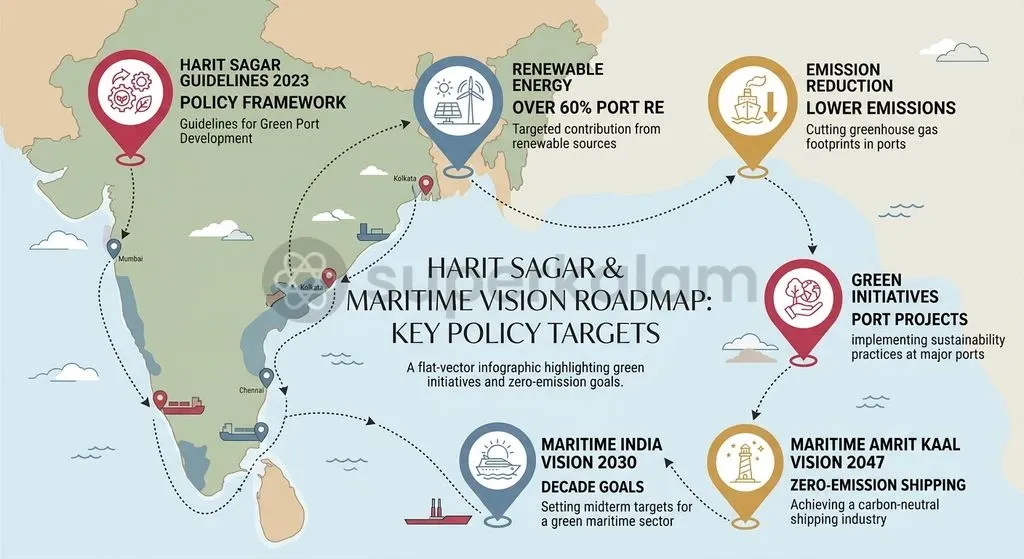
The Kandla project serves as an operational testbed for national green shipping frameworks. In May 2023, the Ministry of Ports, Shipping and Waterways issued the Harit Sagar Green Port Guidelines, mandating emission benchmarks, environmental reporting, and alternative fuel bunkering infrastructure across all Major Ports.
These efforts integrate with long-term statutory and developmental targets:
- Maritime India Vision 2030: Aims to scale the share of renewable energy at major ports to over 60% by 2030 through rooftop solar, wind installations, and electrified cargo handling.
- Maritime Amrit Kaal Vision 2047: Focuses on establishing green shipping corridors, expanding port-led industrialisation, and deploying comprehensive bunkering facilities for hydrogen derivatives.
- National Green Hydrogen Mission (NGHM): Provides capital support and strategic backing to anchor commercial bunkering infrastructure at designated major ports.
Comparing Marine Fuels: Heavy Fuel Oil, LNG, Green Ammonia, and e-Methanol
Decarbonising international shipping requires evaluating life-cycle emissions, energy density, handling complexity, and infrastructure retrofitting costs across competing marine fuels.
| Parameter | Heavy Fuel Oil (VLSFO) | Liquified Natural Gas (LNG) | Green Ammonia ($NH_3$) | E-Methanol ($CH_3OH$) |
|---|---|---|---|---|
| Well-to-Wake GHG Emissions | High (Baseline fossil emissions) | Moderate (15–25% reduction; methane slip risk) | Zero to Near-Zero (Zero carbon molecule) | Near-Zero (Closed carbon cycle) |
| Storage Temperature & Pressure | Ambient ($15^\circ\text{C}$ to $50^\circ\text{C}$, atmospheric) | Cryogenic ($-162^\circ\text{C}$, insulated tanks) | Refrigerated ($-33^\circ\text{C}$) or pressurised | Ambient liquid (Atmospheric pressure) |
| Infrastructure Compatibility | Existing global bunkering baseline | Requires dedicated cryogenic bunkering terminals | Requires specialised toxic gas handling systems | High compatibility with standard liquid storage tanks |
| Toxicity & Safety Risks | Low immediate toxicity; environmental hazard | Flammable; cryogenic burn risk | High acute toxicity to crew and marine ecology | Flammable; standard industrial chemical handling |
| Technological Maturity | Mature commercial standard | Fully commercialised global fleet | Under development (engine pilots underway) | Commercially deployed in modern dual-fuel container vessels |
Compared to green ammonia, which presents severe toxicity and corrosion hurdles, e-methanol offers a practical drop-in alternative for dual-fuel vessel engines while avoiding the high capital costs of cryogenic LNG bunkering.
Discuss with Superkalam
If a global shipping line transits the Asia-Europe corridor, what operational parameters determine whether it bunks at Kandla over competing international ports?
Ask NowStrategic, Economic, and Climate Benefits for India
Establishing a commercial e-methanol bunkering terminal at Kandla delivers compounding benefits across energy security, domestic employment, and global environmental governance.
Delivering Global Cost Competitiveness
The Ministry of Ports, Shipping and Waterways projects the Kandla facility to produce green methanol at US$750 per tonne, significantly undercutting prevailing global market benchmarks of approximately US$1,300 per tonne. This cost advantage attracts foreign merchant fleets seeking compliance with tightening environmental norms.
Meeting Global Decarbonisation Mandates
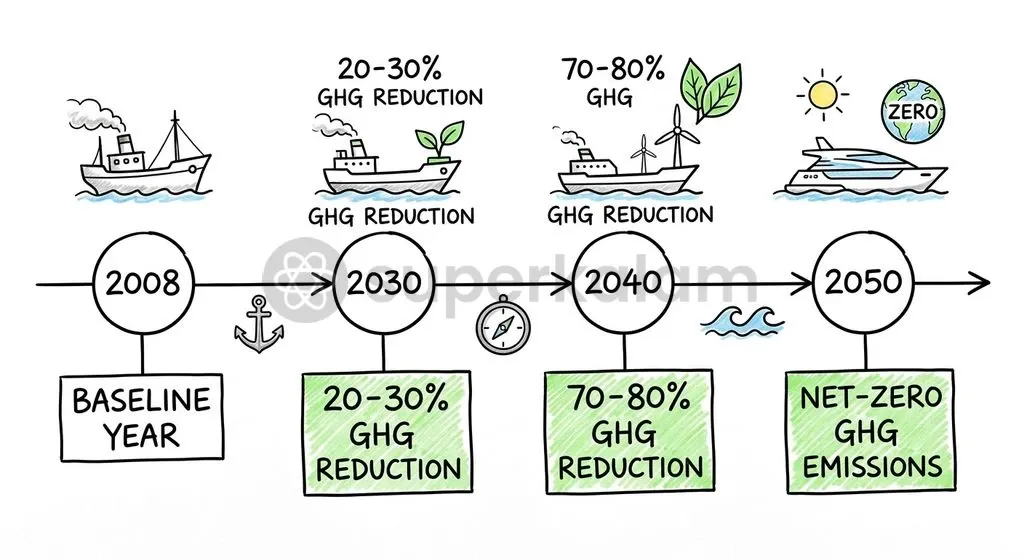
The 2023 IMO Strategy on Reduction of GHG Emissions from Ships mandates net-zero greenhouse gas emissions from international shipping by or around 2050. The framework establishes indicative interim targets:
- Reducing international shipping GHG emissions by at least 20% (striving for 30%) by 2030 compared to 2008 levels.
- Slashing emissions by at least 70% (striving for 80%) by 2040.
Supplying port-side e-methanol enables Indian ports to capture high-value bunkering trade as shipowners transition away from high-carbon fossil fuels.
Socio-Economic Multipliers
The project generates over 3,500 direct and indirect employment opportunities across green power generation, chemical plant operations, pipeline maintenance, and bunkering logistics.
Key Challenges in Scaling Port-Based Green Bunkering
Despite the strategic rationale, scaling green e-methanol bunkering across India's coastline encounters structural commercial and operational bottlenecks:
- High Electrolyser Capital Expenditure: High upfront costs for electrolyser stacks and balance-of-plant components keep capital intensity elevated across early manufacturing phases.
- Biogenic Carbon Feedstock Sourcing: Ensuring uninterrupted supplies of captured biogenic $CO_2$ from distilleries or biomass plants requires complex inland supply chain corridors.
- Fuel Price Disparities: Conventional Very Low Sulphur Fuel Oil (VLSFO) remains significantly cheaper on an energy-equivalent basis, requiring carbon pricing mechanisms or subsidies to bridge the commercial gap.
- Fleet Dual-Fuel Readiness: International shipping fleets must undertake capital-intensive fleet replacement or engine retrofits to consume methanol, moderating immediate spot bunkering demand.
Discuss with Superkalam
Analyse the trade-offs between zero-carbon green ammonia and closed-loop e-methanol regarding port safety, fuel availability, and engine retrofitting.
Ask NowWay Forward: Building a Resilient Maritime Green Fuel Ecosystem
Scaling India's maritime green fuel infrastructure requires targeted fiscal, technological, and regulatory interventions:
- Developing Dedicated Green Shipping Corridors: Partner with major trading terminals in Europe and East Asia to guarantee bilateral demand for zero-emission fuels along high-volume routes.
- Aggregating Carbon Feedstock Supply Chains: Establish regional $CO_2$ capture networks linking agricultural biomass clusters and industrial plants in Gujarat to Kandla via rail and pipeline logistics.
- Implementing Green Bunkering Standards: Streamline port safety regulations, fuel certification protocols, and vessel bunkering guidelines under the Harit Sagar framework to facilitate seamless bunkering operations.
- Deploying Demand-Side Guarantees: Introduce initial port fee concessions and green bunkering incentives to bridge the operating cost differential between clean fuels and fossil bunker oils.
Key Takeaways
- Deendayal Port Authority in Kandla is developing India's first port-based e-methanol production and bunkering hub with a ₹2,300 crore capital outlay.
- The project is executed as a 76:24 joint venture between Deendayal Port Authority and Assam Petro-Chemicals Ltd, adding 150 tonnes per day capacity across two phases.
- E-methanol synthesis combines green hydrogen from renewable water electrolysis with captured biogenic or industrial carbon dioxide.
- Kandla's projected production cost of US$750 per tonne undercuts international market prices of ~US$1,300 per tonne, aided by Gujarat's vast renewable energy resources.
- The initiative operationalises the Harit Sagar Guidelines (2023) and supports the IMO 2023 GHG Strategy targeting net-zero shipping emissions by or around 2050.
Mains Question
In the backdrop of the 2023 IMO GHG Strategy and the Harit Sagar Green Port Guidelines, examine how the development of port-based green bunkering infrastructure positions India in global green maritime trade. (15 Marks)
Evaluate NowMains Question
'Owing to thermodynamic stability and handling convenience, e-methanol offers a practical transition pathway over cryogenic LNG and green ammonia for maritime decarbonisation.' Elucidate. (10 Marks)
Evaluate NowPractice MCQs
QUESTION 1
With reference to the production and physical properties of e-methanol as a marine fuel, consider the following statements:
- It is synthesized catalytically by reacting green hydrogen with captured carbon dioxide.
- Unlike liquid natural gas, e-methanol remains in a liquid state at ambient temperature and pressure.
- Its combustion results in zero life-cycle emissions without relying on a closed carbon cycle. Which of the statements given above are correct?
QUESTION 2
Consider the following statements regarding green maritime initiatives in India:
- Deendayal Port Authority in Kandla, V.O. Chidambaranar Port in Tuticorin, and Paradip Port have been recognised as green hydrogen hubs under the National Green Hydrogen Mission.
- Maritime India Vision 2030 sets a target to scale the share of renewable energy at major ports to over 60% by 2030.
- The Harit Sagar Guidelines mandate emission benchmarks and alternative fuel bunkering infrastructure across all Major Ports. Which of the statements given above are correct?
QUESTION 3
In the context of alternative marine fuels evaluated for international shipping decarbonisation, consider the following statements:
- Green ammonia produces zero carbon emissions on a well-to-wake basis but involves acute toxicity and crew safety challenges.
- Liquified Natural Gas (LNG) bunkering eliminates methane slip and requires standard atmospheric storage tanks.
- E-methanol can be stored in standard liquid cargo tanks with minor retrofitting and is commercially deployed in dual-fuel container vessels. Which of the statements given above is/are correct?
QUESTION 4
Under the 2023 International Maritime Organization (IMO) Strategy on Reduction of GHG Emissions from Ships, what is the targeted reduction in greenhouse gas emissions from international shipping by 2030 compared to 2008 levels?
QUESTION 5
With reference to the port-based e-methanol project at Deendayal Port Authority (Kandla), consider the following statements:
- The plant is structured as a joint venture between Deendayal Port Authority and Assam Petro-Chemicals Ltd.
- It has achieved a Port Readiness Level (PRL) of 6 and utilizes an indigenous electrolyser plant.
- The projected production cost of e-methanol at Kandla is higher than the prevailing global market benchmark. Which of the statements given above is/are correct?