UDAN Scheme at 10 Years: Achievements and Modified UDAN 2026 Explained
Decadal audits expose fragile regional air routes, shifting policy focus from temporary ticket subsidies to structural aerodrome and fleet viability.
Oct, 2026
•11 min read
Overview
The Ministry of Civil Aviation launched the Modified UDAN scheme in July 2026 with a financial outlay of Rs 28,840 crore to restructure India's regional aviation network, shifting the policy focus from short-term ticket subsidies toward long-term aerodrome viability and domestic fleet capacity. This policy shift addresses a chronic structural bottleneck where regional airlines frequently collapsed once initial three-year government subsidies expired. By replacing rigid operational grants with tapered five-year viability gap funding and targeted airport maintenance assistance, the initiative seeks to insulate secondary flight corridors from market volatility. The reform balances economic connectivity with territorial integration, linking remote border regions, island chains, and industrial belts to the national aviation core.
Why in the News: A Decade of RCS-UDAN and the Call for a Structural Reset
Prime Minister Narendra Modi officially launched the Modified UDAN scheme from Jodhpur on July 4, 2026, following formal Union Cabinet approval on March 25, 2026. As of October 2026, the original Regional Connectivity Scheme (RCS-UDAN) has completed a full decade of operational implementation since its rollout under the National Civil Aviation Policy (NCAP) 2016, according to a Ministry of Civil Aviation review.
The decadal milestone exposed a central policy contradiction in regional aviation. While the programme expanded physical infrastructure to underserved areas, commercial carriers struggled to sustain routes without public subsidies. Modified UDAN marks a structural transition from blunt passenger fare subsidisation to systemic network resilience, but its ultimate success depends on dismantling fundamental cost asymmetries in fuel taxation, fleet leasing, and metropolitan airport slot allocation.
The 10-Year Audit: Regional Connectivity Expansion vs High Route Discontinuation
The Ministry of Civil Aviation recorded measurable spatial expansion under RCS-UDAN between October 2016 and October 2026. Official operational reviews confirm that the scheme operationalised 687 regional routes across 95 aerodromes, including 17 heliports and 2 water aerodromes. Over this ten-year span, the programme facilitated air travel for more than 1.72 crore passengers across 3.68 lakh commercial flights, supported by Rs 5,091.23 crore in disbursed Viability Gap Funding (VGF).
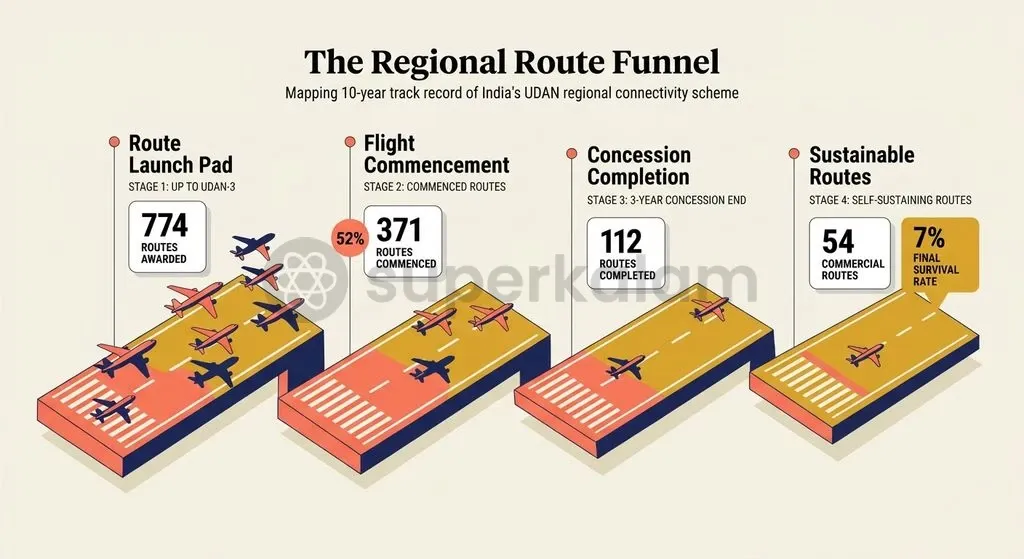
Beneath these headline achievements lies severe operational attrition among commercial regional carriers. According to the Comptroller and Auditor General (CAG) of India, out of 774 routes awarded across the first three bidding cycles, 52 percent (403 routes) never commenced scheduled operations.
The attrition data highlights significant commercial vulnerability across regional networks:
- Low Post-Subsidy Survival: Out of 371 routes that commenced flights up to UDAN-3, only 112 finished their mandatory three-year concession term, and merely 54 routes sustained operations without financial aid.
- Premature Route Abandonment: Government disclosures in the Rajya Sabha revealed that out of 923 total awarded routes, 651 were operationalised, yet 123 routes folded prematurely before finishing their initial three-year term.
- Aerodrome De-activation: The termination of regional flight schedules caused 14 revived aerodromes to lapse back into complete non-operational status.
Discuss with Superkalam
Recall the total financial outlay approved by the Union Cabinet for the Modified UDAN scheme over the 2026–2036 period.
Ask NowThe Structural Flaw: Why Routes Collapsed Once the Viability Gap Funding Sunset Ended
Regional airline business models experienced an abrupt financial shock whenever the initial three-year Viability Gap Funding packages expired. Under the early guidelines of NCAP 2016, VGF was designed as a temporary three-year taper to stimulate latent travel demand on unserved city pairs. In practice, operators treated the subsidy as an operational lifeline rather than a transitional bridge toward commercial viability.
Airlines routinely failed to develop organic, non-subsidised passenger traffic over the three-year concession period. The Ministry of Civil Aviation reported in the Lok Sabha that repeated non-performance and sudden flight suspensions forced the government to forfeit airline bank guarantees in 14 individual cases across FY 2024-25 and FY 2025-26.
Regional operational stress became acute in geographically distinct operating theatres:
- Northern Plains Concentration: In Uttar Pradesh, commercial carriers abandoned 32 routes prior to completing their three-year concession window, causing 6 state aerodromes to close completely due to operator withdrawal.
- North Eastern Connectivity Collapse: Across the North Eastern States, where 90 routes were activated across different scheme phases, only 38 remained operational by mid-2026, as 28 routes collapsed immediately upon the expiration of their three-year subsidy.
Broader macroeconomic and supply-chain pressures worsened route mortality across the country. The Ministry noted that engine groundings from Pratt & Whitney, acute shortages of global components, and severe corporate insolvencies—such as the collapse of regional airlines like Flybig and Air Carnival—paralysed fleet availability.
Foreign exchange imbalances compounded these technical bottlenecks for domestic operators. Because Indian commercial operators lease over 75% of their active aircraft fleets under contracts denominated in foreign currency, regional carriers bore severe foreign exchange exposure that eroded the real purchasing value of fixed, rupee-denominated state subsidies.
Discuss with Superkalam
Explain why foreign currency aircraft leases created financial distress for regional airlines receiving rupee-denominated subsidies.
Ask NowComparing Models: Original UDAN (1.0 to 5.0) vs The Modified UDAN Framework
The Union Cabinet designed Modified UDAN with an aggregate capital and operational outlay of Rs 28,840 crore, structured over a ten-year timeline running from FY 2026-27 through FY 2035-36. The revised scheme moves away from isolated, point-to-point route auctions in favour of an integrated network and aerodrome capitalization model.
The budgetary architecture allocates resources across three core capital and operational pillars:
- Airstrip Conversion: A dedicated envelope of Rs 12,159 crore will transform 100 unserved airstrips into fully operational regional airports over an eight-year development schedule.
- Helicopter Infrastructure: Targeted funding of Rs 3,661 crore is earmarked to build and commission 200 modern helipads to expand hilly and island connectivity.
- Operational Underwriting: An operational reserve of Rs 10,043 crore is reserved for direct airline Viability Gap Funding disbursements to support carrier solvency.
| Operational Dimension | Original UDAN Framework (1.0–5.0) | Modified UDAN Framework (2026–2036) |
|---|---|---|
| Financial Outlay & Horizon | Ad-hoc annual allocations under NCAP 2016; cumulative disbursement of Rs 5,091.23 crore | Long-term programmatic outlay of Rs 28,840 crore committed across ten financial years |
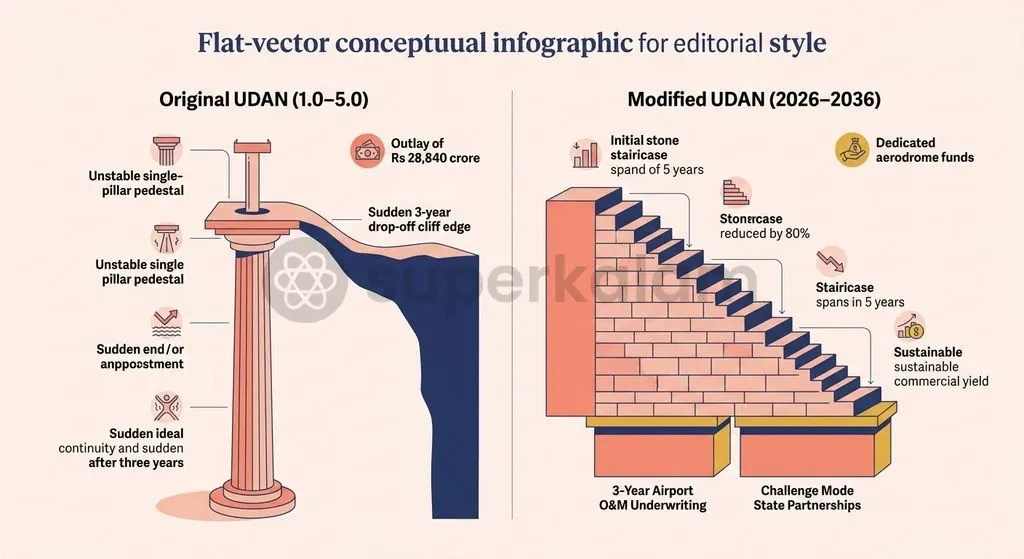
| Subsidy Lifespan & Tapering | Fixed, abrupt 3-year cliff edge with flat funding rates followed by complete termination | Dynamic tapered 5-year support providing 80% to 90% in initial years before step-downs |
| Aerodrome Selection Model | Airline-led route selection based primarily on isolated commercial bidding preferences | Competitive Challenge Mode scoring state land readiness, counterpart funds, and economic links |
| Airport Financial Viability | Capital creation via AAI with zero long-term underwriting for recurring operating losses | Mandatory 3-year O&M funding for newly activated airports to absorb early cash deficits |
| Fleet & Fleet Sourcing Strategy | Indifferent to fleet origins; high reliance on dollar-denominated foreign lease structures | Earmarks Rs 400 crore to deploy indigenous aircraft like HAL-manufactured Dornier 228s |
| Intermodal Planning Integration | Standalone civil aviation nodes operating in logistical isolation from surface transport | Mandatory synchronization through the PM Gati Shakti National Master Plan GIS platform |
Discuss with Superkalam
If you were advising a state government competing under the 'Challenge Mode', which parameters would you prioritize to secure aerodrome selection?
Ask NowEvaluating the Reset: Does Modified UDAN Fix Regional Aviation Economics or Postpone Failure?
Modified UDAN addresses regional aviation failures by dismantling the abrupt three-year operational cliff edge that grounded earlier routes. Under the revised guidelines, financial assistance is structured across a tapered five-year schedule, starting with 80% to 90% operational gap coverage in early years before gradually stepping down as routes mature. This phased withdrawal gives airlines the necessary runway to build sustainable local passenger yields, test corporate demand, and adjust flight frequencies without risking immediate insolvency.
The programme also introduces direct fiscal support for regional airport balance sheets. By providing dedicated Operation and Maintenance (O&M) funding for newly commissioned aerodromes across their initial three operating years, the policy protects regional facilities from running unsustainable fiscal deficits while air traffic builds up.
State-level execution delays are addressed through a competitive qualification framework. Under the new Challenge Mode scoring system, the Centre evaluates prospective aerodrome projects based on confirmed land transfers, proximity to industrial or pilgrimage clusters, and firm state commitments regarding tax exemptions. This framework targets institutional bottlenecks highlighted by the CAG, which documented that delayed handovers of encumbrance-free state land stalled development at 40 planned aerodromes.
Structural market failures could still limit the effectiveness of this policy reset:
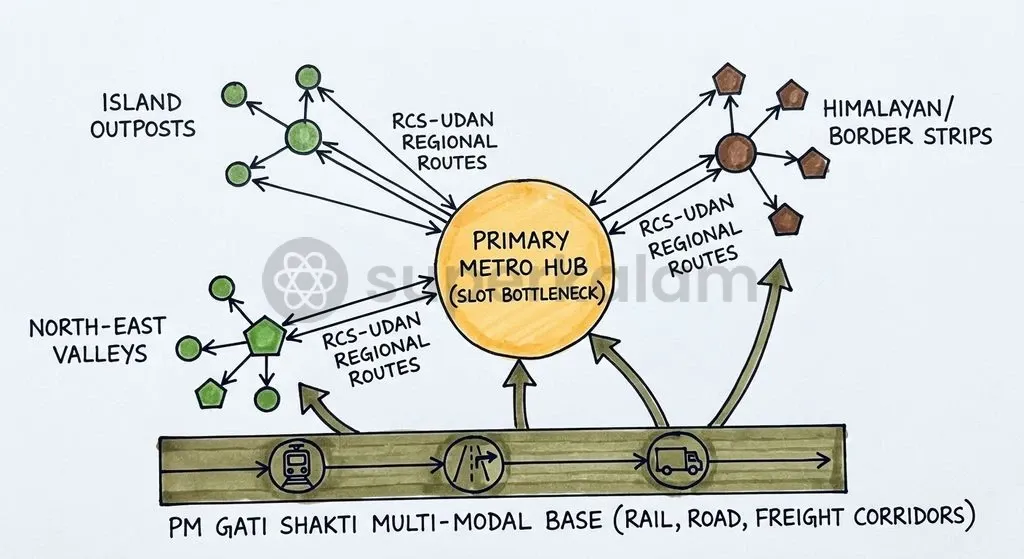
- Metropolitan Hub Saturation: Over 80 percent of domestic passenger volume remains concentrated in India's top 15 hub airports, creating chronic peak-hour slot congestion that prevents airlines from pairing regional flights with profitable commercial metros.
- Disproportionate Fuel Taxation: While participating States cap Value Added Tax (VAT) on Aviation Turbine Fuel (ATF) at 1% or less at RCS airports, connecting metro hubs frequently impose state taxes between 20% and 30%, distorting airline operating costs on round trips.
Without broad slot access at major economic hubs, regional feeder flights risk carrying passengers between secondary hubs that lack the commercial density required to sustain air services.
Discuss with Superkalam
Compare the root causes of route discontinuation in the North Eastern States with those in the Northern Plains as highlighted in the audit.
Ask NowStrategic Imperatives: Border Integration, Island Connectivity, and Regional Growth
The expansion of regional air links serves broader constitutional and developmental goals beyond basic passenger transit. Modern civil aviation creates substantial economic spillover effects across secondary and tertiary towns. Analytical studies from the International Civil Aviation Organization (ICAO) demonstrate that scheduled air transport yields an output multiplier of 3.25 alongside an employment multiplier of 6.10 across regional host economies.
Spatial integration remains essential for national cohesion, particularly along remote borders and island archipelagos. The Ministry of Civil Aviation prioritises remote territories by designating priority connectivity corridors across Jammu & Kashmir, Ladakh, Uttarakhand, Himachal Pradesh, the North East, and the Andaman & Nicobar and Lakshadweep island chains.
In these ecologically sensitive frontiers, commercial aviation functions as vital lifeline infrastructure for administrative access, high-value trade, and disaster response during severe weather disruptions.
Strategic territory requirements differ fundamentally from standard domestic commercial aviation routes:
- State Funding Parity: While standard UDAN routes require state governments to contribute 20% of the VGF capital, the central framework lowers the state counterpart share to 10% for North Eastern states and Union Territories to reflect their fiscal constraints.
- Sovereign Fleet Security: Modified UDAN introduces a Rs 400 crore allocation dedicated exclusively to procuring and deploying Made-in-India aircraft, such as the 19-seater Hindustan Aeronautics Limited (HAL) Dornier 228 variants.
Deploying indigenously manufactured airframes reduces carrier reliance on overseas leasing cartels, simplifies regulatory spare-parts pipelines, and provides transport platforms that can operate reliably from short, high-altitude border runways.
Discuss with Superkalam
Propose complementary policy reforms beyond VGF and airport development needed to insulate regional carriers from sudden global supply-chain shocks.
Ask NowWay Forward: Building a Self-Sustaining Regional Aviation Ecosystem
Transforming regional connectivity from a subsidised public initiative into a self-sustaining aviation ecosystem requires coordinated legal, fiscal, and operational reforms across central and state institutions.
The following institutional interventions provide a viable roadmap for policy implementation:
- Fiscal Rationalisation of Aviation Turbine Fuel: The GST Council should consider bringing Aviation Turbine Fuel under the unified Goods and Services Tax framework with an input tax credit mechanism. In the interim, state governments must lower their local VAT rates on regional aircraft refuelling at non-RCS metro airports to eliminate the severe operating cost penalties currently borne by commuter carriers.
- Onshoring Commercial Aircraft Leasing via GIFT IFSC: The Ministry of Civil Aviation and the International Financial Services Centres Authority (IFSCA) must expand incentives for domestic rupee-denominated aircraft leasing. Establishing local leasing mechanisms builds on early gains at GIFT City, where 19 leasing entities registered and financed over 137 aviation assets. Rupee-denominated leases help insulate emerging commuter airlines from sharp currency devaluations.
- Guaranteed Peak-Hour Hub Slot Allocations: The Directorate General of Civil Aviation (DGCA) should mandate that congested tier-one metro airports reserve a dedicated quota of peak morning and evening landing slots for regional turboprop aircraft. Connecting regional flights into high-density commercial schedules generates the feeder passenger traffic needed to keep secondary routes viable without perpetual state subsidies.
- Intermodal Logistics Alignment via PM Gati Shakti: State infrastructure planners must integrate regional aerodromes into the PM Gati Shakti GIS platform. Linking remote airstrips directly with high-speed expressways, regional rail nodes, and cold-chain storage facilities transforms regional airports into multi-modal logistics centres that generate year-round commercial cargo revenue.
Key Takeaways
- The Ministry of Civil Aviation launched Modified UDAN in July 2026 with a ten-year budget of Rs 28,840 crore, replacing the rigid three-year operational subsidy cliff edge with a tapered five-year viability gap funding model.
- Over its first decade of operations, RCS-UDAN operationalised 687 routes across 95 aerodromes and carried 1.72 crore passengers, supported by Rs 5,091.23 crore in disbursed Viability Gap Funding.
- Early implementation suffered from severe commercial instability: out of 774 routes awarded through UDAN-3, only 54 routes sustained commercial operations once government financial support ended.
- Modified UDAN introduces an eight-year target of Rs 12,159 crore to develop 100 airports from existing airstrips, Rs 3,661 crore for 200 helipads, and three years of dedicated operating and maintenance support for newly commissioned aerodromes.
- Aerodrome project selection has shifted to a competitive Challenge Mode scoring mechanism, requiring states to guarantee encumbrance-free land transfers, lower utility charges, and local fuel tax concessions.
- Long-term commercial viability requires addressing broader structural headwinds, including metro airport slot congestion, the need to onshore aircraft leases through GIFT City, and fuel tax rationalisation across major transit hubs.
Mains Question
A decade of Regional Connectivity Scheme (RCS-UDAN) implementation reveals that expanding physical infrastructure does not automatically translate into commercial route viability. In light of the findings of the CAG Compliance Audit, critically analyse the structural factors responsible for high route discontinuation in regional aviation. (15 Marks)
Evaluate NowMains Question
'The transition from original UDAN to Modified UDAN marks a policy shift from blunt operational subsidisation toward systemic aerodrome capitalization and network resilience.' Elucidate. (10 Marks)
Evaluate NowPractice MCQs
QUESTION 1
With reference to the Modified UDAN scheme launched in 2026, consider the following statements:
- It introduces a dynamic tapered five-year Viability Gap Funding (VGF) model to replace the rigid three-year subsidy cliff.
- It provides dedicated Operation and Maintenance (O&M) funding for newly commissioned aerodromes for their initial three operating years.
- It relies exclusively on an airline-driven route bidding process without state-level evaluation criteria. Which of the statements given above are correct?
QUESTION 2
Regarding the 10-year implementation audit of the original Regional Connectivity Scheme (RCS-UDAN) between 2016 and 2026, consider the following statements:
- More than 50 percent of routes awarded across the first three bidding cycles never commenced scheduled operations.
- Out of the routes that commenced operations up to UDAN-3, over half continued to operate sustainably without financial aid after their concession ended.
- Several revived aerodromes lapsed back into complete non-operational status following airline withdrawals. Which of the statements given above is/are correct?
QUESTION 3
Consider the following statements regarding the structural challenges faced by regional airlines under RCS-UDAN:
- Commercial operators incurred high foreign exchange exposure because over three-quarters of active aircraft fleets were leased under foreign currency-denominated contracts.
- Supply-chain disruptions, including global component shortages and engine groundings, contributed to regional carrier insolvencies.
- Fixed rupee-denominated Viability Gap Funding grants gained real purchasing power amidst foreign lease obligations. Which of the statements given above are correct?
QUESTION 4
In the budgetary architecture of the Modified UDAN scheme (FY 2026-27 to FY 2035-36), which of the following allocations is specifically earmarked for transforming unserved airstrips into operational regional airports?
QUESTION 5
With reference to the capital and operational shifts in Modified UDAN, consider the following pairs:
- Challenge Mode framework: Scoring aerodrome selection based on land readiness and state commitments
- PM Gati Shakti integration: Synchronization of civil aviation infrastructure with multimodal logistics
- Indigenous Fleet Sourcing: Allocation of Rs 400 crore to deploy aircraft such as HAL-manufactured Dornier 228s How many of the pairs given above are correctly matched?